3/11/2014SMART GRID TECHNOLOGY DEPT.ECE SDMIT 1
SMART GRID
TECHNOLOGY
Presented by:
Shriram Gokhale M
4SU10EC073
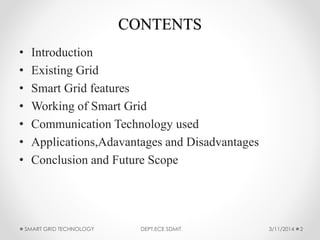
CONTENTS
• Introduction
• Existing Grid
• Smart Grid features
• Working of Smart Grid
• Communication Technology used
• Applications,Adavantages and Disadvantages
• Conclusion and Future Scope
SMART GRID TECHNOLOGY DEPT.ECE SDMIT 23/11/2014
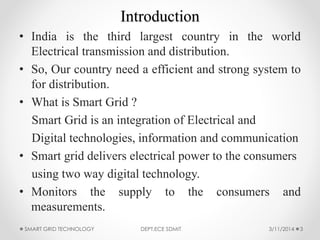
Introduction
• India is the third largest country in the world
Electrical transmission and distribution.
• So, Our country need a efficient and strong system to
for distribution.
• What is Smart Grid ?
Smart Grid is an integration of Electrical and
Digital technologies, information and communication
• Smart grid delivers electrical power to the consumers
using two way digital technology.
• Monitors the supply to the consumers and
measurements.
SMART GRID TECHNOLOGY DEPT.ECE SDMIT 33/11/2014
Existing Grid
• Limited Delivery System.
• High cost of power outage and power quality
interruption .
• Inefficiency at managing peak load.
• Communications too slow.
SMART GRID TECHNOLOGY DEPT.ECE SDMIT 43/11/2014
Key Features
• Energy efficiency
• Direct load control
• Distributed generation and cogeneration
• Automated Demand Response
3/11/2014SMART GRID TECHNOLOGY DEPT.ECE SDMIT 5
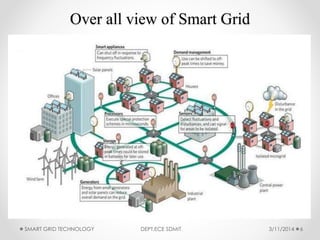
Over all view of Smart Grid
3/11/2014SMART GRID TECHNOLOGY DEPT.ECE SDMIT 6
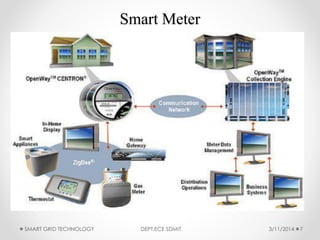
Smart Meter
3/11/2014SMART GRID TECHNOLOGY DEPT.ECE SDMIT 7
Continued….
Working
• Enable two-way communication between the
meter and the central system
• Features
Communication
Connect/Disconnect
Voltage Quality
Tariffing
3/11/2014SMART GRID TECHNOLOGY DEPT.ECE SDMIT 8
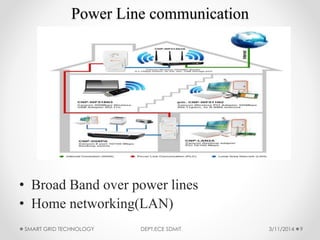
Power Line communication
• Broad Band over power lines
• Home networking(LAN)
3/11/2014SMART GRID TECHNOLOGY DEPT.ECE SDMIT 9
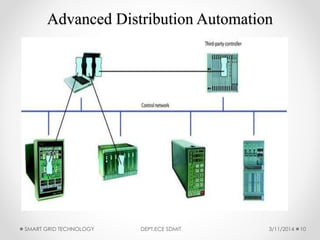
Advanced Distribution Automation
3/11/2014SMART GRID TECHNOLOGY DEPT.ECE SDMIT 10
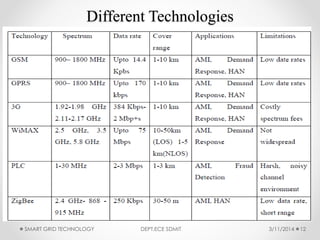
Communication Technologies
The connectivity Network
• Core Networks
• Distribution Networks
• Access Networks
3/11/2014SMART GRID TECHNOLOGY DEPT.ECE SDMIT 11
Different Technologies
3/11/2014SMART GRID TECHNOLOGY DEPT.ECE SDMIT 12
Advantages
• Integrate isolated technologies : Smart Grid enables
better energy management.
• Proactive management of electrical network during
emergency situations.
• Better demand supply / demand response
management.
• Better power quality.
• Increasing demand for energy : requires more
complex and critical solution with better energy
management
3/11/2014SMART GRID TECHNOLOGY DEPT.ECE SDMIT 13
Disadvantages
• Present Infrastructure is inadequate and requires
augmentation to support the growth of Smart Grids.
• Most renewable resources are intermittent and can
not be relied on (in its present form)for secure
energy supply.
• Regulatory Policies to deal with consequences of
Smart Grid; like off peak, peak tariffs and other
related matters.
• Grid Operation : Monitoring & control
3/11/2014SMART GRID TECHNOLOGY DEPT.ECE SDMIT 14
Conclusion and Future work
• The smart grid has been conceived as an evolution of
electric power systems due to the increasing diffusion
of distributed generation by renewable sources.
• This makes cost-effective remote sensing
technologies vital for safe, seamless and efficient
power delivery.
Future Work
• Security
• Up front consumer expenses
• Standardization
3/11/2014SMART GRID TECHNOLOGY DEPT.ECE SDMIT 15
3/11/2014SMART GRID TECHNOLOGY DEPT.ECE SDMIT 16
THANK YOU

Smart Grid Technology

  • 1.
    3/11/2014SMART GRID TECHNOLOGYDEPT.ECE SDMIT 1 SMART GRID TECHNOLOGY Presented by: Shriram Gokhale M 4SU10EC073
  • 2.
    CONTENTS • Introduction • ExistingGrid • Smart Grid features • Working of Smart Grid • Communication Technology used • Applications,Adavantages and Disadvantages • Conclusion and Future Scope SMART GRID TECHNOLOGY DEPT.ECE SDMIT 23/11/2014
  • 3.
    Introduction • India isthe third largest country in the world Electrical transmission and distribution. • So, Our country need a efficient and strong system to for distribution. • What is Smart Grid ? Smart Grid is an integration of Electrical and Digital technologies, information and communication • Smart grid delivers electrical power to the consumers using two way digital technology. • Monitors the supply to the consumers and measurements. SMART GRID TECHNOLOGY DEPT.ECE SDMIT 33/11/2014
  • 4.
    Existing Grid • LimitedDelivery System. • High cost of power outage and power quality interruption . • Inefficiency at managing peak load. • Communications too slow. SMART GRID TECHNOLOGY DEPT.ECE SDMIT 43/11/2014
  • 5.
    Key Features • Energyefficiency • Direct load control • Distributed generation and cogeneration • Automated Demand Response 3/11/2014SMART GRID TECHNOLOGY DEPT.ECE SDMIT 5
  • 6.
    Over all viewof Smart Grid 3/11/2014SMART GRID TECHNOLOGY DEPT.ECE SDMIT 6
  • 7.
    Smart Meter 3/11/2014SMART GRIDTECHNOLOGY DEPT.ECE SDMIT 7
  • 8.
    Continued…. Working • Enable two-waycommunication between the meter and the central system • Features Communication Connect/Disconnect Voltage Quality Tariffing 3/11/2014SMART GRID TECHNOLOGY DEPT.ECE SDMIT 8
  • 9.
    Power Line communication •Broad Band over power lines • Home networking(LAN) 3/11/2014SMART GRID TECHNOLOGY DEPT.ECE SDMIT 9
  • 10.
    Advanced Distribution Automation 3/11/2014SMARTGRID TECHNOLOGY DEPT.ECE SDMIT 10
  • 11.
    Communication Technologies The connectivityNetwork • Core Networks • Distribution Networks • Access Networks 3/11/2014SMART GRID TECHNOLOGY DEPT.ECE SDMIT 11
  • 12.
    Different Technologies 3/11/2014SMART GRIDTECHNOLOGY DEPT.ECE SDMIT 12
  • 13.
    Advantages • Integrate isolatedtechnologies : Smart Grid enables better energy management. • Proactive management of electrical network during emergency situations. • Better demand supply / demand response management. • Better power quality. • Increasing demand for energy : requires more complex and critical solution with better energy management 3/11/2014SMART GRID TECHNOLOGY DEPT.ECE SDMIT 13
  • 14.
    Disadvantages • Present Infrastructureis inadequate and requires augmentation to support the growth of Smart Grids. • Most renewable resources are intermittent and can not be relied on (in its present form)for secure energy supply. • Regulatory Policies to deal with consequences of Smart Grid; like off peak, peak tariffs and other related matters. • Grid Operation : Monitoring & control 3/11/2014SMART GRID TECHNOLOGY DEPT.ECE SDMIT 14
  • 15.
    Conclusion and Futurework • The smart grid has been conceived as an evolution of electric power systems due to the increasing diffusion of distributed generation by renewable sources. • This makes cost-effective remote sensing technologies vital for safe, seamless and efficient power delivery. Future Work • Security • Up front consumer expenses • Standardization 3/11/2014SMART GRID TECHNOLOGY DEPT.ECE SDMIT 15
  • 16.
    3/11/2014SMART GRID TECHNOLOGYDEPT.ECE SDMIT 16 THANK YOU