PRESENTED BY :
SATABDY JENA
MTECH( POWER AND ENERGY SYSTEMS)
ROLL NO.: T14EE003
NIT MEGHALAYA
1
CONTENTS
2
INTRODUCTION
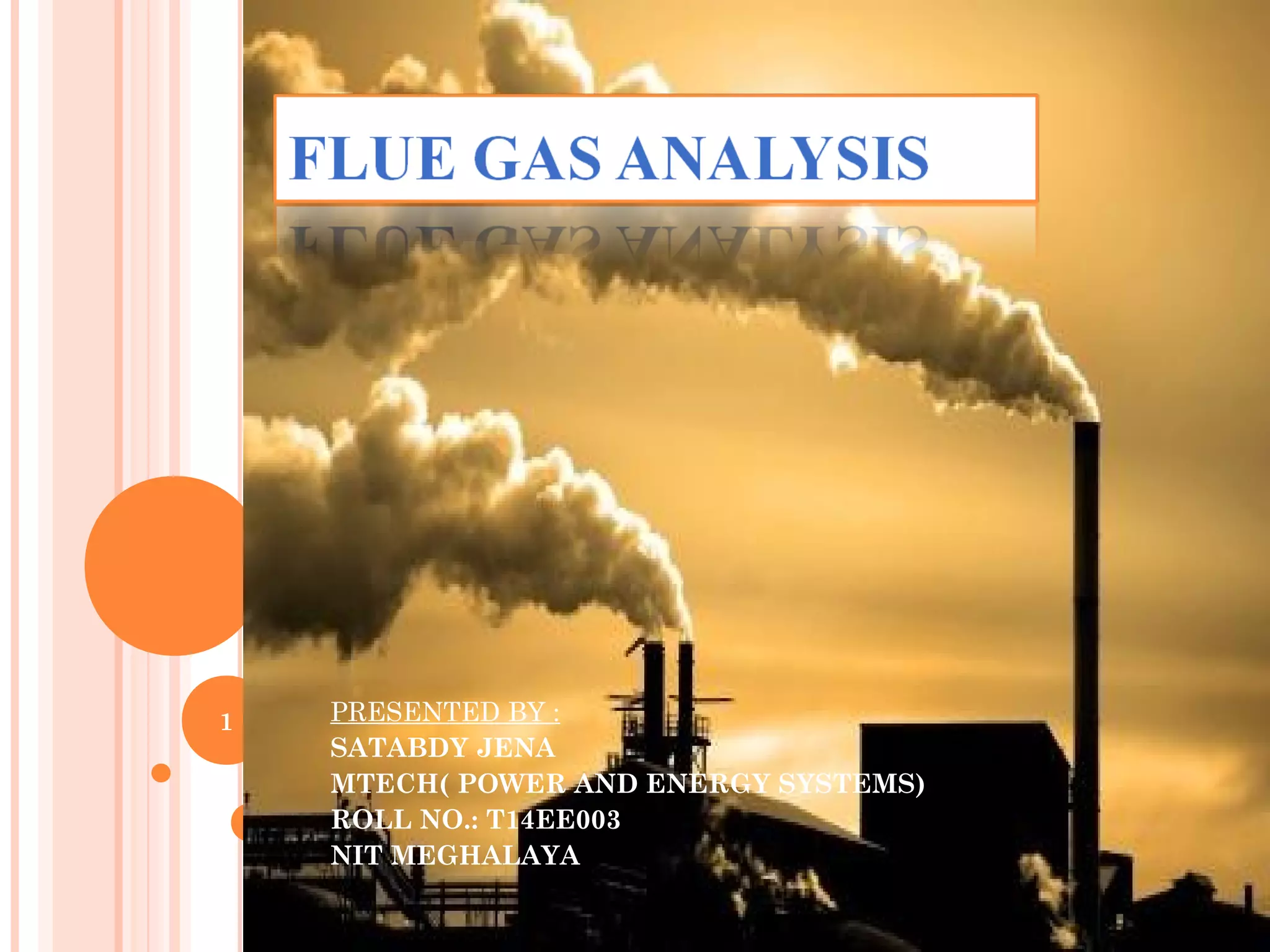
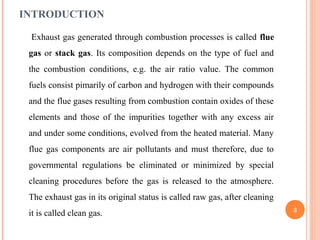
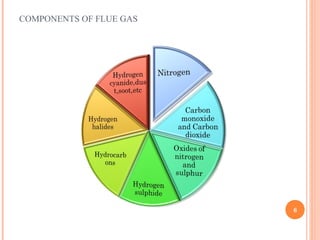
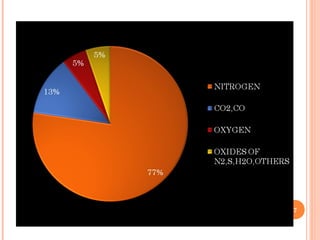
Exhaust gas generated through combustion processes is called flue
gas or stack gas. Its composition depends on the type of fuel and
the combustion conditions, e.g. the air ratio value. The common
fuels consist pimarily of carbon and hydrogen with their compounds
and the flue gases resulting from combustion contain oxides of these
elements and those of the impurities together with any excess air
and under some conditions, evolved from the heated material. Many
flue gas components are air pollutants and must therefore, due to
governmental regulations be eliminated or minimized by special
cleaning procedures before the gas is released to the atmosphere.
The exhaust gas in its original status is called raw gas, after cleaning
it is called clean gas. 3
 An analysis of the flue gases gives evidence of efficiency of
combustion and is a prime factor in controlling the
operation for maximum results and in arriving at
improvements in design.
 Flue gas analysis indicates the air to fuel ratio.
 It is often desirable to predict the quantity and analysis of
the products of combustion to determine flue sizes and
furnace pressure and to predict the magnitude of stack or
flue gas losses.
 There are equations to permit the calculation of the
quantities of gases in the combustion products of gaseous
fuels either by volume or by weight. The percentages to be
submitted in all these equations are percentages by
volume.
4
5
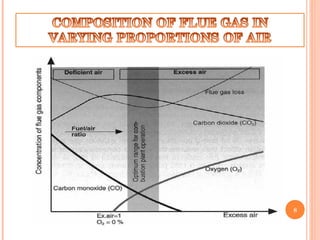
COMPONENTS OF FLUE GAS
6
7
8
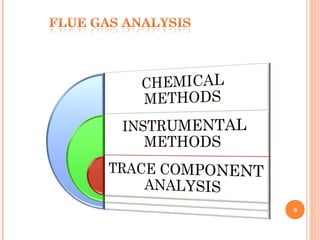
9
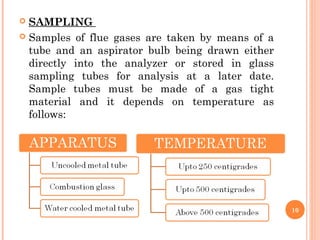
 SAMPLING
 Samples of flue gases are taken by means of a
tube and an aspirator bulb being drawn either
directly into the analyzer or stored in glass
sampling tubes for analysis at a later date.
Sample tubes must be made of a gas tight
material and it depends on temperature as
follows:
10
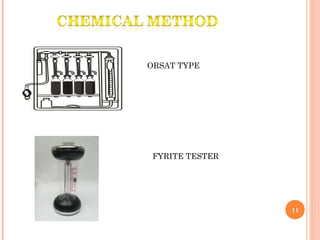
11
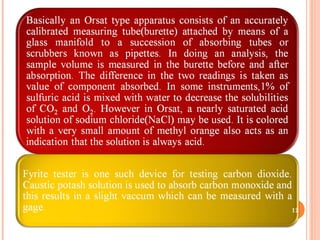
ORSAT TYPE
FYRITE TESTER
12
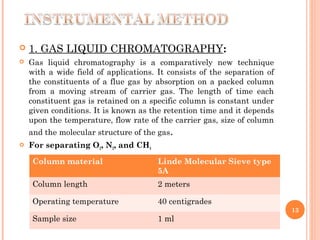
 1. GAS LIQUID CHROMATOGRAPHY:
 Gas liquid chromatography is a comparatively new technique
with a wide field of applications. It consists of the separation of
the constituents of a flue gas by absorption on a packed column
from a moving stream of carrier gas. The length of time each
constituent gas is retained on a specific column is constant under
given conditions. It is known as the retention time and it depends
upon the temperature, flow rate of the carrier gas, size of column
and the molecular structure of the gas.
 For separating O2, N2, and CH4
13
Column material Linde Molecular Sieve type
5A
Column length 2 meters
Operating temperature 40 centigrades
Sample size 1 ml
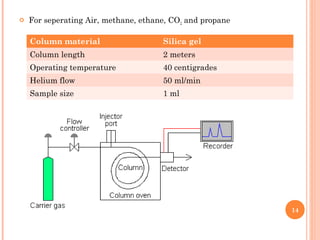
 For seperating Air, methane, ethane, CO2 and propane
14
Column material Silica gel
Column length 2 meters
Operating temperature 40 centigrades
Helium flow 50 ml/min
Sample size 1 ml
15
 Mass spectroscopy is primarily a lab technique requiring
more expensive equipment than gas chromatography. In
this procedure the molecular species making up a gaseous
mixture are ionized and dissociated by electron
bombardment, the resulting positive ions of different
masses are then accelerated in an electric field and
separated magnetically. A spectrogram is obtaibed showing
the mass of each constituent and this is compared to a
similar spectrograph for a known mixture.
Instrumentation for mass spectroscopy is considerably
expensive.
16
17
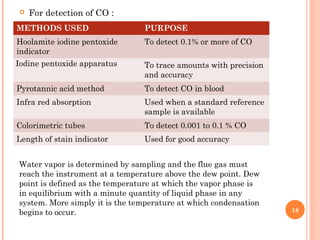
 For detection of CO :
18
METHODS USED PURPOSE
Hoolamite iodine pentoxide
indicator
To detect 0.1% or more of CO
Iodine pentoxide apparatus To trace amounts with precision
and accuracy
Pyrotannic acid method To detect CO in blood
Infra red absorption Used when a standard reference
sample is available
Colorimetric tubes To detect 0.001 to 0.1 % CO
Length of stain indicator Used for good accuracy
Water vapor is determined by sampling and the flue gas must
reach the instrument at a temperature above the dew point. Dew
point is defined as the temperature at which the vapor phase is
in equilibrium with a minute quantity of liquid phase in any
system. More simply it is the temperature at which condensation
begins to occur.
 The gas concentration is measured in ppm. Ppm means part per millions.
 100 ppm is equivalent to 0.01%,1000 ppm is equivalent to 0.1%,10000
ppm is equivalent to 1%. Pollutants can be measured in mg/Nm3
( milligrams per cubic meter ). This is mass refer to a volume in normal
condition ( 0°C 1013 mBar ). Ppm is converted in this unit with a
coefficient differen t for each gas.
 Example : CO mg/Nm3 = CO ppm x 1.25
 The conversion to an energy related unit can again be done by
multiplying a constant which is different for individual
gases(mg/kWh :milligrams per kilowatt-hour of energy ).
 Example : CO mg/kWh = CO ppm x 1.074
19
CONCLUSION
 Since flue gases consist of the end products of a combustion
process, their composition is of interest and important from
the view point of: 1.safety 2.efficiency and 3.computation of
specific values which might affect the continuity of a process.
In combustion process the common personnel hazard is carbon
monoxide which can result from incomplete combustion. An
operational hazard can be the formation of an explosive
mixture. This hazard can be present wherever combustible
gases or vapors are in contact with a substance which will
support combustion and the properties are in the explosive
range. Flue gas analysis can be used to detect and to confirm
and locate suspected condition of this nature.
 The use of flue gas analysis to promote efficiency are varied
and many. Efficiency and economy do not necessarily imply
the complete oxidation in the least amount of oxygen or air. It
is the reason by which the goals for good utilization can be
reached :
 for gas appliances to operate safely without liberating
injurious quantities of toxic gases.
 for gas appliances to operate near optimum efficiency. 20
References :
 
 [1] Flue gas analysis, Wikipedia
 [2] Products of combustion of gaseous fuels, by
Edwin L. Hall ARA Lab.
 [3] North American combustion handbook, by the
North American Manufacturing Company, Ohio
 [4] Gas Liquid chromatography, by Stephen Dal
 [5] Modern Gas Analysis, by P.W.Mullen
 [6] Manual for Hydrocarbon Analysis, by AATM
Special Technology Publisher No. 332
21
22
23

Flue gas analysis

  • 1.
    PRESENTED BY : SATABDYJENA MTECH( POWER AND ENERGY SYSTEMS) ROLL NO.: T14EE003 NIT MEGHALAYA 1
  • 2.
  • 3.
    INTRODUCTION Exhaust gas generatedthrough combustion processes is called flue gas or stack gas. Its composition depends on the type of fuel and the combustion conditions, e.g. the air ratio value. The common fuels consist pimarily of carbon and hydrogen with their compounds and the flue gases resulting from combustion contain oxides of these elements and those of the impurities together with any excess air and under some conditions, evolved from the heated material. Many flue gas components are air pollutants and must therefore, due to governmental regulations be eliminated or minimized by special cleaning procedures before the gas is released to the atmosphere. The exhaust gas in its original status is called raw gas, after cleaning it is called clean gas. 3
  • 4.
     An analysisof the flue gases gives evidence of efficiency of combustion and is a prime factor in controlling the operation for maximum results and in arriving at improvements in design.  Flue gas analysis indicates the air to fuel ratio.  It is often desirable to predict the quantity and analysis of the products of combustion to determine flue sizes and furnace pressure and to predict the magnitude of stack or flue gas losses.  There are equations to permit the calculation of the quantities of gases in the combustion products of gaseous fuels either by volume or by weight. The percentages to be submitted in all these equations are percentages by volume. 4
  • 5.
  • 6.
  • 7.
  • 8.
  • 9.
  • 10.
     SAMPLING  Samplesof flue gases are taken by means of a tube and an aspirator bulb being drawn either directly into the analyzer or stored in glass sampling tubes for analysis at a later date. Sample tubes must be made of a gas tight material and it depends on temperature as follows: 10
  • 11.
  • 12.
  • 13.
     1. GASLIQUID CHROMATOGRAPHY:  Gas liquid chromatography is a comparatively new technique with a wide field of applications. It consists of the separation of the constituents of a flue gas by absorption on a packed column from a moving stream of carrier gas. The length of time each constituent gas is retained on a specific column is constant under given conditions. It is known as the retention time and it depends upon the temperature, flow rate of the carrier gas, size of column and the molecular structure of the gas.  For separating O2, N2, and CH4 13 Column material Linde Molecular Sieve type 5A Column length 2 meters Operating temperature 40 centigrades Sample size 1 ml
  • 14.
     For seperatingAir, methane, ethane, CO2 and propane 14 Column material Silica gel Column length 2 meters Operating temperature 40 centigrades Helium flow 50 ml/min Sample size 1 ml
  • 15.
  • 16.
     Mass spectroscopyis primarily a lab technique requiring more expensive equipment than gas chromatography. In this procedure the molecular species making up a gaseous mixture are ionized and dissociated by electron bombardment, the resulting positive ions of different masses are then accelerated in an electric field and separated magnetically. A spectrogram is obtaibed showing the mass of each constituent and this is compared to a similar spectrograph for a known mixture. Instrumentation for mass spectroscopy is considerably expensive. 16
  • 17.
  • 18.
     For detectionof CO : 18 METHODS USED PURPOSE Hoolamite iodine pentoxide indicator To detect 0.1% or more of CO Iodine pentoxide apparatus To trace amounts with precision and accuracy Pyrotannic acid method To detect CO in blood Infra red absorption Used when a standard reference sample is available Colorimetric tubes To detect 0.001 to 0.1 % CO Length of stain indicator Used for good accuracy Water vapor is determined by sampling and the flue gas must reach the instrument at a temperature above the dew point. Dew point is defined as the temperature at which the vapor phase is in equilibrium with a minute quantity of liquid phase in any system. More simply it is the temperature at which condensation begins to occur.
  • 19.
     The gasconcentration is measured in ppm. Ppm means part per millions.  100 ppm is equivalent to 0.01%,1000 ppm is equivalent to 0.1%,10000 ppm is equivalent to 1%. Pollutants can be measured in mg/Nm3 ( milligrams per cubic meter ). This is mass refer to a volume in normal condition ( 0°C 1013 mBar ). Ppm is converted in this unit with a coefficient differen t for each gas.  Example : CO mg/Nm3 = CO ppm x 1.25  The conversion to an energy related unit can again be done by multiplying a constant which is different for individual gases(mg/kWh :milligrams per kilowatt-hour of energy ).  Example : CO mg/kWh = CO ppm x 1.074 19
  • 20.
    CONCLUSION  Since fluegases consist of the end products of a combustion process, their composition is of interest and important from the view point of: 1.safety 2.efficiency and 3.computation of specific values which might affect the continuity of a process. In combustion process the common personnel hazard is carbon monoxide which can result from incomplete combustion. An operational hazard can be the formation of an explosive mixture. This hazard can be present wherever combustible gases or vapors are in contact with a substance which will support combustion and the properties are in the explosive range. Flue gas analysis can be used to detect and to confirm and locate suspected condition of this nature.  The use of flue gas analysis to promote efficiency are varied and many. Efficiency and economy do not necessarily imply the complete oxidation in the least amount of oxygen or air. It is the reason by which the goals for good utilization can be reached :  for gas appliances to operate safely without liberating injurious quantities of toxic gases.  for gas appliances to operate near optimum efficiency. 20
  • 21.
    References :    [1]Flue gas analysis, Wikipedia  [2] Products of combustion of gaseous fuels, by Edwin L. Hall ARA Lab.  [3] North American combustion handbook, by the North American Manufacturing Company, Ohio  [4] Gas Liquid chromatography, by Stephen Dal  [5] Modern Gas Analysis, by P.W.Mullen  [6] Manual for Hydrocarbon Analysis, by AATM Special Technology Publisher No. 332 21
  • 22.
  • 23.