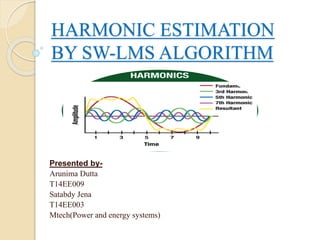
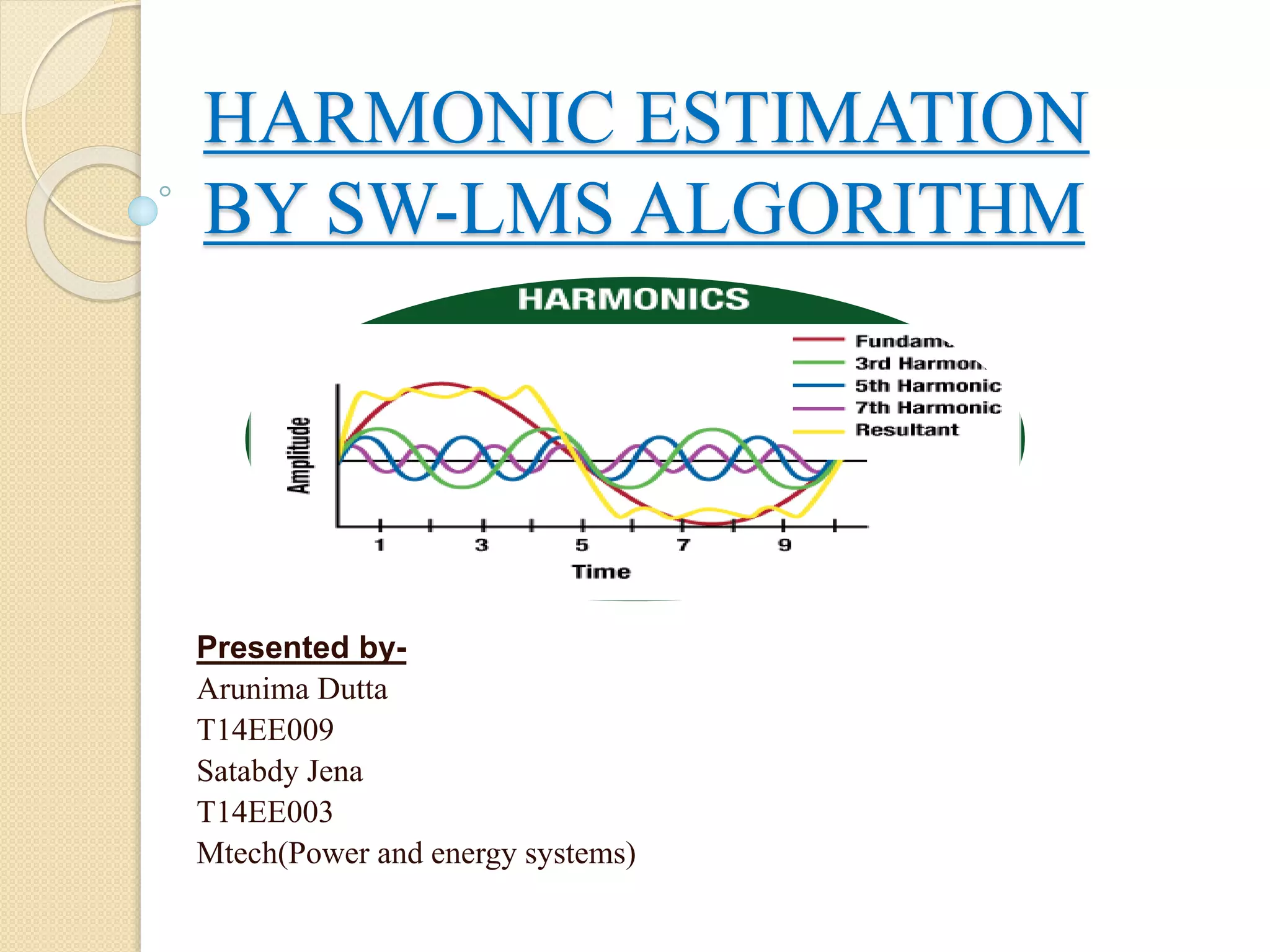


HARMONIC ESTIMATION 
BY SW-LMS ALGORITHM 
Presented by- 
Arunima Dutta 
T14EE009 
Satabdy Jena 
T14EE003 
Mtech(Power and energy systems)
Contents : 
Introduction 
Power quality 
Harmonics 
LMS algorithm and sliding 
window LMS algorithm 
Comparison of results 
Conclusion
Introduction 
Power system harmonics is an area that is receiving a great 
deal of attention recently. This is primarily due to the fact 
that non-linear (or harmonic producing) loads are 
comprising an ever-increasing portion of the total load for 
a typical industrial plant. Incidence of harmonic related 
problems is low, but awareness of harmonic issues can 
help to increase plant power system reliability. 
There are various methods for analysis of harmonics like 
FFT,LMS,RLS,etc.
Power Quality 
 The power quality of a system expresses to which 
degree practical supply system resembles the ideal 
supply system. 
 The best electrical supply would be a constant 
magnitude and frequency sinusoidal voltage waveform. 
 Due to transients, outages, voltage spikes etc. reality is 
different. 
 Causes of poor power quality: 
Reactive power 
Harmonic pollution 
Load imbalance 
Fast voltage variation
Effects of poor power quality : 
 Power failure 
 Equipment malfunctioning, failure, overheating,etc. 
 EMI 
 Increase in losses 
 Oversizing of installations 
 Penalties imposed by utilities 
 Connection refusal
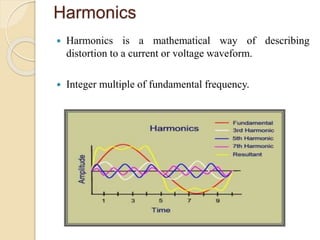
Harmonics 
 Harmonics is a mathematical way of describing 
distortion to a current or voltage waveform. 
 Integer multiple of fundamental frequency.
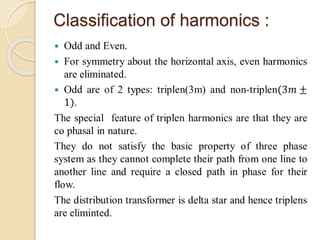
Classification of harmonics :
Effect of Harmonics 
 Overheating of distribution transformers 
 Poor system efficiency 
 Instability 
 Disturbance of the other consumers 
 Malfunctioning of medical facilities
Drawbacks with FFT : 
 Spectral leakage. 
 Aliasing. 
 “Picket –fence” effect. 
LMS ALGORITHM : 
Features : 
 Simplicity 
 Low computational complexity 
 Robustness 
 No matrix inversion is required
Drawbacks : 
 Slow convergence 
 Data dependent behavior 
 Sensitivity to noise 
SLIDING WINDOW LMS ALGORITHM : 
 Easy to work with noisy system. 
 Good estimation in different SNR. 
 No oscillations in results obtained. 
 To increase the convergence speed.
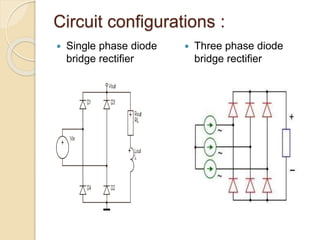
Circuit configurations : 
 Single phase diode 
bridge rectifier 
 Three phase diode 
bridge rectifier
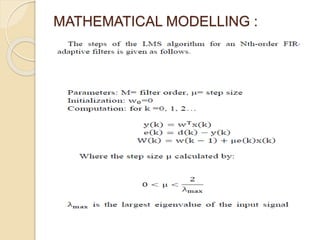
MATHEMATICAL MODELLING :
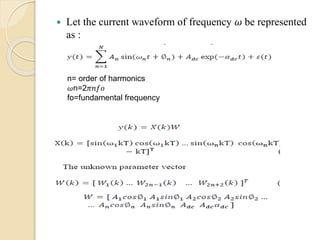
 Let the current waveform of frequency 휔 be represented 
as : 
n= order of harmonics 
휔n=2휋푛푓표 
fo=fundamental frequency
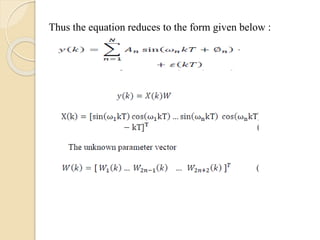
Thus the equation reduces to the form given below :
 Where the weight and the constants are updated as folows 
: 
USING SLIDING WINDOW : 
SW training algorithms also known as high order training algorithms 
use a sliding window of system input/output observations to perform 
instantaneous learning.It can be applied when the data is highly 
noisy.Typically the model weights are updated using information 
obtained from store of [L ]previous training vectors.
 Given [L] vector data store and current data point 푥푡,this 
algorithm computes a moving average search direction 
for LMS as follows : 
The weighting factor 훼 controls the contribution of the 
current vector to the search direction. The weights are 
updated as follows : 
The store S for harmonic estimation includes only input 
given as : 
S=[ x1 x2 … xL]
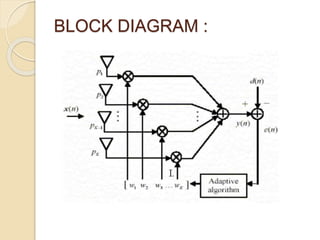
BLOCK DIAGRAM :
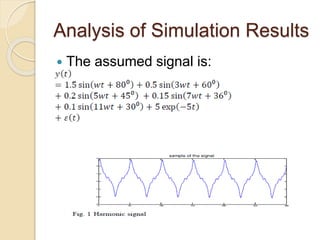
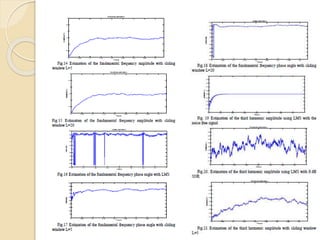
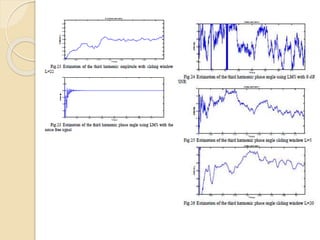
Analysis of Simulation Results 
 The assumed signal is:
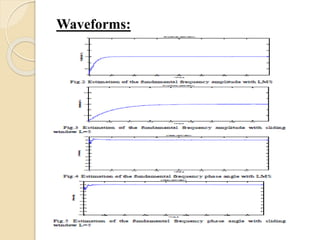
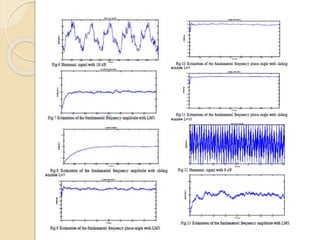
Waveforms:
Conclusion : 
 Thus we see that the LMS algorithm employed with 
sliding window gives better results,excludes oscillations 
and is effective even in high noise signals. 
 Harmonic mitigation equipment includes : 
 Line reactors 
 Isolation transformers 
 Filters 
 12 and 18 pulse rectifiers
References : 
 “Power system harmonic estimation using sliding 
window based LMS”, 
Hussam,Nursyarizal,M.F.Abdullah,Vijanth S. 
Asirvadam.(IEEE 2013 International Conference on 
signal and image processing). 
 “A review of harmonic mitigation techniques” ,Gonzalo 
Sandoval & John Houdek. 
 Power system harmonics by Allen Bradley.
Thank You

Harmonic estimation by lms algorithm

  • 1.
    HARMONIC ESTIMATION BYSW-LMS ALGORITHM Presented by- Arunima Dutta T14EE009 Satabdy Jena T14EE003 Mtech(Power and energy systems)
  • 2.
    Contents : Introduction Power quality Harmonics LMS algorithm and sliding window LMS algorithm Comparison of results Conclusion
  • 3.
    Introduction Power systemharmonics is an area that is receiving a great deal of attention recently. This is primarily due to the fact that non-linear (or harmonic producing) loads are comprising an ever-increasing portion of the total load for a typical industrial plant. Incidence of harmonic related problems is low, but awareness of harmonic issues can help to increase plant power system reliability. There are various methods for analysis of harmonics like FFT,LMS,RLS,etc.
  • 4.
    Power Quality The power quality of a system expresses to which degree practical supply system resembles the ideal supply system.  The best electrical supply would be a constant magnitude and frequency sinusoidal voltage waveform.  Due to transients, outages, voltage spikes etc. reality is different.  Causes of poor power quality: Reactive power Harmonic pollution Load imbalance Fast voltage variation
  • 5.
    Effects of poorpower quality :  Power failure  Equipment malfunctioning, failure, overheating,etc.  EMI  Increase in losses  Oversizing of installations  Penalties imposed by utilities  Connection refusal
  • 6.
    Harmonics  Harmonicsis a mathematical way of describing distortion to a current or voltage waveform.  Integer multiple of fundamental frequency.
  • 7.
  • 9.
    Effect of Harmonics  Overheating of distribution transformers  Poor system efficiency  Instability  Disturbance of the other consumers  Malfunctioning of medical facilities
  • 10.
    Drawbacks with FFT:  Spectral leakage.  Aliasing.  “Picket –fence” effect. LMS ALGORITHM : Features :  Simplicity  Low computational complexity  Robustness  No matrix inversion is required
  • 11.
    Drawbacks : Slow convergence  Data dependent behavior  Sensitivity to noise SLIDING WINDOW LMS ALGORITHM :  Easy to work with noisy system.  Good estimation in different SNR.  No oscillations in results obtained.  To increase the convergence speed.
  • 12.
    Circuit configurations :  Single phase diode bridge rectifier  Three phase diode bridge rectifier
  • 13.
  • 14.
     Let thecurrent waveform of frequency 휔 be represented as : n= order of harmonics 휔n=2휋푛푓표 fo=fundamental frequency
  • 15.
    Thus the equationreduces to the form given below :
  • 16.
     Where theweight and the constants are updated as folows : USING SLIDING WINDOW : SW training algorithms also known as high order training algorithms use a sliding window of system input/output observations to perform instantaneous learning.It can be applied when the data is highly noisy.Typically the model weights are updated using information obtained from store of [L ]previous training vectors.
  • 17.
     Given [L]vector data store and current data point 푥푡,this algorithm computes a moving average search direction for LMS as follows : The weighting factor 훼 controls the contribution of the current vector to the search direction. The weights are updated as follows : The store S for harmonic estimation includes only input given as : S=[ x1 x2 … xL]
  • 18.
  • 19.
    Analysis of SimulationResults  The assumed signal is:
  • 20.
  • 24.
    Conclusion : Thus we see that the LMS algorithm employed with sliding window gives better results,excludes oscillations and is effective even in high noise signals.  Harmonic mitigation equipment includes :  Line reactors  Isolation transformers  Filters  12 and 18 pulse rectifiers
  • 25.
    References : “Power system harmonic estimation using sliding window based LMS”, Hussam,Nursyarizal,M.F.Abdullah,Vijanth S. Asirvadam.(IEEE 2013 International Conference on signal and image processing).  “A review of harmonic mitigation techniques” ,Gonzalo Sandoval & John Houdek.  Power system harmonics by Allen Bradley.
  • 26.