-Prof. A S PANDEY
B.E, M.TECH (IPS), PhD Registered. (IITRAM)
1
DEPARTMENT OF ELECTRICAL
ENGINEERING, Sanjivani COE,
Kopargaon
16/03/2021
MICRO GRID
MICROGRID
CONTENT
• DC Microgrid.
• Issues of interconnection.
DEPARTMENT OF ELECTRICAL
ENGINEERING, Sanjivani COE, Kopargaon
2
16/03/2021
16/03/2021
DEPARTMENT OF ELECTRICAL
ENGINEERING, Sanjivani COE, Kopargaon
3
https://global-sei.com/technology/tr/bn75/pdf/75-25.pdf
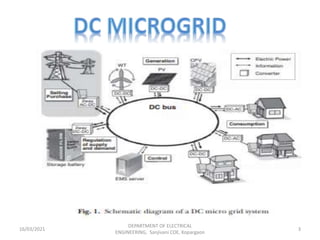
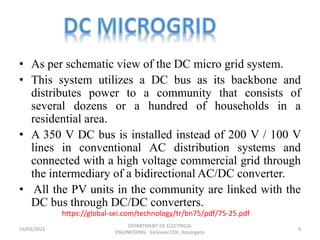
• As per schematic view of the DC micro grid system.
• This system utilizes a DC bus as its backbone and
distributes power to a community that consists of
several dozens or a hundred of households in a
residential area.
• A 350 V DC bus is installed instead of 200 V / 100 V
lines in conventional AC distribution systems and
connected with a high voltage commercial grid through
the intermediary of a bidirectional AC/DC converter.
• All the PV units in the community are linked with the
DC bus through DC/DC converters.
16/03/2021
DEPARTMENT OF ELECTRICAL
ENGINEERING, Sanjivani COE, Kopargaon
4
16/03/2021
DEPARTMENT OF ELECTRICAL
ENGINEERING, Sanjivani COE, Kopargaon
5
• These converters always track the maximum power point of the
DC power sources which fluctuates depending on the intensity
of solar radiation.
• Conventional appliances can be used as they are if an inverter
is installed in each house to change the DC power into 200 V /
100 V AC power, but DC power feeding will spread widely
because of its high efficiency, once safe and compact gears,
such as breakers and outlets, are standardized in the future.
• Storage batteries of the community are also linked to the DC
bus.
• The DC-based distribution system reduces facility costs and
energy dissipation associated with AC/DC conversion because
the PV units and battery are DC connected and most of the
current energy-saving appliances operate on DC due to the
progress of inverter technology.
• This is why we should push ahead with the DC system.
16/03/2021
DEPARTMENT OF ELECTRICAL
ENGINEERING, Sanjivani COE, Kopargaon
6
Interconnection methods and technologies
1. Directly through switchgear
2. Power electronic interfaces
3. Static switches
4. Directly through circuit breakers:
• Relatively simple and in expensive Slow (3 to 6 cycles to
achieve a complete disconnection).
• Since electrical characteristics on both sides of the circuit
breakers must be the same, then, electrical characteristics on the
micro-grid side are dependent on the grid characteristics.
• For example, use of a circuit breaker implicitly limits the micro-
grid to have, at least partially, an ac power distribution system in
order to match the grid’s electrical characteristics.
• Power flow through the PCC cannot be controlled.
Issues of interconnection in
MICROGRID
16/03/2021
DEPARTMENT OF ELECTRICAL
ENGINEERING, Sanjivani COE, Kopargaon
7
Issues of interconnection
• Electricity grids must have standard conditions of supply to ensure that end-use
equipment and infrastructure can operate safely and effectively. These conditions
are commonly referred to as power quality requirements and are defined in
standards or by supply authorities .
• They most commonly relate to voltage and frequency regulation, power factor
correction and harmonics.
• In all distribution networks, challenges to maintaining these power quality
requirements arise from the technical characteristics and end-user operation of
electrical loads, and the network equipment and lines.
• Some loads have significant power demands that increase network current flows
pulling down line voltage (such as electric hot water heaters and large air-
conditioners).
• Some have very short-lived but major power draws on start-up (such as standard
induction motors) driving voltage fluctuations.
• Some have significant reactive power needs (again including motors) or create
significant harmonics (such as computer power supplies and fluorescent lighting).
• Power quality at different points of the distribution network at any time is impacted
by the aggregate impacts of loads and network equipment in highly complex ways.
16/03/2021
DEPARTMENT OF ELECTRICAL
ENGINEERING, Sanjivani COE, Kopargaon
8
Issues of interconnection
(a) Voltage fluctuation and regulation: Voltage fluctuation is a
change or swing in voltage, and can be problematic if it moves
outside specified values.
(b) Power factor correction: Poor power factor on the grid
increases line losses and makes voltage regulation more
difficult.
(c) Frequency variation and regulation: Frequency is one of
the more important factors in power quality. The frequency is
controlled by maintaining a balance between the connected
loads and generation.
• Disruptions in the balance between supply and demand lead
to frequency fluctuation, it falls when demand exceeds
supply and rises when supply exceeds demand.
16/03/2021
DEPARTMENT OF ELECTRICAL
ENGINEERING, Sanjivani COE, Kopargaon
9
Issues of interconnection
(d) Harmonics: Harmonics are currents or voltages with frequencies
that are integer multiples of the fundamental power frequency.
• The standard frequency's 50 or 60 Hz depending on t h e country,
and so harmonic in a 50 Hz country could be 100, 150, 200Hz, etc.
• Harmonics can also be eliminated using passive and active filters,
which are generally cheaper than inverters.
• Passive filters are composed of passive elements such as capacitors
or reactor s, and absorb harmonic current by providing a low-
impedance shunt for specific frequency domains
(e) Unintentional islanding: Unintentional islanding occurs when
distributed generation delivers power to the network even after circuit
breakers have disconnected that part of t h e network from the main
grid and associated generators
16/03/2021
DEPARTMENT OF ELECTRICAL
ENGINEERING, Sanjivani COE, Kopargaon
10
16/03/2021
DEPARTMENT OF ELECTRICAL
ENGINEERING, Sanjivani COE, Kopargaon
11
QUERIES??
Mail at :-
pandey.amarjeet73@gmail.com

Interconnection issue in microgrid

  • 1.
    -Prof. A SPANDEY B.E, M.TECH (IPS), PhD Registered. (IITRAM) 1 DEPARTMENT OF ELECTRICAL ENGINEERING, Sanjivani COE, Kopargaon 16/03/2021 MICRO GRID
  • 2.
    MICROGRID CONTENT • DC Microgrid. •Issues of interconnection. DEPARTMENT OF ELECTRICAL ENGINEERING, Sanjivani COE, Kopargaon 2 16/03/2021
  • 3.
  • 4.
    https://global-sei.com/technology/tr/bn75/pdf/75-25.pdf • As perschematic view of the DC micro grid system. • This system utilizes a DC bus as its backbone and distributes power to a community that consists of several dozens or a hundred of households in a residential area. • A 350 V DC bus is installed instead of 200 V / 100 V lines in conventional AC distribution systems and connected with a high voltage commercial grid through the intermediary of a bidirectional AC/DC converter. • All the PV units in the community are linked with the DC bus through DC/DC converters. 16/03/2021 DEPARTMENT OF ELECTRICAL ENGINEERING, Sanjivani COE, Kopargaon 4
  • 5.
    16/03/2021 DEPARTMENT OF ELECTRICAL ENGINEERING,Sanjivani COE, Kopargaon 5 • These converters always track the maximum power point of the DC power sources which fluctuates depending on the intensity of solar radiation. • Conventional appliances can be used as they are if an inverter is installed in each house to change the DC power into 200 V / 100 V AC power, but DC power feeding will spread widely because of its high efficiency, once safe and compact gears, such as breakers and outlets, are standardized in the future. • Storage batteries of the community are also linked to the DC bus. • The DC-based distribution system reduces facility costs and energy dissipation associated with AC/DC conversion because the PV units and battery are DC connected and most of the current energy-saving appliances operate on DC due to the progress of inverter technology. • This is why we should push ahead with the DC system.
  • 6.
    16/03/2021 DEPARTMENT OF ELECTRICAL ENGINEERING,Sanjivani COE, Kopargaon 6 Interconnection methods and technologies 1. Directly through switchgear 2. Power electronic interfaces 3. Static switches 4. Directly through circuit breakers: • Relatively simple and in expensive Slow (3 to 6 cycles to achieve a complete disconnection). • Since electrical characteristics on both sides of the circuit breakers must be the same, then, electrical characteristics on the micro-grid side are dependent on the grid characteristics. • For example, use of a circuit breaker implicitly limits the micro- grid to have, at least partially, an ac power distribution system in order to match the grid’s electrical characteristics. • Power flow through the PCC cannot be controlled.
  • 7.
    Issues of interconnectionin MICROGRID 16/03/2021 DEPARTMENT OF ELECTRICAL ENGINEERING, Sanjivani COE, Kopargaon 7
  • 8.
    Issues of interconnection •Electricity grids must have standard conditions of supply to ensure that end-use equipment and infrastructure can operate safely and effectively. These conditions are commonly referred to as power quality requirements and are defined in standards or by supply authorities . • They most commonly relate to voltage and frequency regulation, power factor correction and harmonics. • In all distribution networks, challenges to maintaining these power quality requirements arise from the technical characteristics and end-user operation of electrical loads, and the network equipment and lines. • Some loads have significant power demands that increase network current flows pulling down line voltage (such as electric hot water heaters and large air- conditioners). • Some have very short-lived but major power draws on start-up (such as standard induction motors) driving voltage fluctuations. • Some have significant reactive power needs (again including motors) or create significant harmonics (such as computer power supplies and fluorescent lighting). • Power quality at different points of the distribution network at any time is impacted by the aggregate impacts of loads and network equipment in highly complex ways. 16/03/2021 DEPARTMENT OF ELECTRICAL ENGINEERING, Sanjivani COE, Kopargaon 8
  • 9.
    Issues of interconnection (a)Voltage fluctuation and regulation: Voltage fluctuation is a change or swing in voltage, and can be problematic if it moves outside specified values. (b) Power factor correction: Poor power factor on the grid increases line losses and makes voltage regulation more difficult. (c) Frequency variation and regulation: Frequency is one of the more important factors in power quality. The frequency is controlled by maintaining a balance between the connected loads and generation. • Disruptions in the balance between supply and demand lead to frequency fluctuation, it falls when demand exceeds supply and rises when supply exceeds demand. 16/03/2021 DEPARTMENT OF ELECTRICAL ENGINEERING, Sanjivani COE, Kopargaon 9
  • 10.
    Issues of interconnection (d)Harmonics: Harmonics are currents or voltages with frequencies that are integer multiples of the fundamental power frequency. • The standard frequency's 50 or 60 Hz depending on t h e country, and so harmonic in a 50 Hz country could be 100, 150, 200Hz, etc. • Harmonics can also be eliminated using passive and active filters, which are generally cheaper than inverters. • Passive filters are composed of passive elements such as capacitors or reactor s, and absorb harmonic current by providing a low- impedance shunt for specific frequency domains (e) Unintentional islanding: Unintentional islanding occurs when distributed generation delivers power to the network even after circuit breakers have disconnected that part of t h e network from the main grid and associated generators 16/03/2021 DEPARTMENT OF ELECTRICAL ENGINEERING, Sanjivani COE, Kopargaon 10
  • 11.
  • 12.