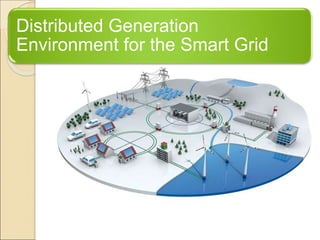
Distributed Generation 
Environment for the Smart Grid
Contents 
Introduction 
Forms of renewable energy 
Distributed generation, its challenges and 
solution 
Features of Smart Grid 
Components of Smart Grid 
AMI and PMUs 
Need for Smart grids 
Rules of interconnection 
Benefits of integration with smart grid 
Conclusion 
References 
2
Introduction 
The 20th century had seen significant advances in energy 
generation, delivery and utilization, but has also 
produced tremendous impact on the environment and 
natural resources. 
• Significant changes must be made to how we generate, 
deliver and use energy so as to 
– establish sustainable utilization, and 
– restore environmental balance. 
• Education must occur at all levels: 
– researchers; 
– workforce; 
– consumers. 
3
Needs of the 21st century 
• Decrease fossil fuel consumption 
– 85% of today’s energy supply comes from fossil 
fuels. 
– Transportation and electric generation need to 
move away from fossil fuels. 
– Fossil fuels are the predominant contributors to 
environmental pollution. 
(COx, SOx, NOx, particulates) 
–Will also lead to energy independence. 
4
• Increase renewable generation 
– 7% of today’s energy supply comes from 
renewable sources (hydroelectric, 
geothermal, wind, solar, biomass). 
– Renewable generation must increase 
significantly but responsibly. 
• Increase nuclear generation suitably 
– 8% of today’s energy supply comes from 
nuclear power 
– Nuclear generation must increase so that 
there is adequate supply from steady 
sources. 
5
Sustainable utilization of resources 
• Technological enablers 
– Energy efficient buildings with thermal storage 
– “Smart” homes and “smart” appliances 
– Demand response and load management programs 
– Energy efficient transportation: hybrid and electric 
vehicles 
– Storage and direct conversion technologies 
• Growing need for conservation 
• Demand profiles will change significantly 
– Composition of load is changing 
– Load factor is likely to change too 
6
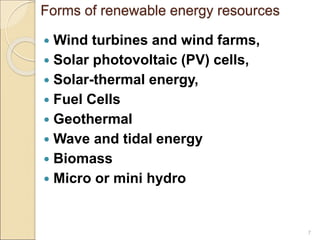
Forms of renewable energy resources 
 Wind turbines and wind farms, 
 Solar photovoltaic (PV) cells, 
 Solar-thermal energy, 
 Fuel Cells 
 Geothermal 
 Wave and tidal energy 
 Biomass 
 Micro or mini hydro 
7
8 
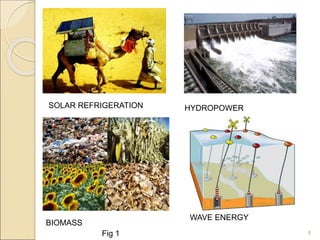
SOLAR REFRIGERATION HYDROPOWER 
BIOMASS 
WAVE ENERGY 
Fig 1
9 
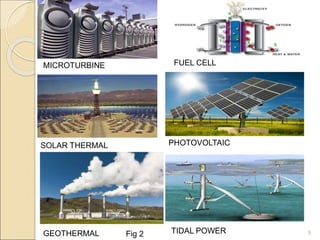
MICROTURBINE FUEL CELL 
SOLAR THERMAL PHOTOVOLTAIC 
GEOTHERMAL Fig 2 TIDAL POWER
Distributed Generation 
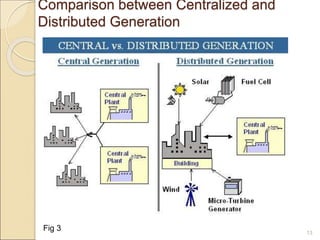
Distributed Generation (DG) technology 
incorporates wind turbines, micro turbines, 
photovoltaic systems, fuel cells, energy storage and 
synchronous generator applications to supply active 
power to distributed systems connected close to the 
consumers load. This concept is becoming a major 
player for Green House Gases (GHG) mitigation 
and power system reliability. 
10
Distributed Energy Resources 
• Generating Devices 
–Windmills 
– PV and solar thermal 
– Microturbines 
– Fuel cells 
– Biomass and biofuels 
– Geothermal power 
– Tidal and ocean thermal 
– Reciprocating engines 
11
• Storage Devices 
– Batteries 
– Ultracapacitors 
– SMES 
– Flywheels 
• Combined heat and power 
• Interruptible loads 
12
Comparison between Centralized and 
Distributed Generation 
13 
Fig 3
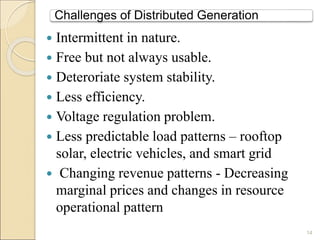
Challenges of Distributed Generation 
 Intermittent in nature. 
 Free but not always usable. 
 Deteroriate system stability. 
 Less efficiency. 
 Voltage regulation problem. 
 Less predictable load patterns – rooftop 
solar, electric vehicles, and smart grid 
 Changing revenue patterns - Decreasing 
marginal prices and changes in resource 
operational pattern 
14
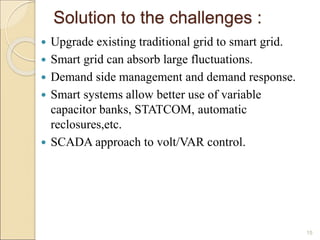
Solution to the challenges : 
 Upgrade existing traditional grid to smart grid. 
 Smart grid can absorb large fluctuations. 
 Demand side management and demand response. 
 Smart systems allow better use of variable 
capacitor banks, STATCOM, automatic 
reclosures,etc. 
 SCADA approach to volt/VAR control. 
15
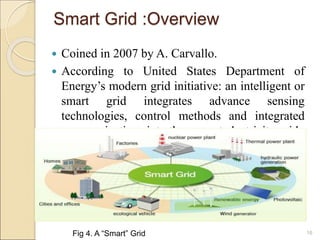
Smart Grid :Overview 
16 
 Coined in 2007 by A. Carvallo. 
 According to United States Department of 
Energy’s modern grid initiative: an intelligent or 
smart grid integrates advance sensing 
technologies, control methods and integrated 
communications into the current electricity grid. 
Fig 4. A “Smart” Grid
According to[EPRI 2006]: “The term ‘Smart Grid’ refers 
to a modernization of the electricity delivery system so it 
monitors, protects and automatically optimizes the 
operation of its interconnected elements from the central 
and distributed generator through the high-voltage 
network and distribution system, to industrial users and 
building automation systems, to energy storage 
installations and to end-use consumers…” 
17 
Energy 
Smart 
IT Grid 
Telecom 
Fig 5. Infrastructure of Smart Grid
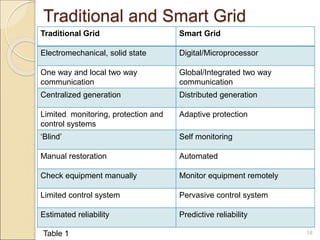
Traditional and Smart Grid 
Traditional Grid Smart Grid 
Electromechanical, solid state Digital/Microprocessor 
One way and local two way 
communication 
Global/Integrated two way 
communication 
Centralized generation Distributed generation 
Limited monitoring, protection and 
control systems 
Adaptive protection 
‘Blind’ Self monitoring 
Manual restoration Automated 
Check equipment manually Monitor equipment remotely 
Limited control system Pervasive control system 
Estimated reliability Predictive reliability 
Table 1 18
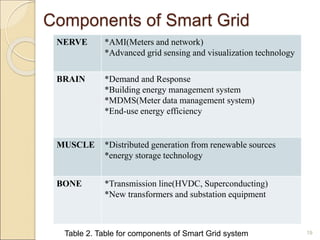
Components of Smart Grid 
19 
NERVE *AMI(Meters and network) 
*Advanced grid sensing and visualization technology 
BRAIN *Demand and Response 
*Building energy management system 
*MDMS(Meter data management system) 
*End-use energy efficiency 
MUSCLE *Distributed generation from renewable sources 
*energy storage technology 
BONE *Transmission line(HVDC, Superconducting) 
*New transformers and substation equipment 
Table 2. Table for components of Smart Grid system
20 
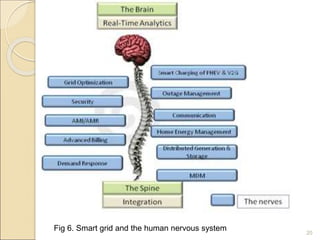
Fig 6. Smart grid and the human nervous system
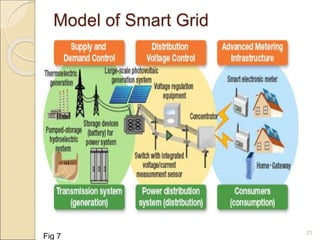
Model of Smart Grid 
21 Fig 7
Advanced Metering Infrastructure(AMI) 
or Smart Meters : 
22 
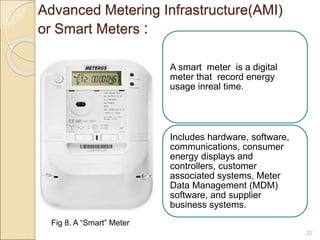
A smart meter is a digital 
meter that record energy 
usage inreal time. 
Includes hardware, software, 
communications, consumer 
energy displays and 
controllers, customer 
associated systems, Meter 
Data Management (MDM) 
software, and supplier 
business systems. 
Fig 8. A “Smart” Meter
AMI: Two Layers 
23 
1. Transport Layer: 2 components 
A. The physical smart meter-replacing the older 
mechanical one. 
B. AMI Communications network to transport 
the data. 
2. Application Layer : 
Information converted to actionable intelligence via 
meter specific applications.
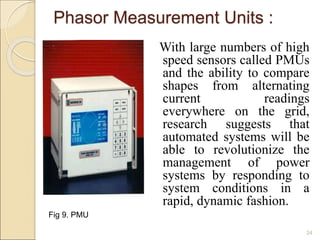
With large numbers of high 
speed sensors called PMUs 
and the ability to compare 
shapes from alternating 
current readings 
everywhere on the grid, 
research suggests that 
automated systems will be 
able to revolutionize the 
management of power 
systems by responding to 
system conditions in a 
rapid, dynamic fashion. 
Fig 9. PMU 
24 
Phasor Measurement Units :
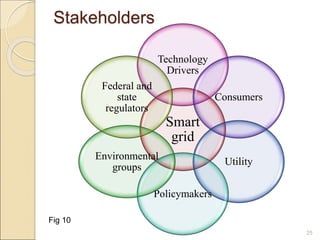
Stakeholders 
Technology 
Drivers 
Smart 
grid 
Consumers 
Utility 
Federal and 
state 
regulators 
Environmental 
Policymakers 
groups 
25 
Fig 10
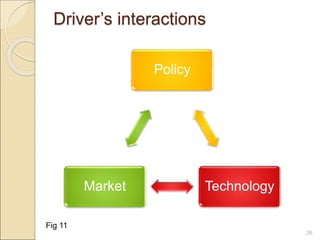
Driver’s interactions 
Policy 
Market Technology 
26 
Fig 11
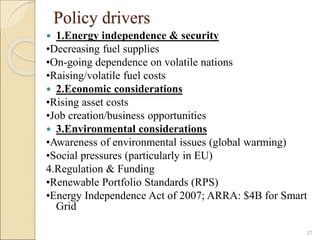
Policy drivers 
 1.Energy independence & security 
•Decreasing fuel supplies 
•On-going dependence on volatile nations 
•Raising/volatile fuel costs 
 2.Economic considerations 
•Rising asset costs 
•Job creation/business opportunities 
 3.Environmental considerations 
•Awareness of environmental issues (global warming) 
•Social pressures (particularly in EU) 
4.Regulation & Funding 
•Renewable Portfolio Standards (RPS) 
•Energy Independence Act of 2007; ARRA: $4B for Smart 
Grid 
27
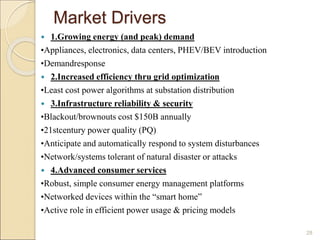
Market Drivers 
 1.Growing energy (and peak) demand 
•Appliances, electronics, data centers, PHEV/BEV introduction 
•Demandresponse 
 2.Increased efficiency thru grid optimization 
•Least cost power algorithms at substation distribution 
 3.Infrastructure reliability & security 
•Blackout/brownouts cost $150B annually 
•21stcentury power quality (PQ) 
•Anticipate and automatically respond to system disturbances 
•Network/systems tolerant of natural disaster or attacks 
 4.Advanced consumer services 
•Robust, simple consumer energy management platforms 
•Networked devices within the “smart home” 
•Active role in efficient power usage & pricing models 
28
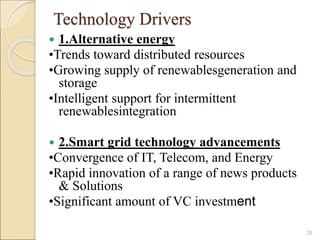
Technology Drivers 
 1.Alternative energy 
•Trends toward distributed resources 
•Growing supply of renewablesgeneration and 
storage 
•Intelligent support for intermittent 
renewablesintegration 
 2.Smart grid technology advancements 
•Convergence of IT, Telecom, and Energy 
•Rapid innovation of a range of news products 
& Solutions 
•Significant amount of VC investment 
29
Need for establishment of smart grids : 
Higher penetration of renewable resources or 
distributed generation. 
 Extensive and effective communication overlay 
from generation to consumers. 
 Use of advanced sensors and high speed 
control. 
 Higher operating efficiency. 
 Greater resiliency against attacks and natural 
disasters. 
Automated metering and rapid power 
restoration. 
 Provide greater customer participation. 
30
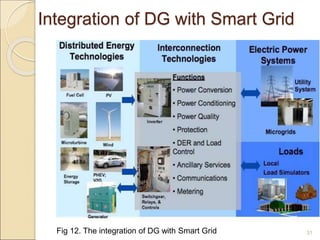
Integration of DG with Smart Grid 
Fig 12. The integration of DG with Smart Grid 31
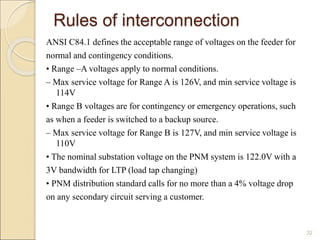
Rules of interconnection 
ANSI C84.1 defines the acceptable range of voltages on the feeder for 
normal and contingency conditions. 
• Range –A voltages apply to normal conditions. 
– Max service voltage for Range A is 126V, and min service voltage is 
114V 
• Range B voltages are for contingency or emergency operations, such 
as when a feeder is switched to a backup source. 
– Max service voltage for Range B is 127V, and min service voltage is 
110V 
• The nominal substation voltage on the PNM system is 122.0V with a 
3V bandwidth for LTP (load tap changing) 
• PNM distribution standard calls for no more than a 4% voltage drop 
on any secondary circuit serving a customer. 
32
Benefits of integration with Smart Grid : 
Transmission Reliability : 
 Automated Fault Location 
 Composite Core Conductor 
 Advanced System Planning Tools 
 Dynamic Voltage and VAR Control 
 Energy Storage for Transmission Reliability 
 Real Time Voltage Stability Program 
 Synchrophasors (Transmission) 
 Convert Manual Switches to Remote SCADA 
 Operation 
 Fiber Optic and Wireless Communication System 
 Spinning Reserve for emergencies 
33
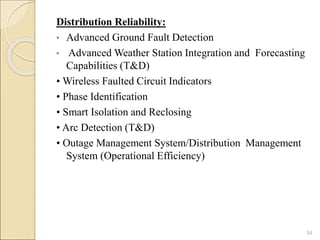
Distribution Reliability: 
• Advanced Ground Fault Detection 
• Advanced Weather Station Integration and Forecasting 
Capabilities (T&D) 
• Wireless Faulted Circuit Indicators 
• Phase Identification 
• Smart Isolation and Reclosing 
• Arc Detection (T&D) 
• Outage Management System/Distribution Management 
System (Operational Efficiency) 
34
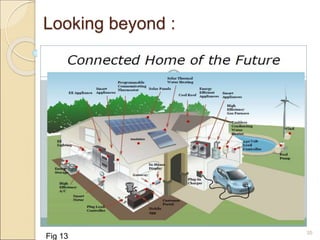
Looking beyond : 
35 Fig 13
Conclusion 
A Smart Grid impacts all the components 
of a power system and generation is 
likely to change with a drive towards 
more renewable generation. This will 
lead to conservation of the environment 
and decrease the adverse effects of 
pollution. The pressure on the existing 
conventional resources will also 
decrease. 
36
References : 
 Introduction to generation, Euginuisz Rosolawski 
 Smart Grid, Dr. Gleb V. Tcheslavski 
 Impact of Distributed Generation on Smart Grid 
Transient Stability,Nur Asyik Hidayatullah, Zahir J. 
Paracha, Akhtar Kalam 
 Smart Grid improves the value of Distributed 
Generation, Prof. Saifur Rahman 
 Compensation of impacts of Distributed Generation 
using Smart Grid Technology, Manoj Kumar Nigam, A. 
Krishna Nag 
 Smart Grid, Ali Firouzi ,PhD 
 Smart Grid power system control in distributed 
generation environment, Pertti Järventausta, Sami Repo, 
Antti Rautiainen,Jarmo Partanen 
37
38

DISTRIBUTED GENERATION ENVIRONMENT WITH SMART GRID

  • 1.
  • 2.
    Contents Introduction Formsof renewable energy Distributed generation, its challenges and solution Features of Smart Grid Components of Smart Grid AMI and PMUs Need for Smart grids Rules of interconnection Benefits of integration with smart grid Conclusion References 2
  • 3.
    Introduction The 20thcentury had seen significant advances in energy generation, delivery and utilization, but has also produced tremendous impact on the environment and natural resources. • Significant changes must be made to how we generate, deliver and use energy so as to – establish sustainable utilization, and – restore environmental balance. • Education must occur at all levels: – researchers; – workforce; – consumers. 3
  • 4.
    Needs of the21st century • Decrease fossil fuel consumption – 85% of today’s energy supply comes from fossil fuels. – Transportation and electric generation need to move away from fossil fuels. – Fossil fuels are the predominant contributors to environmental pollution. (COx, SOx, NOx, particulates) –Will also lead to energy independence. 4
  • 5.
    • Increase renewablegeneration – 7% of today’s energy supply comes from renewable sources (hydroelectric, geothermal, wind, solar, biomass). – Renewable generation must increase significantly but responsibly. • Increase nuclear generation suitably – 8% of today’s energy supply comes from nuclear power – Nuclear generation must increase so that there is adequate supply from steady sources. 5
  • 6.
    Sustainable utilization ofresources • Technological enablers – Energy efficient buildings with thermal storage – “Smart” homes and “smart” appliances – Demand response and load management programs – Energy efficient transportation: hybrid and electric vehicles – Storage and direct conversion technologies • Growing need for conservation • Demand profiles will change significantly – Composition of load is changing – Load factor is likely to change too 6
  • 7.
    Forms of renewableenergy resources  Wind turbines and wind farms,  Solar photovoltaic (PV) cells,  Solar-thermal energy,  Fuel Cells  Geothermal  Wave and tidal energy  Biomass  Micro or mini hydro 7
  • 8.
    8 SOLAR REFRIGERATIONHYDROPOWER BIOMASS WAVE ENERGY Fig 1
  • 9.
    9 MICROTURBINE FUELCELL SOLAR THERMAL PHOTOVOLTAIC GEOTHERMAL Fig 2 TIDAL POWER
  • 10.
    Distributed Generation DistributedGeneration (DG) technology incorporates wind turbines, micro turbines, photovoltaic systems, fuel cells, energy storage and synchronous generator applications to supply active power to distributed systems connected close to the consumers load. This concept is becoming a major player for Green House Gases (GHG) mitigation and power system reliability. 10
  • 11.
    Distributed Energy Resources • Generating Devices –Windmills – PV and solar thermal – Microturbines – Fuel cells – Biomass and biofuels – Geothermal power – Tidal and ocean thermal – Reciprocating engines 11
  • 12.
    • Storage Devices – Batteries – Ultracapacitors – SMES – Flywheels • Combined heat and power • Interruptible loads 12
  • 13.
    Comparison between Centralizedand Distributed Generation 13 Fig 3
  • 14.
    Challenges of DistributedGeneration  Intermittent in nature.  Free but not always usable.  Deteroriate system stability.  Less efficiency.  Voltage regulation problem.  Less predictable load patterns – rooftop solar, electric vehicles, and smart grid  Changing revenue patterns - Decreasing marginal prices and changes in resource operational pattern 14
  • 15.
    Solution to thechallenges :  Upgrade existing traditional grid to smart grid.  Smart grid can absorb large fluctuations.  Demand side management and demand response.  Smart systems allow better use of variable capacitor banks, STATCOM, automatic reclosures,etc.  SCADA approach to volt/VAR control. 15
  • 16.
    Smart Grid :Overview 16  Coined in 2007 by A. Carvallo.  According to United States Department of Energy’s modern grid initiative: an intelligent or smart grid integrates advance sensing technologies, control methods and integrated communications into the current electricity grid. Fig 4. A “Smart” Grid
  • 17.
    According to[EPRI 2006]:“The term ‘Smart Grid’ refers to a modernization of the electricity delivery system so it monitors, protects and automatically optimizes the operation of its interconnected elements from the central and distributed generator through the high-voltage network and distribution system, to industrial users and building automation systems, to energy storage installations and to end-use consumers…” 17 Energy Smart IT Grid Telecom Fig 5. Infrastructure of Smart Grid
  • 18.
    Traditional and SmartGrid Traditional Grid Smart Grid Electromechanical, solid state Digital/Microprocessor One way and local two way communication Global/Integrated two way communication Centralized generation Distributed generation Limited monitoring, protection and control systems Adaptive protection ‘Blind’ Self monitoring Manual restoration Automated Check equipment manually Monitor equipment remotely Limited control system Pervasive control system Estimated reliability Predictive reliability Table 1 18
  • 19.
    Components of SmartGrid 19 NERVE *AMI(Meters and network) *Advanced grid sensing and visualization technology BRAIN *Demand and Response *Building energy management system *MDMS(Meter data management system) *End-use energy efficiency MUSCLE *Distributed generation from renewable sources *energy storage technology BONE *Transmission line(HVDC, Superconducting) *New transformers and substation equipment Table 2. Table for components of Smart Grid system
  • 20.
    20 Fig 6.Smart grid and the human nervous system
  • 21.
    Model of SmartGrid 21 Fig 7
  • 22.
    Advanced Metering Infrastructure(AMI) or Smart Meters : 22 A smart meter is a digital meter that record energy usage inreal time. Includes hardware, software, communications, consumer energy displays and controllers, customer associated systems, Meter Data Management (MDM) software, and supplier business systems. Fig 8. A “Smart” Meter
  • 23.
    AMI: Two Layers 23 1. Transport Layer: 2 components A. The physical smart meter-replacing the older mechanical one. B. AMI Communications network to transport the data. 2. Application Layer : Information converted to actionable intelligence via meter specific applications.
  • 24.
    With large numbersof high speed sensors called PMUs and the ability to compare shapes from alternating current readings everywhere on the grid, research suggests that automated systems will be able to revolutionize the management of power systems by responding to system conditions in a rapid, dynamic fashion. Fig 9. PMU 24 Phasor Measurement Units :
  • 25.
    Stakeholders Technology Drivers Smart grid Consumers Utility Federal and state regulators Environmental Policymakers groups 25 Fig 10
  • 26.
    Driver’s interactions Policy Market Technology 26 Fig 11
  • 27.
    Policy drivers 1.Energy independence & security •Decreasing fuel supplies •On-going dependence on volatile nations •Raising/volatile fuel costs  2.Economic considerations •Rising asset costs •Job creation/business opportunities  3.Environmental considerations •Awareness of environmental issues (global warming) •Social pressures (particularly in EU) 4.Regulation & Funding •Renewable Portfolio Standards (RPS) •Energy Independence Act of 2007; ARRA: $4B for Smart Grid 27
  • 28.
    Market Drivers 1.Growing energy (and peak) demand •Appliances, electronics, data centers, PHEV/BEV introduction •Demandresponse  2.Increased efficiency thru grid optimization •Least cost power algorithms at substation distribution  3.Infrastructure reliability & security •Blackout/brownouts cost $150B annually •21stcentury power quality (PQ) •Anticipate and automatically respond to system disturbances •Network/systems tolerant of natural disaster or attacks  4.Advanced consumer services •Robust, simple consumer energy management platforms •Networked devices within the “smart home” •Active role in efficient power usage & pricing models 28
  • 29.
    Technology Drivers 1.Alternative energy •Trends toward distributed resources •Growing supply of renewablesgeneration and storage •Intelligent support for intermittent renewablesintegration  2.Smart grid technology advancements •Convergence of IT, Telecom, and Energy •Rapid innovation of a range of news products & Solutions •Significant amount of VC investment 29
  • 30.
    Need for establishmentof smart grids : Higher penetration of renewable resources or distributed generation.  Extensive and effective communication overlay from generation to consumers.  Use of advanced sensors and high speed control.  Higher operating efficiency.  Greater resiliency against attacks and natural disasters. Automated metering and rapid power restoration.  Provide greater customer participation. 30
  • 31.
    Integration of DGwith Smart Grid Fig 12. The integration of DG with Smart Grid 31
  • 32.
    Rules of interconnection ANSI C84.1 defines the acceptable range of voltages on the feeder for normal and contingency conditions. • Range –A voltages apply to normal conditions. – Max service voltage for Range A is 126V, and min service voltage is 114V • Range B voltages are for contingency or emergency operations, such as when a feeder is switched to a backup source. – Max service voltage for Range B is 127V, and min service voltage is 110V • The nominal substation voltage on the PNM system is 122.0V with a 3V bandwidth for LTP (load tap changing) • PNM distribution standard calls for no more than a 4% voltage drop on any secondary circuit serving a customer. 32
  • 33.
    Benefits of integrationwith Smart Grid : Transmission Reliability :  Automated Fault Location  Composite Core Conductor  Advanced System Planning Tools  Dynamic Voltage and VAR Control  Energy Storage for Transmission Reliability  Real Time Voltage Stability Program  Synchrophasors (Transmission)  Convert Manual Switches to Remote SCADA  Operation  Fiber Optic and Wireless Communication System  Spinning Reserve for emergencies 33
  • 34.
    Distribution Reliability: •Advanced Ground Fault Detection • Advanced Weather Station Integration and Forecasting Capabilities (T&D) • Wireless Faulted Circuit Indicators • Phase Identification • Smart Isolation and Reclosing • Arc Detection (T&D) • Outage Management System/Distribution Management System (Operational Efficiency) 34
  • 35.
    Looking beyond : 35 Fig 13
  • 36.
    Conclusion A SmartGrid impacts all the components of a power system and generation is likely to change with a drive towards more renewable generation. This will lead to conservation of the environment and decrease the adverse effects of pollution. The pressure on the existing conventional resources will also decrease. 36
  • 37.
    References : Introduction to generation, Euginuisz Rosolawski  Smart Grid, Dr. Gleb V. Tcheslavski  Impact of Distributed Generation on Smart Grid Transient Stability,Nur Asyik Hidayatullah, Zahir J. Paracha, Akhtar Kalam  Smart Grid improves the value of Distributed Generation, Prof. Saifur Rahman  Compensation of impacts of Distributed Generation using Smart Grid Technology, Manoj Kumar Nigam, A. Krishna Nag  Smart Grid, Ali Firouzi ,PhD  Smart Grid power system control in distributed generation environment, Pertti Järventausta, Sami Repo, Antti Rautiainen,Jarmo Partanen 37
  • 38.