WELCOME
HYBRID SOLAR-WIND POWER GENERATION SYSTEM
Presented by
D. Hemanth kumar
13761A0218
INTRODUCTION
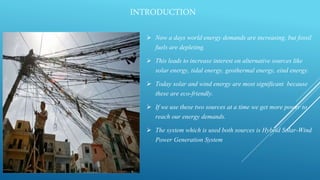
 Now a days world energy demands are increasing, but fossil
fuels are depleting.
 This leads to increase interest on alternative sources like
solar energy, tidal energy, geothermal energy, eind energy.
 Today solar and wind energy are most significant because
these are eco-friendly.
 If we use these two sources at a time we get more power to
reach our energy demands.
 The system which is used both sources is Hybrid Solar-Wind
Power Generation System
HYBRID
The thing that are made by combining two or more different things
Need For Hybridization:
 For increasing output
 For fulfilling demand of consumer
 Providing uninterrupted power supply
 System can design for both off grid and on grid
HYBRID SOLAR WIND POWER
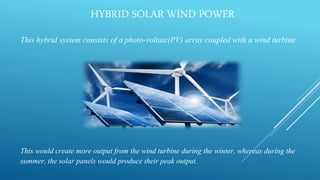
This hybrid system consists of a photo-voltaic(PV) array coupled with a wind turbine
This would create more output from the wind turbine during the winter, whereas during the
summer, the solar panels would produce their peak output.
PV WIND POWER
 Photovoltaic (PV) cells are electronic devices that are based on semiconductor technology
and can produce an electric current directly from sunlight.
 The best silicon PV modules now available commercially have an efficiency of over 18%, and
it is expected that in about 10 years’ time module efficiencies may rise over 25%.
 Wind power is electricity produced by a generator, which is driven by a turbine according to
aerodynamics in flowing air.
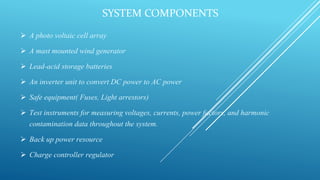
SYSTEM COMPONENTS
 A photo voltaic cell array
 A mast mounted wind generator
 Lead-acid storage batteries
 An inverter unit to convert DC power to AC power
 Safe equipment( Fuses, Light arrestors)
 Test instruments for measuring voltages, currents, power factors, and harmonic
contamination data throughout the system.
 Back up power resource
 Charge controller regulator
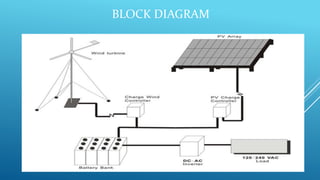
BLOCK DIAGRAM
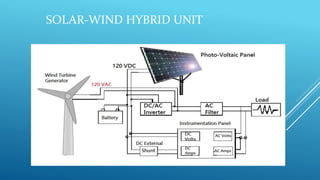
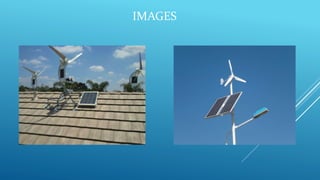
SOLAR-WIND HYBRID UNIT
IMAGES
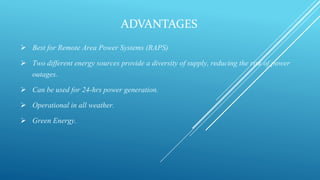
ADVANTAGES
 Best for Remote Area Power Systems (RAPS)
 Two different energy sources provide a diversity of supply, reducing the risk of power
outages.
 Can be used for 24-hrs power generation.
 Operational in all weather.
 Green Energy.
DISADVANTAGES
 Infrastructure cost may be high.
 Too labor intensive.
 Wind turbines can’t operate in high or low wind speeds.
 Not for Large scale production.
NEED FOR RESEARCH
Research and development efforts in solar, wind, and other renewable energy technologies are
required to continue for:
 Improving their performance.
 Establishing techniques for accurately predicting their output.
 Reliably integrating them with other conventional generating sources.
CONCLUSION
Solar Photovoltaic (PV) – Wind Turbine (WT) Hybrid System is the best way to utilize not just
one local available RE resource but multiple renewable RE resources, so that remote located
village communities, with no hope for any future grid connection, can consider to tap into their
own local renewable energy resources and convert them through various contextualized
renewable energy technologies into useful energy services.
REFERENCES
 www.slideshare.com
 http://en.wikipedia.org/wiki/Photovoltaic_system#Hybrid_systems
 http://en.wikipedia.org/wiki/Hybrid_renewable_energy_system
 http://energy.gov/energysaver/articles/hybrid-wind-and-solar-electric-systems
Hybrid solar wind power generation system

Hybrid solar wind power generation system

  • 1.
  • 2.
    HYBRID SOLAR-WIND POWERGENERATION SYSTEM Presented by D. Hemanth kumar 13761A0218
  • 3.
    INTRODUCTION  Now adays world energy demands are increasing, but fossil fuels are depleting.  This leads to increase interest on alternative sources like solar energy, tidal energy, geothermal energy, eind energy.  Today solar and wind energy are most significant because these are eco-friendly.  If we use these two sources at a time we get more power to reach our energy demands.  The system which is used both sources is Hybrid Solar-Wind Power Generation System
  • 4.
    HYBRID The thing thatare made by combining two or more different things Need For Hybridization:  For increasing output  For fulfilling demand of consumer  Providing uninterrupted power supply  System can design for both off grid and on grid
  • 5.
    HYBRID SOLAR WINDPOWER This hybrid system consists of a photo-voltaic(PV) array coupled with a wind turbine This would create more output from the wind turbine during the winter, whereas during the summer, the solar panels would produce their peak output.
  • 6.
    PV WIND POWER Photovoltaic (PV) cells are electronic devices that are based on semiconductor technology and can produce an electric current directly from sunlight.  The best silicon PV modules now available commercially have an efficiency of over 18%, and it is expected that in about 10 years’ time module efficiencies may rise over 25%.  Wind power is electricity produced by a generator, which is driven by a turbine according to aerodynamics in flowing air.
  • 7.
    SYSTEM COMPONENTS  Aphoto voltaic cell array  A mast mounted wind generator  Lead-acid storage batteries  An inverter unit to convert DC power to AC power  Safe equipment( Fuses, Light arrestors)  Test instruments for measuring voltages, currents, power factors, and harmonic contamination data throughout the system.  Back up power resource  Charge controller regulator
  • 8.
  • 9.
  • 10.
  • 11.
    ADVANTAGES  Best forRemote Area Power Systems (RAPS)  Two different energy sources provide a diversity of supply, reducing the risk of power outages.  Can be used for 24-hrs power generation.  Operational in all weather.  Green Energy.
  • 12.
    DISADVANTAGES  Infrastructure costmay be high.  Too labor intensive.  Wind turbines can’t operate in high or low wind speeds.  Not for Large scale production.
  • 13.
    NEED FOR RESEARCH Researchand development efforts in solar, wind, and other renewable energy technologies are required to continue for:  Improving their performance.  Establishing techniques for accurately predicting their output.  Reliably integrating them with other conventional generating sources.
  • 14.
    CONCLUSION Solar Photovoltaic (PV)– Wind Turbine (WT) Hybrid System is the best way to utilize not just one local available RE resource but multiple renewable RE resources, so that remote located village communities, with no hope for any future grid connection, can consider to tap into their own local renewable energy resources and convert them through various contextualized renewable energy technologies into useful energy services.
  • 15.
    REFERENCES  www.slideshare.com  http://en.wikipedia.org/wiki/Photovoltaic_system#Hybrid_systems http://en.wikipedia.org/wiki/Hybrid_renewable_energy_system  http://energy.gov/energysaver/articles/hybrid-wind-and-solar-electric-systems