SEMINAR: PRESENTED BY:  P.KOMAL ENOCH 8 TH  SEM MECHANICAL ENGG P.D.I.T -2011
CONTENTS   INTODUCTION HISTORY DESGIN CONSIDERATION  WORKING OF FPP ADVANTAGES  DISADVANTAGES FUTURE OF FPP CONCLUSION REFERENCES
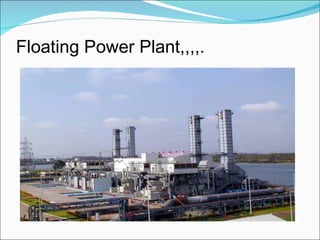
INTRODUCTION  : The floating power plant can economically supply electricity to a specific district or to a specific facility that temporarily uses electricity And can minimize limitations caused by environmental regulations, and can be used as an emergency electric power source.
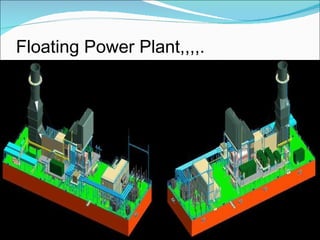
Floating Power Plant,,,,.
HISTORY In fact one of the earlier units, constructed in 1940 by the US Army Corp of Engineers, a 30 MW steam generation facility and put into service in the Philippines, is still in operation at a site in Ecuador The initial answer was the need to install fast, reliable capacity in countries experiencing severe capacity shortages Countries in South East Asia, particularly the Philippines, South America and the Caribbean found themselves desperately short of power In 2000, what is currently the largest FPP in the world was  installed in Mangalore, on the west coat of India.
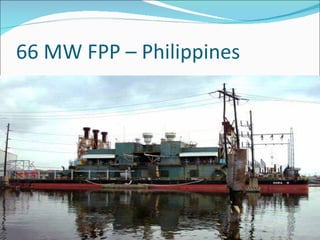
66 MW FPP – Philippines
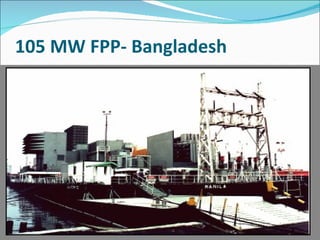
105 MW FPP- Bangladesh
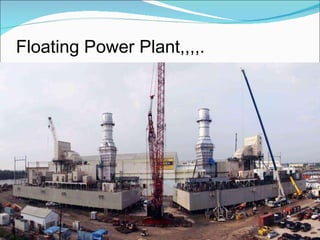
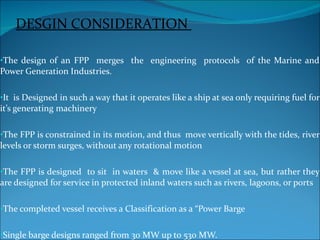
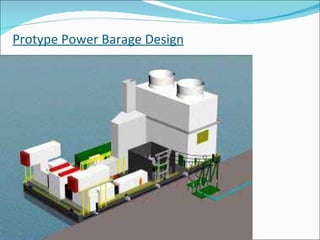
The design of an FPP  merges  the  engineering  protocols  of the Marine and Power Generation Industries. It  is Designed in such a way that it operates like a ship at sea only requiring fuel for it’s generating machinery The FPP is constrained in its motion, and thus  move vertically with the tides, river levels or storm surges, without any rotational motion The FPP is designed  to sit  in waters  & move like a vessel at sea, but rather they are designed for service in protected inland waters such as rivers, lagoons, or ports The completed vessel receives a Classification as a “Power Barge Single barge designs ranged from 30 MW up to 530 MW. DESGIN CONSIDERATION
Protype Power Barage Design
Floating Power Plant,,,,.
The structure of the Fpp can be divided into, Floating platform  Rotor with blades (A Floating Turbine) The floating platform(float) has various functions : It is  equipped  with submerged lateral guides to direct the river water It permits the adjustment of the height of the equipment above the surface of the river. It prevents undesirable materials from entering the rotor of the turbine It has automatic adjustments in case there are variations in the water level Working of a FPP
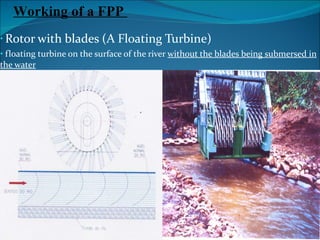
Rotor with blades (A Floating Turbine) floating turbine on the surface of the river  without the blades being submersed in the water Working of a FPP
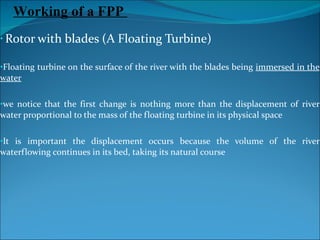
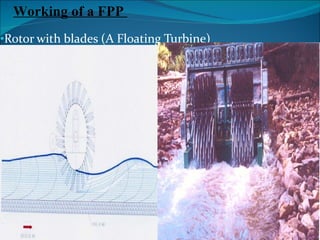
Rotor with blades (A Floating Turbine) Floating turbine on the surface of the river with the blades being  immersed in the water we notice that the first change is nothing more than the displacement of river water proportional to the mass of the floating turbine in its physical space It is important the displacement occurs because the volume of the river waterflowing continues in its bed, taking its natural course Working of a FPP
Rotor with blades (A Floating Turbine) Working of a FPP
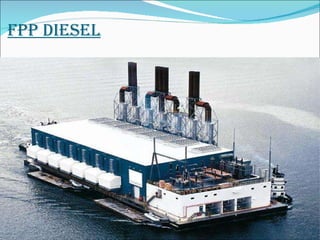
Resent Developments The recent  research and operation on FPP has developed more sophisticated, light weight, high efficient and effective FPP Some of the latest developments are FPP diesel FPP wind energy FPP tidal energy
FPP diesel
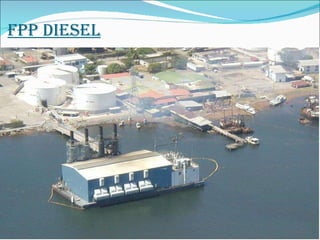
FPP diesel
ADVANTAGES Fast supply of electricity to areas with limited infrastructure Installation possible in areas with poor logistic infrastructure Independent from soil quality Provides additional safety in earth quake and flooding areas Where land space is limited, large site area not needed Mobile asset for the owner, possibility to trade Short Delivery Time
DISADVANTAGES FPP as a problem with end-user power demand and supply not being synchronized. The access to the installations is critical when working off-shore. Infrastructure is costly when working off-shore.
FUTURE OF FPP More than 60 floating power stations are in operation around the world. Deploying some 4 GW at continental shores where electricity is most needed. Though these feature a variety of power sources.
There are several positive environmental impacts from the construction of FPP. The energy production from a 230 meter Poseidon power plant will reduce the  annual emission from a traditional fossil fuel power generation by:  145 tons of sulphur dioxide 120 tons of nitric oxides 35,000 tons of carbon dioxide 2,600 tons of slag and fly ash FPP utilizes and absorbs the inherent energy from the Nature, thereby reducing the use of elements that are Harmful to the Mother nature. conclusion
WWW.WIKIPEDIA.COM WWW.GOOGLE.COM WWW.FLOATINGPOWERPLANT.COM www.wallermarine.com SOURCES
Thanking U All….

Floating power plant 25 03-11

  • 1.
    SEMINAR: PRESENTED BY: P.KOMAL ENOCH 8 TH SEM MECHANICAL ENGG P.D.I.T -2011
  • 2.
    CONTENTS   INTODUCTIONHISTORY DESGIN CONSIDERATION WORKING OF FPP ADVANTAGES DISADVANTAGES FUTURE OF FPP CONCLUSION REFERENCES
  • 3.
    INTRODUCTION :The floating power plant can economically supply electricity to a specific district or to a specific facility that temporarily uses electricity And can minimize limitations caused by environmental regulations, and can be used as an emergency electric power source.
  • 4.
  • 5.
  • 6.
    HISTORY In factone of the earlier units, constructed in 1940 by the US Army Corp of Engineers, a 30 MW steam generation facility and put into service in the Philippines, is still in operation at a site in Ecuador The initial answer was the need to install fast, reliable capacity in countries experiencing severe capacity shortages Countries in South East Asia, particularly the Philippines, South America and the Caribbean found themselves desperately short of power In 2000, what is currently the largest FPP in the world was installed in Mangalore, on the west coat of India.
  • 7.
    66 MW FPP– Philippines
  • 8.
    105 MW FPP-Bangladesh
  • 9.
    The design ofan FPP merges the engineering protocols of the Marine and Power Generation Industries. It is Designed in such a way that it operates like a ship at sea only requiring fuel for it’s generating machinery The FPP is constrained in its motion, and thus move vertically with the tides, river levels or storm surges, without any rotational motion The FPP is designed to sit in waters & move like a vessel at sea, but rather they are designed for service in protected inland waters such as rivers, lagoons, or ports The completed vessel receives a Classification as a “Power Barge Single barge designs ranged from 30 MW up to 530 MW. DESGIN CONSIDERATION
  • 10.
  • 11.
  • 12.
    The structure ofthe Fpp can be divided into, Floating platform Rotor with blades (A Floating Turbine) The floating platform(float) has various functions : It is equipped with submerged lateral guides to direct the river water It permits the adjustment of the height of the equipment above the surface of the river. It prevents undesirable materials from entering the rotor of the turbine It has automatic adjustments in case there are variations in the water level Working of a FPP
  • 13.
    Rotor with blades(A Floating Turbine) floating turbine on the surface of the river without the blades being submersed in the water Working of a FPP
  • 14.
    Rotor with blades(A Floating Turbine) Floating turbine on the surface of the river with the blades being immersed in the water we notice that the first change is nothing more than the displacement of river water proportional to the mass of the floating turbine in its physical space It is important the displacement occurs because the volume of the river waterflowing continues in its bed, taking its natural course Working of a FPP
  • 15.
    Rotor with blades(A Floating Turbine) Working of a FPP
  • 16.
    Resent Developments Therecent research and operation on FPP has developed more sophisticated, light weight, high efficient and effective FPP Some of the latest developments are FPP diesel FPP wind energy FPP tidal energy
  • 17.
  • 18.
  • 19.
    ADVANTAGES Fast supplyof electricity to areas with limited infrastructure Installation possible in areas with poor logistic infrastructure Independent from soil quality Provides additional safety in earth quake and flooding areas Where land space is limited, large site area not needed Mobile asset for the owner, possibility to trade Short Delivery Time
  • 20.
    DISADVANTAGES FPP asa problem with end-user power demand and supply not being synchronized. The access to the installations is critical when working off-shore. Infrastructure is costly when working off-shore.
  • 21.
    FUTURE OF FPPMore than 60 floating power stations are in operation around the world. Deploying some 4 GW at continental shores where electricity is most needed. Though these feature a variety of power sources.
  • 22.
    There are severalpositive environmental impacts from the construction of FPP. The energy production from a 230 meter Poseidon power plant will reduce the annual emission from a traditional fossil fuel power generation by: 145 tons of sulphur dioxide 120 tons of nitric oxides 35,000 tons of carbon dioxide 2,600 tons of slag and fly ash FPP utilizes and absorbs the inherent energy from the Nature, thereby reducing the use of elements that are Harmful to the Mother nature. conclusion
  • 23.
  • 24.