Download as PDF, PPTX

![1.1
What is Distributed Generation?
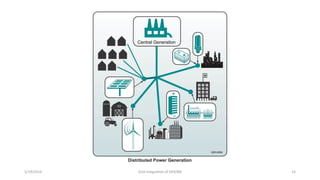
Distributed generation is an approach that employs small-scale technologies to produce
electricity close to the end users of power. DG technologies often consist of modular (and
sometimes renewable-energy) generators, and they offer a number of potential benefits. In
many cases, distributed generators can provide lower-cost electricity and higher power
reliability and security with fewer environmental consequences than can traditional power
generators.
In contrast to the use of a few large-scale generating stations located far from load centers--the
approach used in the traditional electric power paradigm--DG systems employ numerous, but
small plants and can provide power onsite with little reliance on the distribution and
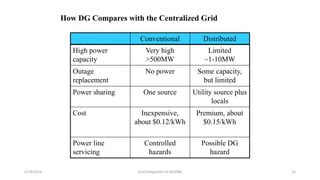
transmission grid. DG technologies yield power in capacities that range from a fraction of a
kilowatt [kW] to about 10 megawatts [MW]. Utility-scale generation units generate power in
capacities that often reach beyond 1,000 MW.
5/19/2016 Grid Integration of DER/BG 2](https://image.slidesharecdn.com/unit1-220312134155/85/Unit1-2-320.jpg)
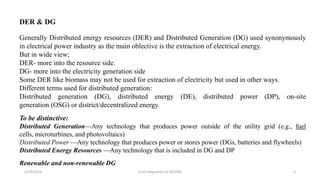
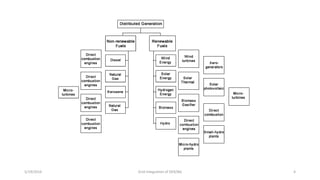
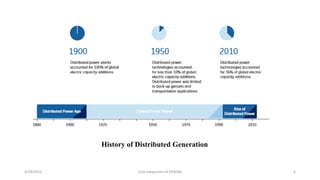
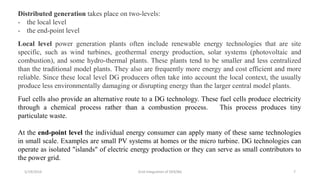
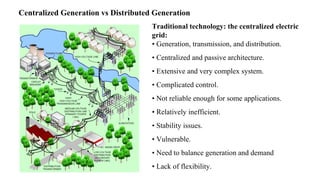
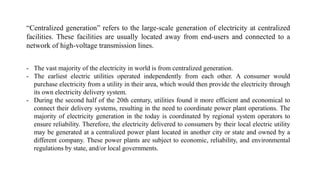
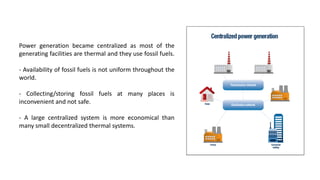
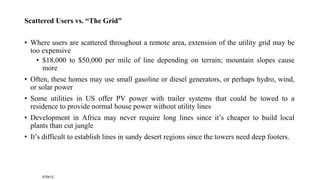
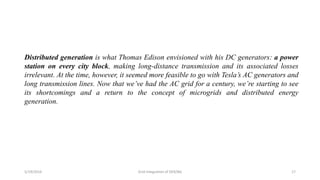
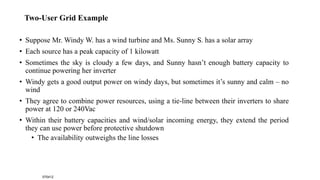
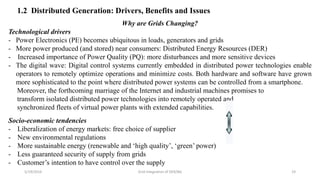
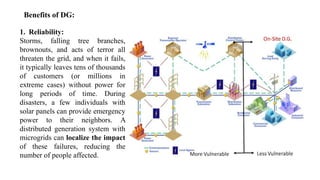
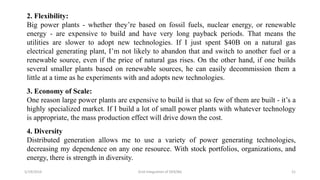
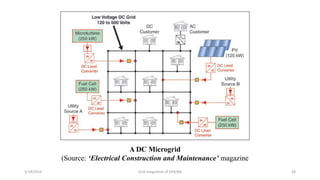
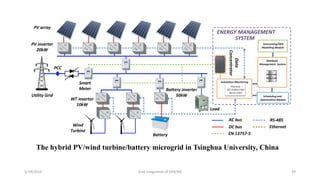

Distributed generation takes advantage of small-scale power generation located near end users to provide electricity with benefits over traditional large-scale power plants. These include increased reliability as failures have localized impact, flexibility to adopt new technologies more easily, and reduced transmission losses. However, issues can include difficulty with load following due to variable renewable sources, potential voltage and stability problems integrating with the grid, and higher capital costs compared to large plants. Careful planning is needed to address power quality impacts on frequency and voltage from large amounts of distributed generation as well as connection challenges like bidirectional power flows, protection schemes, reactive power support, and power conditioning.


![[Deck] What's New in Spark-Iceberg Integration via DSV2.pptx](https://cdn.slidesharecdn.com/ss_thumbnails/deckwhatsnewinspark-icebergintegrationviadsv2-260210005337-25955b12-thumbnail.jpg?width=640&height=640&fit=bounds)