ANALYSIS ON
GRID CONNEC TED PV
SYSTEM
Project Member:
Ishwor singh(BEL/070/219)
Khaga Raj subedi (BEL/070/221)
Kishor ghimire(BEL/070/222)
Ramesh adhikari(BEL/070/233)
Project Supervisor:
Shahabuddin Khan
Date: Sept 17,2017
CONTENTS
Introduction
Problem of Statement
Objectives
Methodology
Simulation Results
Future Works
Conclusion
References
INTRODUCTION
• Solar PV systems are generally classified into Grid-
connected and Stand-alone systems.
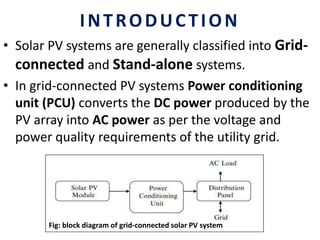
• In grid-connected PV systems Power conditioning
unit (PCU) converts the DC power produced by the
PV array into AC power as per the voltage and
power quality requirements of the utility grid.
Fig: block diagram of grid-connected solar PV system
STATEMENT OF PROBLEM
• In isolated system, power from the PV is not
sufficient to supply load during bad weather
condition
• The excess power generated by isolated PV
system is loss during summer days
OBJECTIVE
• The main objective of the project is to
utilize the deficient power required for
solar energy system through grid and to
fed surplus power of the solar energy
system to the grid
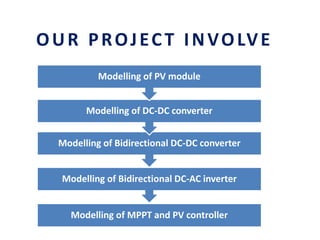
OUR PROJECT INVOLVE
Modelling of MPPT and PV controller
Modelling of Bidirectional DC-AC inverter
Modelling of Bidirectional DC-DC converter
Modelling of DC-DC converter
Modelling of PV module
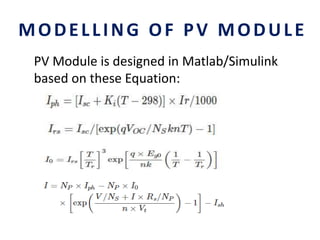
MODELLING OF PV MODULE
PV Module is designed in Matlab/Simulink
based on these Equation:
IV CURVE FROM SIMULINK
AT VARIOUS IRRADIANCE
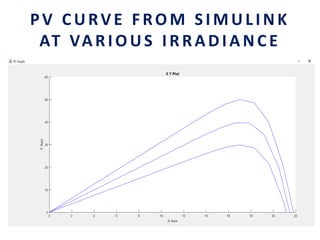
PV CURVE FROM SIMULINK
AT VARIOUS IRRADIANCE
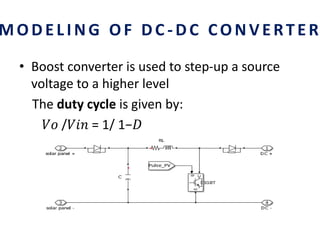
MODELING OF DC - DC CONVERTER
• Boost converter is used to step-up a source
voltage to a higher level
The duty cycle is given by:
𝑉𝑜 /𝑉𝑖𝑛 = 1/ 1−𝐷
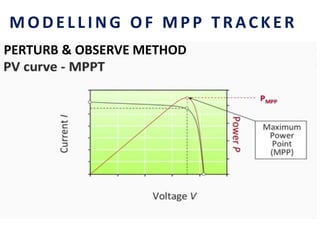
PERTURB & OBSERVE METHOD
MODELLING OF MPP TRACKER
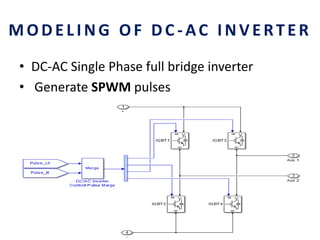
MODELING OF DC - AC INVERTER
• DC-AC Single Phase full bridge inverter
• Generate SPWM pulses
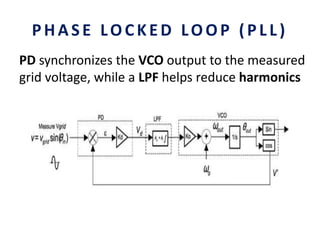
PHASE LOCKED LOOP (PLL)
PD synchronizes the VCO output to the measured
grid voltage, while a LPF helps reduce harmonics
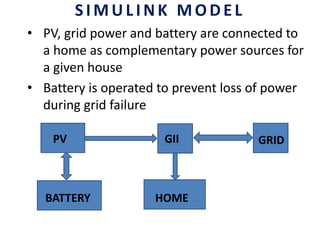
SIMULINK MODEL
• PV, grid power and battery are connected to
a home as complementary power sources for
a given house
• Battery is operated to prevent loss of power
during grid failure
PV GII
BATTERY HOME
GRID
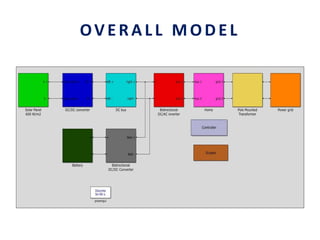
OVERALL MODEL
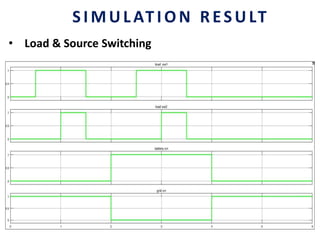
• Load & Source Switching
SIMULATION RESULT
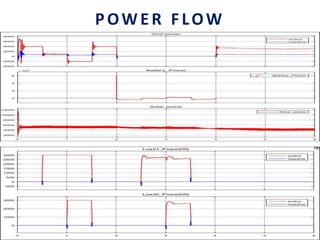
POWER FLOW
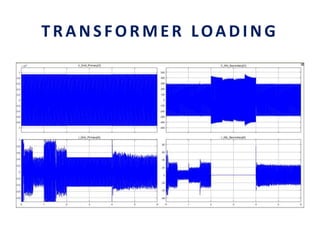
TRANSFORMER LOADING
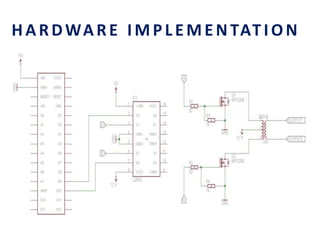
HARDWARE IMPLEMENTATION
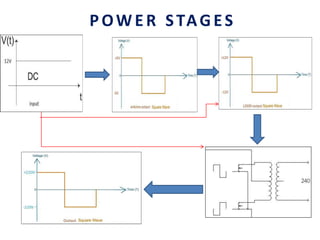
POW ER STAGES
CONCLUSION
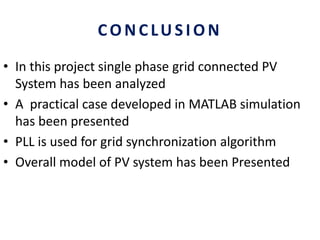
• In this project single phase grid connected PV
System has been analyzed
• A practical case developed in MATLAB simulation
has been presented
• PLL is used for grid synchronization algorithm
• Overall model of PV system has been Presented
FURTHER WORK
• Centralized inverter topology can be replaced
by multistring or modular topology
• Net metering system can be incorporated
• A circuitry to disconnect PV system and GFCI
can be incorporated
• Advanced MPPT controller like INCC can be
used
REFERENCES
• S. Sumathi et al., “Solar PV and Wind Energy Conversion Systems”,
Springer International Publishing, Switzerland
• W.Hart Daniel, power electronics, Mc Graw Hill, New York, 2011
• H.Rashid Muhammad, power electronics, pearson publication
• www.ijareeie.com
• www.google.com
• www.Wikipedia.org
• www.mathworks.com
• www.ironridge.com
Grid-connected PV system

Grid-connected PV system

  • 1.
    ANALYSIS ON GRID CONNECTED PV SYSTEM Project Member: Ishwor singh(BEL/070/219) Khaga Raj subedi (BEL/070/221) Kishor ghimire(BEL/070/222) Ramesh adhikari(BEL/070/233) Project Supervisor: Shahabuddin Khan Date: Sept 17,2017
  • 2.
  • 3.
    INTRODUCTION • Solar PVsystems are generally classified into Grid- connected and Stand-alone systems. • In grid-connected PV systems Power conditioning unit (PCU) converts the DC power produced by the PV array into AC power as per the voltage and power quality requirements of the utility grid. Fig: block diagram of grid-connected solar PV system
  • 4.
    STATEMENT OF PROBLEM •In isolated system, power from the PV is not sufficient to supply load during bad weather condition • The excess power generated by isolated PV system is loss during summer days
  • 5.
    OBJECTIVE • The mainobjective of the project is to utilize the deficient power required for solar energy system through grid and to fed surplus power of the solar energy system to the grid
  • 6.
    OUR PROJECT INVOLVE Modellingof MPPT and PV controller Modelling of Bidirectional DC-AC inverter Modelling of Bidirectional DC-DC converter Modelling of DC-DC converter Modelling of PV module
  • 7.
    MODELLING OF PVMODULE PV Module is designed in Matlab/Simulink based on these Equation:
  • 8.
    IV CURVE FROMSIMULINK AT VARIOUS IRRADIANCE
  • 9.
    PV CURVE FROMSIMULINK AT VARIOUS IRRADIANCE
  • 10.
    MODELING OF DC- DC CONVERTER • Boost converter is used to step-up a source voltage to a higher level The duty cycle is given by: 𝑉𝑜 /𝑉𝑖𝑛 = 1/ 1−𝐷
  • 11.
    PERTURB & OBSERVEMETHOD MODELLING OF MPP TRACKER
  • 12.
    MODELING OF DC- AC INVERTER • DC-AC Single Phase full bridge inverter • Generate SPWM pulses
  • 13.
    PHASE LOCKED LOOP(PLL) PD synchronizes the VCO output to the measured grid voltage, while a LPF helps reduce harmonics
  • 14.
    SIMULINK MODEL • PV,grid power and battery are connected to a home as complementary power sources for a given house • Battery is operated to prevent loss of power during grid failure PV GII BATTERY HOME GRID
  • 15.
  • 16.
    • Load &Source Switching SIMULATION RESULT
  • 17.
  • 18.
  • 19.
  • 20.
  • 21.
    CONCLUSION • In thisproject single phase grid connected PV System has been analyzed • A practical case developed in MATLAB simulation has been presented • PLL is used for grid synchronization algorithm • Overall model of PV system has been Presented
  • 22.
    FURTHER WORK • Centralizedinverter topology can be replaced by multistring or modular topology • Net metering system can be incorporated • A circuitry to disconnect PV system and GFCI can be incorporated • Advanced MPPT controller like INCC can be used
  • 23.
    REFERENCES • S. Sumathiet al., “Solar PV and Wind Energy Conversion Systems”, Springer International Publishing, Switzerland • W.Hart Daniel, power electronics, Mc Graw Hill, New York, 2011 • H.Rashid Muhammad, power electronics, pearson publication • www.ijareeie.com • www.google.com • www.Wikipedia.org • www.mathworks.com • www.ironridge.com