Distributed Generation 
SUBMITTED TO:- SUBMITTED BY:- 
Mr.inderpreet Singh Mr. Naresh Chand 
UIDNO-13MEL1007
Introduction 
 Distributed generation in simple term can be 
defined as a small-scale generation. It is active 
power generating unit that is connected at 
distribution level. 
 IEEE defines the generation of electricity by 
facilities sufficiently smaller than central plants, 
so as to allow interconnection at nearly any point 
in the power system, as Distributed Resources. 
 Electric Power Research Institute (EPRI) defines 
distributed generation as generation from a few 
kilowatts up to 50 MW. 
 Distributed generation, also called on-site 
generation, distributed energy or district
 Most countries generate electricity in large 
centralized facilities, such as fossil fuel (coal, gas 
powered), nuclear, large solar power plants or 
hydropower plants. These plants have excellent 
economies of scale, but usually transmit electricity 
long distances and can negatively affect the 
environment. 
 Distributed generation allows collection of energy 
from many sources and may give lower 
environmental impacts and improved security of 
supply. 
 Distributed generation reduces the amount of 
energy lost in transmitting electricity because the 
electricity is generated very near where it is used, 
perhaps even in the same building. This also
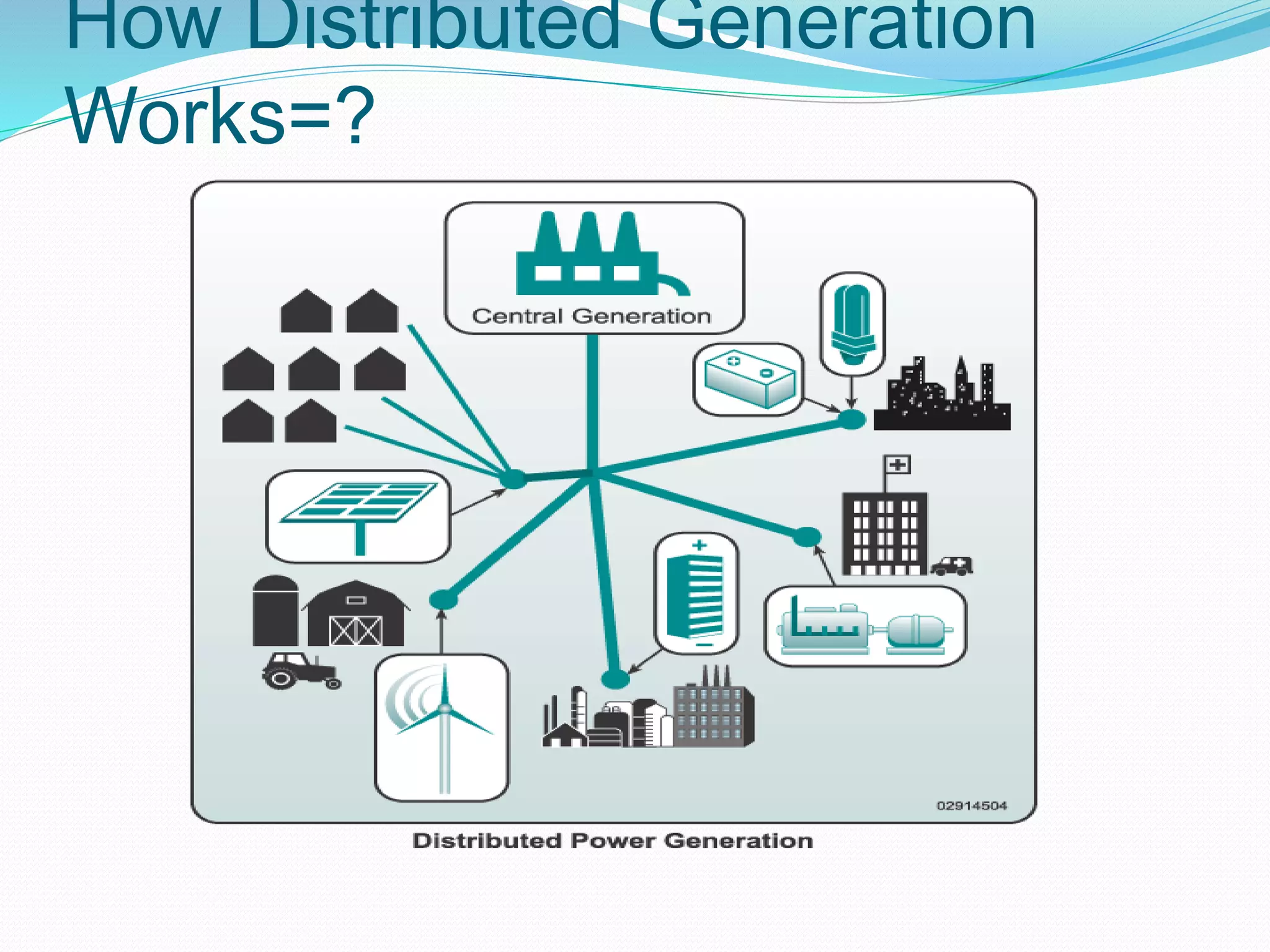
How Distributed Generation 
Works=?
 DG as generation that is not centrally planned, 
centrally dispatched at present, usually 
connected to the distribution network, and 
smaller than 50-100 MW. 
 These generators are distributed throughout the 
power system closer to the loads as shown in the 
previous slide. 
 The DG penetration in the grid poses new 
challenges and problems to the network 
operators as these can have a significant impact 
on the system and equipment operations in 
terms of reliability, power quality, stability and 
safety for both customers and electricity supplier.
Types of Distributed Energy 
Resources 
Cogeneration:-Distributed cogeneration sources 
use steam turbines, natural gas-fired fuel cells, 
micro turbines or reciprocating engines to turn 
generators. The hot exhaust is then used for 
space or water heating, or to drive an absorptive 
chiller for cooling such as air-conditioning. 
Vehicle-to-grid:-Future generations of electric 
vehicles may have the ability to deliver power 
from the battery in a vehicle-to-grid into the grid 
when needed. An electric vehicle network could 
also be an important distributed generation 
resource.
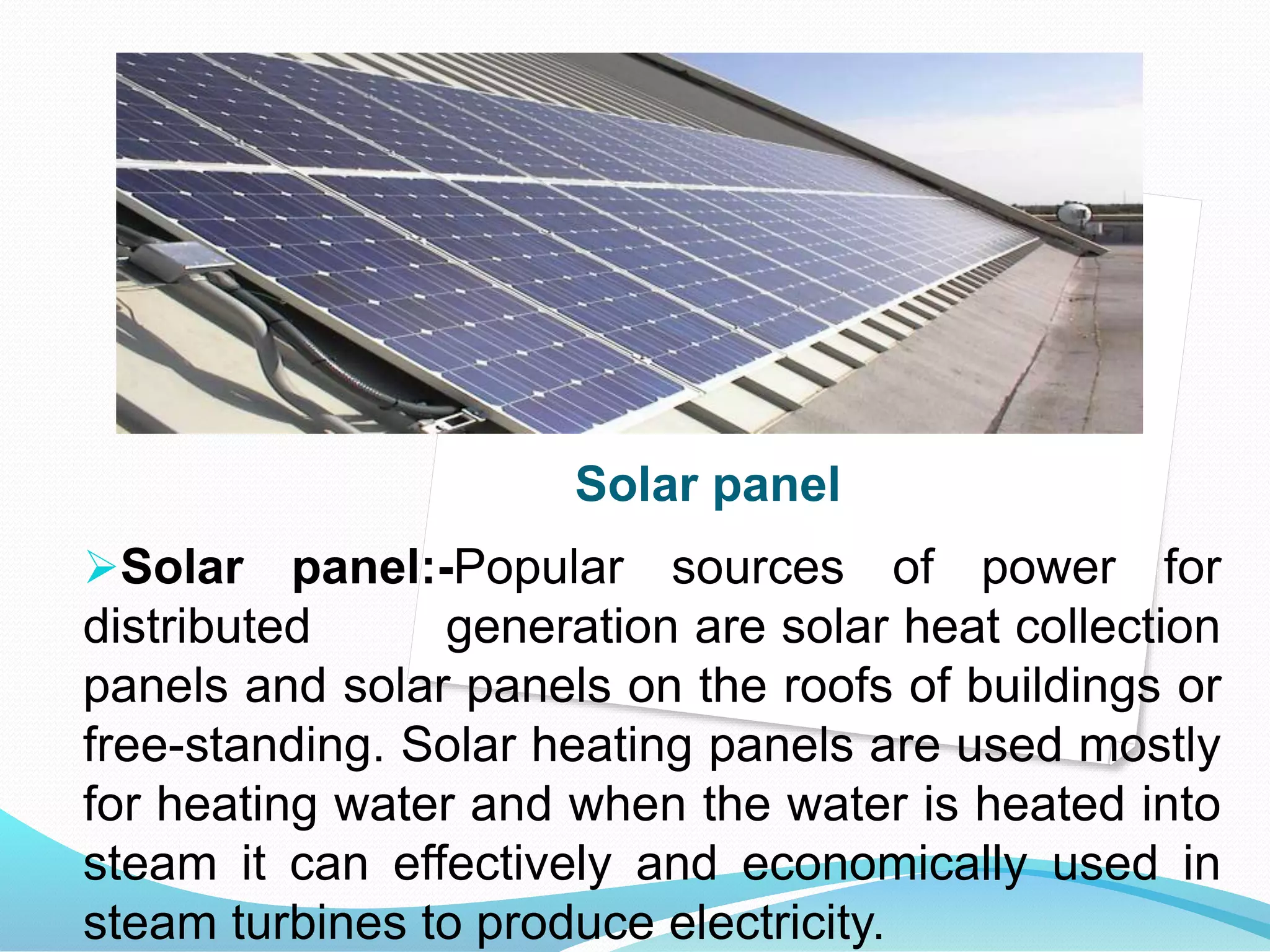
Solar panel 
Solar panel:-Popular sources of power for 
distributed generation are solar heat collection 
panels and solar panels on the roofs of buildings or 
free-standing. Solar heating panels are used mostly 
for heating water and when the water is heated into 
steam it can effectively and economically used in 
steam turbines to produce electricity.
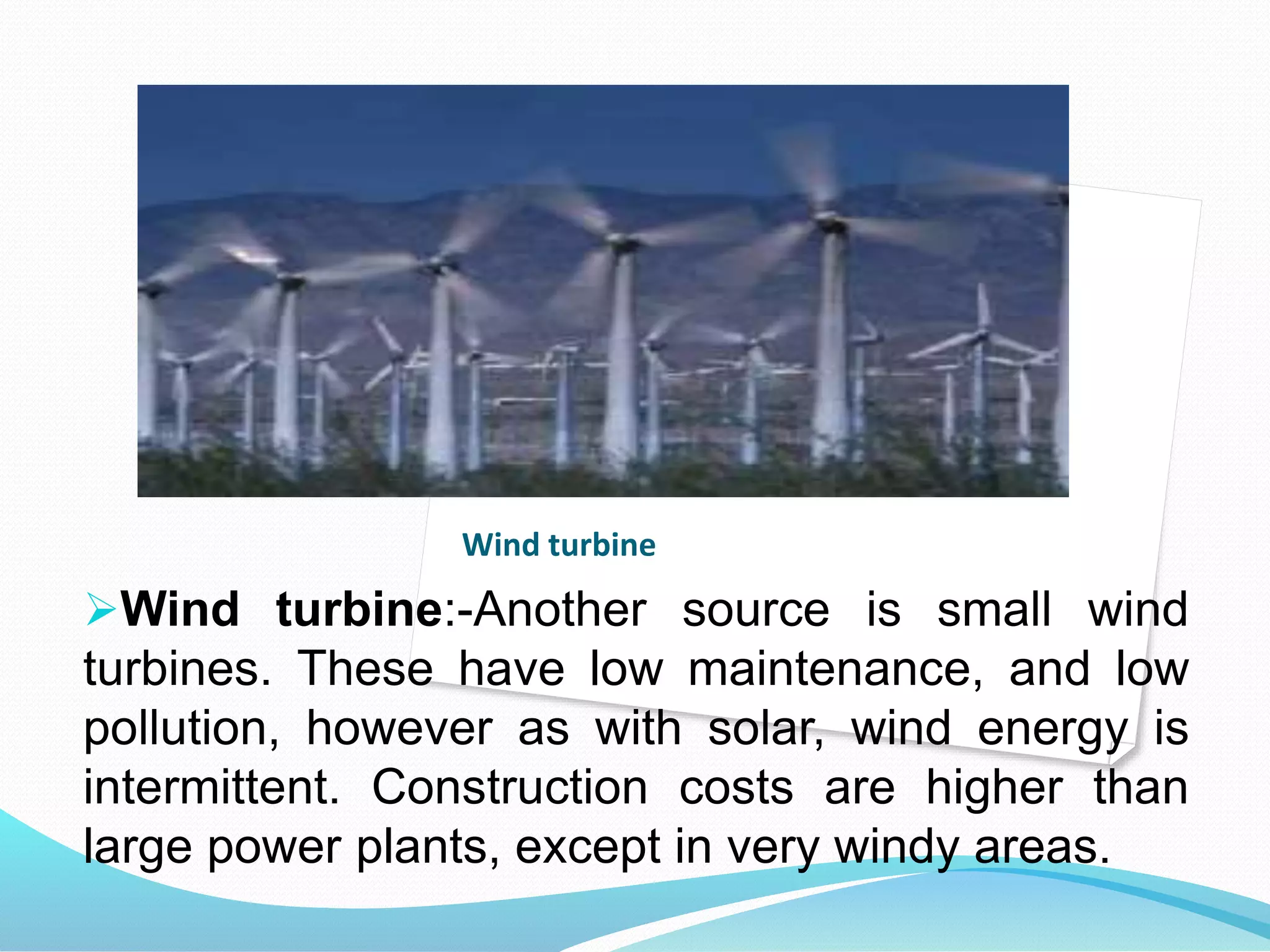
Wind turbine 
Wind turbine:-Another source is small wind 
turbines. These have low maintenance, and low 
pollution, however as with solar, wind energy is 
intermittent. Construction costs are higher than 
large power plants, except in very windy areas.
Waste-to-energy:- Municipal solid waste (MSW) 
and natural waste, such as sewage sludge, food 
waste and animal manure will decompose and 
discharge methane-containing gas that can be 
collected as used as fuel in gas turbines or micro 
turbines to produce electricity as a distributed 
energy resource. 
Cost factors:- Co generators are also more 
expensive per watt than central generators. They 
find favor because most buildings already burn 
fuels, and the cogeneration can extract more 
value from the fuel. Local production has no 
electricity transportation losses on long distance 
power lines or energy losses from the Joule 
effect in transformers where in general 8-15% of
Modes of Power 
Generation 
DER systems may include the following 
technologies:- 
 Combined heat power (CHP) 
 Fuel cells 
 Micro combined heat and power (Micro CHP) 
 Micro turbines 
 Photovoltaic Systems 
 Reciprocating engines 
 Small Wind power systems 
 Tri generation
Power Quality Issues:- 
A major issue related to interconnection of 
distributed resources onto the power grid is the 
potential impacts on the quality of power 
provided to other customers connected to the 
grid. 
Voltage Regulation:-Over-voltages due to 
reverse power flow: If the downstream DG output 
exceeds the downstream feeder load, there is an 
increase in feeder voltage with increasing 
distance. If the substation end voltage is held to 
near the maximum allowable value, voltages 
downstream on the feeder can exceed the 
acceptable range.
DG Grounding Issue:-A grid-connected DG, 
whether directly or through a transformer, should 
provide an effective ground to prevent un-faulted 
phases from over-voltage during a single-phase 
to ground fault. Proper grounding analysis of DG 
will ensure compatibility with grounding for both 
the primary and secondary power systems. 
Harmonic Distortion:-Voltage harmonics are 
virtually always present on the utility grid. 
Nonlinear loads, power electronic loads effects of 
the harmonics include overheating and 
equipment failure, faulty operation of protective 
devices, nuisance tripping of a sensitive load and 
interference with communication circuits’
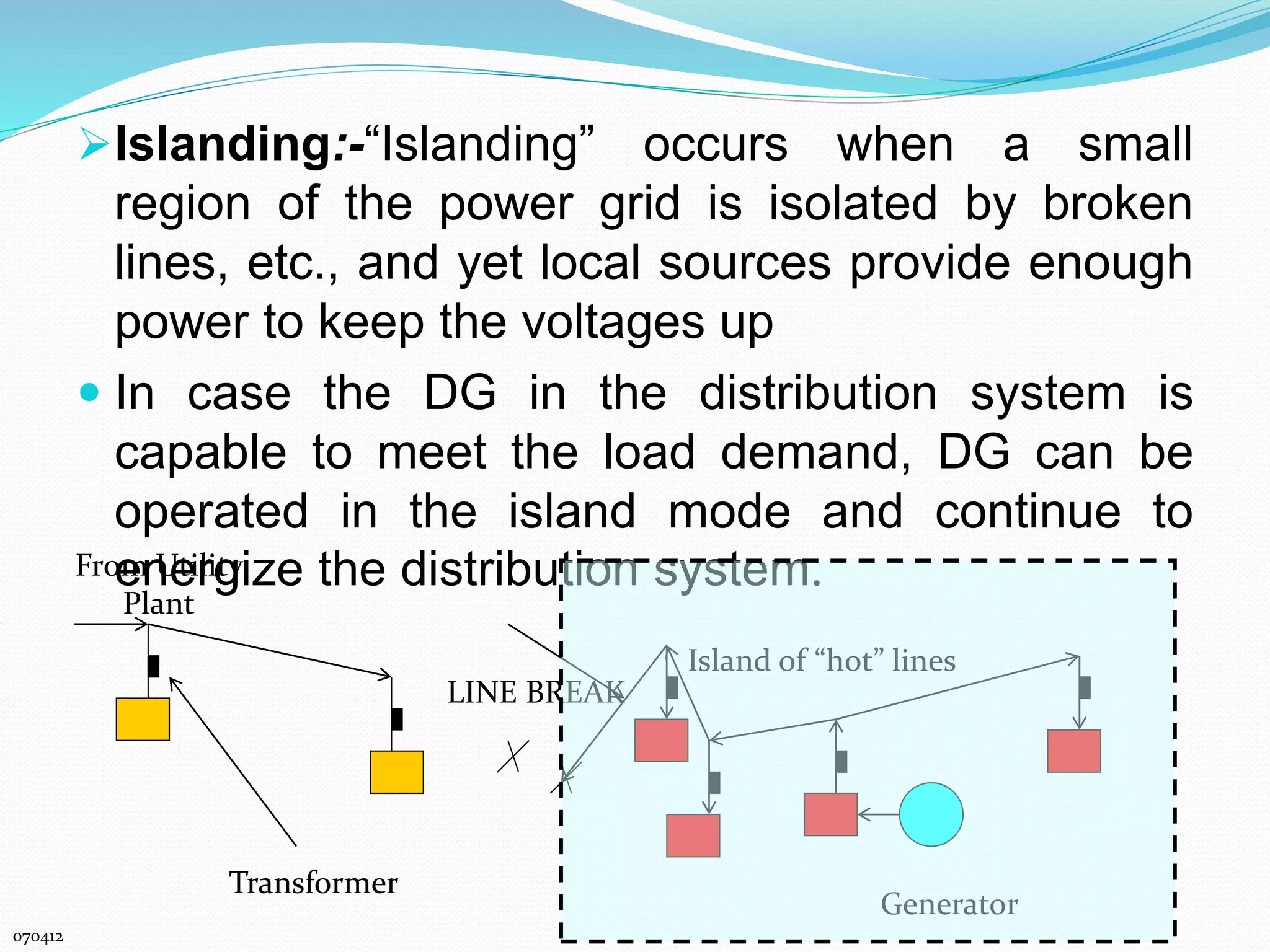
Islanding:-“Islanding” occurs when a small 
region of the power grid is isolated by broken 
lines, etc., and yet local sources provide enough 
power to keep the voltages up 
 In case the DG in the distribution system is 
capable to meet the load demand, DG can be 
operated in the island mode and continue to 
Froemn Uetirligtyi ze the distribution system. 
Plant 
070412 
LINE BREAK 
Island of “hot” lines 
Generator 
Transformer
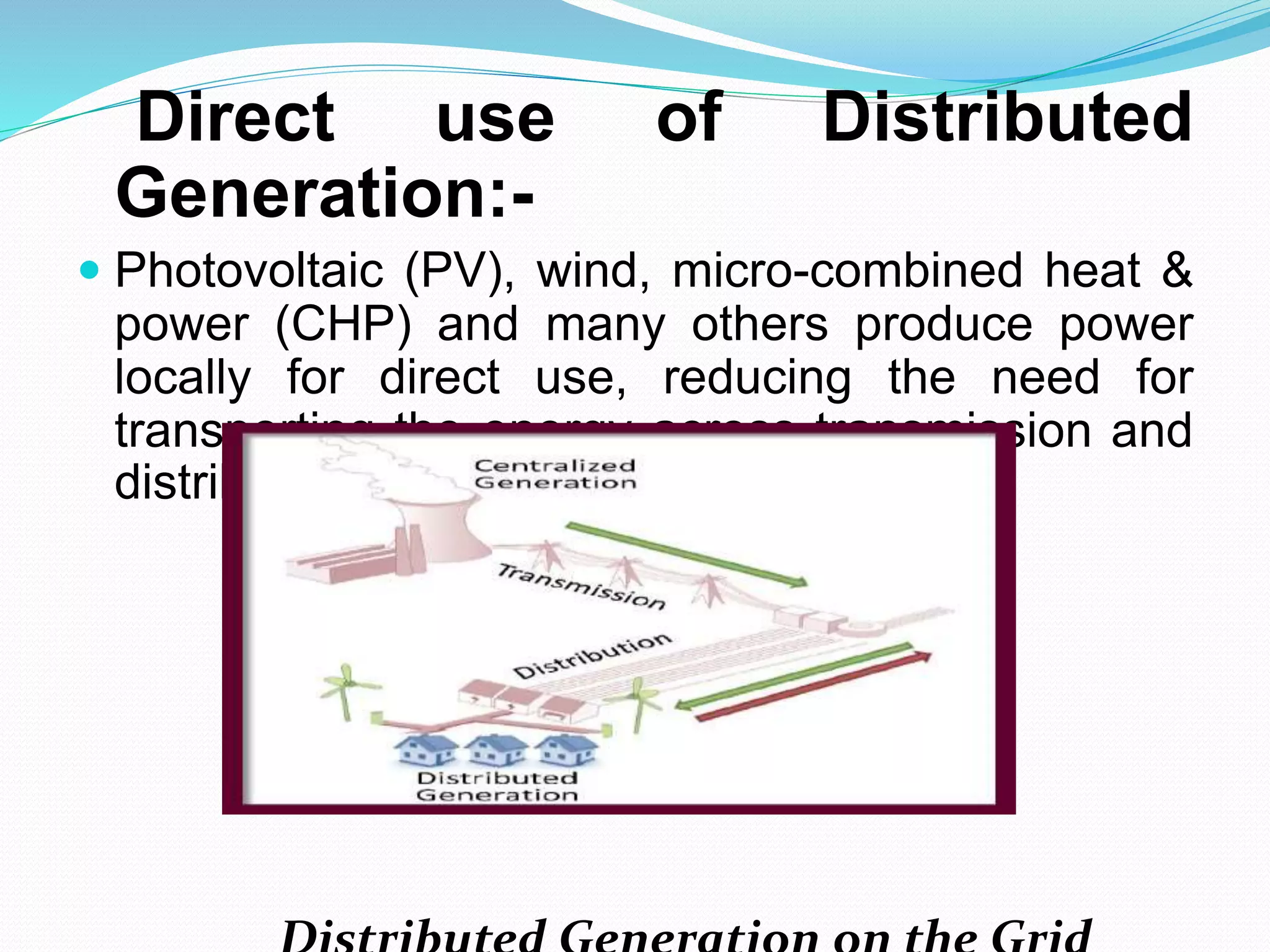
Direct use of Distributed 
Generation:- 
 Photovoltaic (PV), wind, micro-combined heat & 
power (CHP) and many others produce power 
locally for direct use, reducing the need for 
transporting the energy across transmission and 
distribution grids. 
Distributed Generation on the Grid
Advantages & Disadvantages 
 Distributed generation reduces the amount of 
energy lost in transmitting electricity because 
the electricity is generated very near where it 
is used, perhaps even in the same building. 
This also reduces the size and number of 
power lines that must be constructed. 
 Disadvantages of DG 
 Power Quality 
 Cost of Operation and Maintenance 
 Long Term Reliability of the Units 
 Interconnection
Conclusion 
 The distributed generation help us to reduce the 
cost of the transmission line and the transmission 
losses .distributed generation playing important 
role in the field of the electricity generation 
whereas Different issues related to power quality 
when DR is integrated with the existing power 
system has been discussed in the report .It can 
be concluded from this discussion that when 
interconnecting DR to the power system, these 
issues must be considered which could affect 
power quality and safety. Penetration of DR can 
be successfully integrated with the power system 
as long as the interconnection designs meet the 
basic requirements that consider not only power
References:- 
1. www.clarke-energy.com, retrieved 16 
September 2013 
2.http://www.forbes.com/sites/peterdetwiler/201 
2/12/26/solar-grid-parity-comes-to-spain/ 
3.http://oilprice.com/Latest-Energy-News/World- 
News/Spain-Achieves-Grid-Parity-for-Solar- 
Power .html 
4.Boyle, Godfrey. Renewable Energy, Second 
Edition. Oxford: Oxford University Press, 
2004, ISBN 0-19-26178-4. (my preferred text) 
5.http://www.forbes.com/sites/peter 
detwiler/2012/12/26/solar-grid-parity-comes-to-spain
THANK YOU

Distributed generation b 3

  • 1.
    Distributed Generation SUBMITTEDTO:- SUBMITTED BY:- Mr.inderpreet Singh Mr. Naresh Chand UIDNO-13MEL1007
  • 2.
    Introduction  Distributedgeneration in simple term can be defined as a small-scale generation. It is active power generating unit that is connected at distribution level.  IEEE defines the generation of electricity by facilities sufficiently smaller than central plants, so as to allow interconnection at nearly any point in the power system, as Distributed Resources.  Electric Power Research Institute (EPRI) defines distributed generation as generation from a few kilowatts up to 50 MW.  Distributed generation, also called on-site generation, distributed energy or district
  • 3.
     Most countriesgenerate electricity in large centralized facilities, such as fossil fuel (coal, gas powered), nuclear, large solar power plants or hydropower plants. These plants have excellent economies of scale, but usually transmit electricity long distances and can negatively affect the environment.  Distributed generation allows collection of energy from many sources and may give lower environmental impacts and improved security of supply.  Distributed generation reduces the amount of energy lost in transmitting electricity because the electricity is generated very near where it is used, perhaps even in the same building. This also
  • 4.
  • 5.
     DG asgeneration that is not centrally planned, centrally dispatched at present, usually connected to the distribution network, and smaller than 50-100 MW.  These generators are distributed throughout the power system closer to the loads as shown in the previous slide.  The DG penetration in the grid poses new challenges and problems to the network operators as these can have a significant impact on the system and equipment operations in terms of reliability, power quality, stability and safety for both customers and electricity supplier.
  • 6.
    Types of DistributedEnergy Resources Cogeneration:-Distributed cogeneration sources use steam turbines, natural gas-fired fuel cells, micro turbines or reciprocating engines to turn generators. The hot exhaust is then used for space or water heating, or to drive an absorptive chiller for cooling such as air-conditioning. Vehicle-to-grid:-Future generations of electric vehicles may have the ability to deliver power from the battery in a vehicle-to-grid into the grid when needed. An electric vehicle network could also be an important distributed generation resource.
  • 7.
    Solar panel Solarpanel:-Popular sources of power for distributed generation are solar heat collection panels and solar panels on the roofs of buildings or free-standing. Solar heating panels are used mostly for heating water and when the water is heated into steam it can effectively and economically used in steam turbines to produce electricity.
  • 8.
    Wind turbine Windturbine:-Another source is small wind turbines. These have low maintenance, and low pollution, however as with solar, wind energy is intermittent. Construction costs are higher than large power plants, except in very windy areas.
  • 9.
    Waste-to-energy:- Municipal solidwaste (MSW) and natural waste, such as sewage sludge, food waste and animal manure will decompose and discharge methane-containing gas that can be collected as used as fuel in gas turbines or micro turbines to produce electricity as a distributed energy resource. Cost factors:- Co generators are also more expensive per watt than central generators. They find favor because most buildings already burn fuels, and the cogeneration can extract more value from the fuel. Local production has no electricity transportation losses on long distance power lines or energy losses from the Joule effect in transformers where in general 8-15% of
  • 10.
    Modes of Power Generation DER systems may include the following technologies:-  Combined heat power (CHP)  Fuel cells  Micro combined heat and power (Micro CHP)  Micro turbines  Photovoltaic Systems  Reciprocating engines  Small Wind power systems  Tri generation
  • 11.
    Power Quality Issues:- A major issue related to interconnection of distributed resources onto the power grid is the potential impacts on the quality of power provided to other customers connected to the grid. Voltage Regulation:-Over-voltages due to reverse power flow: If the downstream DG output exceeds the downstream feeder load, there is an increase in feeder voltage with increasing distance. If the substation end voltage is held to near the maximum allowable value, voltages downstream on the feeder can exceed the acceptable range.
  • 12.
    DG Grounding Issue:-Agrid-connected DG, whether directly or through a transformer, should provide an effective ground to prevent un-faulted phases from over-voltage during a single-phase to ground fault. Proper grounding analysis of DG will ensure compatibility with grounding for both the primary and secondary power systems. Harmonic Distortion:-Voltage harmonics are virtually always present on the utility grid. Nonlinear loads, power electronic loads effects of the harmonics include overheating and equipment failure, faulty operation of protective devices, nuisance tripping of a sensitive load and interference with communication circuits’
  • 13.
    Islanding:-“Islanding” occurs whena small region of the power grid is isolated by broken lines, etc., and yet local sources provide enough power to keep the voltages up  In case the DG in the distribution system is capable to meet the load demand, DG can be operated in the island mode and continue to Froemn Uetirligtyi ze the distribution system. Plant 070412 LINE BREAK Island of “hot” lines Generator Transformer
  • 14.
    Direct use ofDistributed Generation:-  Photovoltaic (PV), wind, micro-combined heat & power (CHP) and many others produce power locally for direct use, reducing the need for transporting the energy across transmission and distribution grids. Distributed Generation on the Grid
  • 15.
    Advantages & Disadvantages  Distributed generation reduces the amount of energy lost in transmitting electricity because the electricity is generated very near where it is used, perhaps even in the same building. This also reduces the size and number of power lines that must be constructed.  Disadvantages of DG  Power Quality  Cost of Operation and Maintenance  Long Term Reliability of the Units  Interconnection
  • 16.
    Conclusion  Thedistributed generation help us to reduce the cost of the transmission line and the transmission losses .distributed generation playing important role in the field of the electricity generation whereas Different issues related to power quality when DR is integrated with the existing power system has been discussed in the report .It can be concluded from this discussion that when interconnecting DR to the power system, these issues must be considered which could affect power quality and safety. Penetration of DR can be successfully integrated with the power system as long as the interconnection designs meet the basic requirements that consider not only power
  • 17.
    References:- 1. www.clarke-energy.com,retrieved 16 September 2013 2.http://www.forbes.com/sites/peterdetwiler/201 2/12/26/solar-grid-parity-comes-to-spain/ 3.http://oilprice.com/Latest-Energy-News/World- News/Spain-Achieves-Grid-Parity-for-Solar- Power .html 4.Boyle, Godfrey. Renewable Energy, Second Edition. Oxford: Oxford University Press, 2004, ISBN 0-19-26178-4. (my preferred text) 5.http://www.forbes.com/sites/peter detwiler/2012/12/26/solar-grid-parity-comes-to-spain
  • 18.