Distributed Generation
ANSHUL SHRIVASTAVA
M.tech (Power Distribution with Specialization in
Smart Grid)
University of Petroleum & Energy Studies,
Dehradun
1
Introduction
 Perspectives on DG Benefits
– End-User Perspective
• Back Generation to Provide Improved Reliability
• Reduce Energy Bill
• Participation in the Competitive Power Market
– Distribution Utility Perspective
• Transmission & Distribution Relief
• Hedge Against of Uncertain Load Growth
• Hedge Against Price Spike
– Commercial Power Producer Perspective
• Selling Power or Ancillary Service in the Deregulated Market
• Integrated Resource Planning
2
Introduction
 Distributed generation (DG), also known as on-site
generation, distributed resources (DR), distributed energy
resources (DER) or dispersed power (DP) is the use of
small-scale power generation technologies located close
to the load being served
Energy Companies
Equipment Suppliers,
Regulators,
Energy Users
Financial and Supporting Companies
3
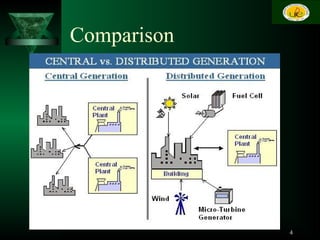
Comparison
4
DG Technologies
 Reciprocating Engine Genset
– The Least Expensive DG Technology
– High Nox and Sox Emission. This Severely Limits the
Number of Hours the Units, Particularly Diesels, May
Operate per Year.
– Natural Gas-Fire Engine Produce Fewer Emission.
However, the Natural Gas Price is Unpredictable.
5
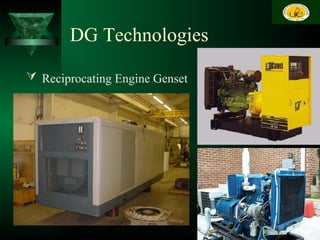
DG Technologies
 Reciprocating Engine Genset
6
DG Technologies
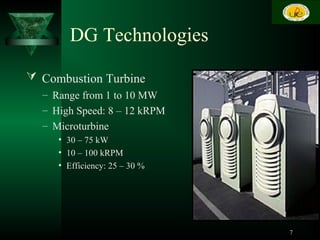
 Combustion Turbine
– Range from 1 to 10 MW
– High Speed: 8 – 12 kRPM
– Microturbine
• 30 – 75 kW
• 10 – 100 kRPM
• Efficiency: 25 – 30 %
7
DG Technologies
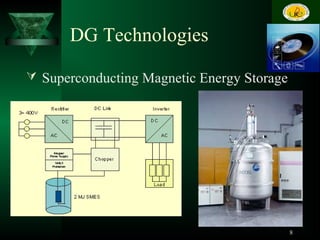
 Superconducting Magnetic Energy Storage
8
DG Technologies
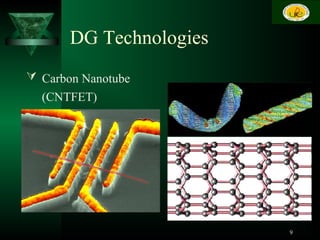
 Carbon Nanotube
(CNTFET)
9
DG Technologies
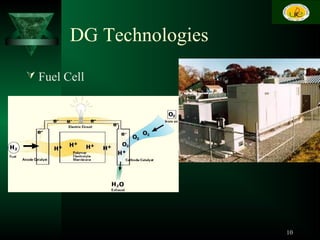
 Fuel Cell
10
DG Technologies
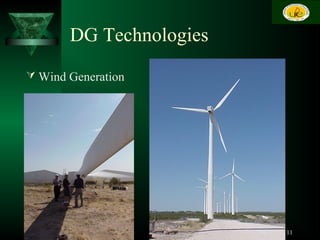
 Wind Generation
11
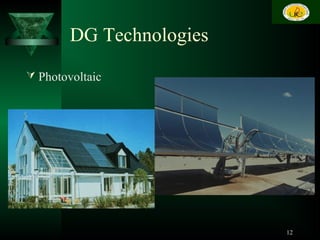
DG Technologies
 Photovoltaic
12
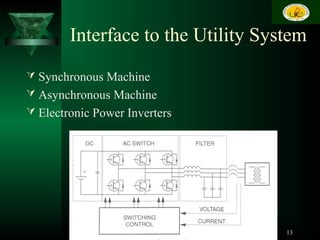
Interface to the Utility System
 Synchronous Machine
 Asynchronous Machine
 Electronic Power Inverters
13
Power Quality Issues
 Sustained Interruptions
 Voltage Regulation
 Voltage Ride Through
 Harmonics
 Voltage Sags
 Load Following
 Power Variation
 Misfiring of Reciprocating Engines
14
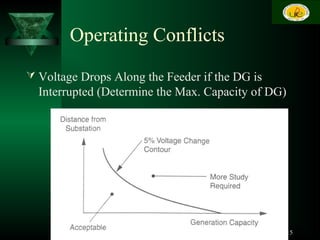
Operating Conflicts
 Voltage Drops Along the Feeder if the DG is
Interrupted (Determine the Max. Capacity of DG)
15
Operating Conflicts
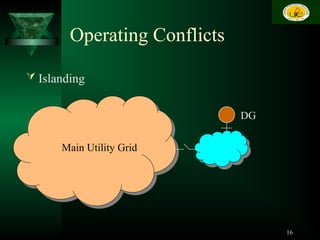
 Islanding
Main Utility Grid
DG
16
Operating Conflicts
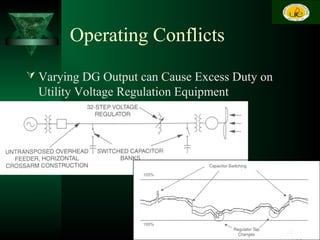
 Varying DG Output can Cause Excess Duty on
Utility Voltage Regulation Equipment
17
Operating Conflicts
 Transformer Connections
– Grounded Y-Y Connection
• No Phase Shift
• Less Concern for Ferroresonance
• Allow DG to Feed All Types of Faults on the Utility System
• Back Feed of the Triplen Harmonic
• Should Insert Ground Impedance to Limit the Current
18
DG on Low-Voltage
Distribution Networks
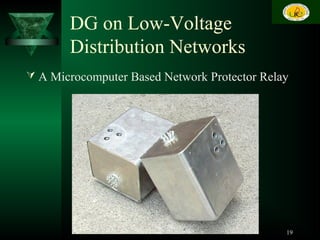
 A Microcomputer Based Network Protector Relay
19
DG on Low-Voltage
Distribution Networks
 Operation of A Microcomputer Based Network
Protector Relay
– Network protector relays are used to monitor and
control the power flow of low voltage AC to secondary
network systems
– The purpose of the network protector is to prevent the
system from backfeeding and initiate automatic
reclosing when the system returns to normal
20
Benefits of Decentralized
Generation
No high peak load shortages
Reduced high transmission and distribution
losses
Linking remote and inaccessible areas
Faster response to new power demands
Improved supply reliability and power
management
21
 Disadvantages of DG
– Power Quality
– Cost of Operation and Maintenance
– Long Term Reliability of the Units
– Interconnection
22
Distributed Generation
Applications
 Continuous Power
 Combined Heat and Power (CHP)
 Peaking Power
 Green Power
 Premium Power
 Emergency Power System
 Standby Power System
 True Premium Power System
 Transmission and Distribution Deferral
 Ancillary Service Power
23
Identification of DG
Installation
Evaluation of distributed generation
opportunities in end-use markets
Assessments of distributed generation
technologies
Identification of potential sites for distributed
generation applications
Different price and Performance parameters
Feasibility studies for distributed generation
projects 24
Role of Decentralized
Generation in Smart Grid
 Natural Extensions of Smart Grid
 Better System Management
 Additional Revenue Stream
 Less Investment and less transportation cost
 Cutting line losses
 Ease of Control from Islanding and anti islanding
Scheme
 Reduces carbon emission and thus supports
sustainable livelihood.
 Automatic Resynchronization. 25
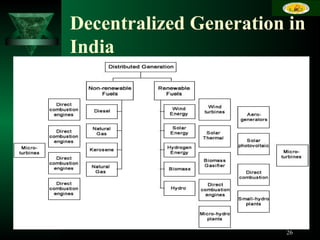
Decentralized Generation in
India
26
Government Policy of India
 The Electricity Act, 2003 has given a thrust to distributed generation
particularly in the context of rural electrification. The Act specifies
distributed generation and supply through stand-alone conventional and
renewable energy systems.
 The National Electricity Policy notified on 12 February 2005 recommends
under the Rural Electrification component, that to provide a reliable rural
electrification system, wherever conventional grid is not feasible,
decentralized distributed generation facilities (using conventional or non-
conventional sources of energy) together with local distribution network be
provided.
 Two specific schemes, the Rajiv Gandhi Grameen Vidyutikaran Yojna and
the Remote Village Electrification Scheme, will provide up to 90% capital
subsidy for rural electrification projects using decentralized distributed
generation options based on conventional and non-conventional fuels.
27
28

Distributed Generation

  • 1.
    Distributed Generation ANSHUL SHRIVASTAVA M.tech(Power Distribution with Specialization in Smart Grid) University of Petroleum & Energy Studies, Dehradun 1
  • 2.
    Introduction  Perspectives onDG Benefits – End-User Perspective • Back Generation to Provide Improved Reliability • Reduce Energy Bill • Participation in the Competitive Power Market – Distribution Utility Perspective • Transmission & Distribution Relief • Hedge Against of Uncertain Load Growth • Hedge Against Price Spike – Commercial Power Producer Perspective • Selling Power or Ancillary Service in the Deregulated Market • Integrated Resource Planning 2
  • 3.
    Introduction  Distributed generation(DG), also known as on-site generation, distributed resources (DR), distributed energy resources (DER) or dispersed power (DP) is the use of small-scale power generation technologies located close to the load being served Energy Companies Equipment Suppliers, Regulators, Energy Users Financial and Supporting Companies 3
  • 4.
  • 5.
    DG Technologies  ReciprocatingEngine Genset – The Least Expensive DG Technology – High Nox and Sox Emission. This Severely Limits the Number of Hours the Units, Particularly Diesels, May Operate per Year. – Natural Gas-Fire Engine Produce Fewer Emission. However, the Natural Gas Price is Unpredictable. 5
  • 6.
  • 7.
    DG Technologies  CombustionTurbine – Range from 1 to 10 MW – High Speed: 8 – 12 kRPM – Microturbine • 30 – 75 kW • 10 – 100 kRPM • Efficiency: 25 – 30 % 7
  • 8.
    DG Technologies  SuperconductingMagnetic Energy Storage 8
  • 9.
    DG Technologies  CarbonNanotube (CNTFET) 9
  • 10.
  • 11.
  • 12.
  • 13.
    Interface to theUtility System  Synchronous Machine  Asynchronous Machine  Electronic Power Inverters 13
  • 14.
    Power Quality Issues Sustained Interruptions  Voltage Regulation  Voltage Ride Through  Harmonics  Voltage Sags  Load Following  Power Variation  Misfiring of Reciprocating Engines 14
  • 15.
    Operating Conflicts  VoltageDrops Along the Feeder if the DG is Interrupted (Determine the Max. Capacity of DG) 15
  • 16.
  • 17.
    Operating Conflicts  VaryingDG Output can Cause Excess Duty on Utility Voltage Regulation Equipment 17
  • 18.
    Operating Conflicts  TransformerConnections – Grounded Y-Y Connection • No Phase Shift • Less Concern for Ferroresonance • Allow DG to Feed All Types of Faults on the Utility System • Back Feed of the Triplen Harmonic • Should Insert Ground Impedance to Limit the Current 18
  • 19.
    DG on Low-Voltage DistributionNetworks  A Microcomputer Based Network Protector Relay 19
  • 20.
    DG on Low-Voltage DistributionNetworks  Operation of A Microcomputer Based Network Protector Relay – Network protector relays are used to monitor and control the power flow of low voltage AC to secondary network systems – The purpose of the network protector is to prevent the system from backfeeding and initiate automatic reclosing when the system returns to normal 20
  • 21.
    Benefits of Decentralized Generation Nohigh peak load shortages Reduced high transmission and distribution losses Linking remote and inaccessible areas Faster response to new power demands Improved supply reliability and power management 21
  • 22.
     Disadvantages ofDG – Power Quality – Cost of Operation and Maintenance – Long Term Reliability of the Units – Interconnection 22
  • 23.
    Distributed Generation Applications  ContinuousPower  Combined Heat and Power (CHP)  Peaking Power  Green Power  Premium Power  Emergency Power System  Standby Power System  True Premium Power System  Transmission and Distribution Deferral  Ancillary Service Power 23
  • 24.
    Identification of DG Installation Evaluationof distributed generation opportunities in end-use markets Assessments of distributed generation technologies Identification of potential sites for distributed generation applications Different price and Performance parameters Feasibility studies for distributed generation projects 24
  • 25.
    Role of Decentralized Generationin Smart Grid  Natural Extensions of Smart Grid  Better System Management  Additional Revenue Stream  Less Investment and less transportation cost  Cutting line losses  Ease of Control from Islanding and anti islanding Scheme  Reduces carbon emission and thus supports sustainable livelihood.  Automatic Resynchronization. 25
  • 26.
  • 27.
    Government Policy ofIndia  The Electricity Act, 2003 has given a thrust to distributed generation particularly in the context of rural electrification. The Act specifies distributed generation and supply through stand-alone conventional and renewable energy systems.  The National Electricity Policy notified on 12 February 2005 recommends under the Rural Electrification component, that to provide a reliable rural electrification system, wherever conventional grid is not feasible, decentralized distributed generation facilities (using conventional or non- conventional sources of energy) together with local distribution network be provided.  Two specific schemes, the Rajiv Gandhi Grameen Vidyutikaran Yojna and the Remote Village Electrification Scheme, will provide up to 90% capital subsidy for rural electrification projects using decentralized distributed generation options based on conventional and non-conventional fuels. 27
  • 28.