PRESENTED BY
Shashikumar v
ROLL/USN NO : 52
MAXIMUM POWER
POINT
TRACKING
R V COLLEGE OF ENGINEERING
Department of electronic and communication
Objective
What is a solar cell ?
a solar cell converts optical energy directly into electrical energy.
It is essentially a semiconductor device fabricated in a manner which generates a voltage
when solar radiation falls on it.
Efficiency of solar cell is less, it only converts 30-40% of energy incindent on it to electrical energy.
Need to use solar energy : pollution free
maintenance free
silent operation
long life time.
Efficiency of solar cell increased by a technique called maximum power point tracking, by installing this
technique we can get additional 20-30% of extra energy.
Methodology
Phase 1 :
Introduction to maximum power point tracking (MPPT).
Need of MPPT.
Different types of techniques for MPPT.
perturb and observe technique (P&O)
incremental conductance (INC).
Phase 2 :
Introduction to charge controller and and their need for MPPT.
Present and upcoming research in finding most efficient MPPT technique.
Modelling of standalone pv system.
Introduction
What is MPPT ?
It is an electronic system that operates the photovoltaic modules in a manner to extract the maximum
power from the system.
What is maximum power point ?
It is a operating point at which maximum power can be extracted from the system.Usually represented as
MPP.
The output of solar module is a function of solar irradiance, temperature.
Generally MPPT is installed in between PV system and load.Coupling to the load for maximum power
transfer may required either providing a higher voltage at lower current or lower voltage at higher current.
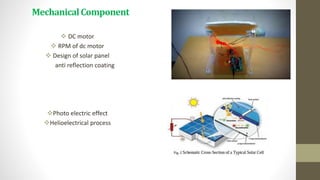
MechanicalComponent
 DC motor
 RPM of dc motor
 Design of solar panel
anti reflection coating
Photo electric effect
Helioelectrical process
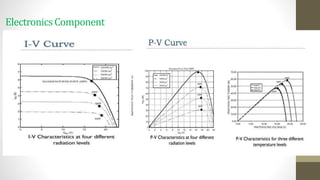
ElectronicsComponent
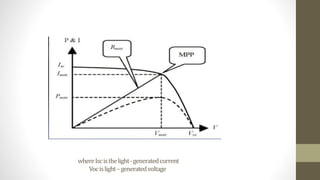
whereIscisthelight-generatedcurrent
Vocislight–generatedvoltage
Perturbandobserve(hillclimbing)
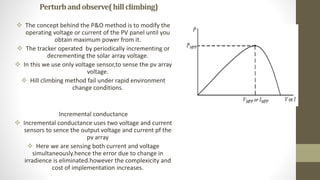
 The concept behind the P&O method is to modify the
operating voltage or current of the PV panel until you
obtain maximum power from it.
 The tracker operated by periodically incrementing or
decrementing the solar array voltage.
 In this we use only voltage sensor,to sense the pv array
voltage.
 Hill climbing method fail under rapid environment
change conditions.
Incremental conductance
 Incremental conductance uses two voltage and current
sensors to sence the output voltage and current pf the
pv array
 Here we are sensing both current and voltage
simultaneously.hence the error due to change in
irradience is eliminated.however the complexicity and
cost of implementation increases.
MathematicalComponent
Incremental conductance
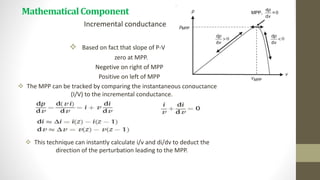
 Based on fact that slope of P-V
zero at MPP.
Negetive on right of MPP
Positive on left of MPP
 The MPP can be tracked by comparing the instantaneous conductance
(I/V) to the incremental conductance.
 This technique can instantly calculate i/v and di/dv to deduct the
direction of the perturbation leading to the MPP.
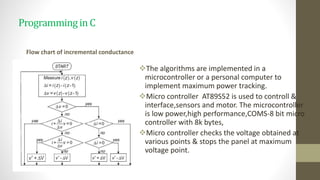
Programmingin C
Flow chart of incremental conductance
The algorithms are implemented in a
microcontroller or a personal computer to
implement maximum power tracking.
Micro controller AT89S52 is used to controll &
interface,sensors and motor. The microcontroller
is low power,high performance,COMS-8 bit micro
controller with 8k bytes,
Micro controller checks the voltage obtained at
various points & stops the panel at maximum
voltage point.
Reference
• Y.Kou,et.AL.,”Maximum Power Point tracking controller for Photovoltaic energy conversion
system,”IEEE Trans.Ind .Electron.,Vol.48,pp.594-601,2001.
• S.Jain and V.Agarval,”A New Algorithm for Rapid Tracking of Approximate Maximum Power
point in photovoltaic systems ,”IEEE power Electronic Letter.,Vol.2,pp.16-19,m.2004.
• J.A.Jiang et.AL.,”Maximum power tracking for photovoltaic power systems,” Tamkang
Journal of Science and Engineering, Vol.8, No. 2,pp . 147-153,2005.
• E.Koutroulis;et.al,” Development of a microcontroller based photovoltaic maximum power
tracking control system”,IEEE trans.On power Electron., Vol. 16No. 1, pp. 46-54,2001.
• R.Faranda and S.Leva,”Energy Comparision of MPPT techniques for PV Systems ,”WSEAS
Transaction on Power Systems “ Vol.3, pp.446-455.
THANK YOU

maximum power point tracking (mppt)

  • 1.
    PRESENTED BY Shashikumar v ROLL/USNNO : 52 MAXIMUM POWER POINT TRACKING R V COLLEGE OF ENGINEERING Department of electronic and communication
  • 2.
    Objective What is asolar cell ? a solar cell converts optical energy directly into electrical energy. It is essentially a semiconductor device fabricated in a manner which generates a voltage when solar radiation falls on it. Efficiency of solar cell is less, it only converts 30-40% of energy incindent on it to electrical energy. Need to use solar energy : pollution free maintenance free silent operation long life time. Efficiency of solar cell increased by a technique called maximum power point tracking, by installing this technique we can get additional 20-30% of extra energy.
  • 3.
    Methodology Phase 1 : Introductionto maximum power point tracking (MPPT). Need of MPPT. Different types of techniques for MPPT. perturb and observe technique (P&O) incremental conductance (INC). Phase 2 : Introduction to charge controller and and their need for MPPT. Present and upcoming research in finding most efficient MPPT technique. Modelling of standalone pv system.
  • 4.
    Introduction What is MPPT? It is an electronic system that operates the photovoltaic modules in a manner to extract the maximum power from the system. What is maximum power point ? It is a operating point at which maximum power can be extracted from the system.Usually represented as MPP. The output of solar module is a function of solar irradiance, temperature. Generally MPPT is installed in between PV system and load.Coupling to the load for maximum power transfer may required either providing a higher voltage at lower current or lower voltage at higher current.
  • 5.
    MechanicalComponent  DC motor RPM of dc motor  Design of solar panel anti reflection coating Photo electric effect Helioelectrical process
  • 6.
  • 7.
  • 8.
    Perturbandobserve(hillclimbing)  The conceptbehind the P&O method is to modify the operating voltage or current of the PV panel until you obtain maximum power from it.  The tracker operated by periodically incrementing or decrementing the solar array voltage.  In this we use only voltage sensor,to sense the pv array voltage.  Hill climbing method fail under rapid environment change conditions. Incremental conductance  Incremental conductance uses two voltage and current sensors to sence the output voltage and current pf the pv array  Here we are sensing both current and voltage simultaneously.hence the error due to change in irradience is eliminated.however the complexicity and cost of implementation increases.
  • 9.
    MathematicalComponent Incremental conductance  Basedon fact that slope of P-V zero at MPP. Negetive on right of MPP Positive on left of MPP  The MPP can be tracked by comparing the instantaneous conductance (I/V) to the incremental conductance.  This technique can instantly calculate i/v and di/dv to deduct the direction of the perturbation leading to the MPP.
  • 10.
    Programmingin C Flow chartof incremental conductance The algorithms are implemented in a microcontroller or a personal computer to implement maximum power tracking. Micro controller AT89S52 is used to controll & interface,sensors and motor. The microcontroller is low power,high performance,COMS-8 bit micro controller with 8k bytes, Micro controller checks the voltage obtained at various points & stops the panel at maximum voltage point.
  • 11.
    Reference • Y.Kou,et.AL.,”Maximum PowerPoint tracking controller for Photovoltaic energy conversion system,”IEEE Trans.Ind .Electron.,Vol.48,pp.594-601,2001. • S.Jain and V.Agarval,”A New Algorithm for Rapid Tracking of Approximate Maximum Power point in photovoltaic systems ,”IEEE power Electronic Letter.,Vol.2,pp.16-19,m.2004. • J.A.Jiang et.AL.,”Maximum power tracking for photovoltaic power systems,” Tamkang Journal of Science and Engineering, Vol.8, No. 2,pp . 147-153,2005. • E.Koutroulis;et.al,” Development of a microcontroller based photovoltaic maximum power tracking control system”,IEEE trans.On power Electron., Vol. 16No. 1, pp. 46-54,2001. • R.Faranda and S.Leva,”Energy Comparision of MPPT techniques for PV Systems ,”WSEAS Transaction on Power Systems “ Vol.3, pp.446-455.
  • 12.