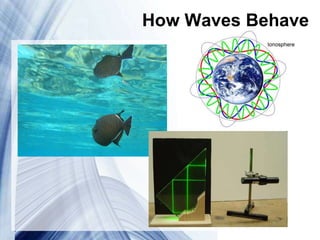
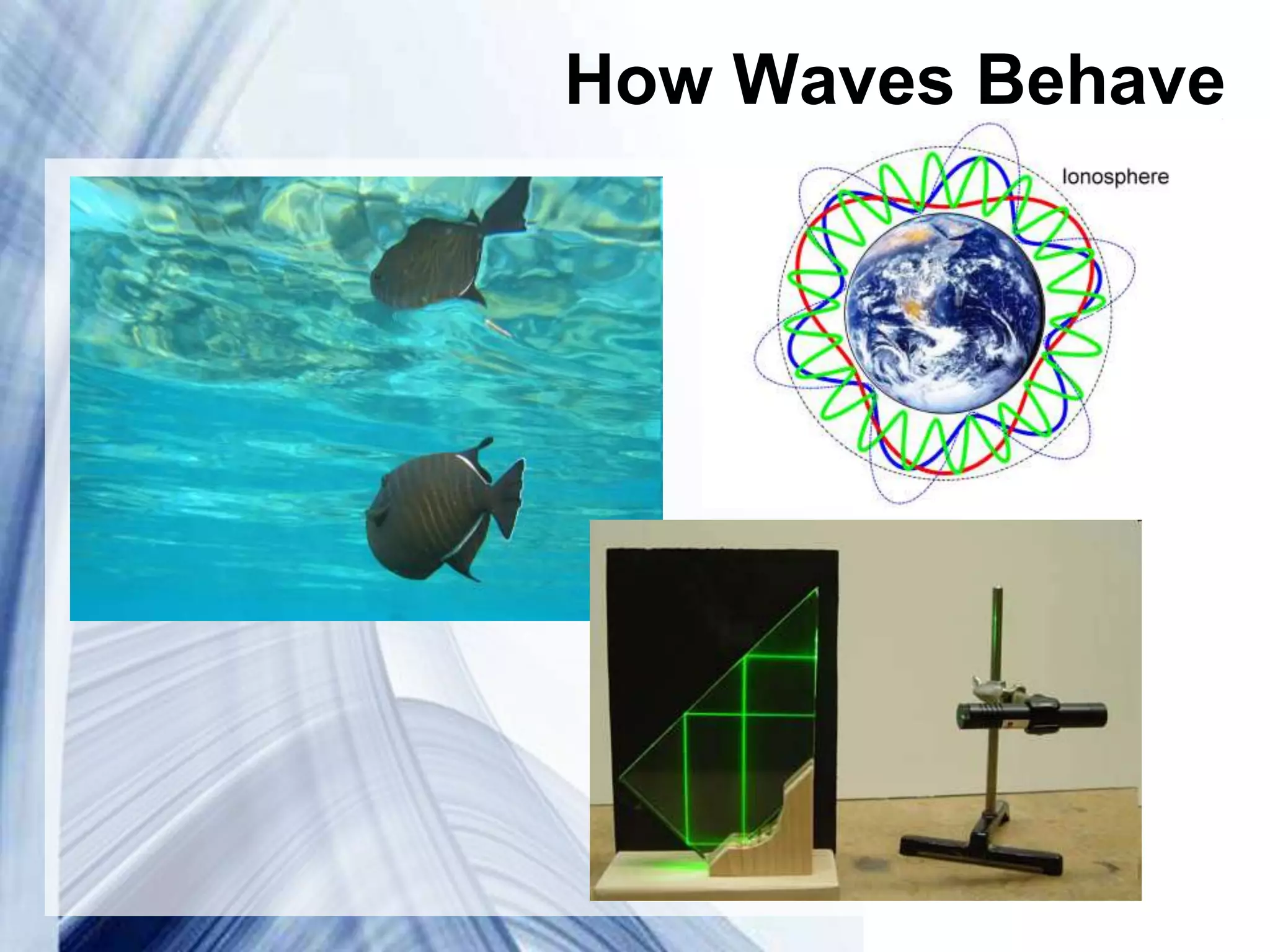
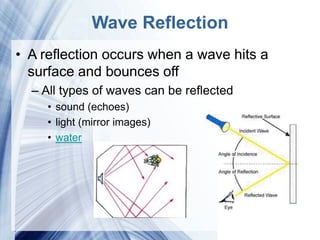
How Waves Behave


Powerpoint Templates
Wave Reflection
• A reflection occurs when a wave hits a
  surface and bounces off
  – All types of waves can be reflected
     • sound (echoes)
     • light (mirror images)
     • water


                     Powerpoint Templates
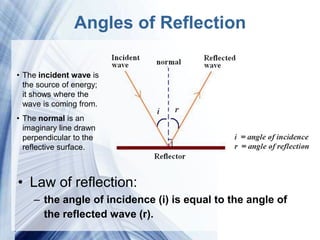
Angles of Reflection

• The incident wave is
  the source of energy;
  it shows where the
  wave is coming from.
• The normal is an
  imaginary line drawn
  perpendicular to the
  reflective surface.


• Law of reflection:
    – the angle of incidence (i) is equal to the angle of
      the reflected wave (r).
                          Powerpoint Templates
Reflection and Sight

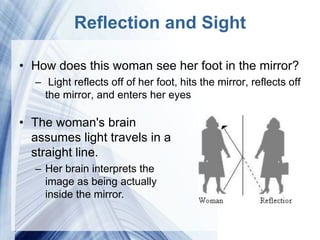
• How does this woman see her foot in the mirror?
  – Light reflects off of her foot, hits the mirror, reflects off
    the mirror, and enters her eyes

• The woman's brain
  assumes light travels in a
  straight line.
  – Her brain interprets the
    image as being actually
    inside the mirror.

                      Powerpoint Templates
Refraction
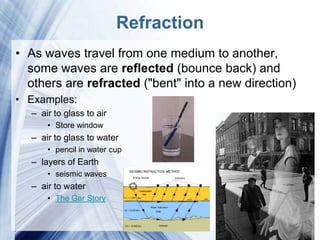
• As waves travel from one medium to another,
  some waves are reflected (bounce back) and
  others are refracted ("bent" into a new direction)
• Examples:
  – air to glass to air
      • Store window
  – air to glass to water
      • pencil in water cup
  – layers of Earth
      • seismic waves
  – air to water
      • The Gar Story


                            Powerpoint Templates
Visualizations of Refraction
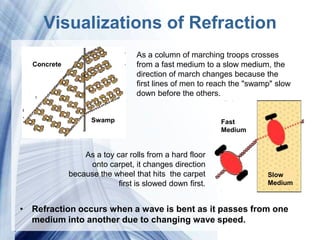
                                 As a column of marching troops crosses
  Concrete                       from a fast medium to a slow medium, the
                                 direction of march changes because the
                                 first lines of men to reach the "swamp" slow
                                 down before the others.


                   Swamp                                 Fast
                                                         Medium


                 As a toy car rolls from a hard floor
                  onto carpet, it changes direction
             because the wheel that hits the carpet                   Slow
                           first is slowed down first.                Medium


• Refraction occurs when a wave is bent as it passes from one
  medium into another due to changing wave speed.
                            Powerpoint Templates
Direction of Refraction

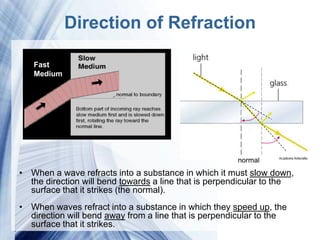
   Fast
   Medium


                                                      normal
• When a wave refracts into a substance in which it must slow down,
  the direction will bend towards a line that is perpendicular to the
  surface that it strikes (the normal).
• When waves refract into a substance in which they speed up, the
  direction will bend away from a line that is perpendicular to the
  surface that it strikes. Powerpoint Templates
Refraction
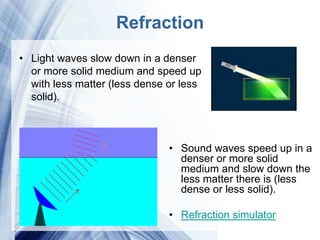
• Light waves slow down in a denser
  or more solid medium and speed up
  with less matter (less dense or less
  solid).


                                 • Sound waves speed up in a
                                   denser or more solid
                                   medium and slow down the
                                   less matter there is (less
                                   dense or less solid).

                                 • Refraction simulator
                     Powerpoint Templates
Mirage
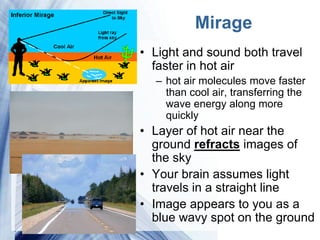
    • Light and sound both travel
      faster in hot air
         – hot air molecules move faster
           than cool air, transferring the
           wave energy along more
           quickly
    • Layer of hot air near the
      ground refracts images of
      the sky
    • Your brain assumes light
      travels in a straight line
    • Image appears to you as a
      blue wavy spot on the ground
Powerpoint Templates
Diffraction
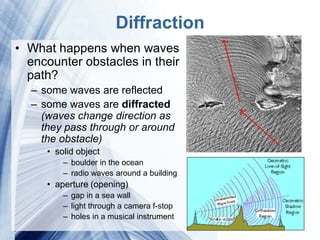
• What happens when waves
  encounter obstacles in their
  path?
  – some waves are reflected
  – some waves are diffracted
    (waves change direction as
    they pass through or around
    the obstacle)
     • solid object
         – boulder in the ocean
         – radio waves around a building
     • aperture (opening)
         – gap in a sea wall
         – light through a camera f-stop
         – holes in a musical instrument
                          Powerpoint Templates
Diffraction Around an Object
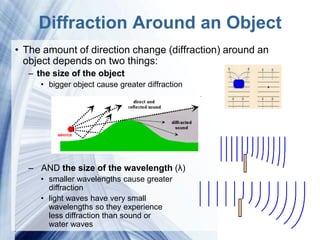
• The amount of direction change (diffraction) around an
  object depends on two things:
  – the size of the object
     • bigger object cause greater diffraction


  – AND the size of the wavelength (λ)
     • smaller wavelengths cause greater
       diffraction
     • light waves have very small
       wavelengths so they experience
       less diffraction than sound or
       water waves           Powerpoint Templates
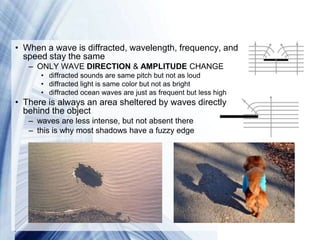
• When a wave is diffracted, wavelength, frequency, and
  speed stay the same
   – ONLY WAVE DIRECTION & AMPLITUDE CHANGE
      • diffracted sounds are same pitch but not as loud
      • diffracted light is same color but not as bright
      • diffracted ocean waves are just as frequent but less high
• There is always an area sheltered by waves directly
  behind the object
   – waves are less intense, but not absent there
   – this is why most shadows have a fuzzy edge


                               Powerpoint Templates
Diffraction Through an Aperture
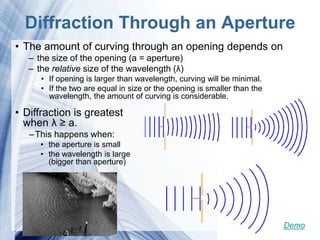
• The amount of curving through an opening depends on
   – the size of the opening (a = aperture)
   – the relative size of the wavelength (λ)
      • If opening is larger than wavelength, curving will be minimal.
      • If the two are equal in size or the opening is smaller than the
        wavelength, the amount of curving is considerable.

• Diffraction is greatest
  when λ ≥ a.
   – This happens when:
      • the aperture is small
      • the wavelength is large
        (bigger than aperture)


                             Powerpoint Templates                         Demo
Useful Diffraction
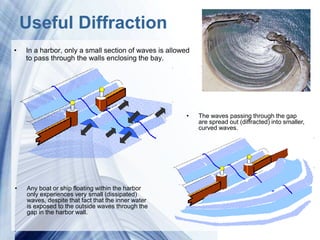
•   In a harbor, only a small section of waves is allowed
    to pass through the walls enclosing the bay.


                                                        •   The waves passing through the gap
                                                            are spread out (diffracted) into smaller,
                                                            curved waves.


•   Any boat or ship floating within the harbor
    only experiences very small (dissipated)
    waves, despite that fact that the inner water
    is exposed to the outside waves through the
    gap in the harbor wall.

                                      Powerpoint Templates
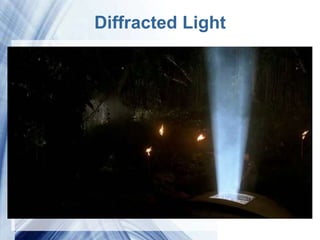
Diffracted Light


   Powerpoint Templates
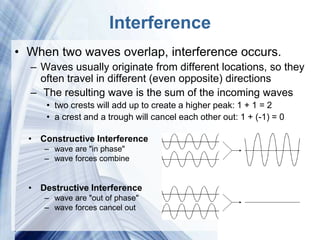
Interference
• When two waves overlap, interference occurs.
  – Waves usually originate from different locations, so they
    often travel in different (even opposite) directions
  – The resulting wave is the sum of the incoming waves
      • two crests will add up to create a higher peak: 1 + 1 = 2
      • a crest and a trough will cancel each other out: 1 + (-1) = 0

  • Constructive Interference
     – wave are "in phase"
     – wave forces combine


  • Destructive Interference
     – wave are "out of phase"
     – wave forces cancel out

                         Powerpoint Templates
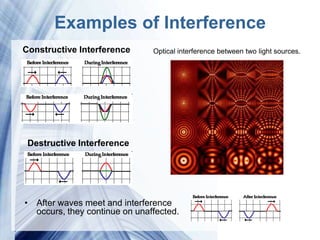
Examples of Interference
Constructive Interference      Optical interference between two light sources.


 Destructive Interference


• After waves meet and interference
  occurs, they continue on unaffected.
                       Powerpoint Templates
Resonance
• Every object has a natural frequency at which it vibrates
    – This is determined by:
        • the object's size & shape
        • mass of the object
        • material the object is made out of


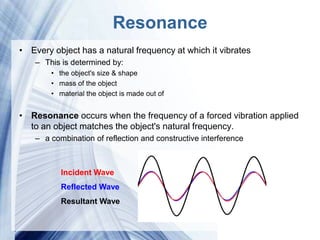
• Resonance occurs when the frequency of a forced vibration applied
  to an object matches the object's natural frequency.
    – a combination of reflection and constructive interference


           Incident Wave
           Reflected Wave
           Resultant Wave

                              Powerpoint Templates
Resonance - a destructive force!

• Tacoma Bridge

• Wine Glass Breaking

• Starfield Concert Floor Collapse


                Powerpoint Templates

How Waves Behave

  • 1.
  • 2.
    Wave Reflection • Areflection occurs when a wave hits a surface and bounces off – All types of waves can be reflected • sound (echoes) • light (mirror images) • water Powerpoint Templates
  • 3.
    Angles of Reflection •The incident wave is the source of energy; it shows where the wave is coming from. • The normal is an imaginary line drawn perpendicular to the reflective surface. • Law of reflection: – the angle of incidence (i) is equal to the angle of the reflected wave (r). Powerpoint Templates
  • 4.
    Reflection and Sight •How does this woman see her foot in the mirror? – Light reflects off of her foot, hits the mirror, reflects off the mirror, and enters her eyes • The woman's brain assumes light travels in a straight line. – Her brain interprets the image as being actually inside the mirror. Powerpoint Templates
  • 5.
    Refraction • As wavestravel from one medium to another, some waves are reflected (bounce back) and others are refracted ("bent" into a new direction) • Examples: – air to glass to air • Store window – air to glass to water • pencil in water cup – layers of Earth • seismic waves – air to water • The Gar Story Powerpoint Templates
  • 6.
    Visualizations of Refraction As a column of marching troops crosses Concrete from a fast medium to a slow medium, the direction of march changes because the first lines of men to reach the "swamp" slow down before the others. Swamp Fast Medium As a toy car rolls from a hard floor onto carpet, it changes direction because the wheel that hits the carpet Slow first is slowed down first. Medium • Refraction occurs when a wave is bent as it passes from one medium into another due to changing wave speed. Powerpoint Templates
  • 7.
    Direction of Refraction Fast Medium normal • When a wave refracts into a substance in which it must slow down, the direction will bend towards a line that is perpendicular to the surface that it strikes (the normal). • When waves refract into a substance in which they speed up, the direction will bend away from a line that is perpendicular to the surface that it strikes. Powerpoint Templates
  • 8.
    Refraction • Light wavesslow down in a denser or more solid medium and speed up with less matter (less dense or less solid). • Sound waves speed up in a denser or more solid medium and slow down the less matter there is (less dense or less solid). • Refraction simulator Powerpoint Templates
  • 9.
    Mirage • Light and sound both travel faster in hot air – hot air molecules move faster than cool air, transferring the wave energy along more quickly • Layer of hot air near the ground refracts images of the sky • Your brain assumes light travels in a straight line • Image appears to you as a blue wavy spot on the ground Powerpoint Templates
  • 10.
    Diffraction • What happenswhen waves encounter obstacles in their path? – some waves are reflected – some waves are diffracted (waves change direction as they pass through or around the obstacle) • solid object – boulder in the ocean – radio waves around a building • aperture (opening) – gap in a sea wall – light through a camera f-stop – holes in a musical instrument Powerpoint Templates
  • 11.
    Diffraction Around anObject • The amount of direction change (diffraction) around an object depends on two things: – the size of the object • bigger object cause greater diffraction – AND the size of the wavelength (λ) • smaller wavelengths cause greater diffraction • light waves have very small wavelengths so they experience less diffraction than sound or water waves Powerpoint Templates
  • 12.
    • When awave is diffracted, wavelength, frequency, and speed stay the same – ONLY WAVE DIRECTION & AMPLITUDE CHANGE • diffracted sounds are same pitch but not as loud • diffracted light is same color but not as bright • diffracted ocean waves are just as frequent but less high • There is always an area sheltered by waves directly behind the object – waves are less intense, but not absent there – this is why most shadows have a fuzzy edge Powerpoint Templates
  • 13.
    Diffraction Through anAperture • The amount of curving through an opening depends on – the size of the opening (a = aperture) – the relative size of the wavelength (λ) • If opening is larger than wavelength, curving will be minimal. • If the two are equal in size or the opening is smaller than the wavelength, the amount of curving is considerable. • Diffraction is greatest when λ ≥ a. – This happens when: • the aperture is small • the wavelength is large (bigger than aperture) Powerpoint Templates Demo
  • 14.
    Useful Diffraction • In a harbor, only a small section of waves is allowed to pass through the walls enclosing the bay. • The waves passing through the gap are spread out (diffracted) into smaller, curved waves. • Any boat or ship floating within the harbor only experiences very small (dissipated) waves, despite that fact that the inner water is exposed to the outside waves through the gap in the harbor wall. Powerpoint Templates
  • 15.
    Diffracted Light Powerpoint Templates
  • 16.
    Interference • When twowaves overlap, interference occurs. – Waves usually originate from different locations, so they often travel in different (even opposite) directions – The resulting wave is the sum of the incoming waves • two crests will add up to create a higher peak: 1 + 1 = 2 • a crest and a trough will cancel each other out: 1 + (-1) = 0 • Constructive Interference – wave are "in phase" – wave forces combine • Destructive Interference – wave are "out of phase" – wave forces cancel out Powerpoint Templates
  • 17.
    Examples of Interference ConstructiveInterference Optical interference between two light sources. Destructive Interference • After waves meet and interference occurs, they continue on unaffected. Powerpoint Templates
  • 18.
    Resonance • Every objecthas a natural frequency at which it vibrates – This is determined by: • the object's size & shape • mass of the object • material the object is made out of • Resonance occurs when the frequency of a forced vibration applied to an object matches the object's natural frequency. – a combination of reflection and constructive interference Incident Wave Reflected Wave Resultant Wave Powerpoint Templates
  • 19.
    Resonance - adestructive force! • Tacoma Bridge • Wine Glass Breaking • Starfield Concert Floor Collapse Powerpoint Templates