Waves Unit Waves, sound and light
Waves and Vibrations A vibration is a movement that occurs in a period of time. A wave is a movement that occurs in a period of time and also in space. A wave is a way of transferring energy.
Time for a Cycle The time that it takes for a wave (or vibration) to complete one cycle is called a period (T). A cycle is when a process starts to repeat itself. A period is measured in units of time (seconds, most of the time).
Simple Harmonic Motion The swinging of a pendulum (or a mass bouncing on a spring), the motion back-and-forth, is called simple harmonic motion. The result of this simple oscillation back-and-forth is a sine wave.
Wave Characteristics There are some distinct parts of a wave called characteristics. The peak is the top part of the wave. The trough is the bottom part of the wave.
More Characteristics The baseline is the line of 0 energy in the wave. The wavelength (  )is the distance from peak to peak of the wave. The amplitude is the distance from the baseline to the peak of the wave.
More Characteristics Period (T) is the time that it takes for the wave to start over again, typically it is the time for one wavelength (  ) to pass by. Frequency ( f )is the number of    to pass by in a time frame. Frequency is measured in Hertz (Hz).
Wave Speed It is calculated by dividing distance by time. With a wave, it is no different, we just change some of the symbols The velocity of a wave is calculated by dividing wavelength by period of the wave. v =    / T  or v =     f v = d / t How is speed (velocity) calculated?
Simple Calculations What is the speed of a wave that has a wavelength of 10.0 meters and it takes 2.0 seconds to go by? The solution is:    = 10.0 m T = 2.0 s v =    / T So, v = 10.0 m / 2.0 s v = 5.0 m/s
What is the velocity of a wave that has a wavelength of 5.0 x 10 -3  meters and a frequency of 20.0 Hz? The solution is:    = 5.0 x 10 -3  m f = 20.0 Hz v =     f So, v = (5.0 x 10 -3 m)(20.0 Hz) v = 0.10 m/s
What is the wavelength of a wave that travels at 4.00 m/s and has a period of 3.0 seconds? The solution is: v = 4.00 m/s T = 3.0 s    = v T So,    = (4.00 m/s)(3.0 s)    = 12 m
What is the wavelength of a wave that travels at 200.0 m/s and has a frequency of 40.0 Hz? The solution is: v = 200.0 m/s f  = 40.0 Hz    = v /  f  So,  = (200.0 m/s)/(40.0 Hz)    = 5.00 m
What is the frequency of a pendulum if it swings back and forth with a period of 4.0 seconds? The solution is: T = 4.0 s f  = 1 / T So, f  = 1 / (4.0 s) f  = 0.25 Hz
What is the period of a wave if the wavelength is 20.0 m and the velocity is 10.0 m/s? The solution is:    = 20.0 m v = 10.0 m/s T =    / v So, T = (20.0 m)/(10.0 m/s) T = 2.00 s
Types of Waves There are 2 basic types of waves. One is called a longitudinal wave. The other is called a transverse wave.
Longitudinal Wave Longitudinal waves move the medium parallel to the motion of the wave. Longitudinal waves are compression waves. Longitudinal waves have the same characteristics as transverse waves. However, peaks are referred to as condensations and troughs are rarefactions.
Transverse Waves Transverse waves move the medium perpendicular to the motion of the wave. Transverse waves are like ocean waves.
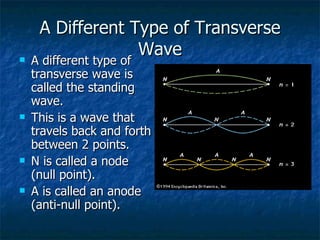
A Different Type of Transverse Wave A different type of transverse wave is called the standing wave. This is a wave that travels back and forth between 2 points. N is called a node (null point). A is called an anode (anti-null point).
How do waves interact? When waves interact, it is called interference. There are 2 types of interference. Constructive interference Destructive interference
Constructive interference Constructive interference is when 2 or more waves come together and build themselves up. They add their collective amplitudes together.
Destructive interference Destructive interference is when 2 or more waves tear each other down. They are off by “half a phase” and their amplitudes (peak and trough) subtract from each other.
What happens if the interference keeps progressing? If the interference keeps going, then it is called resonance. Resonance is when the waves keep building upon each other. This occurs with constructive interference.
What happens if the source of the wave is moving? If the source of the wave is moving, then the wave adjusts for the speed. It compresses or expands depending on the direction the source is moving relative to the detector of the wave.
Doppler Effect with Sound If the object isn’t moving, then the sound generated stays constant. If the object is moving toward another object, then the sound is compressed. This gives the sound a higher frequency and a higher pitch.
If the source is moving away from the observer, then the sound is stretched out as it reaches the observer. This gives the sound a lower frequency or a lower pitch.
Doppler Effect with Light Similarly to sound, if the object is not moving, then the light emitted is normal. If the source of the light is moving close to the speed of light, then the light is compressed and it is given a higher frequency (more energy).
However, if the source of the light is moving away from the observer at nearly the speed of light, then it will have a stretched out wavelength and lower frequency (less energy). This is also known as Red Shift.
Light Light is known as an Electromagnetic wave. But, light is also known as a photon. Light is both a particle and a wave. This is called the Duality of Light. Light is a particle with a wave-like characteristic.
More light Light does not need a medium to travel, neither do any of the EM waves. Light travels at it’s own speed. The speed of light is 3.00 x 10 8  m/s or 186,000 miles/sec. Light travels in straight lines. The photon is a packet of energy. Einstein showed that light was a particle. He was able to show that the momentum of the photon was able to move electrons, causing electricity to be produced.
Waves Bounce When a sound wave bounces, we call it an echo. When a light wave bounces, we call it a reflection The law of reflection says that the reflected ray bounces off at the same angle, to the normal, as the incoming ray.
Flat Mirror A flat mirror (flat surface) will reflect a true image. This image will appear as if it were a copy of the original.
Concave Mirror Concave mirrors follow the law of reflections. Concave mirrors have the reflective surface on the inside of the curve.
If an object is beyond the focal point of the concave mirror, then the image is smaller and inverted.
If an object is within the focal point of the concave mirror, then the image is magnified.
Convex Mirror  A convex mirror has its reflective surface on the outside of the curve of the mirror. Therefore, the focal point is inside the mirror, and the object of the reflection can not reach that focal point.
Images seen in a convex mirror appear as smaller, right-side up, and the view is spread out more.
Refraction Refraction is when a light wave travels through a medium and bends.  Whenever, light enters or exits a medium, the light rays bend. A medium is a material that waves travel through.
As the incoming light enters the medium at an angle, the medium bends that light according to its “index of refraction”. This index is constant for each medium. The different mediums also cause the light to change speeds.
This bending of the light gives us the illusion that the objects are bent or in different locations when they are in water.
Lenses Like mirrors, there are 2 different types of lenses. A concave lens is curved so the open part is the inside of the curve.
All lenses follow the same law of refraction. Light bends as it goes through a lens.
 
Convex Lens Convex lenses have the medium within the curve of the lens.
Unlike the concave lens, which bends the rays outward, convex lenses bend the rays inward to a single point.
 
 
The Electro-Magnetic Spectrum The electro-magnetic spectrum is also referred to as the EM spectrum. This spectrum consists of waves that are driven by electric fields and magnetic fields that continuously create each other.
Unlike other waves, the EM waves do not need a medium to propagate. All EM waves (including light) travel at 3.0 x 10 8  m/s or 186,000 miles/second.

Waves unit (1)

  • 1.
    Waves Unit Waves,sound and light
  • 2.
    Waves and VibrationsA vibration is a movement that occurs in a period of time. A wave is a movement that occurs in a period of time and also in space. A wave is a way of transferring energy.
  • 3.
    Time for aCycle The time that it takes for a wave (or vibration) to complete one cycle is called a period (T). A cycle is when a process starts to repeat itself. A period is measured in units of time (seconds, most of the time).
  • 4.
    Simple Harmonic MotionThe swinging of a pendulum (or a mass bouncing on a spring), the motion back-and-forth, is called simple harmonic motion. The result of this simple oscillation back-and-forth is a sine wave.
  • 5.
    Wave Characteristics Thereare some distinct parts of a wave called characteristics. The peak is the top part of the wave. The trough is the bottom part of the wave.
  • 6.
    More Characteristics Thebaseline is the line of 0 energy in the wave. The wavelength (  )is the distance from peak to peak of the wave. The amplitude is the distance from the baseline to the peak of the wave.
  • 7.
    More Characteristics Period(T) is the time that it takes for the wave to start over again, typically it is the time for one wavelength (  ) to pass by. Frequency ( f )is the number of  to pass by in a time frame. Frequency is measured in Hertz (Hz).
  • 8.
    Wave Speed Itis calculated by dividing distance by time. With a wave, it is no different, we just change some of the symbols The velocity of a wave is calculated by dividing wavelength by period of the wave. v =  / T or v =  f v = d / t How is speed (velocity) calculated?
  • 9.
    Simple Calculations Whatis the speed of a wave that has a wavelength of 10.0 meters and it takes 2.0 seconds to go by? The solution is:  = 10.0 m T = 2.0 s v =  / T So, v = 10.0 m / 2.0 s v = 5.0 m/s
  • 10.
    What is thevelocity of a wave that has a wavelength of 5.0 x 10 -3 meters and a frequency of 20.0 Hz? The solution is:  = 5.0 x 10 -3 m f = 20.0 Hz v =  f So, v = (5.0 x 10 -3 m)(20.0 Hz) v = 0.10 m/s
  • 11.
    What is thewavelength of a wave that travels at 4.00 m/s and has a period of 3.0 seconds? The solution is: v = 4.00 m/s T = 3.0 s  = v T So,  = (4.00 m/s)(3.0 s)  = 12 m
  • 12.
    What is thewavelength of a wave that travels at 200.0 m/s and has a frequency of 40.0 Hz? The solution is: v = 200.0 m/s f = 40.0 Hz  = v / f So,  = (200.0 m/s)/(40.0 Hz)  = 5.00 m
  • 13.
    What is thefrequency of a pendulum if it swings back and forth with a period of 4.0 seconds? The solution is: T = 4.0 s f = 1 / T So, f = 1 / (4.0 s) f = 0.25 Hz
  • 14.
    What is theperiod of a wave if the wavelength is 20.0 m and the velocity is 10.0 m/s? The solution is:  = 20.0 m v = 10.0 m/s T =  / v So, T = (20.0 m)/(10.0 m/s) T = 2.00 s
  • 15.
    Types of WavesThere are 2 basic types of waves. One is called a longitudinal wave. The other is called a transverse wave.
  • 16.
    Longitudinal Wave Longitudinalwaves move the medium parallel to the motion of the wave. Longitudinal waves are compression waves. Longitudinal waves have the same characteristics as transverse waves. However, peaks are referred to as condensations and troughs are rarefactions.
  • 17.
    Transverse Waves Transversewaves move the medium perpendicular to the motion of the wave. Transverse waves are like ocean waves.
  • 18.
    A Different Typeof Transverse Wave A different type of transverse wave is called the standing wave. This is a wave that travels back and forth between 2 points. N is called a node (null point). A is called an anode (anti-null point).
  • 19.
    How do wavesinteract? When waves interact, it is called interference. There are 2 types of interference. Constructive interference Destructive interference
  • 20.
    Constructive interference Constructiveinterference is when 2 or more waves come together and build themselves up. They add their collective amplitudes together.
  • 21.
    Destructive interference Destructiveinterference is when 2 or more waves tear each other down. They are off by “half a phase” and their amplitudes (peak and trough) subtract from each other.
  • 22.
    What happens ifthe interference keeps progressing? If the interference keeps going, then it is called resonance. Resonance is when the waves keep building upon each other. This occurs with constructive interference.
  • 23.
    What happens ifthe source of the wave is moving? If the source of the wave is moving, then the wave adjusts for the speed. It compresses or expands depending on the direction the source is moving relative to the detector of the wave.
  • 24.
    Doppler Effect withSound If the object isn’t moving, then the sound generated stays constant. If the object is moving toward another object, then the sound is compressed. This gives the sound a higher frequency and a higher pitch.
  • 25.
    If the sourceis moving away from the observer, then the sound is stretched out as it reaches the observer. This gives the sound a lower frequency or a lower pitch.
  • 26.
    Doppler Effect withLight Similarly to sound, if the object is not moving, then the light emitted is normal. If the source of the light is moving close to the speed of light, then the light is compressed and it is given a higher frequency (more energy).
  • 27.
    However, if thesource of the light is moving away from the observer at nearly the speed of light, then it will have a stretched out wavelength and lower frequency (less energy). This is also known as Red Shift.
  • 28.
    Light Light isknown as an Electromagnetic wave. But, light is also known as a photon. Light is both a particle and a wave. This is called the Duality of Light. Light is a particle with a wave-like characteristic.
  • 29.
    More light Lightdoes not need a medium to travel, neither do any of the EM waves. Light travels at it’s own speed. The speed of light is 3.00 x 10 8 m/s or 186,000 miles/sec. Light travels in straight lines. The photon is a packet of energy. Einstein showed that light was a particle. He was able to show that the momentum of the photon was able to move electrons, causing electricity to be produced.
  • 30.
    Waves Bounce Whena sound wave bounces, we call it an echo. When a light wave bounces, we call it a reflection The law of reflection says that the reflected ray bounces off at the same angle, to the normal, as the incoming ray.
  • 31.
    Flat Mirror Aflat mirror (flat surface) will reflect a true image. This image will appear as if it were a copy of the original.
  • 32.
    Concave Mirror Concavemirrors follow the law of reflections. Concave mirrors have the reflective surface on the inside of the curve.
  • 33.
    If an objectis beyond the focal point of the concave mirror, then the image is smaller and inverted.
  • 34.
    If an objectis within the focal point of the concave mirror, then the image is magnified.
  • 35.
    Convex Mirror A convex mirror has its reflective surface on the outside of the curve of the mirror. Therefore, the focal point is inside the mirror, and the object of the reflection can not reach that focal point.
  • 36.
    Images seen ina convex mirror appear as smaller, right-side up, and the view is spread out more.
  • 37.
    Refraction Refraction iswhen a light wave travels through a medium and bends. Whenever, light enters or exits a medium, the light rays bend. A medium is a material that waves travel through.
  • 38.
    As the incominglight enters the medium at an angle, the medium bends that light according to its “index of refraction”. This index is constant for each medium. The different mediums also cause the light to change speeds.
  • 39.
    This bending ofthe light gives us the illusion that the objects are bent or in different locations when they are in water.
  • 40.
    Lenses Like mirrors,there are 2 different types of lenses. A concave lens is curved so the open part is the inside of the curve.
  • 41.
    All lenses followthe same law of refraction. Light bends as it goes through a lens.
  • 42.
  • 43.
    Convex Lens Convexlenses have the medium within the curve of the lens.
  • 44.
    Unlike the concavelens, which bends the rays outward, convex lenses bend the rays inward to a single point.
  • 45.
  • 46.
  • 47.
    The Electro-Magnetic SpectrumThe electro-magnetic spectrum is also referred to as the EM spectrum. This spectrum consists of waves that are driven by electric fields and magnetic fields that continuously create each other.
  • 48.
    Unlike other waves,the EM waves do not need a medium to propagate. All EM waves (including light) travel at 3.0 x 10 8 m/s or 186,000 miles/second.