GENERAL WAVE PROPERTIES SECONDARY 3 PHYSICS
Waves Around Us Water waves Sound waves Earthquake (seismic waves) Note:  Waves carry energy (eg. Electromagnetic waves)
What is a wave? A wave may be thought of as a spread of disturbance. Eg: the surface of a pond is actually calm until we drop a pebble. Then the surface of the water starts to move as it is disturbed. That disturbance spreads outwards. http:// webphysics.davidson.edu/Applets/Ripple/Ripple.html
Types Of Waves There are two types of waves: Transverse waves Longitudinal waves
Transverse Waves The direction of vibration is perpendicular to the direction of wave travel. Example of transverse waves:  water waves, electromagnetic waves http://www. phy . ntnu . edu . tw /java/wave/wave.html
Longitudinal Waves The direction of vibration is parallel to the direction of wave travel. Example of  longitudinal wave: sound  http://www.explorescience.com/activities/Activity_page.cfm?ActivityID =50
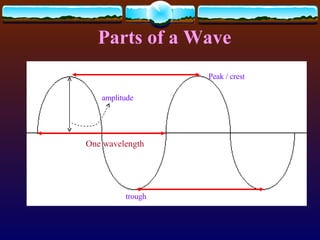
Parts of a Wave amplitude trough Peak / crest One wavelength
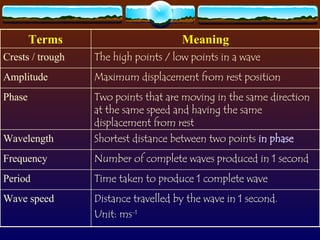
Distance travelled by the wave in 1 second.  Unit: ms -1 Wave speed Time taken to produce 1 complete wave Period Number of complete waves produced in 1 second Frequency Shortest distance between two points  in phase Wavelength  Two points that are moving in the same direction at the same speed and having the same displacement from rest  Phase Maximum displacement from rest position Amplitude The high points / low points in a wave Crests / trough Meaning Terms
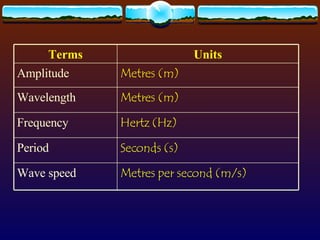
Metres per second (m/s) Wave speed Seconds (s) Period Hertz (Hz) Frequency Metres (m) Wavelength  M etres (m) Amplitude Units Terms
Wave Equation v  = f   Speed of wave [ms -1 ] Frequency [Hz] Wavelength [m]
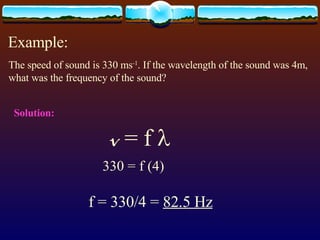
Example: The speed of sound is 330 ms -1 . If the wavelength of the sound was 4m, what was the frequency of the sound? Solution: v  = f   330 = f (4) f = 330/4 =  82.5 Hz
Relationship between T and f Period [s] Frequency [Hz]
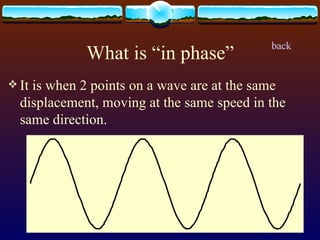
What is “in phase” It is when 2 points on a wave are at the same displacement, moving at the same speed in the same direction. back

General Wave Properties

  • 1.
    GENERAL WAVE PROPERTIESSECONDARY 3 PHYSICS
  • 2.
    Waves Around UsWater waves Sound waves Earthquake (seismic waves) Note: Waves carry energy (eg. Electromagnetic waves)
  • 3.
    What is awave? A wave may be thought of as a spread of disturbance. Eg: the surface of a pond is actually calm until we drop a pebble. Then the surface of the water starts to move as it is disturbed. That disturbance spreads outwards. http:// webphysics.davidson.edu/Applets/Ripple/Ripple.html
  • 4.
    Types Of WavesThere are two types of waves: Transverse waves Longitudinal waves
  • 5.
    Transverse Waves Thedirection of vibration is perpendicular to the direction of wave travel. Example of transverse waves: water waves, electromagnetic waves http://www. phy . ntnu . edu . tw /java/wave/wave.html
  • 6.
    Longitudinal Waves Thedirection of vibration is parallel to the direction of wave travel. Example of longitudinal wave: sound http://www.explorescience.com/activities/Activity_page.cfm?ActivityID =50
  • 7.
    Parts of aWave amplitude trough Peak / crest One wavelength
  • 8.
    Distance travelled bythe wave in 1 second. Unit: ms -1 Wave speed Time taken to produce 1 complete wave Period Number of complete waves produced in 1 second Frequency Shortest distance between two points in phase Wavelength Two points that are moving in the same direction at the same speed and having the same displacement from rest Phase Maximum displacement from rest position Amplitude The high points / low points in a wave Crests / trough Meaning Terms
  • 9.
    Metres per second(m/s) Wave speed Seconds (s) Period Hertz (Hz) Frequency Metres (m) Wavelength M etres (m) Amplitude Units Terms
  • 10.
    Wave Equation v = f  Speed of wave [ms -1 ] Frequency [Hz] Wavelength [m]
  • 11.
    Example: The speedof sound is 330 ms -1 . If the wavelength of the sound was 4m, what was the frequency of the sound? Solution: v = f  330 = f (4) f = 330/4 = 82.5 Hz
  • 12.
    Relationship between Tand f Period [s] Frequency [Hz]
  • 13.
    What is “inphase” It is when 2 points on a wave are at the same displacement, moving at the same speed in the same direction. back