Waves
• Wave-any disturbance that transmits
energy through matter or empty space
• Medium – substance through which a
wave can travel (solid, liquid, gas)
• Wave particles vibrate and pass the
energy to a particle next to it
• Mechanical waves must use a medium to
travel (sound, ocean waves)
• Electromagnetic waves travel without a
medium or in a vacuum (light waves from
the sun)
• Transverse wave-particles vibrate up and
down (wave travels forward while moving
perpendicular to the forward motion) - all
electromagnetic wave
• Longitudinal wave – moves back and forth
parallel with the direction of the motion
• Compression – crowded
• Rarefaction-spread apart
• Properties of Waves:
• Amplitude-related to height, large wave
height more energy
• Wavelength- distance between two crests
or compressions, shorter the wave length
the greater the energy
Frequency – number of waves in a given amount of time,
higher the frequency the greater the energy
Wave speed-the speed at which a wave travels through a
medium
• Wave interactions:
• Reflection – wave bounces back after hitting a barrier
(sound, light, heat)
• Refraction – bending of light due to a change in medium
and a change in wave speed
• Diffraction-bending of waves around a barrier or
through an opening
• Interference – the combination of two or more waves
that results in a single wave (Ex: resonance – when two
object vibrate at the same frequency)
• Absorption: energy transferred to particles of matter
Electromagnetic waves
• Consists of changing electric and
magnetic fields at right angles to each
other and can travel without a medium (in
a vacuum)
• Electric fields surround all electrically
charged objects by vibration which causes
the magnetic field to be created.
• Energy is transferred as radiation
• Light travels in a straight line until it strikes
an object is reflected, absorbed or
transmitted
• The speed of light can change depending
on the type of media (matter traveling
through)
• Light is a form of radiant energy that
moves in transverse waves
• EM energy from the sun are major source
of energy on earth
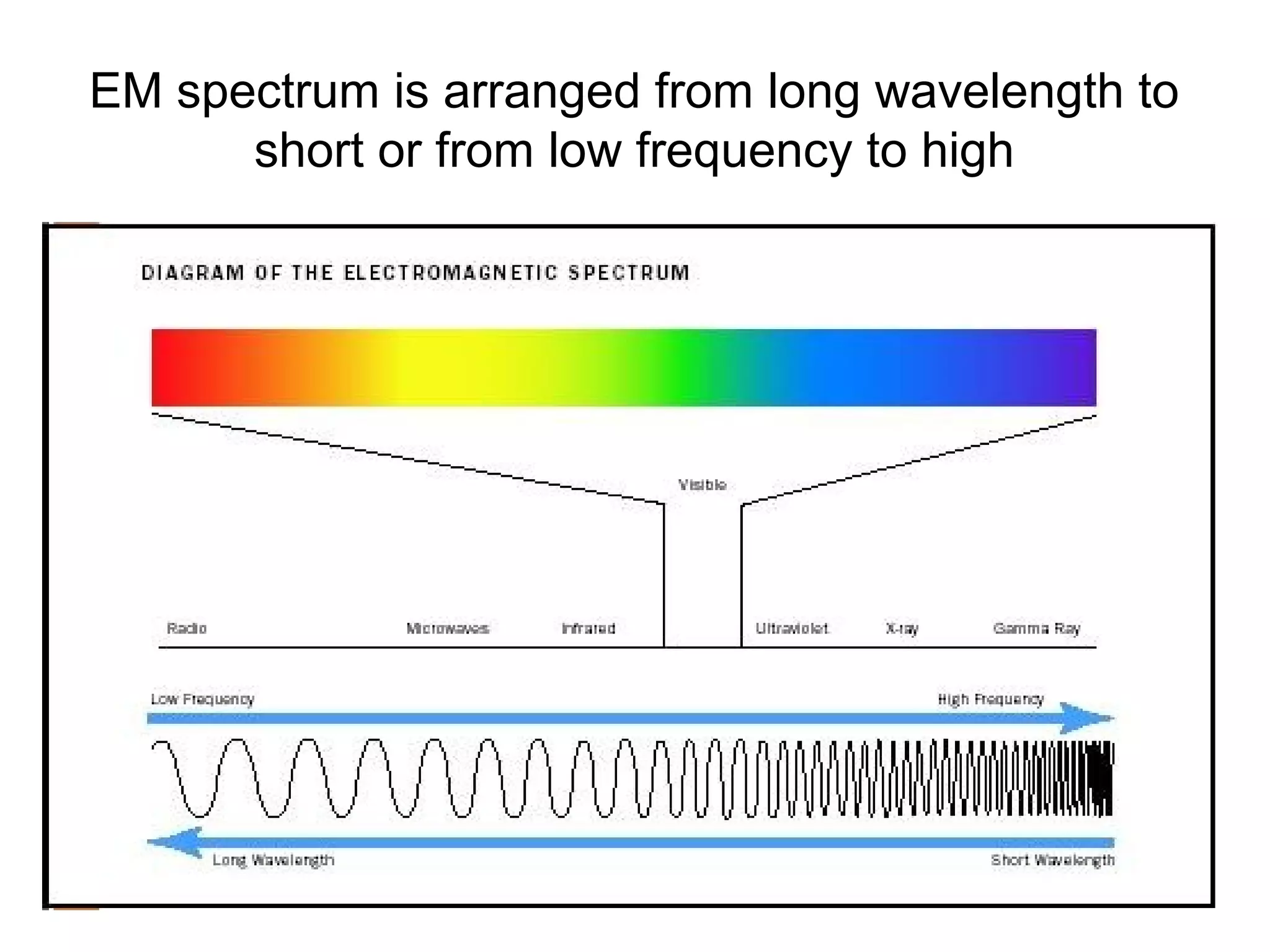
• Em spectrum consists of:
• Radio waves, microwaves, infrared, visible
light, ultraviolet, x-ray, and gamma rays,
all move at the speed of light
Light theory
• Pythagoras (580-500) – light travels in the
form of tiny particles
• Einstein – EM radiation (light) was a
stream of particles rather than a wave of
energy called photons and that the energy
in the photon was equivalent to the mass
which meant that photons had mass.
E=mc2
• Light travels at 300,000,000 m/s through a
vacuum and slightly less through air and
other materials
• 1 light year=9,500,000,000,000 km
• Closest galaxy to ours Andromeda
• 21 quintrillion km or
21,000,000,000,000,000,000 km or
• 2.3 million light years
• Closest star Proxima Centauri
• 40,000,000,000,000 km
• EM energy from the sun are major source
of energy on earth
Sound
• Sound – energy transmitted through a
medium, type: longitudinal wave
• Composed of compression and rarefaction
waves
• Travel in all directions way from the
source
• Caused by the vibration of an object
EM spectrum is arranged from long wavelength to
short or from low frequency to high

Waves and light

  • 1.
    Waves • Wave-any disturbancethat transmits energy through matter or empty space • Medium – substance through which a wave can travel (solid, liquid, gas) • Wave particles vibrate and pass the energy to a particle next to it • Mechanical waves must use a medium to travel (sound, ocean waves)
  • 2.
    • Electromagnetic wavestravel without a medium or in a vacuum (light waves from the sun) • Transverse wave-particles vibrate up and down (wave travels forward while moving perpendicular to the forward motion) - all electromagnetic wave • Longitudinal wave – moves back and forth parallel with the direction of the motion
  • 3.
    • Compression –crowded • Rarefaction-spread apart • Properties of Waves: • Amplitude-related to height, large wave height more energy • Wavelength- distance between two crests or compressions, shorter the wave length the greater the energy
  • 4.
    Frequency – numberof waves in a given amount of time, higher the frequency the greater the energy Wave speed-the speed at which a wave travels through a medium
  • 5.
    • Wave interactions: •Reflection – wave bounces back after hitting a barrier (sound, light, heat) • Refraction – bending of light due to a change in medium and a change in wave speed • Diffraction-bending of waves around a barrier or through an opening • Interference – the combination of two or more waves that results in a single wave (Ex: resonance – when two object vibrate at the same frequency) • Absorption: energy transferred to particles of matter
  • 6.
    Electromagnetic waves • Consistsof changing electric and magnetic fields at right angles to each other and can travel without a medium (in a vacuum) • Electric fields surround all electrically charged objects by vibration which causes the magnetic field to be created. • Energy is transferred as radiation
  • 7.
    • Light travelsin a straight line until it strikes an object is reflected, absorbed or transmitted • The speed of light can change depending on the type of media (matter traveling through) • Light is a form of radiant energy that moves in transverse waves
  • 8.
    • EM energyfrom the sun are major source of energy on earth • Em spectrum consists of: • Radio waves, microwaves, infrared, visible light, ultraviolet, x-ray, and gamma rays, all move at the speed of light
  • 9.
    Light theory • Pythagoras(580-500) – light travels in the form of tiny particles • Einstein – EM radiation (light) was a stream of particles rather than a wave of energy called photons and that the energy in the photon was equivalent to the mass which meant that photons had mass. E=mc2
  • 10.
    • Light travelsat 300,000,000 m/s through a vacuum and slightly less through air and other materials • 1 light year=9,500,000,000,000 km • Closest galaxy to ours Andromeda • 21 quintrillion km or 21,000,000,000,000,000,000 km or • 2.3 million light years
  • 11.
    • Closest starProxima Centauri • 40,000,000,000,000 km • EM energy from the sun are major source of energy on earth
  • 12.
    Sound • Sound –energy transmitted through a medium, type: longitudinal wave • Composed of compression and rarefaction waves • Travel in all directions way from the source • Caused by the vibration of an object
  • 13.
    EM spectrum isarranged from long wavelength to short or from low frequency to high