Vibrations & Waves
WAVES
   Energy can be transferred in a number of
    ways.
   A moving car is an example of energy in
    motion
   Not only does the energy move the car
    moves as well.
   Energy can move without the object/particle
    moving with it.
   This occurs in waves.
Travelling Wave
Characteristics
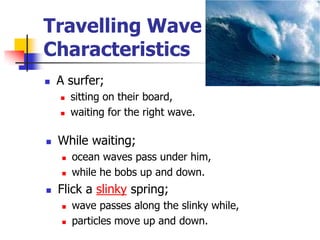
   A surfer;
       sitting on their board,
       waiting for the right wave.

   While waiting;
       ocean waves pass under him,
       while he bobs up and down.
   Flick a slinky spring;
       wave passes along the slinky while,
       particles move up and down.
Travelling Wave
Characteristics

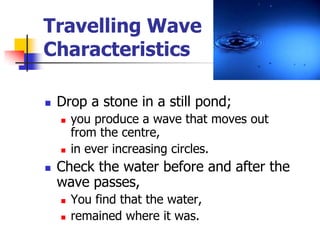
   Drop a stone in a still pond;
       you produce a wave that moves out
        from the centre,
       in ever increasing circles.
   Check the water before and after the
    wave passes,
       You find that the water,
       remained where it was.
Travelling Wave
Characteristics
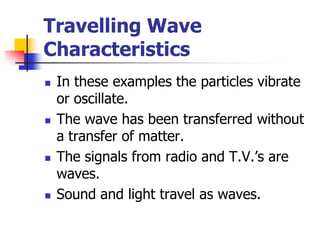
   In these examples the particles vibrate
    or oscillate.
   The wave has been transferred without
    a transfer of matter.
   The signals from radio and T.V.’s are
    waves.
   Sound and light travel as waves.
Transverse Waves
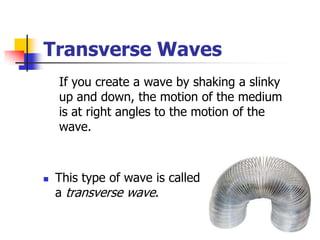
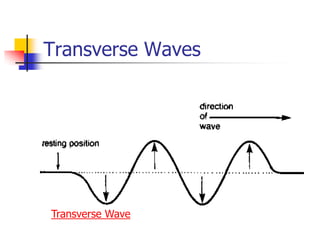
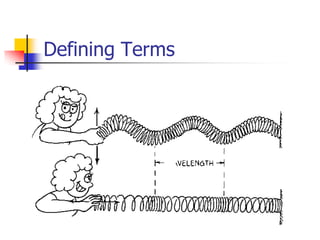
    If you create a wave by shaking a slinky
    up and down, the motion of the medium
    is at right angles to the motion of the
    wave.


   This type of wave is called
    a transverse wave.
Transverse Waves
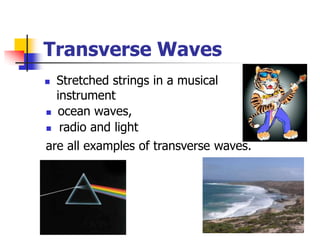
   Stretched strings in a musical
    instrument
   ocean waves,
    radio and light
are all examples of transverse waves.
Transverse Waves


Transverse Wave
Longitudinal Waves
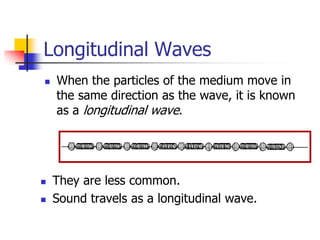
   When the particles of the medium move in
    the same direction as the wave, it is known
    as a longitudinal wave.


   They are less common.
   Sound travels as a longitudinal wave.
Longitudinal Waves
   In both forms, the energy can be
    transferred as a single pulse, a number
    of pulses, or a continuous wave.
   Particles may be set in motion by a
    wave no particle travels far from its
    initial position.
Longitudinal Waves
   As the wave particles set neighbouring
    particles into motion the wave is
    propagated through the
    medium, energy is transferred in the
    medium.
Longitudinal Waves
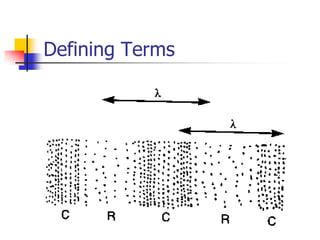
   Wavelength of a longitudinal wave
    distance between successive
    compressions or successive
    rarefactions.
Defining Terms
   Medium:
       The substance through which the wave
        moves the particles making up the
        medium, are those which are displaced, as
        the wave moves through it.
Defining Terms
   Displacement:
       The distance a particle has moved from its
        mean position.
Defining Terms
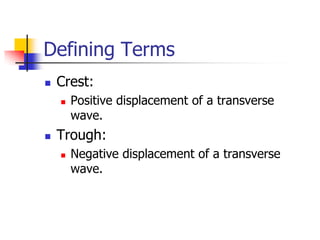
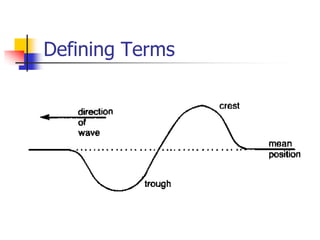
   Crest:
       Positive displacement of a transverse
        wave.
   Trough:
       Negative displacement of a transverse
        wave.
Defining Terms
Defining Terms
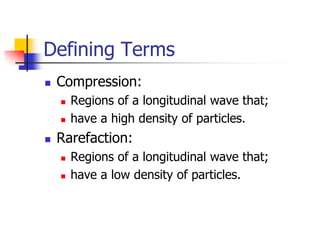
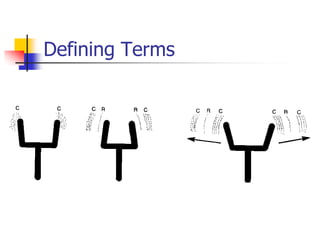
   Compression:
       Regions of a longitudinal wave that;
       have a high density of particles.
   Rarefaction:
       Regions of a longitudinal wave that;
       have a low density of particles.
Defining Terms
Defining Terms
Defining Terms
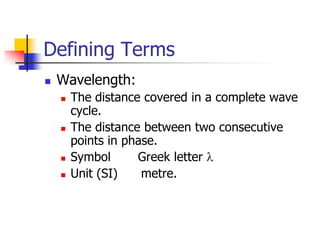
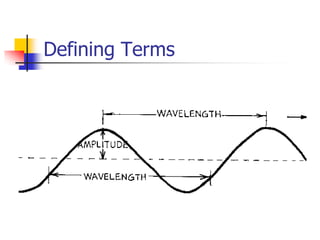
   Wavelength:
       The distance covered in a complete wave
        cycle.
       The distance between two consecutive
        points in phase.
       Symbol      Greek letter
       Unit (SI)    metre.
Defining Terms
Defining Terms
   Amplitude:
       The difference between the maximum
        displacement and the mean position.
       Symbol       A
       Unit (SI)    metre.
Defining Terms
Defining Terms
   Period:
       The time for one complete oscillation.
        Symbol    T
       Unit (SI) second.
Defining Terms
   Frequency:
       Is the number of wavelengths generated
        by a source in a second.
       Symbol        f
       Unit (SI)     Hertz (Hz)
Defining Terms
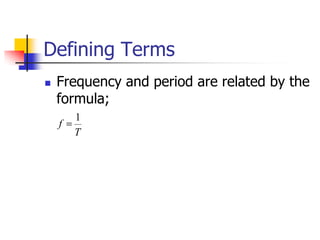
   Frequency and period are related by the
    formula;
        1
    f
        T
Defining Terms
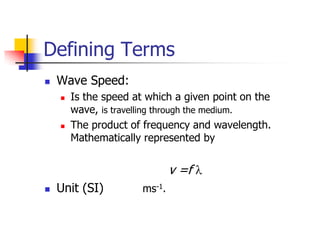
   Wave Speed:
       Is the speed at which a given point on the
        wave, is travelling through the medium.
       The product of frequency and wavelength.
        Mathematically represented by


                               v =f
   Unit (SI)          ms-1.
Defining Terms
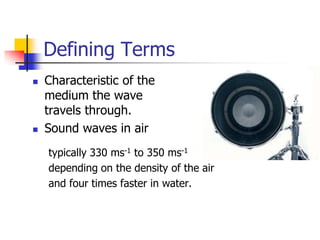
   Characteristic of the
    medium the wave
    travels through.
   Sound waves in air
    typically 330 ms-1 to 350 ms-1
    depending on the density of the air
    and four times faster in water.
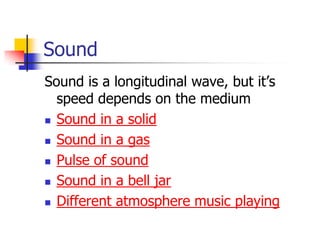
Sound
Sound is a longitudinal wave, but it’s
  speed depends on the medium
 Sound in a solid

 Sound in a gas

 Pulse of sound

 Sound in a bell jar

 Different atmosphere music playing
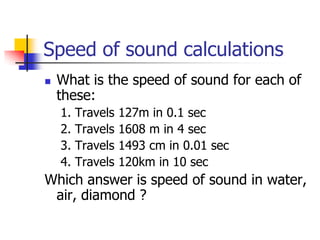
Speed of sound calculations
   What is the speed of sound for each of
    these:
    1.   Travels   127m in 0.1 sec
    2.   Travels   1608 m in 4 sec
    3.   Travels   1493 cm in 0.01 sec
    4.   Travels   120km in 10 sec
Which answer is speed of sound in water,
 air, diamond ?
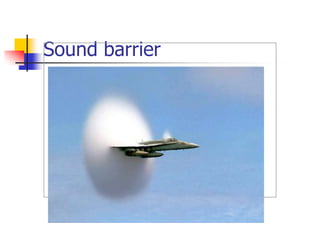
Sound barrier
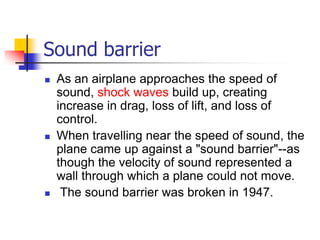
Sound barrier
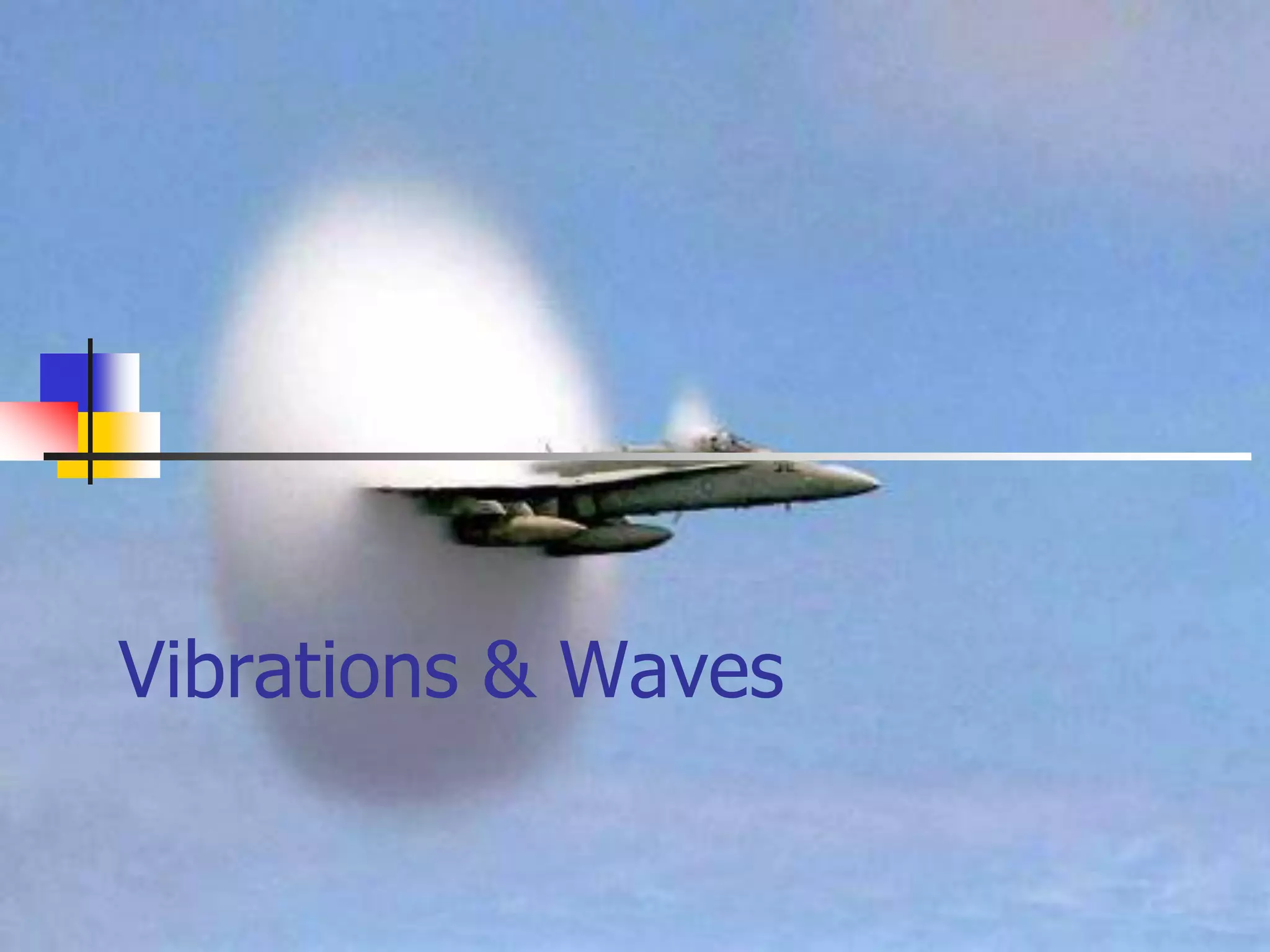
   As an airplane approaches the speed of
    sound, shock waves build up, creating
    increase in drag, loss of lift, and loss of
    control.
   When travelling near the speed of sound, the
    plane came up against a "sound barrier"--as
    though the velocity of sound represented a
    wall through which a plane could not move.
    The sound barrier was broken in 1947.
Shock waves
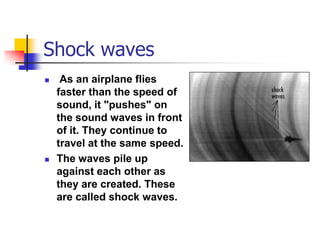
    As an airplane flies
    faster than the speed of
    sound, it "pushes" on
    the sound waves in front
    of it. They continue to
    travel at the same speed.
   The waves pile up
    against each other as
    they are created. These
    are called shock waves.
Sonic Booms
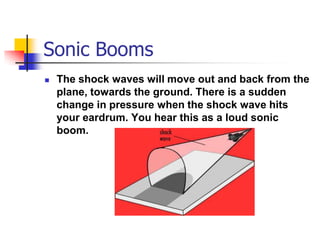
   The shock waves will move out and back from the
    plane, towards the ground. There is a sudden
    change in pressure when the shock wave hits
    your eardrum. You hear this as a loud sonic
    boom.
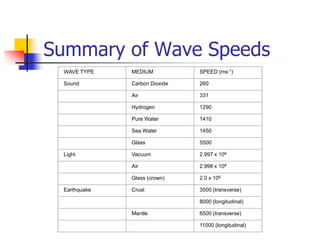
Summary of Wave Speeds
 WAVE TYPE    MEDIUM           SPEED (ms-1)

 Sound        Carbon Dioxide   260

              Air              331

              Hydrogen         1290

              Pure Water       1410

              Sea Water        1450

              Glass            5500

 Light        Vacuum           2.997 x 10⁸

              Air              2.998 x 10⁸

              Glass (crown)    2.0 x 10⁸

 Earthquake   Crust            3500 (transverse)

                               8000 (longitudinal)

              Mantle           6500 (transverse)

                               11000 (longitudinal)
The Behaviour of Waves
   When a wave moves through a medium
    the velocity and shape of that
    wave, remains constant.
   This is so, no matter what the medium.
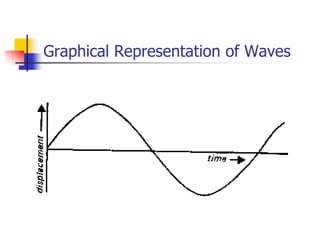
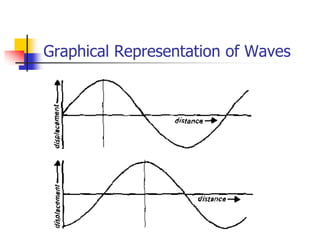
Graphical Representation of Waves
Reflections in one Dimension
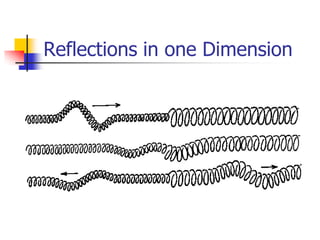
   When a wave reaches a boundary
    between two media some or all of the
    wave bounces back, into the first
    medium.
Reflections in one Dimension
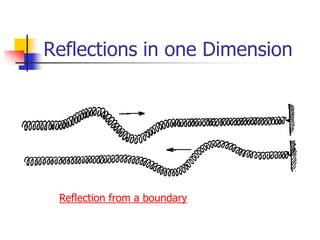
   A pulse is sent along a slinky spring
    which is attached at one end to a wall.
   All the energy is reflected back along
    the spring, rather than into the wall.
Reflections in one Dimension


 Reflection from a boundary
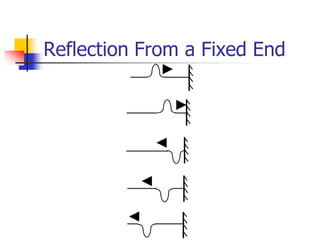
Reflection From a Fixed End
Reflections in one Dimension
   The pulse becomes inverted as it is
    reflected.
   This is called phase reversal.
   This is why metals are so shiny.
   A Metal surface is rigid to the light
    waves that shine upon it.
Reflections in one Dimension
   Most of the light is reflected apart from
    a small energy loss, due to the friction
    of, the vibrating electrons in the
    surface.
   Metals can be used as mirrors for this
    reason.
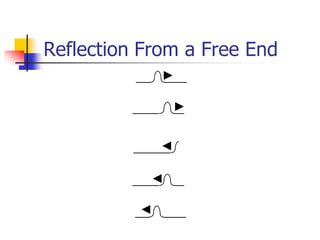
Reflection From a Free End
Reflections in one Dimension
   The part of the spring adjacent to the
    boundary is free to be displaced, and
    no phase change occurs on reflection.
Reflections in one Dimension
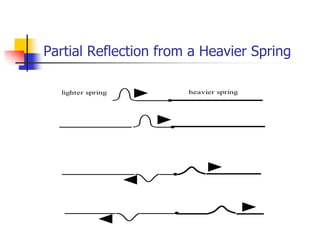
   If the wall is replaced with a heavy
    spring as a new medium, some energy
    is transmitted, some energy is reflected.


       Reflection from a boundary
Reflections in one Dimension
Partial Reflection from a Heavier Spring

  lighter spring
                   .    heavier spring


                   .
                    .
                    .
Reflections in one Dimension
   The heavy spring acts as an imperfect
    ‘rigid’ boundary, partially reflecting the
    pulse, with a change of phase but, also
    partially transmitting it.
Reflections in one Dimension
   Two pulses of reduced amplitude move
    at speeds characteristic of the media
   result.
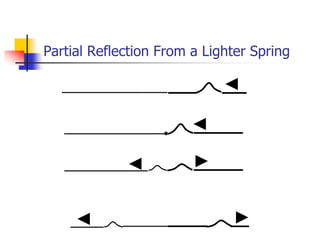
Partial Reflection From a Lighter Spring


                   .
Reflections in one Dimension
   The lighter spring acts as an imperfect
    ‘free end’, partially reflecting the pulse,
    without change of phase and, partially
    transmitting it.
   Two pulses with reduced amplitude are
    produced.
Reflections in Two Dimensions
   In one dimension the reflected wave
    simply travels back, in the direction
    from which it came.
   In two dimensions, the situation is a
    little different.
Reflections in Two Dimensions
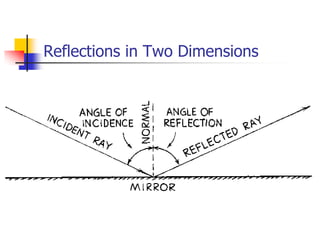
   Direction of incident & reflected waves
    described by straight lines called rays.
   The incoming ray (incident ray) and the
    reflected ray makes, equal angles with
    the normal.
Reflections in Two Dimensions
   Angle between incident ray & normal
    called the angle of incidence
   Angle between the reflected ray &
    normal called the angle of reflection.
Reflections in Two Dimensions
   Relationship is called Law of reflection.
   Law applies equally to both partially
    reflected and, totally reflected waves.
   Stated mathematically:
     i= r


    Reflection of light
Reflection
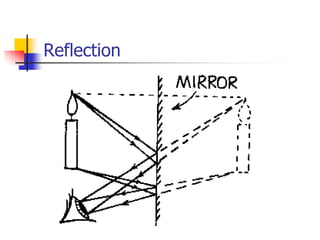
   If a lit candle is placed in front of a
    plane mirror, rays of light are reflected
    in all directions.
   There are an infinite number all obey
    the law of reflection.
Reflection
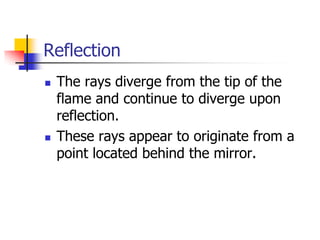
   The rays diverge from the tip of the
    flame and continue to diverge upon
    reflection.
   These rays appear to originate from a
    point located behind the mirror.
Reflection
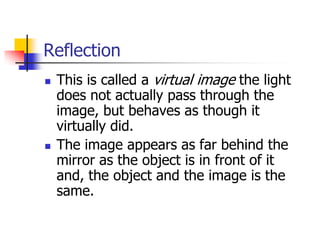
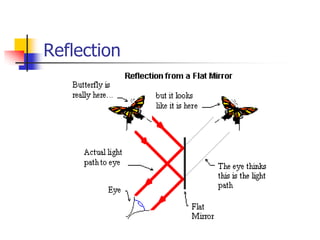
   This is called a virtual image the light
    does not actually pass through the
    image, but behaves as though it
    virtually did.
   The image appears as far behind the
    mirror as the object is in front of it
    and, the object and the image is the
    same.
Reflection
Reflection
Reflection
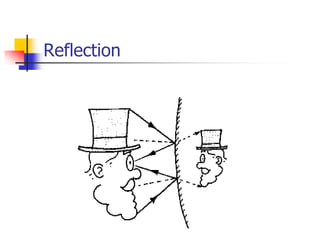
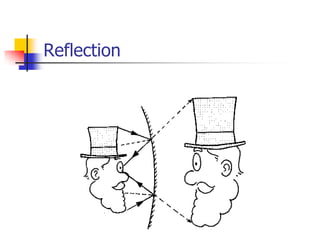
   When the mirror is curved sizes &
    distances of the object and image, are
    no longer equal, but the law of
    reflection still holds.
Reflection
Reflection
Reflection


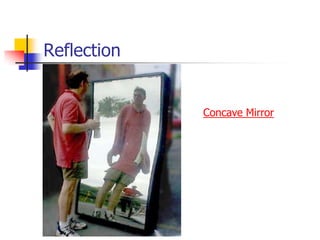
             Concave Mirror
Reflection
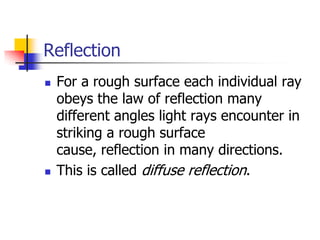
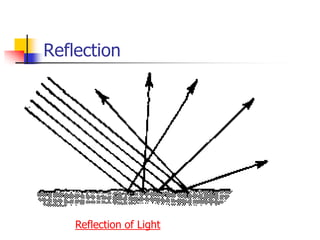
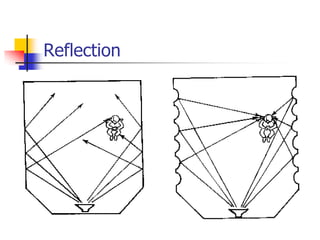
   For a rough surface each individual ray
    obeys the law of reflection many
    different angles light rays encounter in
    striking a rough surface
    cause, reflection in many directions.
   This is called diffuse reflection.
Reflection


    Reflection of Light
Reflection
Diffraction
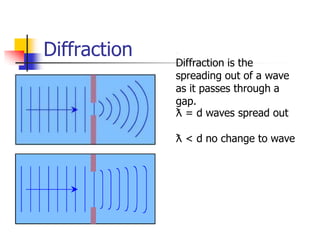
              Diffraction is the
              spreading out of a wave
              as it passes through a
              gap.
              ƛ = d waves spread out

              ƛ < d no change to wave
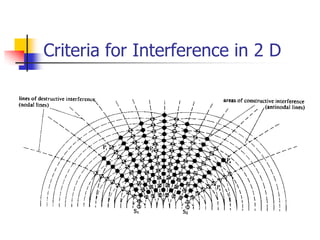
Criteria for Interference in 2 D
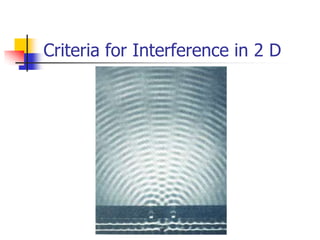
   Consider a ripple tank with two dippers
    producing waves, of the same
    frequency and in phase.
   A two dimensional standing wave would
    be seen.
Criteria for Interference in 2 D
   Even if the dippers were out of phase
    by radians ( /2), the 2D standing
    wave pattern would still be seen.
   In both cases, the dippers maintain a
    constant phase relationship, referred to
    as mutually coherent sources.
Criteria for Interference in 2 D
   Mutually coherent wave sources
    maintain a constant phase relationship.
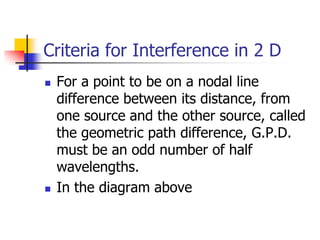
Criteria for Interference in 2 D
   For a point to be on a nodal line
    difference between its distance, from
    one source and the other source, called
    the geometric path difference, G.P.D.
    must be an odd number of half
    wavelengths.
   In the diagram above
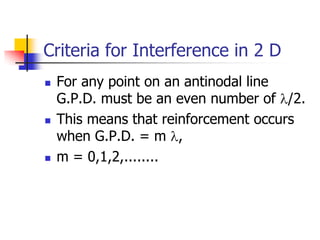
Criteria for Interference in 2 D
   For any point on an antinodal line
    G.P.D. must be an even number of /2.
   This means that reinforcement occurs
    when G.P.D. = m ,
   m = 0,1,2,........
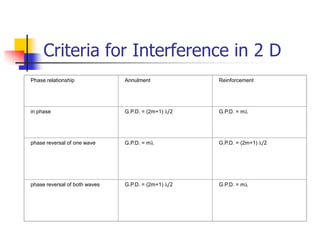
Criteria for Interference in 2 D
Phase relationship             Annulment            Reinforcement


in phase                       G.P.D. = (2m+1) /2   G.P.D. = m


phase reversal of one wave     G.P.D. = m           G.P.D. = (2m+1) /2


phase reversal of both waves   G.P.D. = (2m+1) /2   G.P.D. = m
Refraction of Waves in 1 & 2 Dimensions

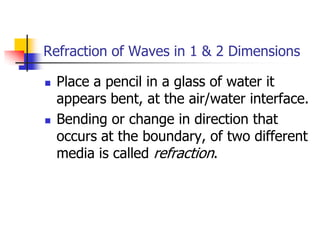
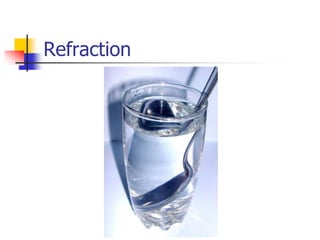
   Place a pencil in a glass of water it
    appears bent, at the air/water interface.
   Bending or change in direction that
    occurs at the boundary, of two different
    media is called refraction.
Refraction of Waves in 1 & 2 Dimensions

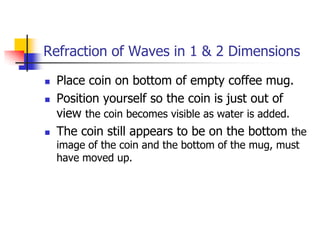
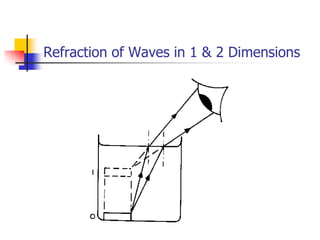
   Place coin on bottom of empty coffee mug.
   Position yourself so the coin is just out of
    view the coin becomes visible as water is added.
   The coin still appears to be on the bottom the
    image of the coin and the bottom of the mug, must
    have moved up.
Refraction of Waves in 1 & 2 Dimensions

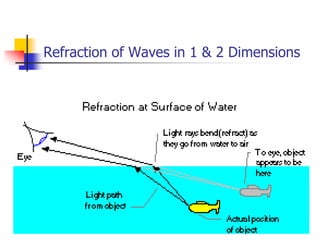
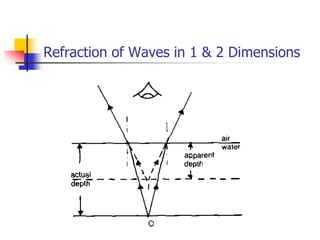
   Water in a pond appears to be only ¾
    its true depth.
   The depth an object appears to be is
    called the apparent depth while its true
    depth is called, the real depth.
Refraction of Waves in 1 & 2 Dimensions


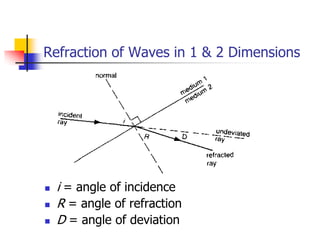
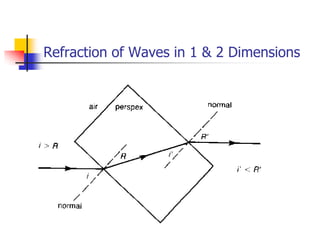
   i = angle of incidence
   R = angle of refraction
   D = angle of deviation
Refraction of Waves in 1 & 2 Dimensions

   Angle of refraction is less than angle of
    incidence when the 2nd medium is more
    optically dense than the first medium,
    such as when light travels from air to
    glass.
   This is reversed when light travels from
    glass to air.
Refraction of Waves in 1 & 2 Dimensions
   Light bends towards the normal when it enters
    a more optically dense medium.
   Light bends away from the normal when it
    enters a less optically dense medium.
   The amount the incident ray is deviated
    depends on the nature of the transparent material
Refraction
Refraction
Refraction
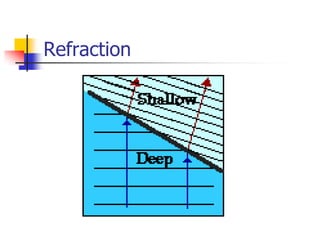
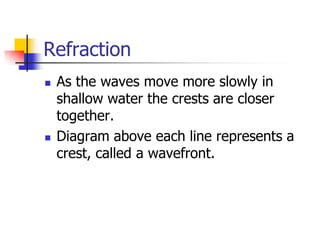
   As the waves move more slowly in
    shallow water the crests are closer
    together.
   Diagram above each line represents a
    crest, called a wavefront.
Refraction
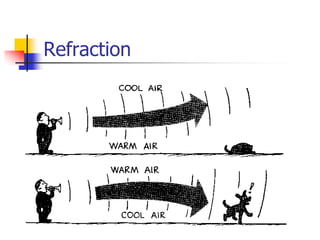
   Waves can also be refracted in air.
   This can happen when winds are
    uneven or, when sound travels through
    air, of uneven temperature.
Refraction
Refraction
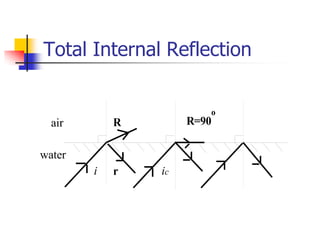
Total Internal Reflection
   Beam of light travelling through water
    hits a water/air interface.
   Some light is refracted some reflected.
Total Internal Reflection
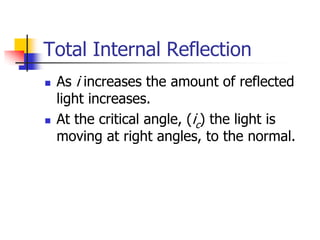
   As i increases the amount of reflected
    light increases.
   At the critical angle, (ic) the light is
    moving at right angles, to the normal.
Total Internal Reflection
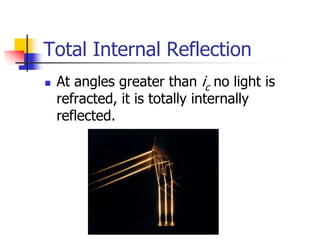
   At angles greater than ic no light is
    refracted, it is totally internally
    reflected.
Total Internal Reflection


                        o
  air       R        R=90

water
        i   r   ic
Applications

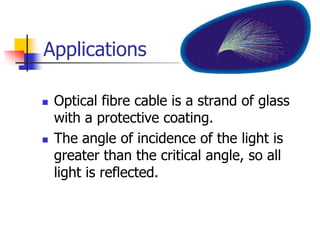
   Optical fibre cable is a strand of glass
    with a protective coating.
   The angle of incidence of the light is
    greater than the critical angle, so all
    light is reflected.
Applications
   This allows the light to be channelled
    around corners, used by anyone from
    mechanics, to doctors and dentists.
Applications
   Communications can also take advantage of
    this phenomenon.
   Copper cables carry information as electrical
    voltages, while optical cables can carry many
    messages, as modulations of laser light in binary
    signals,(‘on’ or ‘off’) at more than 40 million pulses a
    second.

Waves

  • 1.
  • 2.
    WAVES  Energy can be transferred in a number of ways.  A moving car is an example of energy in motion  Not only does the energy move the car moves as well.  Energy can move without the object/particle moving with it.  This occurs in waves.
  • 3.
    Travelling Wave Characteristics  A surfer;  sitting on their board,  waiting for the right wave.  While waiting;  ocean waves pass under him,  while he bobs up and down.  Flick a slinky spring;  wave passes along the slinky while,  particles move up and down.
  • 4.
    Travelling Wave Characteristics  Drop a stone in a still pond;  you produce a wave that moves out from the centre,  in ever increasing circles.  Check the water before and after the wave passes,  You find that the water,  remained where it was.
  • 5.
    Travelling Wave Characteristics  In these examples the particles vibrate or oscillate.  The wave has been transferred without a transfer of matter.  The signals from radio and T.V.’s are waves.  Sound and light travel as waves.
  • 6.
    Transverse Waves If you create a wave by shaking a slinky up and down, the motion of the medium is at right angles to the motion of the wave.  This type of wave is called a transverse wave.
  • 7.
    Transverse Waves  Stretched strings in a musical instrument  ocean waves,  radio and light are all examples of transverse waves.
  • 8.
  • 9.
    Longitudinal Waves  When the particles of the medium move in the same direction as the wave, it is known as a longitudinal wave.  They are less common.  Sound travels as a longitudinal wave.
  • 10.
    Longitudinal Waves  In both forms, the energy can be transferred as a single pulse, a number of pulses, or a continuous wave.  Particles may be set in motion by a wave no particle travels far from its initial position.
  • 11.
    Longitudinal Waves  As the wave particles set neighbouring particles into motion the wave is propagated through the medium, energy is transferred in the medium.
  • 12.
    Longitudinal Waves  Wavelength of a longitudinal wave distance between successive compressions or successive rarefactions.
  • 13.
    Defining Terms  Medium:  The substance through which the wave moves the particles making up the medium, are those which are displaced, as the wave moves through it.
  • 14.
    Defining Terms  Displacement:  The distance a particle has moved from its mean position.
  • 15.
    Defining Terms  Crest:  Positive displacement of a transverse wave.  Trough:  Negative displacement of a transverse wave.
  • 16.
  • 17.
    Defining Terms  Compression:  Regions of a longitudinal wave that;  have a high density of particles.  Rarefaction:  Regions of a longitudinal wave that;  have a low density of particles.
  • 18.
  • 19.
  • 20.
    Defining Terms  Wavelength:  The distance covered in a complete wave cycle.  The distance between two consecutive points in phase.  Symbol Greek letter  Unit (SI) metre.
  • 21.
  • 22.
    Defining Terms  Amplitude:  The difference between the maximum displacement and the mean position.  Symbol A  Unit (SI) metre.
  • 23.
  • 24.
    Defining Terms  Period:  The time for one complete oscillation.  Symbol T  Unit (SI) second.
  • 25.
    Defining Terms  Frequency:  Is the number of wavelengths generated by a source in a second.  Symbol f  Unit (SI) Hertz (Hz)
  • 26.
    Defining Terms  Frequency and period are related by the formula; 1 f T
  • 27.
    Defining Terms  Wave Speed:  Is the speed at which a given point on the wave, is travelling through the medium.  The product of frequency and wavelength. Mathematically represented by v =f  Unit (SI) ms-1.
  • 28.
    Defining Terms  Characteristic of the medium the wave travels through.  Sound waves in air typically 330 ms-1 to 350 ms-1 depending on the density of the air and four times faster in water.
  • 29.
    Sound Sound is alongitudinal wave, but it’s speed depends on the medium  Sound in a solid  Sound in a gas  Pulse of sound  Sound in a bell jar  Different atmosphere music playing
  • 30.
    Speed of soundcalculations  What is the speed of sound for each of these: 1. Travels 127m in 0.1 sec 2. Travels 1608 m in 4 sec 3. Travels 1493 cm in 0.01 sec 4. Travels 120km in 10 sec Which answer is speed of sound in water, air, diamond ?
  • 31.
  • 32.
    Sound barrier  As an airplane approaches the speed of sound, shock waves build up, creating increase in drag, loss of lift, and loss of control.  When travelling near the speed of sound, the plane came up against a "sound barrier"--as though the velocity of sound represented a wall through which a plane could not move.  The sound barrier was broken in 1947.
  • 33.
    Shock waves  As an airplane flies faster than the speed of sound, it "pushes" on the sound waves in front of it. They continue to travel at the same speed.  The waves pile up against each other as they are created. These are called shock waves.
  • 34.
    Sonic Booms  The shock waves will move out and back from the plane, towards the ground. There is a sudden change in pressure when the shock wave hits your eardrum. You hear this as a loud sonic boom.
  • 35.
    Summary of WaveSpeeds WAVE TYPE MEDIUM SPEED (ms-1) Sound Carbon Dioxide 260 Air 331 Hydrogen 1290 Pure Water 1410 Sea Water 1450 Glass 5500 Light Vacuum 2.997 x 10⁸ Air 2.998 x 10⁸ Glass (crown) 2.0 x 10⁸ Earthquake Crust 3500 (transverse) 8000 (longitudinal) Mantle 6500 (transverse) 11000 (longitudinal)
  • 36.
    The Behaviour ofWaves  When a wave moves through a medium the velocity and shape of that wave, remains constant.  This is so, no matter what the medium.
  • 37.
  • 38.
  • 39.
    Reflections in oneDimension  When a wave reaches a boundary between two media some or all of the wave bounces back, into the first medium.
  • 40.
    Reflections in oneDimension  A pulse is sent along a slinky spring which is attached at one end to a wall.  All the energy is reflected back along the spring, rather than into the wall.
  • 41.
    Reflections in oneDimension Reflection from a boundary
  • 42.
  • 43.
    Reflections in oneDimension  The pulse becomes inverted as it is reflected.  This is called phase reversal.  This is why metals are so shiny.  A Metal surface is rigid to the light waves that shine upon it.
  • 44.
    Reflections in oneDimension  Most of the light is reflected apart from a small energy loss, due to the friction of, the vibrating electrons in the surface.  Metals can be used as mirrors for this reason.
  • 45.
  • 46.
    Reflections in oneDimension  The part of the spring adjacent to the boundary is free to be displaced, and no phase change occurs on reflection.
  • 47.
    Reflections in oneDimension  If the wall is replaced with a heavy spring as a new medium, some energy is transmitted, some energy is reflected. Reflection from a boundary
  • 48.
  • 49.
    Partial Reflection froma Heavier Spring lighter spring . heavier spring . . .
  • 50.
    Reflections in oneDimension  The heavy spring acts as an imperfect ‘rigid’ boundary, partially reflecting the pulse, with a change of phase but, also partially transmitting it.
  • 51.
    Reflections in oneDimension  Two pulses of reduced amplitude move at speeds characteristic of the media  result.
  • 52.
    Partial Reflection Froma Lighter Spring .
  • 53.
    Reflections in oneDimension  The lighter spring acts as an imperfect ‘free end’, partially reflecting the pulse, without change of phase and, partially transmitting it.  Two pulses with reduced amplitude are produced.
  • 54.
    Reflections in TwoDimensions  In one dimension the reflected wave simply travels back, in the direction from which it came.  In two dimensions, the situation is a little different.
  • 55.
    Reflections in TwoDimensions  Direction of incident & reflected waves described by straight lines called rays.  The incoming ray (incident ray) and the reflected ray makes, equal angles with the normal.
  • 56.
    Reflections in TwoDimensions  Angle between incident ray & normal called the angle of incidence  Angle between the reflected ray & normal called the angle of reflection.
  • 57.
  • 58.
    Reflections in TwoDimensions  Relationship is called Law of reflection.  Law applies equally to both partially reflected and, totally reflected waves.  Stated mathematically:  i= r Reflection of light
  • 59.
    Reflection  If a lit candle is placed in front of a plane mirror, rays of light are reflected in all directions.  There are an infinite number all obey the law of reflection.
  • 60.
    Reflection  The rays diverge from the tip of the flame and continue to diverge upon reflection.  These rays appear to originate from a point located behind the mirror.
  • 61.
    Reflection  This is called a virtual image the light does not actually pass through the image, but behaves as though it virtually did.  The image appears as far behind the mirror as the object is in front of it and, the object and the image is the same.
  • 62.
  • 63.
  • 64.
    Reflection  When the mirror is curved sizes & distances of the object and image, are no longer equal, but the law of reflection still holds.
  • 65.
  • 66.
  • 67.
    Reflection Concave Mirror
  • 68.
    Reflection  For a rough surface each individual ray obeys the law of reflection many different angles light rays encounter in striking a rough surface cause, reflection in many directions.  This is called diffuse reflection.
  • 69.
    Reflection Reflection of Light
  • 70.
  • 71.
    Diffraction Diffraction is the spreading out of a wave as it passes through a gap. ƛ = d waves spread out ƛ < d no change to wave
  • 72.
    Criteria for Interferencein 2 D  Consider a ripple tank with two dippers producing waves, of the same frequency and in phase.  A two dimensional standing wave would be seen.
  • 73.
  • 74.
    Criteria for Interferencein 2 D  Even if the dippers were out of phase by radians ( /2), the 2D standing wave pattern would still be seen.  In both cases, the dippers maintain a constant phase relationship, referred to as mutually coherent sources.
  • 75.
    Criteria for Interferencein 2 D  Mutually coherent wave sources maintain a constant phase relationship.
  • 76.
  • 77.
    Criteria for Interferencein 2 D  For a point to be on a nodal line difference between its distance, from one source and the other source, called the geometric path difference, G.P.D. must be an odd number of half wavelengths.  In the diagram above
  • 78.
    Criteria for Interferencein 2 D  For any point on an antinodal line G.P.D. must be an even number of /2.  This means that reinforcement occurs when G.P.D. = m ,  m = 0,1,2,........
  • 79.
    Criteria for Interferencein 2 D Phase relationship Annulment Reinforcement in phase G.P.D. = (2m+1) /2 G.P.D. = m phase reversal of one wave G.P.D. = m G.P.D. = (2m+1) /2 phase reversal of both waves G.P.D. = (2m+1) /2 G.P.D. = m
  • 80.
    Refraction of Wavesin 1 & 2 Dimensions  Place a pencil in a glass of water it appears bent, at the air/water interface.  Bending or change in direction that occurs at the boundary, of two different media is called refraction.
  • 81.
    Refraction of Wavesin 1 & 2 Dimensions  Place coin on bottom of empty coffee mug.  Position yourself so the coin is just out of view the coin becomes visible as water is added.  The coin still appears to be on the bottom the image of the coin and the bottom of the mug, must have moved up.
  • 82.
    Refraction of Wavesin 1 & 2 Dimensions
  • 83.
    Refraction of Wavesin 1 & 2 Dimensions
  • 84.
    Refraction of Wavesin 1 & 2 Dimensions  Water in a pond appears to be only ¾ its true depth.  The depth an object appears to be is called the apparent depth while its true depth is called, the real depth.
  • 85.
    Refraction of Wavesin 1 & 2 Dimensions
  • 86.
    Refraction of Wavesin 1 & 2 Dimensions  i = angle of incidence  R = angle of refraction  D = angle of deviation
  • 87.
    Refraction of Wavesin 1 & 2 Dimensions  Angle of refraction is less than angle of incidence when the 2nd medium is more optically dense than the first medium, such as when light travels from air to glass.  This is reversed when light travels from glass to air.
  • 88.
    Refraction of Wavesin 1 & 2 Dimensions
  • 89.
    Refraction of Wavesin 1 & 2 Dimensions  Light bends towards the normal when it enters a more optically dense medium.  Light bends away from the normal when it enters a less optically dense medium.  The amount the incident ray is deviated depends on the nature of the transparent material
  • 90.
  • 91.
  • 92.
    Refraction  As the waves move more slowly in shallow water the crests are closer together.  Diagram above each line represents a crest, called a wavefront.
  • 93.
    Refraction  Waves can also be refracted in air.  This can happen when winds are uneven or, when sound travels through air, of uneven temperature.
  • 94.
  • 95.
  • 96.
    Total Internal Reflection  Beam of light travelling through water hits a water/air interface.  Some light is refracted some reflected.
  • 97.
    Total Internal Reflection  As i increases the amount of reflected light increases.  At the critical angle, (ic) the light is moving at right angles, to the normal.
  • 98.
    Total Internal Reflection  At angles greater than ic no light is refracted, it is totally internally reflected.
  • 99.
    Total Internal Reflection o air R R=90 water i r ic
  • 100.
    Applications  Optical fibre cable is a strand of glass with a protective coating.  The angle of incidence of the light is greater than the critical angle, so all light is reflected.
  • 101.
    Applications  This allows the light to be channelled around corners, used by anyone from mechanics, to doctors and dentists.
  • 102.
    Applications  Communications can also take advantage of this phenomenon.  Copper cables carry information as electrical voltages, while optical cables can carry many messages, as modulations of laser light in binary signals,(‘on’ or ‘off’) at more than 40 million pulses a second.