agenda
1. Physics presentations
2. What you should know about light


Updates:
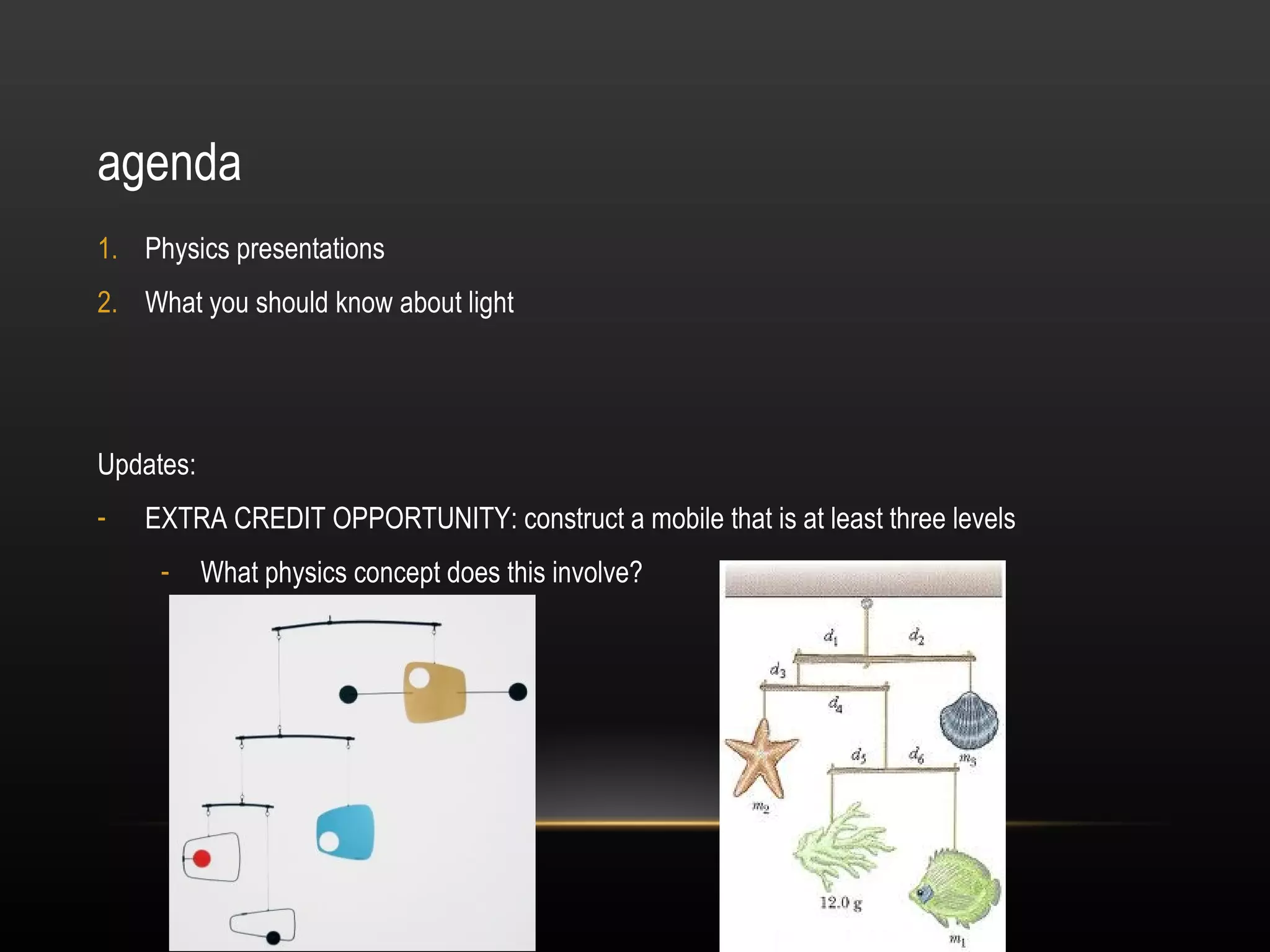
-   EXTRA CREDIT OPPORTUNITY: construct a mobile that is at least three levels
     -     What physics concept does this involve?
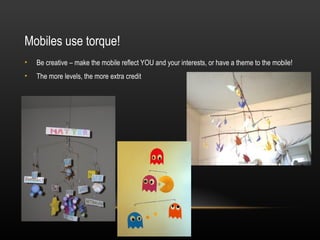
Mobiles use torque!
•   Be creative – make the mobile reflect YOU and your interests, or have a theme to the mobile!
•   The more levels, the more extra credit
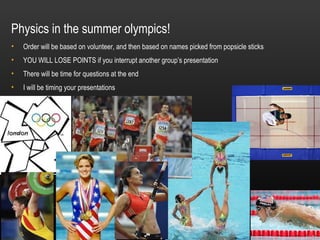
Physics in the summer olympics!
•   Order will be based on volunteer, and then based on names picked from popsicle sticks
•   YOU WILL LOSE POINTS if you interrupt another group’s presentation
•   There will be time for questions at the end
•   I will be timing your presentations
What you should know about light
•   How light supports the wave model of light:
     • It reflects, refracts, diffracts, and can be polarized.
•   Recognize that light has a finite speed
•   Know the order of visible light on the electromagnetic spectrum and how the color of light tells
    us about the wavelength, frequency, and energy contained in light.
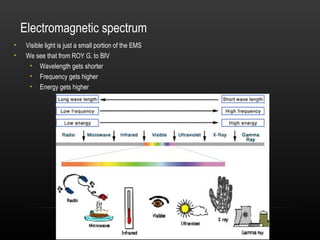
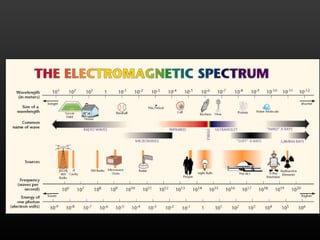
Electromagnetic spectrum
•    Visible light is just a small portion of the EMS
•    We see that from ROY G. to BIV
      • Wavelength gets shorter
      • Frequency gets higher
      • Energy gets higher
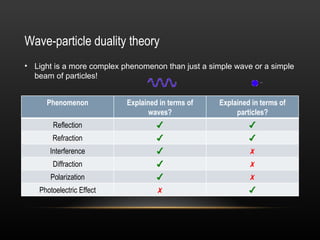
Wave-particle duality theory
• Light is a more complex phenomenon than just a simple wave or a simple
  beam of particles!


     Phenomenon            Explained in terms of    Explained in terms of
                                 waves?                  particles?
       Reflection                   ✔                        ✔
       Refraction                   ✔                        ✔
      Interference                  ✔                        ✗
       Diffraction                  ✔                        ✗
      Polarization                  ✔                        ✗
   Photoelectric Effect             ✗                        ✔
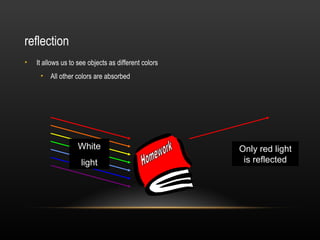
reflection
•   It allows us to see objects as different colors
     • All other colors are absorbed


                    White                             Only red light
                     light                             is reflected
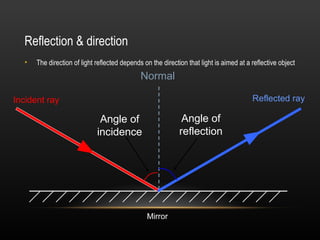
Reflection & direction
  •   The direction of light reflected depends on the direction that light is aimed at a reflective object
                                              Normal

Incident ray                                                                             Reflected ray

                              Angle of                        Angle of
                             incidence                       reflection


                                                Mirror
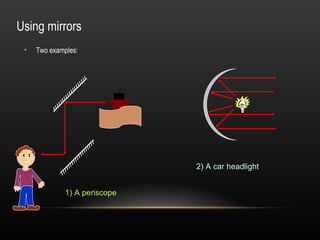
Using mirrors
 •   Two examples:


                               2) A car headlight


              1) A periscope
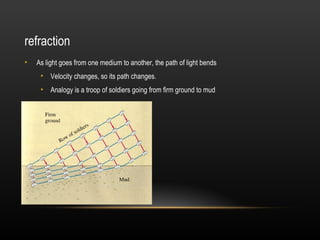
refraction
•   As light goes from one medium to another, the path of light bends
     • Velocity changes, so its path changes.
     • Analogy is a troop of soldiers going from firm ground to mud
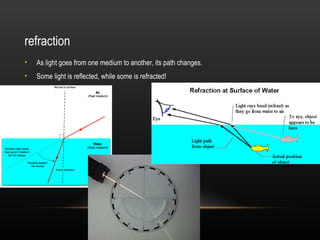
refraction
•   As light goes from one medium to another, its path changes.
•   Some light is reflected, while some is refracted!
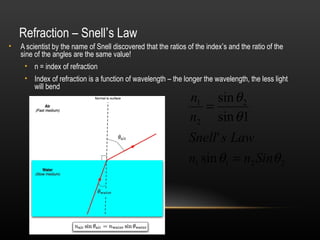
Refraction – Snell’s Law
•   A scientist by the name of Snell discovered that the ratios of the index’s and the ratio of the
    sine of the angles are the same value!
     • n = index of refraction
     • Index of refraction is a function of wavelength – the longer the wavelength, the less light
       will bend
                                                                 n1 sin θ 2
                                                                   =
                                                                 n2 sin θ 1
                                                                Snell ' s Law
                                                                n1 sin θ1 = n2 Sinθ 2
refraction
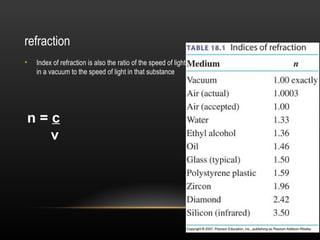
•   Index of refraction is also the ratio of the speed of light
    in a vacuum to the speed of light in that substance


n=c
  v
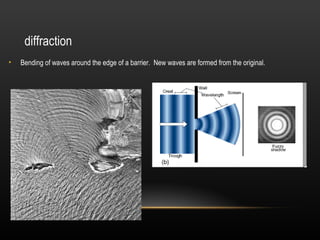
diffraction
•   Bending of waves around the edge of a barrier. New waves are formed from the original.
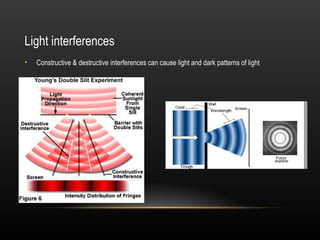
Light interferences
•   Constructive & destructive interferences can cause light and dark patterns of light
dispersion
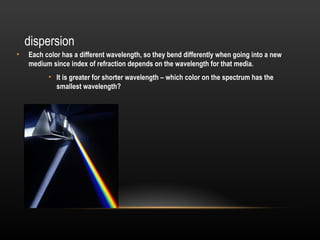
•   Each color has a different wavelength, so they bend differently when going into a new
    medium since index of refraction depends on the wavelength for that media.
          • It is greater for shorter wavelength – which color on the spectrum has the
            smallest wavelength?
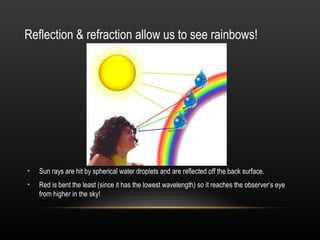
Reflection & refraction allow us to see rainbows!


•   Sun rays are hit by spherical water droplets and are reflected off the back surface.
•   Red is bent the least (since it has the lowest wavelength) so it reaches the observer’s eye
    from higher in the sky!
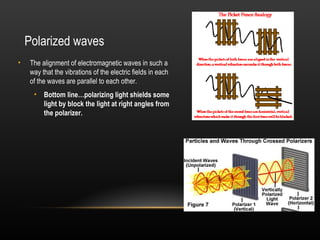
Polarized waves
    P


•       The alignment of electromagnetic waves in such a
        way that the vibrations of the electric fields in each
        of the waves are parallel to each other.
         • Bottom line…polarizing light shields some
           light by block the light at right angles from
           the polarizer.
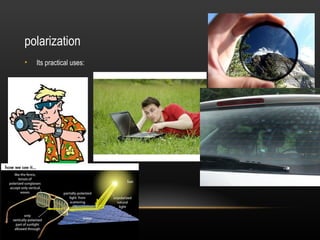
polarization
•   Its practical uses:
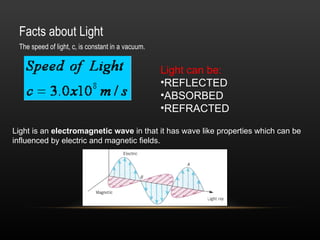
Facts about Light
 The speed of light, c, is constant in a vacuum.


                                                   Light can be:
                                                   •REFLECTED
                                                   •ABSORBED
                                                   •REFRACTED

Light is an electromagnetic wave in that it has wave like properties which can be
influenced by electric and magnetic fields.
sources
•   http://www.bowlesphysics.com

Light website

  • 1.
    agenda 1. Physics presentations 2.What you should know about light Updates: - EXTRA CREDIT OPPORTUNITY: construct a mobile that is at least three levels - What physics concept does this involve?
  • 2.
    Mobiles use torque! • Be creative – make the mobile reflect YOU and your interests, or have a theme to the mobile! • The more levels, the more extra credit
  • 3.
    Physics in thesummer olympics! • Order will be based on volunteer, and then based on names picked from popsicle sticks • YOU WILL LOSE POINTS if you interrupt another group’s presentation • There will be time for questions at the end • I will be timing your presentations
  • 4.
    What you shouldknow about light • How light supports the wave model of light: • It reflects, refracts, diffracts, and can be polarized. • Recognize that light has a finite speed • Know the order of visible light on the electromagnetic spectrum and how the color of light tells us about the wavelength, frequency, and energy contained in light.
  • 5.
    Electromagnetic spectrum • Visible light is just a small portion of the EMS • We see that from ROY G. to BIV • Wavelength gets shorter • Frequency gets higher • Energy gets higher
  • 7.
    Wave-particle duality theory •Light is a more complex phenomenon than just a simple wave or a simple beam of particles! Phenomenon Explained in terms of Explained in terms of waves? particles? Reflection ✔ ✔ Refraction ✔ ✔ Interference ✔ ✗ Diffraction ✔ ✗ Polarization ✔ ✗ Photoelectric Effect ✗ ✔
  • 8.
    reflection • It allows us to see objects as different colors • All other colors are absorbed White Only red light light is reflected
  • 9.
    Reflection & direction • The direction of light reflected depends on the direction that light is aimed at a reflective object Normal Incident ray Reflected ray Angle of Angle of incidence reflection Mirror
  • 10.
    Using mirrors • Two examples: 2) A car headlight 1) A periscope
  • 11.
    refraction • As light goes from one medium to another, the path of light bends • Velocity changes, so its path changes. • Analogy is a troop of soldiers going from firm ground to mud
  • 12.
    refraction • As light goes from one medium to another, its path changes. • Some light is reflected, while some is refracted!
  • 13.
    Refraction – Snell’sLaw • A scientist by the name of Snell discovered that the ratios of the index’s and the ratio of the sine of the angles are the same value! • n = index of refraction • Index of refraction is a function of wavelength – the longer the wavelength, the less light will bend n1 sin θ 2 = n2 sin θ 1 Snell ' s Law n1 sin θ1 = n2 Sinθ 2
  • 14.
    refraction • Index of refraction is also the ratio of the speed of light in a vacuum to the speed of light in that substance n=c v
  • 15.
    diffraction • Bending of waves around the edge of a barrier. New waves are formed from the original.
  • 16.
    Light interferences • Constructive & destructive interferences can cause light and dark patterns of light
  • 17.
    dispersion • Each color has a different wavelength, so they bend differently when going into a new medium since index of refraction depends on the wavelength for that media. • It is greater for shorter wavelength – which color on the spectrum has the smallest wavelength?
  • 18.
    Reflection & refractionallow us to see rainbows! • Sun rays are hit by spherical water droplets and are reflected off the back surface. • Red is bent the least (since it has the lowest wavelength) so it reaches the observer’s eye from higher in the sky!
  • 19.
    Polarized waves P • The alignment of electromagnetic waves in such a way that the vibrations of the electric fields in each of the waves are parallel to each other. • Bottom line…polarizing light shields some light by block the light at right angles from the polarizer.
  • 20.
    polarization • Its practical uses:
  • 21.
    Facts about Light The speed of light, c, is constant in a vacuum. Light can be: •REFLECTED •ABSORBED •REFRACTED Light is an electromagnetic wave in that it has wave like properties which can be influenced by electric and magnetic fields.
  • 22.
    sources • http://www.bowlesphysics.com