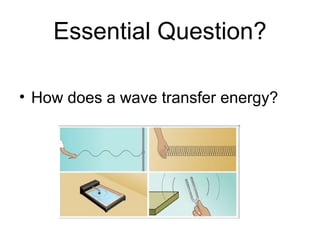
Essential Question?

• How does a wave transfer energy?
Waves
• Wave – a disturbance that carries energy
  through matter or space
• For an example;
• Ocean waves disturb water and transfer energy
  through
• During an earthquakes, energy transferred in
  powerful waves that travel through the earth
• Light is a type of wave that can travel through an
  empty space from one place to another.
Wave – a disturbance that
carries energy through matter
or space


Mechanical waves –require a
medium to travel through
Medium – something that
something travels through


Sound travels through air,
therefore, air is the medium.
Waves in a pond travel
through water, therefore,
water is the medium.
Waves
1. You have learned how Newton's laws of
    motion and principles of conservation of
    energy govern the behavior of particles.
2. These laws and principles also govern the
    motion of waves.
3. There are many types of waves that
    transmit energy even the ones you
    cannot see.
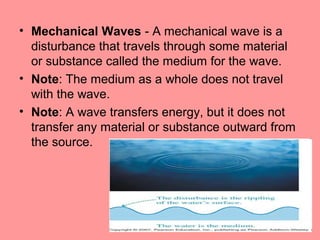
• Mechanical Waves - A mechanical wave is a
  disturbance that travels through some material
  or substance called the medium for the wave.
• Note: The medium as a whole does not travel
  with the wave.
• Note: A wave transfers energy, but it does not
  transfer any material or substance outward from
  the source.
Waves carry energy because
they can do work.
Water waves can move an object
up and down or throw it on a
beach.
Sound waves move your eardrum
and you hear.
Light waves allow your eye to see
and can make an image on film.
Most waves are caused by a
vibration.
Particles in a medium can vibrate
either up and down or back and
forth.

Waves are classified by the
direction that the particles in the
medium move as a wave passes
by.
Wave Phenomenon

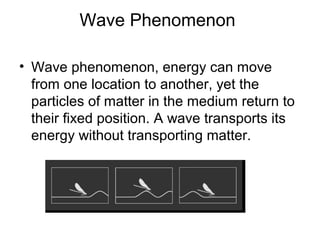
• Wave phenomenon, energy can move
  from one location to another, yet the
  particles of matter in the medium return to
  their fixed position. A wave transports its
  energy without transporting matter.
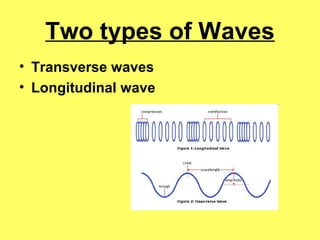
Two types of Waves
• Transverse waves
• Longitudinal wave
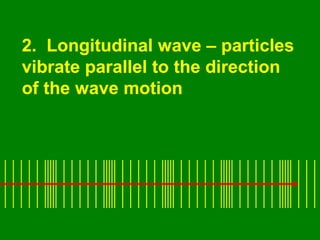
2. Longitudinal wave – particles
vibrate parallel to the direction
of the wave motion
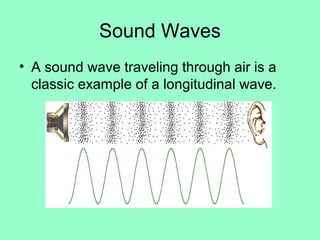
Sound Waves
• A sound wave traveling through air is a
  classic example of a longitudinal wave.
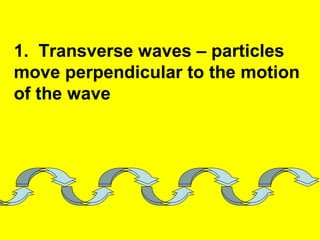
1. Transverse waves – particles
move perpendicular to the motion
of the wave
Transverse waves
• Waves in the electromagnetic spectrum
  are Transverse Waves
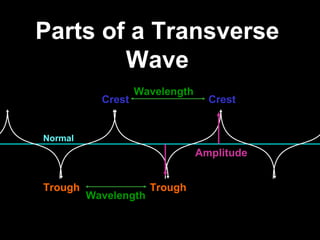
Parts of a Transverse
        Wave
                   Wavelength
           Crest                  Crest


Normal
                                Amplitude


Trough                Trough
         Wavelength
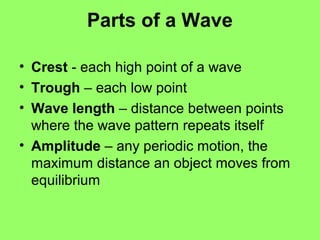
Parts of a Wave

• Crest - each high point of a wave
• Trough – each low point
• Wave length – distance between points
  where the wave pattern repeats itself
• Amplitude – any periodic motion, the
  maximum distance an object moves from
  equilibrium
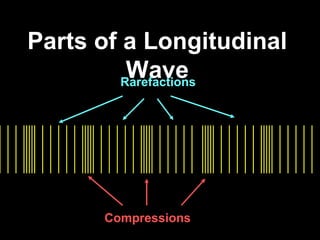
Parts of a Longitudinal
          Wave
         Rarefactions


      Compressions
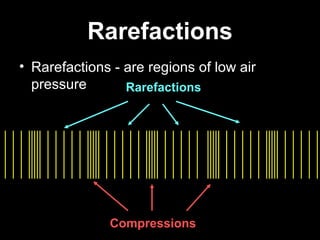
Rarefactions
• Rarefactions - are regions of low air
  pressure       Rarefactions


              Compressions
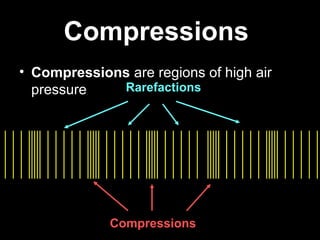
Compressions
• Compressions are regions of high air
  pressure   Rarefactions


             Compressions
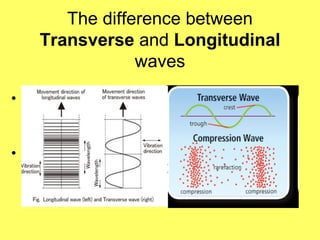
The difference between
    Transverse and Longitudinal
                waves

• Transverse waves -are those in which
  displacement of particle is perpendicular
  to that of propagation of wave.
• Longitudinal waves - are those in which
  displacement of the particle is in a
  direction parallel to that of propagation.
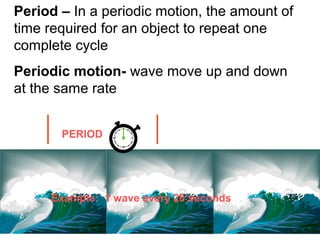
Period – In a periodic motion, the amount of
time required for an object to repeat one
complete cycle
Periodic motion- wave move up and down
at the same rate


       PERIOD


     Example: 1 wave every 20 seconds
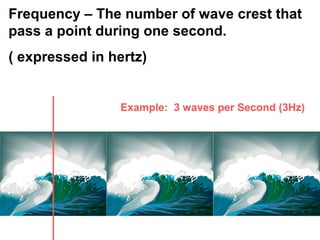
Frequency – The number of wave crest that
pass a point during one second.
( expressed in hertz)


                Example: 3 waves per Second (3Hz)
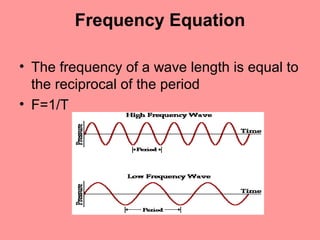
Frequency Equation

• The frequency of a wave length is equal to
  the reciprocal of the period
• F=1/T
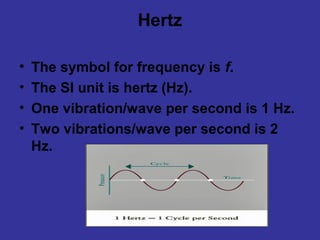
Hertz

•   The symbol for frequency is f.
•   The SI unit is hertz (Hz).
•   One vibration/wave per second is 1 Hz.
•   Two vibrations/wave per second is 2
    Hz.
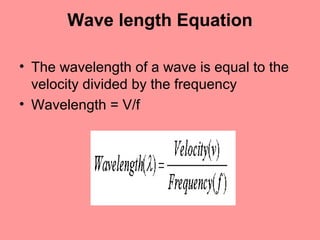
Wave length Equation

• The wavelength of a wave is equal to the
  velocity divided by the frequency
• Wavelength = V/f
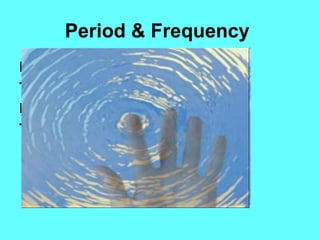
Period & Frequency
Depends on?
The source
Does Not depend on?
The medium and wave’s speed
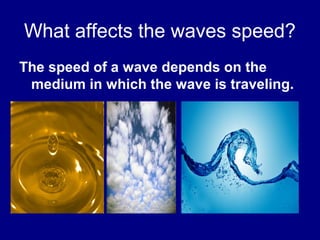
What affects the waves speed?
The speed of a wave depends on the
 medium in which the wave is traveling.
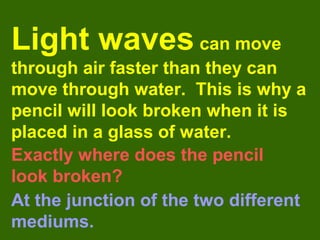
Light waves can move
through air faster than they can
move through water. This is why a
pencil will look broken when it is
placed in a glass of water.
Exactly where does the pencil
look broken?
At the junction of the two different
mediums.
Sound travels faster in
 water than in air. Sound travels
 faster in solids than in liquids.
 Why do you think this is so?
The closer the molecules are, the
easier it will be for the molecules
to bump into one another. This
allows the vibrations to move
faster, thus allowing the wave to
move faster.
Comparing Light & Sound Waves
• Light waves can move through air faster than
  they can move through water. Because?....
• Once the Light Wave enters another medium it
  changes directions and slows down.
• Sound travels faster in water than in air.
  Because?....
• The closer the molecules are, the easier it will be
  for the molecules to bump into one another.
  This allows the vibrations to move faster, thus
  allowing the wave to move faster.
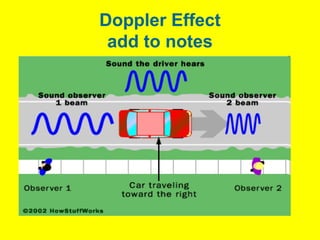
Doppler Effect

Doppler effect – a change in the
 frequency of a wave when the source
 or observer is moving
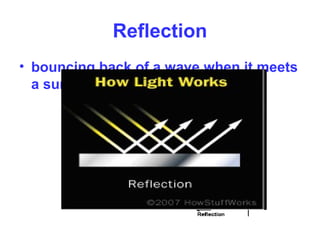
Reflection
• bouncing back of a wave when it meets
  a surface
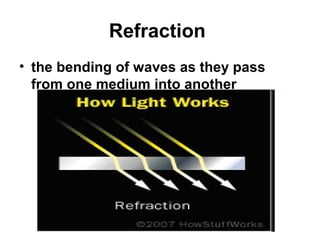
Refraction
• the bending of waves as they pass
  from one medium into another
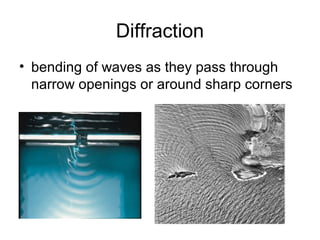
Diffraction
• bending of waves as they pass through
  narrow openings or around sharp corners
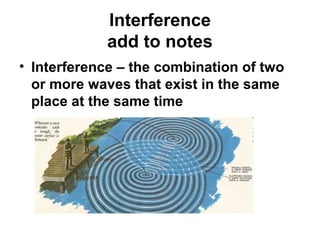
Interference

• Interference – the combination of two
  or more waves that exist in the same
  place at the same time
Interference Waves
• Interference of light is difficult to observe since
  the waves are so small and the vibrations so
  rapid.
• However, interference takes place with any kind
  of wave motion, and the effects of interference
  can be more easily seen by the examining the
  behavior of water waves, which are in many
  ways similar to light waves, but travel more
  slowly and are more easily noticeable.
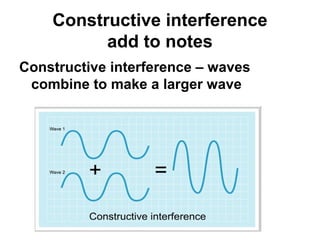
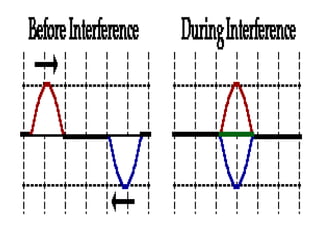
Constructive interference

Constructive interference – waves
 combine to make a larger wave
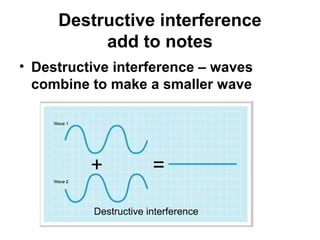
Destructive interference

• Destructive interference – waves
  combine to make a smaller wave
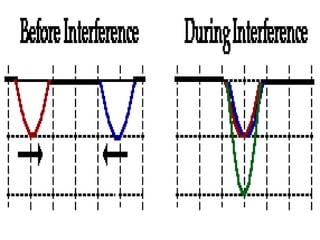
Interference – the combination of
two or more waves that exist in the
same place at the same time


Constructive interference – waves
combine to make a larger wave

Destructive interference – waves
combine to make a smaller wave
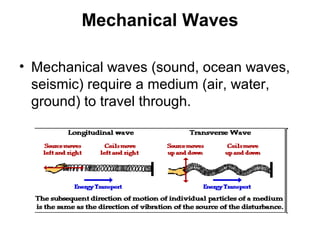
Review
• Mechanical waves (sound, ocean waves,
  seismic) require a medium (air, water,
  ground) to travel through.
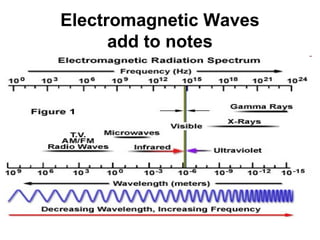
Electromagnetic Waves

Electromagnetic waves – waves that are
  caused by a disturbance in electric and
  magnetic fields and does not require a
  medium to travel through
Electromagnetic waves are produced by
  the vibration of charged particles
Electromagnetic Waves
• Electromagnetic waves are created by the
  vibration of an electric charge.
• This vibration creates a wave which has
  both an electric and a magnetic
  component.
• An electromagnetic wave transports its
  energy through a vacuum at a speed of
  3.00 x 10⁸ m/s (a speed value commonly
  represented by the symbol c).
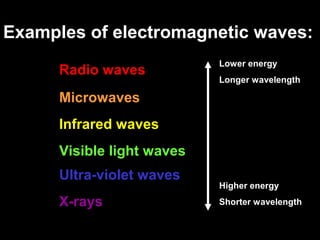
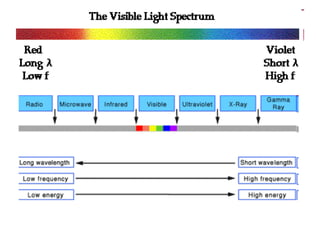
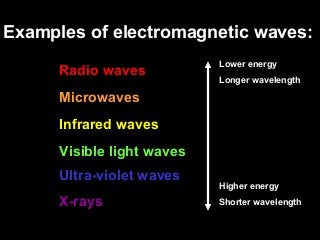
Examples of electromagnetic waves:
                            Lower energy
      Radio waves
                            Longer wavelength

      Microwaves
      Infrared waves
      Visible light waves
      Ultra-violet waves
                            Higher energy
      X-rays                Shorter wavelength
Two types of_waves

Two types of_waves

  • 2.
    Essential Question? • Howdoes a wave transfer energy?
  • 3.
    Waves • Wave –a disturbance that carries energy through matter or space • For an example; • Ocean waves disturb water and transfer energy through • During an earthquakes, energy transferred in powerful waves that travel through the earth • Light is a type of wave that can travel through an empty space from one place to another.
  • 4.
    Wave – adisturbance that carries energy through matter or space Mechanical waves –require a medium to travel through
  • 5.
    Medium – somethingthat something travels through Sound travels through air, therefore, air is the medium. Waves in a pond travel through water, therefore, water is the medium.
  • 6.
    Waves 1. You havelearned how Newton's laws of motion and principles of conservation of energy govern the behavior of particles. 2. These laws and principles also govern the motion of waves. 3. There are many types of waves that transmit energy even the ones you cannot see.
  • 7.
    • Mechanical Waves- A mechanical wave is a disturbance that travels through some material or substance called the medium for the wave. • Note: The medium as a whole does not travel with the wave. • Note: A wave transfers energy, but it does not transfer any material or substance outward from the source.
  • 8.
    Waves carry energybecause they can do work. Water waves can move an object up and down or throw it on a beach. Sound waves move your eardrum and you hear. Light waves allow your eye to see and can make an image on film.
  • 9.
    Most waves arecaused by a vibration. Particles in a medium can vibrate either up and down or back and forth. Waves are classified by the direction that the particles in the medium move as a wave passes by.
  • 10.
    Wave Phenomenon • Wavephenomenon, energy can move from one location to another, yet the particles of matter in the medium return to their fixed position. A wave transports its energy without transporting matter.
  • 11.
    Two types ofWaves • Transverse waves • Longitudinal wave
  • 12.
    2. Longitudinal wave– particles vibrate parallel to the direction of the wave motion
  • 13.
    Sound Waves • Asound wave traveling through air is a classic example of a longitudinal wave.
  • 14.
    1. Transverse waves– particles move perpendicular to the motion of the wave
  • 15.
    Transverse waves • Wavesin the electromagnetic spectrum are Transverse Waves
  • 16.
    Parts of aTransverse Wave Wavelength Crest Crest Normal Amplitude Trough Trough Wavelength
  • 17.
    Parts of aWave • Crest - each high point of a wave • Trough – each low point • Wave length – distance between points where the wave pattern repeats itself • Amplitude – any periodic motion, the maximum distance an object moves from equilibrium
  • 18.
    Parts of aLongitudinal Wave Rarefactions Compressions
  • 19.
    Rarefactions • Rarefactions -are regions of low air pressure Rarefactions Compressions
  • 20.
    Compressions • Compressions areregions of high air pressure Rarefactions Compressions
  • 21.
    The difference between Transverse and Longitudinal waves • Transverse waves -are those in which displacement of particle is perpendicular to that of propagation of wave. • Longitudinal waves - are those in which displacement of the particle is in a direction parallel to that of propagation.
  • 22.
    Period – Ina periodic motion, the amount of time required for an object to repeat one complete cycle Periodic motion- wave move up and down at the same rate PERIOD Example: 1 wave every 20 seconds
  • 23.
    Frequency – Thenumber of wave crest that pass a point during one second. ( expressed in hertz) Example: 3 waves per Second (3Hz)
  • 24.
    Frequency Equation • Thefrequency of a wave length is equal to the reciprocal of the period • F=1/T
  • 25.
    Hertz • The symbol for frequency is f. • The SI unit is hertz (Hz). • One vibration/wave per second is 1 Hz. • Two vibrations/wave per second is 2 Hz.
  • 26.
    Wave length Equation •The wavelength of a wave is equal to the velocity divided by the frequency • Wavelength = V/f
  • 27.
    Period & Frequency Dependson? The source Does Not depend on? The medium and wave’s speed
  • 28.
    What affects thewaves speed? The speed of a wave depends on the medium in which the wave is traveling.
  • 29.
    Light waves canmove through air faster than they can move through water. This is why a pencil will look broken when it is placed in a glass of water. Exactly where does the pencil look broken? At the junction of the two different mediums.
  • 30.
    Sound travels fasterin water than in air. Sound travels faster in solids than in liquids. Why do you think this is so? The closer the molecules are, the easier it will be for the molecules to bump into one another. This allows the vibrations to move faster, thus allowing the wave to move faster.
  • 31.
    Comparing Light &Sound Waves • Light waves can move through air faster than they can move through water. Because?.... • Once the Light Wave enters another medium it changes directions and slows down. • Sound travels faster in water than in air. Because?.... • The closer the molecules are, the easier it will be for the molecules to bump into one another. This allows the vibrations to move faster, thus allowing the wave to move faster.
  • 32.
    Doppler Effect Doppler effect– a change in the frequency of a wave when the source or observer is moving
  • 33.
    Reflection • bouncing backof a wave when it meets a surface
  • 34.
    Refraction • the bendingof waves as they pass from one medium into another
  • 35.
    Diffraction • bending ofwaves as they pass through narrow openings or around sharp corners
  • 36.
    Interference • Interference –the combination of two or more waves that exist in the same place at the same time
  • 37.
    Interference Waves • Interferenceof light is difficult to observe since the waves are so small and the vibrations so rapid. • However, interference takes place with any kind of wave motion, and the effects of interference can be more easily seen by the examining the behavior of water waves, which are in many ways similar to light waves, but travel more slowly and are more easily noticeable.
  • 38.
    Constructive interference Constructive interference– waves combine to make a larger wave
  • 39.
    Destructive interference • Destructiveinterference – waves combine to make a smaller wave
  • 42.
    Interference – thecombination of two or more waves that exist in the same place at the same time Constructive interference – waves combine to make a larger wave Destructive interference – waves combine to make a smaller wave
  • 43.
    Review • Mechanical waves(sound, ocean waves, seismic) require a medium (air, water, ground) to travel through.
  • 44.
    Electromagnetic Waves Electromagnetic waves– waves that are caused by a disturbance in electric and magnetic fields and does not require a medium to travel through Electromagnetic waves are produced by the vibration of charged particles
  • 45.
  • 46.
    Electromagnetic Waves • Electromagneticwaves are created by the vibration of an electric charge. • This vibration creates a wave which has both an electric and a magnetic component. • An electromagnetic wave transports its energy through a vacuum at a speed of 3.00 x 10⁸ m/s (a speed value commonly represented by the symbol c).
  • 47.
    Examples of electromagneticwaves: Lower energy Radio waves Longer wavelength Microwaves Infrared waves Visible light waves Ultra-violet waves Higher energy X-rays Shorter wavelength