CONGESTIVE CARDIAC FAILURE
PRESENTED BY
THUSHARA. C
1st YEAR M.PHARM
GRACE COLLEGE OF PHARM
CONTENTS
1. DEFINITION
2.CLASSIFICATION
3. ETIOLOGY
4.CLINICAL MANIFESTATION
5.PATHOPHYSIOLOGY
6.DIAGNOSIS
7.MANAGEMENT
DEFINITION
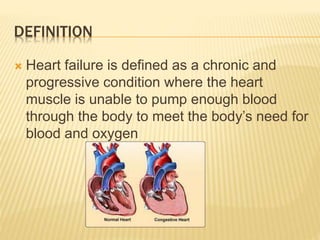
 Heart failure is defined as a chronic and
progressive condition where the heart
muscle is unable to pump enough blood
through the body to meet the body’s need for
blood and oxygen
CLASSIFICATION
 Systolic heart failure
 Diastolic heart failure
 Acute heart failure
 Chronic heart failure
 Left side heart failure
 Right side heart failure
ETIOLOGY
 Arrythmias
 Myocardial infraction
 Hypertension
 Anemia
 Atherosclerosis
 Infection
Obesity
Alcohol and tobaco use
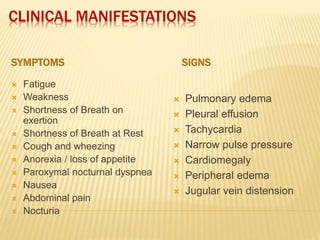
CLINICAL MANIFESTATIONS
SYMPTOMS SIGNS
 Fatigue
 Weakness
 Shortness of Breath on
exertion
 Shortness of Breath at Rest
 Cough and wheezing
 Anorexia / loss of appetite
 Paroxymal nocturnal dyspnea
 Nausea
 Abdominal pain
 Nocturia
 Pulmonary edema
 Pleural effusion
 Tachycardia
 Narrow pulse pressure
 Cardiomegaly
 Peripheral edema
 Jugular vein distension
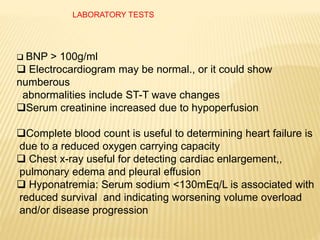
LABORATORY TESTS
 BNP > 100g/ml
 Electrocardiogram may be normal., or it could show
numberous
abnormalities include ST-T wave changes
Serum creatinine increased due to hypoperfusion
Complete blood count is useful to determining heart failure is
due to a reduced oxygen carrying capacity
 Chest x-ray useful for detecting cardiac enlargement,,
pulmonary edema and pleural effusion
 Hyponatremia: Serum sodium <130mEq/L is associated with
reduced survival and indicating worsening volume overload
and/or disease progression
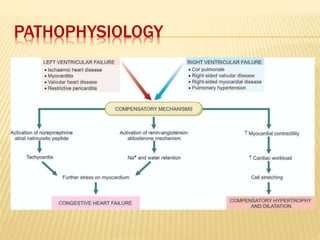
PATHOPHYSIOLOGY
DIAGNOSIS
 Electrocardiogram (ECG)
 Chest x-ray
 Echocardiography (“Echo”)
 Heart catheterization
 Angiography
 Blood tests
MANAGEMENT
NON PHARMACOLOGICAL MANAGEMENT
 Bed rest
 Consuming small but frequent meals
 Moderate sodium restriction (2-4g/day)
 Smoking cessation
 Avoid alcohol intake
TREATMENT (MEDICATION)
 ACE Inhibitors
 Diuretics
 Inotropic Agents
 Beta Blockers
 Calcium Channel Blockers
 Vasodilators
 Digitalis glycosides
 Aldosterone antagonist
 Angiotensin receptor blockers
PHARMACOLOGICAL MANAEMEN
DIURETICS
THIAZIDES
 Hydrochlorothiazide, metolazone, chlorthalidone.
 Block sodium reabsorption in the cortical diluting segment at
the terminal portion of the loop of Henle and in the proximal
portion of the distal convoluted tubule
 Thiazides are ineffective when the GFR falls below 30–40
mL/min.
 Decrease preload and improve ventricular efficiency by
reducing circulating volume
 Remove peripheral edema and pulmonary congestion
 ADR: Hypokalaemia, hearing loss, Hypercalcaemia, Mg
depletion
GIT and CNS disturbances
LOOP DIURETICS
 Furosemide, bumetanide and torsemide.
 Rapid onset and a relatively short duration of
action
 Two or more doses are preferable to a single
larger dose.
 Inhibit chloride reabsorption in the ascending
limb of the loop of henle, which results in
natriuresis, and metabolic alkalosis.
 Increases systemic venous capacitance and
produce rapid symptomatic relief
 ADR: Hpokalaemia, alkalosis
POTASSIUM SPARING DIURESTICS
 Spironolactone, triamterene, and amiloride
 Spironolactone is a specific inhibitor of
aldosterone.
INHIBITORS OF THE
RENIN–ANGIOTENSIN–
ALDOSTERONE
SYSTEM
ACE Inhibitors
•Captoprill, enalaprill, isnoprill
• it inhibit angiotensin converting enzyme
•ACE inhibitors causes feed back increase in renin release resulting in ove
production of Ang1, since its conversion to Ang2 is blocked. Ang1 divert to
Produce more Ang(1-7) which produce vasodilation,
• Decrease in Ang2 and aldosterone attenuates many of the deleterious
effects
this neurohormones , including ventricular remodeling, myocardial
fibrosis,
cardiac hypertrophy , norepinephrine release, sodium and water retention
• ADR : Hypotension, renal insufficiency, dizziness, lightheadedness,
blurred vision, syncope, hyponatremia, hypovolemia, dry cough,
Angioedema
• Contraindicated during second and third trimester of pregnancy due to
increased risk of fetal renal failure.
ANGIOTENSIN RECEPTOR BLOCKERS
Losartan ,candesartan,valsartan
 Angiotensin 2 ,a vasocontrictor is concerned with ventricular remodelling
and fluid retention.
 These drugs inhibit the binding of angiotensin 2 to its AT₁ receptor.
 Thus they preclude the a bove mentioned effects of angiotensin 2.
 These agents do not exert any action on bradykinin and thus do not
produce cough.
 Has comparable effect to ACE I
 Can be used in certain conditions when ACE I are contraindicated
18
Adverse drug reactions
•Hypotension
•Impariment of renal functioning
Dose
Candesartan
•Initial: 4-8mg
•Targeted dose -32mg
Valsartan
•Initial:40mg
•Targeted dose -160mg
INOTROPES
 Increase force of contraction
 All increase intracellular cardiac Ca++ concentration
 Eg:
 Digitalis (cardiac glycoside)
 Dobutamine (β-adrenergic recepter agonist)
 Amrinone (PDE inhibitor)
19
DIGOXIN
20
 It inhibits the
 Functions in the exchange of Na⁺ for k⁺ ions.
 Such blockage results in intracellular
accumulation of Na⁺ ions .
 These ions are then exchanged with Ca₂⁺
ions through Na⁺ - Ca₂⁺ exchange carries.
 These ca₂⁺ ions increase the contractility of
the myocardium which is beneficial to the
failing heart.
 Digoxin enhances the cholinergic activity
which reduces the HR and AV conduction .
 Due to this the time required for diastolic
filling gets enhanced while the myocardial o2
consumption is retarted.
 The sympathetic outflow comprising renin,
aldosterone is also decreased by dioxin
inhibit Na +,K + ATPase , pump which
DRUG REACTION
 Bradycardia
 Nausea
 Vomiting
 Visual disturbances
 Non paroxysomal
junctional tachycardia
 Supraventricular
tachycardia
 Sexual dysfunction
 Neuralgic pain
USES:
 For tachyarrhythmias
 For ventricular
arrhythmias
21
 Dopamine acts at a variety of receptors (dose dependant)
 Rapid elimination- can only be administered as a continuous infusion
22
•Stimulates beta-adrenergic receptors and produces a positive
inotropic response.
•Unlike the vasoconstriction seen with high doses of dopamine,
dobutamine produces a mild vasodilatation
β -Adrenergic Agonists
DOPAMINE
DOBUTAMINE
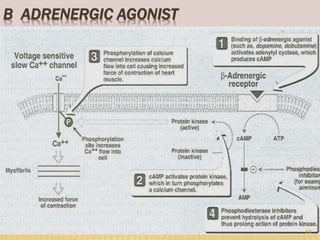
Β ADRENERGIC AGONIST
23
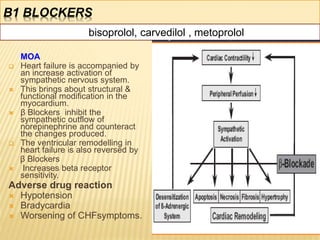
Β1 BLOCKERS
MOA
 Heart failure is accompanied by
an increase activation of
sympathetic nervous system.
 This brings about structural &
functional modification in the
myocardium.
 β Blockers inhibit the
sympathetic outflow of
norepinephrine and counteract
the changes produced.
 The ventricular remodelling in
heart failure is also reversed by
β Blockers
 Increases beta receptor
sensitivity.
Adverse drug reaction
 Hypotension
 Bradycardia
 Worsening of CHFsymptoms.
24
bisoprolol, carvedilol , metoprolol
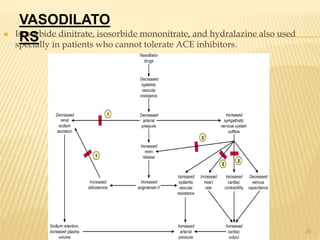
 Isosorbide dinitrate, isosorbide mononitrate, and hydralazine also used
specially in patients who cannot tolerate ACE inhibitors.
25
VASODILATO
RS
VASODILATOR(HYDRALAZINE)
 It directly relaxes the arterioles & arteries reducing the peripheral
vascular reesistances & preload.
 It also help to reduce after load.
Adverse drug reaction:
 Nausea
 Palpitation
 Tachycardia
 Salt & water retention on prolong therapy.
26
BIPYRIDINES
PHOSPHODIESTERASE INHIBITORS
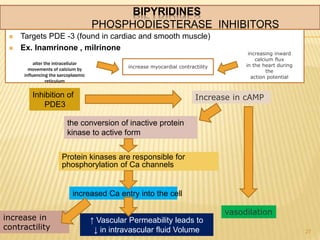
 Targets PDE -3 (found in cardiac and smooth muscle)
 Ex. Inamrinone , milrinone
27
alter the intracellular
movements of calcium by
influencing the sarcoplasmic
reticulum
increasing inward
calcium flux
in the heart during
the
action potential
increase myocardial contractility
Inhibition of
PDE3
Increase in cAMP
the conversion of inactive protein
kinase to active form
Protein kinases are responsible for
phosphorylation of Ca channels
increased Ca entry into the cell
↑ Vascular Permeability leads to
↓ in intravascular fluid Volume
increase in
contractility
vasodilation
NITRATES & NITRITES
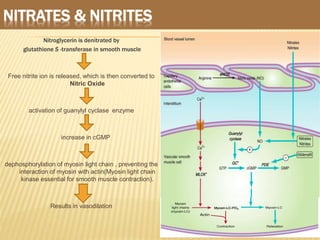
Nitroglycerin is denitrated by
glutathione S -transferase in smooth muscle
Free nitrite ion is released, which is then converted to
Nitric Oxide
activation of guanylyl cyclase enzyme
increase in cGMP
dephosphorylation of myosin light chain , preventing the
interaction of myosin with actin(Myosin light chain
kinase essential for smooth muscle contraction).
Results in vasodilation
28
CALCIUM CHANNEL BLOCKERS
 Verapamil, diltiazam, nefedipine
 It blocks the calcium channel and prevent the entry of calcium in to the
cell
 There by prevent the contraction and arterial dialation occur
The beneficial effects of spironolactone derive from the
direct and competitive blockade of specific aldosterone
receptors.
Aldosterone inhibitors therefore have three types of effects: -
 Diuretic effect, which is most noticeable when fluid retention
and
increased levels of aldosterone are present
Antiarrhythmic effect, mediated by the correction of
hypokalemia
and hypomagnesaemia.
Antifibrotic effect. This effect, demonstrated in animal models,
can
contribute to a decrease in the progression of structural changes
in
patients with heart failure.
ALDOSTERONE RECEPTOR ANTAGONIST
• EG: SPIRONOLACTONE
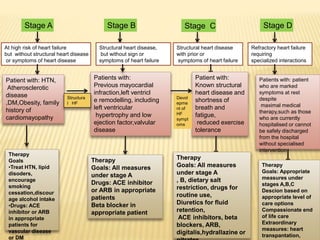
Stage A
At high risk of heart failure
but without structural heart disease
or symptoms of heart disease
Stage B
Structural heart disease,
but without sign or
symptoms of heart failure
Stage C
Structural heart disease
with prior or
symptoms of heart failure
Stage D
Refractory heart failure
requiring
specialized interactions
Patient with: HTN,
Atherosclerotic
disease
,DM,Obesity, family
history of
cardiomayopathy
Patients with:
Previous mayocardial
infraction,left ventricl
e remodelling, including
left ventricular
hypertrophy and low
ejection factor,valvular
disease
Patient with:
Known structural
heart disease and
shortness of
breath and
fatigue,
reduced exercise
tolerance
Patients with: patient
who are marked
symptoms at rest
despite
maximal medical
therapy,such as those
who are currently
hospitalised or cannot
be safely discharged
from the hospital
without specialised
intervention
Structura
l HF
Devol
epme
nt of
HF
sympt
oms
Therapy
Goals
•Treat HTN, lipid
disoders,
encourage
smoking
cessation,discour
age alcohol intake
•Drugs: ACE
inhibitor or ARB
in appropriate
patients for
vascular disease
or DM
Therapy
Goals: All measures
under stage A
Drugs: ACE inhibitor
or ARB in appropriate
patients
Βeta blocker in
appropriate patient
Therapy
Goals: All measures
under stage A
, B, dietary salt
restriction, drugs for
routine use,
Diuretics for fluid
retention,
ACE inhibitors, beta
blockers, ARB,
digitalis,hydrallazine or
Therapy
Goals: Appropriate
measures under
stages A,B,C
Descion based on
appropriate level of
care options
Compassionate end
of life care
Extraordinary
measures: heart
transpantation,
Heart failure ppt

Heart failure ppt

  • 1.
    CONGESTIVE CARDIAC FAILURE PRESENTEDBY THUSHARA. C 1st YEAR M.PHARM GRACE COLLEGE OF PHARM
  • 2.
    CONTENTS 1. DEFINITION 2.CLASSIFICATION 3. ETIOLOGY 4.CLINICALMANIFESTATION 5.PATHOPHYSIOLOGY 6.DIAGNOSIS 7.MANAGEMENT
  • 3.
    DEFINITION  Heart failureis defined as a chronic and progressive condition where the heart muscle is unable to pump enough blood through the body to meet the body’s need for blood and oxygen
  • 4.
    CLASSIFICATION  Systolic heartfailure  Diastolic heart failure  Acute heart failure  Chronic heart failure  Left side heart failure  Right side heart failure
  • 5.
    ETIOLOGY  Arrythmias  Myocardialinfraction  Hypertension  Anemia  Atherosclerosis  Infection Obesity Alcohol and tobaco use
  • 6.
    CLINICAL MANIFESTATIONS SYMPTOMS SIGNS Fatigue  Weakness  Shortness of Breath on exertion  Shortness of Breath at Rest  Cough and wheezing  Anorexia / loss of appetite  Paroxymal nocturnal dyspnea  Nausea  Abdominal pain  Nocturia  Pulmonary edema  Pleural effusion  Tachycardia  Narrow pulse pressure  Cardiomegaly  Peripheral edema  Jugular vein distension
  • 7.
    LABORATORY TESTS  BNP> 100g/ml  Electrocardiogram may be normal., or it could show numberous abnormalities include ST-T wave changes Serum creatinine increased due to hypoperfusion Complete blood count is useful to determining heart failure is due to a reduced oxygen carrying capacity  Chest x-ray useful for detecting cardiac enlargement,, pulmonary edema and pleural effusion  Hyponatremia: Serum sodium <130mEq/L is associated with reduced survival and indicating worsening volume overload and/or disease progression
  • 8.
  • 9.
    DIAGNOSIS  Electrocardiogram (ECG) Chest x-ray  Echocardiography (“Echo”)  Heart catheterization  Angiography  Blood tests
  • 10.
    MANAGEMENT NON PHARMACOLOGICAL MANAGEMENT Bed rest  Consuming small but frequent meals  Moderate sodium restriction (2-4g/day)  Smoking cessation  Avoid alcohol intake
  • 11.
    TREATMENT (MEDICATION)  ACEInhibitors  Diuretics  Inotropic Agents  Beta Blockers  Calcium Channel Blockers  Vasodilators  Digitalis glycosides  Aldosterone antagonist  Angiotensin receptor blockers PHARMACOLOGICAL MANAEMEN
  • 12.
  • 13.
    THIAZIDES  Hydrochlorothiazide, metolazone,chlorthalidone.  Block sodium reabsorption in the cortical diluting segment at the terminal portion of the loop of Henle and in the proximal portion of the distal convoluted tubule  Thiazides are ineffective when the GFR falls below 30–40 mL/min.  Decrease preload and improve ventricular efficiency by reducing circulating volume  Remove peripheral edema and pulmonary congestion  ADR: Hypokalaemia, hearing loss, Hypercalcaemia, Mg depletion GIT and CNS disturbances
  • 14.
    LOOP DIURETICS  Furosemide,bumetanide and torsemide.  Rapid onset and a relatively short duration of action  Two or more doses are preferable to a single larger dose.  Inhibit chloride reabsorption in the ascending limb of the loop of henle, which results in natriuresis, and metabolic alkalosis.  Increases systemic venous capacitance and produce rapid symptomatic relief  ADR: Hpokalaemia, alkalosis
  • 15.
    POTASSIUM SPARING DIURESTICS Spironolactone, triamterene, and amiloride  Spironolactone is a specific inhibitor of aldosterone.
  • 16.
  • 17.
    ACE Inhibitors •Captoprill, enalaprill,isnoprill • it inhibit angiotensin converting enzyme •ACE inhibitors causes feed back increase in renin release resulting in ove production of Ang1, since its conversion to Ang2 is blocked. Ang1 divert to Produce more Ang(1-7) which produce vasodilation, • Decrease in Ang2 and aldosterone attenuates many of the deleterious effects this neurohormones , including ventricular remodeling, myocardial fibrosis, cardiac hypertrophy , norepinephrine release, sodium and water retention • ADR : Hypotension, renal insufficiency, dizziness, lightheadedness, blurred vision, syncope, hyponatremia, hypovolemia, dry cough, Angioedema • Contraindicated during second and third trimester of pregnancy due to increased risk of fetal renal failure.
  • 18.
    ANGIOTENSIN RECEPTOR BLOCKERS Losartan,candesartan,valsartan  Angiotensin 2 ,a vasocontrictor is concerned with ventricular remodelling and fluid retention.  These drugs inhibit the binding of angiotensin 2 to its AT₁ receptor.  Thus they preclude the a bove mentioned effects of angiotensin 2.  These agents do not exert any action on bradykinin and thus do not produce cough.  Has comparable effect to ACE I  Can be used in certain conditions when ACE I are contraindicated 18 Adverse drug reactions •Hypotension •Impariment of renal functioning Dose Candesartan •Initial: 4-8mg •Targeted dose -32mg Valsartan •Initial:40mg •Targeted dose -160mg
  • 19.
    INOTROPES  Increase forceof contraction  All increase intracellular cardiac Ca++ concentration  Eg:  Digitalis (cardiac glycoside)  Dobutamine (β-adrenergic recepter agonist)  Amrinone (PDE inhibitor) 19
  • 20.
    DIGOXIN 20  It inhibitsthe  Functions in the exchange of Na⁺ for k⁺ ions.  Such blockage results in intracellular accumulation of Na⁺ ions .  These ions are then exchanged with Ca₂⁺ ions through Na⁺ - Ca₂⁺ exchange carries.  These ca₂⁺ ions increase the contractility of the myocardium which is beneficial to the failing heart.  Digoxin enhances the cholinergic activity which reduces the HR and AV conduction .  Due to this the time required for diastolic filling gets enhanced while the myocardial o2 consumption is retarted.  The sympathetic outflow comprising renin, aldosterone is also decreased by dioxin inhibit Na +,K + ATPase , pump which
  • 21.
    DRUG REACTION  Bradycardia Nausea  Vomiting  Visual disturbances  Non paroxysomal junctional tachycardia  Supraventricular tachycardia  Sexual dysfunction  Neuralgic pain USES:  For tachyarrhythmias  For ventricular arrhythmias 21
  • 22.
     Dopamine actsat a variety of receptors (dose dependant)  Rapid elimination- can only be administered as a continuous infusion 22 •Stimulates beta-adrenergic receptors and produces a positive inotropic response. •Unlike the vasoconstriction seen with high doses of dopamine, dobutamine produces a mild vasodilatation β -Adrenergic Agonists DOPAMINE DOBUTAMINE
  • 23.
  • 24.
    Β1 BLOCKERS MOA  Heartfailure is accompanied by an increase activation of sympathetic nervous system.  This brings about structural & functional modification in the myocardium.  β Blockers inhibit the sympathetic outflow of norepinephrine and counteract the changes produced.  The ventricular remodelling in heart failure is also reversed by β Blockers  Increases beta receptor sensitivity. Adverse drug reaction  Hypotension  Bradycardia  Worsening of CHFsymptoms. 24 bisoprolol, carvedilol , metoprolol
  • 25.
     Isosorbide dinitrate,isosorbide mononitrate, and hydralazine also used specially in patients who cannot tolerate ACE inhibitors. 25 VASODILATO RS
  • 26.
    VASODILATOR(HYDRALAZINE)  It directlyrelaxes the arterioles & arteries reducing the peripheral vascular reesistances & preload.  It also help to reduce after load. Adverse drug reaction:  Nausea  Palpitation  Tachycardia  Salt & water retention on prolong therapy. 26
  • 27.
    BIPYRIDINES PHOSPHODIESTERASE INHIBITORS  TargetsPDE -3 (found in cardiac and smooth muscle)  Ex. Inamrinone , milrinone 27 alter the intracellular movements of calcium by influencing the sarcoplasmic reticulum increasing inward calcium flux in the heart during the action potential increase myocardial contractility Inhibition of PDE3 Increase in cAMP the conversion of inactive protein kinase to active form Protein kinases are responsible for phosphorylation of Ca channels increased Ca entry into the cell ↑ Vascular Permeability leads to ↓ in intravascular fluid Volume increase in contractility vasodilation
  • 28.
    NITRATES & NITRITES Nitroglycerinis denitrated by glutathione S -transferase in smooth muscle Free nitrite ion is released, which is then converted to Nitric Oxide activation of guanylyl cyclase enzyme increase in cGMP dephosphorylation of myosin light chain , preventing the interaction of myosin with actin(Myosin light chain kinase essential for smooth muscle contraction). Results in vasodilation 28
  • 29.
    CALCIUM CHANNEL BLOCKERS Verapamil, diltiazam, nefedipine  It blocks the calcium channel and prevent the entry of calcium in to the cell  There by prevent the contraction and arterial dialation occur
  • 30.
    The beneficial effectsof spironolactone derive from the direct and competitive blockade of specific aldosterone receptors. Aldosterone inhibitors therefore have three types of effects: -  Diuretic effect, which is most noticeable when fluid retention and increased levels of aldosterone are present Antiarrhythmic effect, mediated by the correction of hypokalemia and hypomagnesaemia. Antifibrotic effect. This effect, demonstrated in animal models, can contribute to a decrease in the progression of structural changes in patients with heart failure. ALDOSTERONE RECEPTOR ANTAGONIST • EG: SPIRONOLACTONE
  • 31.
    Stage A At highrisk of heart failure but without structural heart disease or symptoms of heart disease Stage B Structural heart disease, but without sign or symptoms of heart failure Stage C Structural heart disease with prior or symptoms of heart failure Stage D Refractory heart failure requiring specialized interactions Patient with: HTN, Atherosclerotic disease ,DM,Obesity, family history of cardiomayopathy Patients with: Previous mayocardial infraction,left ventricl e remodelling, including left ventricular hypertrophy and low ejection factor,valvular disease Patient with: Known structural heart disease and shortness of breath and fatigue, reduced exercise tolerance Patients with: patient who are marked symptoms at rest despite maximal medical therapy,such as those who are currently hospitalised or cannot be safely discharged from the hospital without specialised intervention Structura l HF Devol epme nt of HF sympt oms Therapy Goals •Treat HTN, lipid disoders, encourage smoking cessation,discour age alcohol intake •Drugs: ACE inhibitor or ARB in appropriate patients for vascular disease or DM Therapy Goals: All measures under stage A Drugs: ACE inhibitor or ARB in appropriate patients Βeta blocker in appropriate patient Therapy Goals: All measures under stage A , B, dietary salt restriction, drugs for routine use, Diuretics for fluid retention, ACE inhibitors, beta blockers, ARB, digitalis,hydrallazine or Therapy Goals: Appropriate measures under stages A,B,C Descion based on appropriate level of care options Compassionate end of life care Extraordinary measures: heart transpantation,

Editor's Notes

  • #31 Treatment of congestive heart failure. Aldosterone inhibitors: Mechanism of action Aldosterone acts directly on specific receptors. At the renal level it produces retention of sodium and water, resulting in an increase in preload and afterload, edema formation and the appearance of symptoms of pulmonary and systemic venous congestion. In addition, it increases the elimination of potassium and magnesium, creating an electrolyte imbalance which may be responsible in part for cardiac arrhythmias. At the tissue level, aldosterone stimulates the production of collagen, being in large part responsible for the fibrosis that is found in hypertrophied myocardium and in the arterial walls of patients with heart failure.