TUBERCULOSIS
PRESENTED BY
THUSHARA . C
1ST YEAR M PHARM
GRACE COLLEGE OF PHARMACY
INTRODUCTION
Pulmonary Tuberculosis (TB) is an
infectious disease that mainly affect the
lungs parenchyma.
TB is a contagious bacterial (M.
tuberculosis) infection that mainly affects
the lungs parenchyma, but may spread to
other organs.
The World Health Organization declared TB a world
global emergency in 1993; however, economic and
political commitment to TB control programs is
lacking in many countries, and it is estimated that
95% of new cases of TB occur in countries with
limited resources.
This situation facilitates inappropriate or unsustained
TB therapy, which in turn has promoted a rise in the
rates of multidrug-resistant TB (MDR-TB)
EPIDEMIOLOGY
 Over 9 million new cases and 2 million deaths
per year worldwide
 1/3rd of the world’s population is infected with
M. tuberculosis
 Tuberculosis remains one of the top three
killers
 In the U.S.- estimated that 10-15 million people
are infected
◦ Less than 15,000 cases in US per year
◦ India is the highest TB burden country
in the world and accounts nearly 20%
of global burden
◦ Every yr approx 0.8 million new smear
positive cases
EPIDEMOLOGICAL INDICES
1.Prevalence of infection
2.Incidence of infection
3.Prevalence of disease or case rate
4.Incidence of new cases
5.Prevalence of suspected cases
6.Case detection rate
7.Prevalence of drug-resistant cases
8.Mortality rate
ETIOLOGY
1.AGENT FACTORS
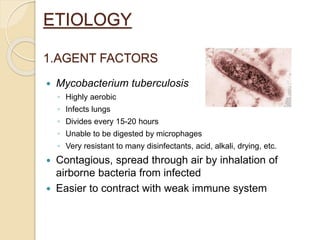
 Mycobacterium tuberculosis
◦ Highly aerobic
◦ Infects lungs
◦ Divides every 15-20 hours
◦ Unable to be digested by microphages
◦ Very resistant to many disinfectants, acid, alkali, drying, etc.
 Contagious, spread through air by inhalation of
airborne bacteria from infected
 Easier to contract with weak immune system
SOURCE OF INFECTION
Two types
1.Human source
2. Bovine sources
Communicability
Patients are infective as long as they remain
untreated
HOST FACTORS
1. Age : Affects all age groups . From an average of 2%
in the 0-14 age group and 20% at age 15-24yrs, and
more common in the elderly
2. Sex : More prevalence in males than in females
3. Nutrition: Malnutrition is widely believed to predispose
to TB
4. Immunity : man has no inherited immunity against TB
. It is acquired as a result
Of natural infection or BCG vaccination
MODE OF TRANSMISSION
Airway droplets: the main
mode of transmission from
person infected with
pulmonary TB to others by
respiratory droplets.
Ingestion: Less frequently
transmitted by ingestion of
mycobacterium bovis found
in unpasteurized milk
products
Direct inoculation
Pulmonary TB is a disease of respiratory transmission,
patients with active disease expel bacilli into the air by:
Coughing
Sneezing
Shouting
Or any other way that will expel bacilli into the air
Millions of tubercle bacilli
in lungs ( mainly in
cavities)
Coughing projects
droplets nuclei into the air
that contain tubercle
bacilli
One cough can release
3,000 droplet nuclei
One sneeze can release
tens of thousands of
droplet nuclei
As few as five M.
tuberculosis (MTB) bacilli
Optimal conditions for transmission
include:
Overcrowding
Poor personal hygiene
Poor public hygiene
DIAGNOSIS
Any cough that persists more than 2 weeks
should be evaluated for pulmonary TB in the
appropriate clinical context ( poor patient,
overcrowded, bad hygiene etc)
A full history and physical examination should
be undertaken
A minimum of 2 sputum samples, ( the first on
spot and the second in the early morning
preferably fasting ) should be examined, the
sputum sample should be of a good quality
representative of lower respiratory tract.
RADIOLOGY
The following characteristics of chest
radiograph favor the diagnosis of
tuberculosis
Shadows mainly in the upper zones
Patchy or nodular shadows
The presence of a cavity or cavities
The presence of calcification
Bilateral shadows especially if theses are in
SPUTUM EXAMINATION
For patients with suspected pulmonary TB, at least three
freshly expectorated first morning sputum samples should
be collected from a deep, productive cough in a sterile
container with a wide mouth. Ideally, the volume of each
sample should be more than 5 mL
Induction of sputum with aerosolized hypertonic saline
solution may be required if the patient is having difficulty
producing sputum; serial morning gastric lavage and
bronchoalveolar lavage are alternative methods of obtaining
clinical specimens.
SIGNIFICANT LAB TEST
Tuberculin skin test (PPD test);
Injecting a small amount of protein from
tuberculosis bacteria between the derived
layer of the skin (usually forearm).
Sputum examination and Cultures;
Is examined under a microscope to look
for tuberculosis bacteria and used to grow
the bacteria in a culture.
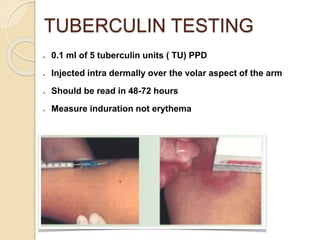
TUBERCULIN TESTING
0.1 ml of 5 tuberculin units ( TU) PPD
Injected intra dermally over the volar aspect of the arm
Should be read in 48-72 hours
Measure induration not erythema
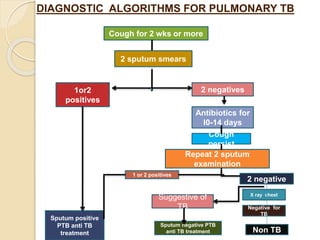
Cough for 2 wks or more
2 sputum smears
1or2
positives
2 negatives
Antibiotics for
I0-14 days
Cough
persist
Repeat 2 sputum
examination
1 or 2 positives
2 negative
X ray chest
Negative for
TB
Non TB
Suggestive of
TB
Sputum negative PTB
anti TB treatment
Sputum positive
PTB anti TB
treatment
DIAGNOSTIC ALGORITHMS FOR PULMONARY TB
Interferon-gamma Blood test;
A simple blood is mixed with synthetic
proteins similar to those produced by the
tuberculosis bacteria.
If people are infected with tuberculosis
bacteria, their white blood cells produce
certain substances (interferons) in response
to the synthetic proteins.
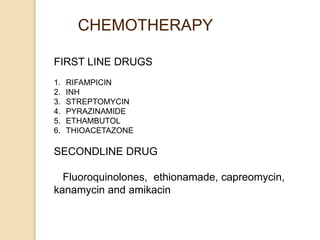
CHEMOTHERAPY
FIRST LINE DRUGS
1. RIFAMPICIN
2. INH
3. STREPTOMYCIN
4. PYRAZINAMIDE
5. ETHAMBUTOL
6. THIOACETAZONE
SECONDLINE DRUG
Fluoroquinolones, ethionamade, capreomycin,
kanamycin and amikacin
Chemotherapy
Initial phase Continuation phase
Reduce bacterial
population rapidly. Destroy any remaining
bacteria.
• Standard treatment involves 6 months
treatment with isoniazid, rifampicin,
pyrazinamide and ethambutol.
• Fixed-dose tablets combining two or three
drugs are preferred.
• Treatment should be started immediately
in any patient who is smear-positive or
smear-negative but with typical chest x-
ray changes and no response to standard
antibiotics.
• 6-months therapy is appropriate for new
onset pulmonary TB.
• However, a 12-months therapy is
recommended for meningeal TB,
including involvement of the spinal cord.
• Treatment may be given daily
throughout the course or intermittently
(either thrice or twice weekly)
• Patients with cavitary pulmonary TB and delayed sputum-
culture conversion should have continuation phase
extended by 3 months.
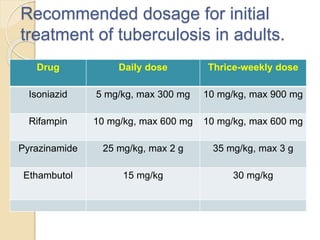
Recommended dosage for initial
treatment of tuberculosis in adults.
Drug Daily dose Thrice-weekly dose
Isoniazid 5 mg/kg, max 300 mg 10 mg/kg, max 900 mg
Rifampin 10 mg/kg, max 600 mg 10 mg/kg, max 600 mg
Pyrazinamide 25 mg/kg, max 2 g 35 mg/kg, max 3 g
Ethambutol 15 mg/kg 30 mg/kg
Initial phase Continuation phase
Duration,
months
Drugs Duration,
months
Drugs
New smear or culture
positive cases
2 HRZE 4 HR
New culture negative
cases
2 HRZE 4 HR
Pregnancy 2 HRE 7 HR
Relapses and default
(pending susceptibility
testing)
3 HRZES 5 HRE
Resistance to H 6 RZE
Resistance to R 12-18 HZEQ
Resistance to all first-
line drugs.
Atleast 20
months
1 injectable agent + 3
of these 4: E,
cycloserine, Q, PAS.
Regimens for the treatment of
latent TB infection in adults.
Regimen Schedule Duration
Isoniazid 300 mg daily (5
mg/kg)
9 months
Rifampin 600 mg daily (10
mg/kg)
4 months
Isoniazid plus
rifapentine
900 mg weekly +
900 mg weekly (15
mg/kg)
4 months
• BCG is live attenuated strain derived from
M. bovis → stimulates development of
hypersensitivity to M. tuberculosis
• Within 2-4wks swelling at injection site,
progresses to papule about 10mm diam &
heals in 6-12 wks
• Aim of BCG vaccination is to reduce a
benign, artificial primary infection which will
stimulate an acquired resistant to possible
subsequent infection with virulent tubercule
bacilli, and thus reduce morbidity and
BCG vaccine
TYPES OF BCG VACCINE
1. Liquid vaccine
2. Freeze dried vaccine
• BCG vaccine stored in a cool place preferably
refrigerated at a temperature below 10˚c
• Normal saline is recommended for diluent for
reconstituting the vaccine. Reconstitute vaccine
May be used up with in 3 hrs.
• Dosage : Usual strength is 0.1mg in 0.1 ml volum
The dose to newborn aged below 4 weeks is .05
•Administration :Injected vaccine intradermally usin
tuberculin syringe , site of injection should be jus
above the deltoid muscle
CONTRAINDICATIONS
• BCG should not be given to patients suffering
from
generalised eczema, infective dermatosis, to
those
patient with a history of deficient immunity,
Patient under immunosupressive treatment,
and in pregnancy
DOTS (directly observed treatment,
shortcourse), is the name given to the
World Health Organization-
recommended tuberculosis control
strategy that combines five
components: • Government
commitment (including both political
will at all levels, and establishing a
centralized and prioritized system of
TB monitoring, recording and training)
•
DOTS
• Case detection by sputum smear
microscopy Standardized treatment
regimen directly observed by a
healthcare worker or community health
worker for at least the first two months
• A regular drug supply
• A standardized recording and reporting
system that allows assessment of
treatment result
DOTS helps in ……
The advantages of DOTS are
• Accuracy of TB diagnosis is more than doubled
• Treatment success rate is up to 95 percent
• Prevents the spread of the tuberculosis infection ,
thus reducing the incidence and prevalence of TB
• Improves quality of health care and removes stigma
associated with TB
• Prevents failure of treatment and the emergence of
MDR-TB by ensuring patient adherence and
uninterrupted drug supply.
TUBERCULOSIS

TUBERCULOSIS

  • 1.
    TUBERCULOSIS PRESENTED BY THUSHARA .C 1ST YEAR M PHARM GRACE COLLEGE OF PHARMACY
  • 2.
    INTRODUCTION Pulmonary Tuberculosis (TB)is an infectious disease that mainly affect the lungs parenchyma. TB is a contagious bacterial (M. tuberculosis) infection that mainly affects the lungs parenchyma, but may spread to other organs.
  • 3.
    The World HealthOrganization declared TB a world global emergency in 1993; however, economic and political commitment to TB control programs is lacking in many countries, and it is estimated that 95% of new cases of TB occur in countries with limited resources. This situation facilitates inappropriate or unsustained TB therapy, which in turn has promoted a rise in the rates of multidrug-resistant TB (MDR-TB) EPIDEMIOLOGY
  • 4.
     Over 9million new cases and 2 million deaths per year worldwide  1/3rd of the world’s population is infected with M. tuberculosis  Tuberculosis remains one of the top three killers  In the U.S.- estimated that 10-15 million people are infected ◦ Less than 15,000 cases in US per year ◦ India is the highest TB burden country in the world and accounts nearly 20% of global burden ◦ Every yr approx 0.8 million new smear positive cases
  • 6.
    EPIDEMOLOGICAL INDICES 1.Prevalence ofinfection 2.Incidence of infection 3.Prevalence of disease or case rate 4.Incidence of new cases 5.Prevalence of suspected cases 6.Case detection rate 7.Prevalence of drug-resistant cases 8.Mortality rate
  • 7.
    ETIOLOGY 1.AGENT FACTORS  Mycobacteriumtuberculosis ◦ Highly aerobic ◦ Infects lungs ◦ Divides every 15-20 hours ◦ Unable to be digested by microphages ◦ Very resistant to many disinfectants, acid, alkali, drying, etc.  Contagious, spread through air by inhalation of airborne bacteria from infected  Easier to contract with weak immune system
  • 8.
    SOURCE OF INFECTION Twotypes 1.Human source 2. Bovine sources Communicability Patients are infective as long as they remain untreated
  • 9.
    HOST FACTORS 1. Age: Affects all age groups . From an average of 2% in the 0-14 age group and 20% at age 15-24yrs, and more common in the elderly 2. Sex : More prevalence in males than in females 3. Nutrition: Malnutrition is widely believed to predispose to TB 4. Immunity : man has no inherited immunity against TB . It is acquired as a result Of natural infection or BCG vaccination
  • 10.
    MODE OF TRANSMISSION Airwaydroplets: the main mode of transmission from person infected with pulmonary TB to others by respiratory droplets. Ingestion: Less frequently transmitted by ingestion of mycobacterium bovis found in unpasteurized milk products Direct inoculation
  • 11.
    Pulmonary TB isa disease of respiratory transmission, patients with active disease expel bacilli into the air by: Coughing Sneezing Shouting Or any other way that will expel bacilli into the air
  • 12.
    Millions of tuberclebacilli in lungs ( mainly in cavities) Coughing projects droplets nuclei into the air that contain tubercle bacilli One cough can release 3,000 droplet nuclei One sneeze can release tens of thousands of droplet nuclei As few as five M. tuberculosis (MTB) bacilli
  • 13.
    Optimal conditions fortransmission include: Overcrowding Poor personal hygiene Poor public hygiene
  • 14.
    DIAGNOSIS Any cough thatpersists more than 2 weeks should be evaluated for pulmonary TB in the appropriate clinical context ( poor patient, overcrowded, bad hygiene etc) A full history and physical examination should be undertaken A minimum of 2 sputum samples, ( the first on spot and the second in the early morning preferably fasting ) should be examined, the sputum sample should be of a good quality representative of lower respiratory tract.
  • 15.
    RADIOLOGY The following characteristicsof chest radiograph favor the diagnosis of tuberculosis Shadows mainly in the upper zones Patchy or nodular shadows The presence of a cavity or cavities The presence of calcification Bilateral shadows especially if theses are in
  • 16.
    SPUTUM EXAMINATION For patientswith suspected pulmonary TB, at least three freshly expectorated first morning sputum samples should be collected from a deep, productive cough in a sterile container with a wide mouth. Ideally, the volume of each sample should be more than 5 mL Induction of sputum with aerosolized hypertonic saline solution may be required if the patient is having difficulty producing sputum; serial morning gastric lavage and bronchoalveolar lavage are alternative methods of obtaining clinical specimens.
  • 17.
    SIGNIFICANT LAB TEST Tuberculinskin test (PPD test); Injecting a small amount of protein from tuberculosis bacteria between the derived layer of the skin (usually forearm). Sputum examination and Cultures; Is examined under a microscope to look for tuberculosis bacteria and used to grow the bacteria in a culture.
  • 18.
    TUBERCULIN TESTING 0.1 mlof 5 tuberculin units ( TU) PPD Injected intra dermally over the volar aspect of the arm Should be read in 48-72 hours Measure induration not erythema
  • 19.
    Cough for 2wks or more 2 sputum smears 1or2 positives 2 negatives Antibiotics for I0-14 days Cough persist Repeat 2 sputum examination 1 or 2 positives 2 negative X ray chest Negative for TB Non TB Suggestive of TB Sputum negative PTB anti TB treatment Sputum positive PTB anti TB treatment DIAGNOSTIC ALGORITHMS FOR PULMONARY TB
  • 20.
    Interferon-gamma Blood test; Asimple blood is mixed with synthetic proteins similar to those produced by the tuberculosis bacteria. If people are infected with tuberculosis bacteria, their white blood cells produce certain substances (interferons) in response to the synthetic proteins.
  • 21.
    CHEMOTHERAPY FIRST LINE DRUGS 1.RIFAMPICIN 2. INH 3. STREPTOMYCIN 4. PYRAZINAMIDE 5. ETHAMBUTOL 6. THIOACETAZONE SECONDLINE DRUG Fluoroquinolones, ethionamade, capreomycin, kanamycin and amikacin
  • 22.
    Chemotherapy Initial phase Continuationphase Reduce bacterial population rapidly. Destroy any remaining bacteria.
  • 23.
    • Standard treatmentinvolves 6 months treatment with isoniazid, rifampicin, pyrazinamide and ethambutol. • Fixed-dose tablets combining two or three drugs are preferred. • Treatment should be started immediately in any patient who is smear-positive or smear-negative but with typical chest x- ray changes and no response to standard antibiotics.
  • 24.
    • 6-months therapyis appropriate for new onset pulmonary TB. • However, a 12-months therapy is recommended for meningeal TB, including involvement of the spinal cord. • Treatment may be given daily throughout the course or intermittently (either thrice or twice weekly) • Patients with cavitary pulmonary TB and delayed sputum- culture conversion should have continuation phase extended by 3 months.
  • 25.
    Recommended dosage forinitial treatment of tuberculosis in adults. Drug Daily dose Thrice-weekly dose Isoniazid 5 mg/kg, max 300 mg 10 mg/kg, max 900 mg Rifampin 10 mg/kg, max 600 mg 10 mg/kg, max 600 mg Pyrazinamide 25 mg/kg, max 2 g 35 mg/kg, max 3 g Ethambutol 15 mg/kg 30 mg/kg
  • 26.
    Initial phase Continuationphase Duration, months Drugs Duration, months Drugs New smear or culture positive cases 2 HRZE 4 HR New culture negative cases 2 HRZE 4 HR Pregnancy 2 HRE 7 HR Relapses and default (pending susceptibility testing) 3 HRZES 5 HRE Resistance to H 6 RZE Resistance to R 12-18 HZEQ Resistance to all first- line drugs. Atleast 20 months 1 injectable agent + 3 of these 4: E, cycloserine, Q, PAS.
  • 27.
    Regimens for thetreatment of latent TB infection in adults. Regimen Schedule Duration Isoniazid 300 mg daily (5 mg/kg) 9 months Rifampin 600 mg daily (10 mg/kg) 4 months Isoniazid plus rifapentine 900 mg weekly + 900 mg weekly (15 mg/kg) 4 months
  • 28.
    • BCG islive attenuated strain derived from M. bovis → stimulates development of hypersensitivity to M. tuberculosis • Within 2-4wks swelling at injection site, progresses to papule about 10mm diam & heals in 6-12 wks • Aim of BCG vaccination is to reduce a benign, artificial primary infection which will stimulate an acquired resistant to possible subsequent infection with virulent tubercule bacilli, and thus reduce morbidity and BCG vaccine
  • 29.
    TYPES OF BCGVACCINE 1. Liquid vaccine 2. Freeze dried vaccine • BCG vaccine stored in a cool place preferably refrigerated at a temperature below 10˚c • Normal saline is recommended for diluent for reconstituting the vaccine. Reconstitute vaccine May be used up with in 3 hrs. • Dosage : Usual strength is 0.1mg in 0.1 ml volum The dose to newborn aged below 4 weeks is .05 •Administration :Injected vaccine intradermally usin tuberculin syringe , site of injection should be jus above the deltoid muscle
  • 30.
    CONTRAINDICATIONS • BCG shouldnot be given to patients suffering from generalised eczema, infective dermatosis, to those patient with a history of deficient immunity, Patient under immunosupressive treatment, and in pregnancy
  • 31.
    DOTS (directly observedtreatment, shortcourse), is the name given to the World Health Organization- recommended tuberculosis control strategy that combines five components: • Government commitment (including both political will at all levels, and establishing a centralized and prioritized system of TB monitoring, recording and training) • DOTS
  • 32.
    • Case detectionby sputum smear microscopy Standardized treatment regimen directly observed by a healthcare worker or community health worker for at least the first two months • A regular drug supply • A standardized recording and reporting system that allows assessment of treatment result DOTS helps in ……
  • 33.
    The advantages ofDOTS are • Accuracy of TB diagnosis is more than doubled • Treatment success rate is up to 95 percent • Prevents the spread of the tuberculosis infection , thus reducing the incidence and prevalence of TB • Improves quality of health care and removes stigma associated with TB • Prevents failure of treatment and the emergence of MDR-TB by ensuring patient adherence and uninterrupted drug supply.