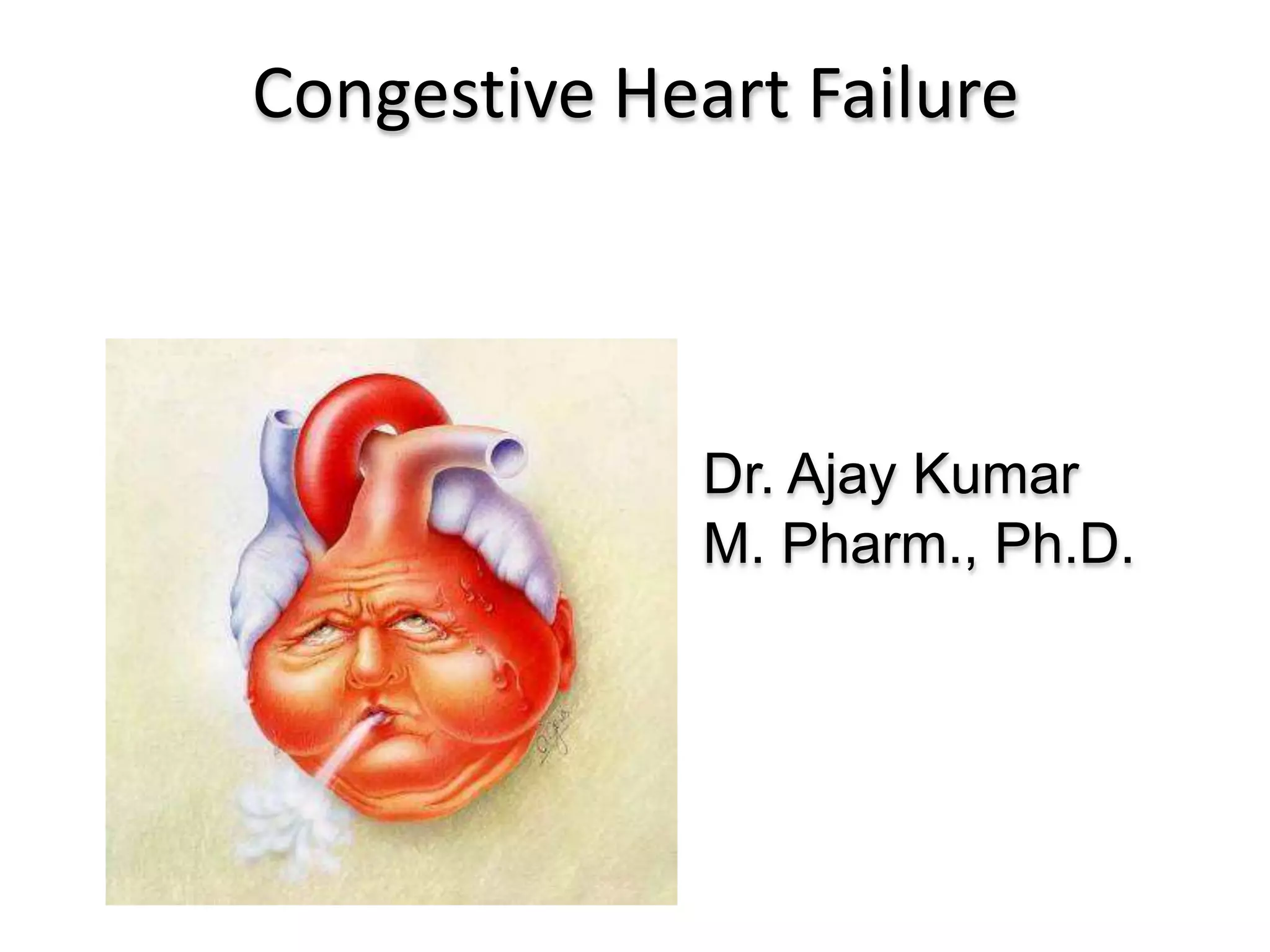
Congestive Heart Failure
Dr. Ajay Kumar
M. Pharm., Ph.D.
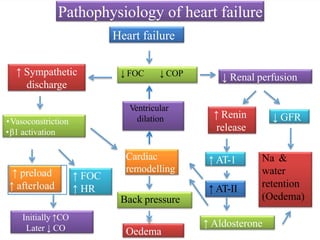
Pathophysiology of heart failure
Heart failure
↓ FOC ↓ COP↑ Sympathetic
discharge
↓ Renal perfusion
•Vasoconstriction
•β1 activation
↑ preload
↑ afterload
↑ FOC
↑ HR
↑ Renin
release
↓ GFR
Cardiac
remodelling
Ventricular
dilation
Back pressure
Oedema
Na &
water
retention
(Oedema)
↑ AT-II
↑ AT-1
↑ Aldosterone
Initially ↑CO
Later ↓ CO
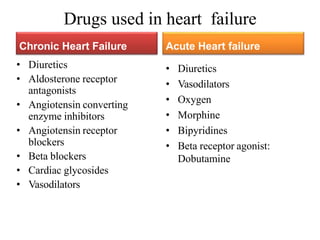
Drugs used in heart failure
• Diuretics
• Aldosterone receptor
antagonists
• Angiotensin converting
enzyme inhibitors
• Angiotensin receptor
blockers
• Beta blockers
• Cardiac glycosides
• Vasodilators
Chronic Heart Failure Acute Heart failure
• Diuretics
• Vasodilators
• Oxygen
• Morphine
• Bipyridines
• Beta receptor agonist:
Dobutamine
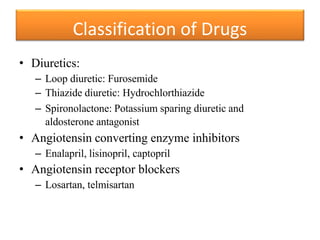
Classification of Drugs
• Diuretics:
– Loop diuretic: Furosemide
– Thiazide diuretic: Hydrochlorthiazide
– Spironolactone: Potassium sparing diuretic and
aldosterone antagonist
• Angiotensin converting enzyme inhibitors
– Enalapril, lisinopril, captopril
• Angiotensin receptor blockers
– Losartan, telmisartan
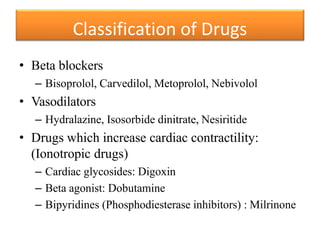
• Beta blockers
– Bisoprolol, Carvedilol, Metoprolol, Nebivolol
• Vasodilators
– Hydralazine, Isosorbide dinitrate, Nesiritide
• Drugs which increase cardiac contractility:
(Ionotropic drugs)
– Cardiac glycosides: Digoxin
– Beta agonist: Dobutamine
– Bipyridines (Phosphodiesterase inhibitors) : Milrinone
Classification of Drugs
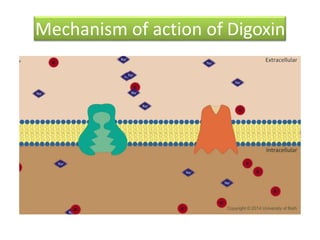
Mechanism of action of Digoxin
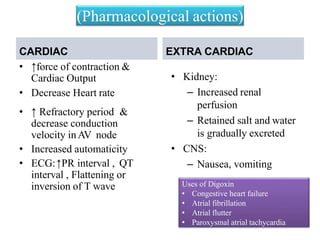
CARDIAC
• ↑force of contraction &
Cardiac Output
• Decrease Heart rate
• ↑ Refractory period &
decrease conduction
velocity inAV node
• Increased automaticity
• ECG:↑PR interval , QT
interval , Flattening or
inversion of T wave
EXTRA CARDIAC
Major effects of digoxin
• Kidney:
– Increased renal
perfusion
– Retained salt and water
is gradually excreted
• CNS:
– Nausea, vomiting
(Pharmacological actions)
Uses of Digoxin
• Congestive heart failure
• Atrial fibrillation
• Atrial flutter
• Paroxysmal atrial tachycardia
Digoxin adverse effects (Toxicity)
• Visual changes:(disturbance in color vision, blurring,
photophobia)
• Gastrointesinal toxicity: anorexia, nausea, vomiting
• Cardiac adverse effects:
– Bradycardia
– Extrasystoles
– A-V Block
– Paroxysmal atrial Tachycardia
– Sino Atrial arrest
– Ventricular tachycardia
• Miscellaneous toxicity
– Gynaecomastia, Skin Rashes
• Prompt insertion of a temporary cardiac pacemaker &
administration of digitalis antibodies (digoxin immune
fab)
• These antibodies recognize cardiac glycosides from many
plants in addition to digoxin. They are extremely useful in
reversing severe intoxication with most glycosides
• Oral or parenteral potassium supplements :
– contraindicated in presence of hyperkalemia
• For ventricular arrhythmias:
– Lidocaine IV drug of choice
• For supraventricular arrhythmia:
– Propranolol may be given IV or orally
• For AV block and bradycardia
– Atropine 0.6 -1.2 mg IM
Treatment of digoxin toxicity
• Amrinone & milrinone : selective phosphodiesterase III
inhibitors
• ↑ cAMP levels
• The PDE III isoenzyme is specific for intracellular degradation
of cAMP in heart, blood vessels and bronchial smooth muscles.
• Inodilator action: Inotropic effect with vasodilation
• IV administration for short term treatment of severe heart
failure
• Common adverse effect of amrinone is thrombocytopenia
• Milrinone is more potent & doesn’t cause thrombocytopenia
Phosphodiesterase inhibitors in heart failure
• Diuretics, especially furosemide, are drugs of
choice in heart failure
• Almost all symptomatic Patients treated with a
diuretic
• High ceiling diuretics (loop diuretics) preferred
– Low dose therapy for maintenance
• They increase salt and water excretion & reduce
blood volume
– Reduce preload & venous pressure
– Improve cardiac performance & relieve edema
Role of diuretics in heart failure
Role of spironolactone in heart failure
• Aldosterone antagonist & potassium sparing
diuretic
• ↓ mortality by 30% when added to in patients
receiving ACE inhibitors and other standard
therapy.
• Possible mechanism for this benefit is prevention
of aldosterone induced myocardial and vascular
fibrosis and baroreceptor dysfunction in addition
to its renal effects.
• ↓ peripheral resistance (↓ afterload)
• ↓reduce salt and water retention by ↓
aldosterone secretion (↓ preload).
• ↓ long-term remodeling of the heart and
vessels an effect that may be responsible for
the observed reduction in mortality and
morbidity
• Drug of first choice in left
ventricular dysfunction without
edema
ACE Inhibitors in heart failure
• Losartan , telmisartan
• Block AT1 receptor on the heart, peripheral
vasculature and kidney
• Produce beneficial hemodynamic effects
similar to those of ACE inhibitors.
• large clinical trials suggest that angiotensin
receptor blockers are best reserved for
patients who cannot tolerate ACE inhibitors
(usually because of cough)
Angiotensin receptor blockers in heart failure
Role of vasodilators in heart failure
• The combination of hydralazine and
isosorbide dinitrate should be used if
intolerant of ACE-i and ARBS as it
reduces mortality.
• It also reduces mortality when added to
standard therapy.
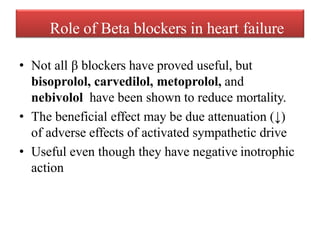
Role of Beta blockers in heart failure
• Not all β blockers have proved useful, but
bisoprolol, carvedilol, metoprolol, and
nebivolol have been shown to reduce mortality.
• The beneficial effect may be due attenuation (↓)
of adverse effects of activated sympathetic drive
• Useful even though they have negative inotrophic
action
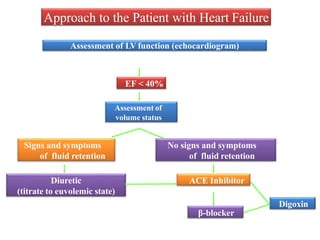
Approach to the Patient with Heart Failure
Assessment of LV function (echocardiogram)
EF < 40%
Assessment of
volume status
Signs and symptoms
of fluid retention
No signs and symptoms
of fluid retention
Diuretic
(titrate to euvolemic state)
ACE Inhibitor
β-blocker
Digoxin
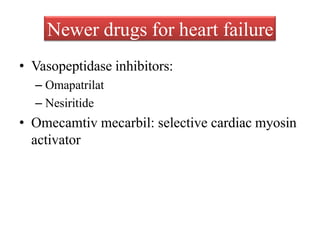
Newer drugs for heart failure
• Vasopeptidase inhibitors:
– Omapatrilat
– Nesiritide
• Omecamtiv mecarbil: selective cardiac myosin
activator
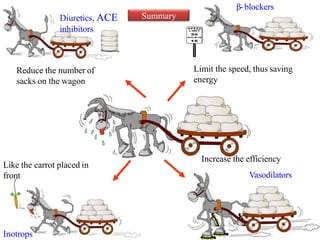
Summary
Reduce the number of
sacks on the wagon
Limit the speed, thus saving
energy
Like the carrot placed in
front
Inotrops
Increase the efficiency
Vasodilators
β-blockers
Diuretics, ACE
inhibitors
Thank you

Congestive heart failure

  • 1.
    Congestive Heart Failure Dr.Ajay Kumar M. Pharm., Ph.D.
  • 2.
    Pathophysiology of heartfailure Heart failure ↓ FOC ↓ COP↑ Sympathetic discharge ↓ Renal perfusion •Vasoconstriction •β1 activation ↑ preload ↑ afterload ↑ FOC ↑ HR ↑ Renin release ↓ GFR Cardiac remodelling Ventricular dilation Back pressure Oedema Na & water retention (Oedema) ↑ AT-II ↑ AT-1 ↑ Aldosterone Initially ↑CO Later ↓ CO
  • 3.
    Drugs used inheart failure • Diuretics • Aldosterone receptor antagonists • Angiotensin converting enzyme inhibitors • Angiotensin receptor blockers • Beta blockers • Cardiac glycosides • Vasodilators Chronic Heart Failure Acute Heart failure • Diuretics • Vasodilators • Oxygen • Morphine • Bipyridines • Beta receptor agonist: Dobutamine
  • 4.
    Classification of Drugs •Diuretics: – Loop diuretic: Furosemide – Thiazide diuretic: Hydrochlorthiazide – Spironolactone: Potassium sparing diuretic and aldosterone antagonist • Angiotensin converting enzyme inhibitors – Enalapril, lisinopril, captopril • Angiotensin receptor blockers – Losartan, telmisartan
  • 5.
    • Beta blockers –Bisoprolol, Carvedilol, Metoprolol, Nebivolol • Vasodilators – Hydralazine, Isosorbide dinitrate, Nesiritide • Drugs which increase cardiac contractility: (Ionotropic drugs) – Cardiac glycosides: Digoxin – Beta agonist: Dobutamine – Bipyridines (Phosphodiesterase inhibitors) : Milrinone Classification of Drugs
  • 6.
  • 7.
    CARDIAC • ↑force ofcontraction & Cardiac Output • Decrease Heart rate • ↑ Refractory period & decrease conduction velocity inAV node • Increased automaticity • ECG:↑PR interval , QT interval , Flattening or inversion of T wave EXTRA CARDIAC Major effects of digoxin • Kidney: – Increased renal perfusion – Retained salt and water is gradually excreted • CNS: – Nausea, vomiting (Pharmacological actions) Uses of Digoxin • Congestive heart failure • Atrial fibrillation • Atrial flutter • Paroxysmal atrial tachycardia
  • 8.
    Digoxin adverse effects(Toxicity) • Visual changes:(disturbance in color vision, blurring, photophobia) • Gastrointesinal toxicity: anorexia, nausea, vomiting • Cardiac adverse effects: – Bradycardia – Extrasystoles – A-V Block – Paroxysmal atrial Tachycardia – Sino Atrial arrest – Ventricular tachycardia • Miscellaneous toxicity – Gynaecomastia, Skin Rashes
  • 9.
    • Prompt insertionof a temporary cardiac pacemaker & administration of digitalis antibodies (digoxin immune fab) • These antibodies recognize cardiac glycosides from many plants in addition to digoxin. They are extremely useful in reversing severe intoxication with most glycosides • Oral or parenteral potassium supplements : – contraindicated in presence of hyperkalemia • For ventricular arrhythmias: – Lidocaine IV drug of choice • For supraventricular arrhythmia: – Propranolol may be given IV or orally • For AV block and bradycardia – Atropine 0.6 -1.2 mg IM Treatment of digoxin toxicity
  • 10.
    • Amrinone &milrinone : selective phosphodiesterase III inhibitors • ↑ cAMP levels • The PDE III isoenzyme is specific for intracellular degradation of cAMP in heart, blood vessels and bronchial smooth muscles. • Inodilator action: Inotropic effect with vasodilation • IV administration for short term treatment of severe heart failure • Common adverse effect of amrinone is thrombocytopenia • Milrinone is more potent & doesn’t cause thrombocytopenia Phosphodiesterase inhibitors in heart failure
  • 11.
    • Diuretics, especiallyfurosemide, are drugs of choice in heart failure • Almost all symptomatic Patients treated with a diuretic • High ceiling diuretics (loop diuretics) preferred – Low dose therapy for maintenance • They increase salt and water excretion & reduce blood volume – Reduce preload & venous pressure – Improve cardiac performance & relieve edema Role of diuretics in heart failure
  • 12.
    Role of spironolactonein heart failure • Aldosterone antagonist & potassium sparing diuretic • ↓ mortality by 30% when added to in patients receiving ACE inhibitors and other standard therapy. • Possible mechanism for this benefit is prevention of aldosterone induced myocardial and vascular fibrosis and baroreceptor dysfunction in addition to its renal effects.
  • 13.
    • ↓ peripheralresistance (↓ afterload) • ↓reduce salt and water retention by ↓ aldosterone secretion (↓ preload). • ↓ long-term remodeling of the heart and vessels an effect that may be responsible for the observed reduction in mortality and morbidity • Drug of first choice in left ventricular dysfunction without edema ACE Inhibitors in heart failure
  • 14.
    • Losartan ,telmisartan • Block AT1 receptor on the heart, peripheral vasculature and kidney • Produce beneficial hemodynamic effects similar to those of ACE inhibitors. • large clinical trials suggest that angiotensin receptor blockers are best reserved for patients who cannot tolerate ACE inhibitors (usually because of cough) Angiotensin receptor blockers in heart failure
  • 15.
    Role of vasodilatorsin heart failure • The combination of hydralazine and isosorbide dinitrate should be used if intolerant of ACE-i and ARBS as it reduces mortality. • It also reduces mortality when added to standard therapy.
  • 16.
    Role of Betablockers in heart failure • Not all β blockers have proved useful, but bisoprolol, carvedilol, metoprolol, and nebivolol have been shown to reduce mortality. • The beneficial effect may be due attenuation (↓) of adverse effects of activated sympathetic drive • Useful even though they have negative inotrophic action
  • 17.
    Approach to thePatient with Heart Failure Assessment of LV function (echocardiogram) EF < 40% Assessment of volume status Signs and symptoms of fluid retention No signs and symptoms of fluid retention Diuretic (titrate to euvolemic state) ACE Inhibitor β-blocker Digoxin
  • 18.
    Newer drugs forheart failure • Vasopeptidase inhibitors: – Omapatrilat – Nesiritide • Omecamtiv mecarbil: selective cardiac myosin activator
  • 19.
    Summary Reduce the numberof sacks on the wagon Limit the speed, thus saving energy Like the carrot placed in front Inotrops Increase the efficiency Vasodilators β-blockers Diuretics, ACE inhibitors
  • 20.