PRESENTED BY,
A.PRIYADHARSHINI M.Sc(N)
LECTURER,
DEPT.OF PAEDIATRICS,
JAI INSTITUTE OF NURSING AND RESEARCH,
GWALIOR.
DEFINITION:
Acute     rheumatic fever is a systemic
 disease of childhood ,often recurrent that
 follows group A beta hemolytic
 streptococcal infection
It is a diffuse inflammatory disease of
 connective tissue primarily involving
 heart, blood vessels, joints, subcut.tissue
 and CNS


                    05/05/1999   Dr.Said Alavi   2
Etiology
Betahemolytic streptococci.
Genetic


                      05/05/1999   Dr.Said Alavi   3
Epidemiology
Ages  5-15 yrs are most susceptible
Rare <3 yrs
Girls>boys
Environmental   factors--over crowding,
 poor sanitation, poverty,
Incidence more during fall ,winter &
 early spring


                   05/05/1999   Dr.Said Alavi   4
Pathogenesis
Delayed  immune response to infection
 with    group    A   beta     hemolytic
 streptococci.
After a latent period of 1-3 weeks,
 antibody induced immunological damage
 occur    to   heart   valves,    joints,
 subcutaneous tissue & basal ganglia of
 brain.


                     05/05/1999   Dr.Said Alavi   5
Pathologic Lesions
Fibrinoid     degeneration of connective tissue,
 inflammatory edema, inflammatory cell infiltration &
 proliferation of specific cells resulting in formation
 of Ashcoff nodules, resulting in-
      -Pancarditis in the heart
      -Arthritis in the joints
      -Ashcoff nodules in the subcutaneous
 tissue
      -Basal gangliar lesions resulting in chorea


                           05/05/1999   Dr.Said Alavi     6
Clinical Features
1.Arthritis
Flitting & fleeting migratory polyarthritis,
 involving major joints
Commonly involved joints-knee,ankle,elbow
 & wrist
Occur in 80%,involved joints are exquisitely
 tender
In children below 5 yrs arthritis usually mild but
 carditis more prominent
Arthritis do not progress to chronic disease

                            05/05/1999   Dr.Said Alavi   7
Clinical Features (Contd)
2.Carditis
Manifest   as pancarditis(endocarditis,
 myocarditis and pericarditis),occur in 40-
 50% of cases
Carditis is the only manifestation of rheumatic
 fever that leaves a sequelae & permanent
 damage to the organ
Valvulitis occur in acute phase
Chronic phase- fibrosis,calcification & stenosis of
 heart valves(fishmouth valves)
                            05/05/1999   Dr.Said Alavi   8
Clinical Features (Contd)
 3.Sydenham Chorea
   Occur in 5-10% of cases
   Mainly in girls of 1-15 yrs age
   May appear even 6/12 after the attack of
     rheumatic fever
   Clinically manifest as-clumsiness,
     deterioration of handwriting, emotional
     lability or grimacing of face
   Clinical signs- pronator sign, jack in the box
     sign , milking sign of hands
                         05/05/1999   Dr.Said Alavi   9
Clinical Features (Contd)
4.Erythema Marginatum
Occur   in <5%.
Unique,transient,serpiginous-looking
 lesions of 1-2 inches in size
Pale center with red irregular margin
More on trunks & limbs & non-itchy
Worsens with application of heat


                        05/05/1999   Dr.Said Alavi   10
Clinical Features (Contd)
 5.Subcutaneous nodules
Occur   in 10%
Painless, pea-sized, palpable nodules
Mainly over extensor surfaces of
 joints,spine,scapulae & scalp
Associated with strong seropositivity


                       05/05/1999   Dr.Said Alavi   11
Clinical Features (Contd)
Other features (Minor features)
Fever-(upto   101 degree F)
Arthralgia
Pallor
Anorexia
Loss   of weight


                         05/05/1999   Dr.Said Alavi   12
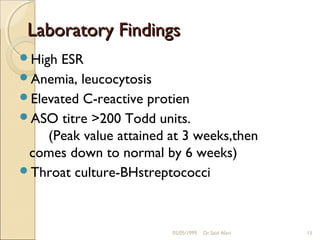
Laboratory Findings
High ESR
Anemia, leucocytosis
Elevated C-reactive protien
ASO titre >200 Todd units.
    (Peak value attained at 3 weeks,then
 comes down to normal by 6 weeks)
Throat culture-BHstreptococci


                         05/05/1999   Dr.Said Alavi   13
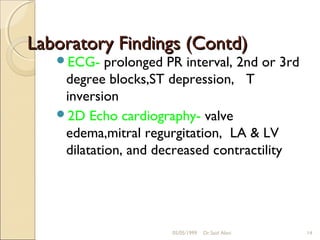
Laboratory Findings (Contd)
   ECG-    prolonged PR interval, 2nd or 3rd
    degree blocks,ST depression, T
    inversion
   2D Echo cardiography- valve
    edema,mitral regurgitation, LA & LV
    dilatation, and decreased contractility


                       05/05/1999   Dr.Said Alavi   14
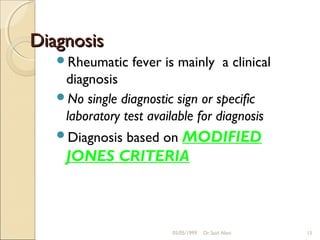
Diagnosis
   Rheumatic    fever is mainly a clinical
    diagnosis
   No single diagnostic sign or specific
    laboratory test available for diagnosis
   Diagnosis   based on MODIFIED
    JONES CRITERIA


                         05/05/1999   Dr.Said Alavi   15
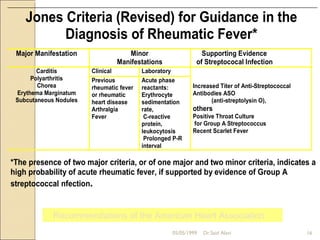
Jones Criteria (Revised) for Guidance in the
          Diagnosis of Rheumatic Fever*
 Major Manifestation                 Minor                     Supporting Evidence
                                 Manifestations              of Streptococal Infection
        Carditis        Clinical          Laboratory
      Polyarthritis     Previous          Acute phase
        Chorea          rheumatic fever   reactants:        Increased Titer of Anti-Streptococcal
 Erythema Marginatum    or rheumatic      Erythrocyte       Antibodies ASO
 Subcutaneous Nodules   heart disease     sedimentation            (anti-streptolysin O),
                        Arthralgia        rate,             others
                        Fever              C-reactive       Positive Throat Culture
                                          protein,          for Group A Streptococcus
                                          leukocytosis      Recent Scarlet Fever
                                           Prolonged P-R
                                          interval

*The presence of two major criteria, or of one major and two minor criteria, indicates a
high probability of acute rheumatic fever, if supported by evidence of Group A
streptococcal nfection.


             Recommendations of the American Heart Association
                                                    05/05/1999   Dr.Said Alavi                      16
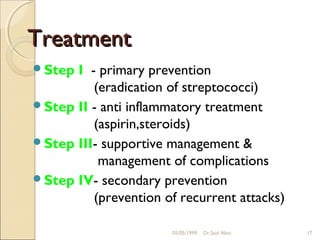
Treatment
Step I - primary prevention
         (eradication of streptococci)
Step II - anti inflammatory treatment
         (aspirin,steroids)
Step III- supportive management &
          management of complications
Step IV- secondary prevention
         (prevention of recurrent attacks)

                       05/05/1999   Dr.Said Alavi   17
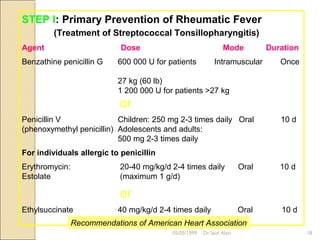
STEP I: Primary Prevention of Rheumatic Fever
         (Treatment of Streptococcal Tonsillopharyngitis)
Agent                       Dose                                 Mode          Duration
Benzathine penicillin G     600 000 U for patients           Intramuscular        Once

                            27 kg (60 lb)
                            1 200 000 U for patients >27 kg
                            or
Penicillin V               Children: 250 mg 2-3 times daily Oral                  10 d
(phenoxymethyl penicillin) Adolescents and adults:
                           500 mg 2-3 times daily
For individuals allergic to penicillin
Erythromycin:               20-40 mg/kg/d 2-4 times daily               Oral      10 d
Estolate                    (maximum 1 g/d)

                            or
Ethylsuccinate           40 mg/kg/d 2-4 times daily        Oral                   10 d
                         (maximum 1 g/d)
                Recommendations of American Heart Association
                                           05/05/1999   Dr.Said Alavi                     18
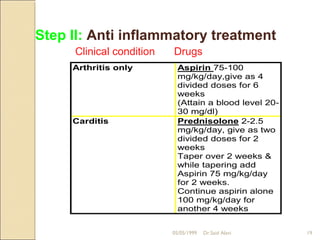
Step II: Anti inflammatory treatment
     Clinical condition   Drugs
     Arthritis only         Aspirin 75-100
                            mg/kg/day,give as 4
                            divided doses for 6
                            weeks
                            (Attain a blood level 20-
                            30 mg/dl)
     Carditis               Prednisolone 2-2.5
                            mg/kg/day, give as two
                            divided doses for 2
                            weeks
                            Taper over 2 weeks &
                            while tapering add
                            Aspirin 75 mg/kg/day
                            for 2 weeks.
                            Continue aspirin alone
                            100 mg/kg/day for
                            another 4 weeks


                          05/05/1999   Dr.Said Alavi    19
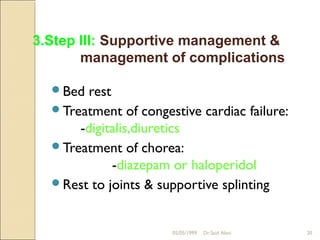
3.Step III: Supportive management &
       management of complications

  Bed  rest
  Treatment of congestive cardiac failure:
      -digitalis,diuretics
  Treatment of chorea:
             -diazepam or haloperidol
  Rest to joints & supportive splinting


                      05/05/1999   Dr.Said Alavi   20
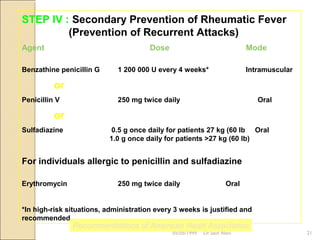
STEP IV : Secondary Prevention of Rheumatic Fever
         (Prevention of Recurrent Attacks)
Agent                                  Dose                                 Mode

Benzathine penicillin G      1 200 000 U every 4 weeks*                     Intramuscular

          or
Penicillin V                 250 mg twice daily                                Oral

          or
Sulfadiazine               0.5 g once daily for patients 27 kg (60 lb Oral
                           1.0 g once daily for patients >27 kg (60 lb)


For individuals allergic to penicillin and sulfadiazine

Erythromycin                 250 mg twice daily                      Oral


*In high-risk situations, administration every 3 weeks is justified and
recommended
               Recommendations of American Heart Association
                                              05/05/1999   Dr.Said Alavi                    21
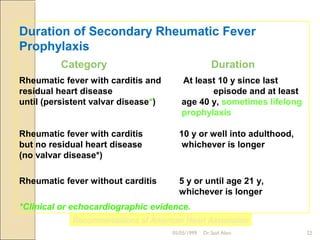
Duration of Secondary Rheumatic Fever
Prophylaxis
          Category                                   Duration
Rheumatic fever with carditis and       At least 10 y since last
residual heart disease                         episode and at least
until (persistent valvar disease*)      age 40 y, sometimes lifelong
                                        prophylaxis

Rheumatic fever with carditis          10 y or well into adulthood,
but no residual heart disease          whichever is longer
(no valvar disease*)

Rheumatic fever without carditis       5 y or until age 21 y,
                                       whichever is longer
*Clinical or echocardiographic evidence.
            Recommendations of American Heart Association
                                     05/05/1999   Dr.Said Alavi        22
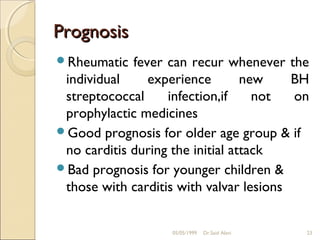
Prognosis
Rheumatic   fever can recur whenever the
 individual     experience        new    BH
 streptococcal     infection,if     not  on
 prophylactic medicines
Good prognosis for older age group & if
 no carditis during the initial attack
Bad prognosis for younger children &
 those with carditis with valvar lesions


                   05/05/1999   Dr.Said Alavi   23
THANK YOU


   05/05/1999   Dr.Said Alavi   24

Rheumatic fever

  • 1.
    PRESENTED BY, A.PRIYADHARSHINI M.Sc(N) LECTURER, DEPT.OFPAEDIATRICS, JAI INSTITUTE OF NURSING AND RESEARCH, GWALIOR.
  • 2.
    DEFINITION: Acute rheumatic fever is a systemic disease of childhood ,often recurrent that follows group A beta hemolytic streptococcal infection It is a diffuse inflammatory disease of connective tissue primarily involving heart, blood vessels, joints, subcut.tissue and CNS 05/05/1999 Dr.Said Alavi 2
  • 3.
  • 4.
    Epidemiology Ages 5-15yrs are most susceptible Rare <3 yrs Girls>boys Environmental factors--over crowding, poor sanitation, poverty, Incidence more during fall ,winter & early spring 05/05/1999 Dr.Said Alavi 4
  • 5.
    Pathogenesis Delayed immuneresponse to infection with group A beta hemolytic streptococci. After a latent period of 1-3 weeks, antibody induced immunological damage occur to heart valves, joints, subcutaneous tissue & basal ganglia of brain. 05/05/1999 Dr.Said Alavi 5
  • 6.
    Pathologic Lesions Fibrinoid degeneration of connective tissue, inflammatory edema, inflammatory cell infiltration & proliferation of specific cells resulting in formation of Ashcoff nodules, resulting in- -Pancarditis in the heart -Arthritis in the joints -Ashcoff nodules in the subcutaneous tissue -Basal gangliar lesions resulting in chorea 05/05/1999 Dr.Said Alavi 6
  • 7.
    Clinical Features 1.Arthritis Flitting &fleeting migratory polyarthritis, involving major joints Commonly involved joints-knee,ankle,elbow & wrist Occur in 80%,involved joints are exquisitely tender In children below 5 yrs arthritis usually mild but carditis more prominent Arthritis do not progress to chronic disease 05/05/1999 Dr.Said Alavi 7
  • 8.
    Clinical Features (Contd) 2.Carditis Manifest as pancarditis(endocarditis, myocarditis and pericarditis),occur in 40- 50% of cases Carditis is the only manifestation of rheumatic fever that leaves a sequelae & permanent damage to the organ Valvulitis occur in acute phase Chronic phase- fibrosis,calcification & stenosis of heart valves(fishmouth valves) 05/05/1999 Dr.Said Alavi 8
  • 9.
    Clinical Features (Contd) 3.Sydenham Chorea Occur in 5-10% of cases Mainly in girls of 1-15 yrs age May appear even 6/12 after the attack of rheumatic fever Clinically manifest as-clumsiness, deterioration of handwriting, emotional lability or grimacing of face Clinical signs- pronator sign, jack in the box sign , milking sign of hands 05/05/1999 Dr.Said Alavi 9
  • 10.
    Clinical Features (Contd) 4.ErythemaMarginatum Occur in <5%. Unique,transient,serpiginous-looking lesions of 1-2 inches in size Pale center with red irregular margin More on trunks & limbs & non-itchy Worsens with application of heat 05/05/1999 Dr.Said Alavi 10
  • 11.
    Clinical Features (Contd) 5.Subcutaneous nodules Occur in 10% Painless, pea-sized, palpable nodules Mainly over extensor surfaces of joints,spine,scapulae & scalp Associated with strong seropositivity 05/05/1999 Dr.Said Alavi 11
  • 12.
    Clinical Features (Contd) Otherfeatures (Minor features) Fever-(upto 101 degree F) Arthralgia Pallor Anorexia Loss of weight 05/05/1999 Dr.Said Alavi 12
  • 13.
    Laboratory Findings High ESR Anemia,leucocytosis Elevated C-reactive protien ASO titre >200 Todd units. (Peak value attained at 3 weeks,then comes down to normal by 6 weeks) Throat culture-BHstreptococci 05/05/1999 Dr.Said Alavi 13
  • 14.
    Laboratory Findings (Contd) ECG- prolonged PR interval, 2nd or 3rd degree blocks,ST depression, T inversion 2D Echo cardiography- valve edema,mitral regurgitation, LA & LV dilatation, and decreased contractility 05/05/1999 Dr.Said Alavi 14
  • 15.
    Diagnosis Rheumatic fever is mainly a clinical diagnosis No single diagnostic sign or specific laboratory test available for diagnosis Diagnosis based on MODIFIED JONES CRITERIA 05/05/1999 Dr.Said Alavi 15
  • 16.
    Jones Criteria (Revised)for Guidance in the Diagnosis of Rheumatic Fever* Major Manifestation Minor Supporting Evidence Manifestations of Streptococal Infection Carditis Clinical Laboratory Polyarthritis Previous Acute phase Chorea rheumatic fever reactants: Increased Titer of Anti-Streptococcal Erythema Marginatum or rheumatic Erythrocyte Antibodies ASO Subcutaneous Nodules heart disease sedimentation (anti-streptolysin O), Arthralgia rate, others Fever C-reactive Positive Throat Culture protein, for Group A Streptococcus leukocytosis Recent Scarlet Fever Prolonged P-R interval *The presence of two major criteria, or of one major and two minor criteria, indicates a high probability of acute rheumatic fever, if supported by evidence of Group A streptococcal nfection. Recommendations of the American Heart Association 05/05/1999 Dr.Said Alavi 16
  • 17.
    Treatment Step I -primary prevention (eradication of streptococci) Step II - anti inflammatory treatment (aspirin,steroids) Step III- supportive management & management of complications Step IV- secondary prevention (prevention of recurrent attacks) 05/05/1999 Dr.Said Alavi 17
  • 18.
    STEP I: PrimaryPrevention of Rheumatic Fever (Treatment of Streptococcal Tonsillopharyngitis) Agent Dose Mode Duration Benzathine penicillin G 600 000 U for patients Intramuscular Once 27 kg (60 lb) 1 200 000 U for patients >27 kg or Penicillin V Children: 250 mg 2-3 times daily Oral 10 d (phenoxymethyl penicillin) Adolescents and adults: 500 mg 2-3 times daily For individuals allergic to penicillin Erythromycin: 20-40 mg/kg/d 2-4 times daily Oral 10 d Estolate (maximum 1 g/d) or Ethylsuccinate 40 mg/kg/d 2-4 times daily Oral 10 d (maximum 1 g/d) Recommendations of American Heart Association 05/05/1999 Dr.Said Alavi 18
  • 19.
    Step II: Antiinflammatory treatment Clinical condition Drugs Arthritis only Aspirin 75-100 mg/kg/day,give as 4 divided doses for 6 weeks (Attain a blood level 20- 30 mg/dl) Carditis Prednisolone 2-2.5 mg/kg/day, give as two divided doses for 2 weeks Taper over 2 weeks & while tapering add Aspirin 75 mg/kg/day for 2 weeks. Continue aspirin alone 100 mg/kg/day for another 4 weeks 05/05/1999 Dr.Said Alavi 19
  • 20.
    3.Step III: Supportivemanagement & management of complications Bed rest Treatment of congestive cardiac failure: -digitalis,diuretics Treatment of chorea: -diazepam or haloperidol Rest to joints & supportive splinting 05/05/1999 Dr.Said Alavi 20
  • 21.
    STEP IV :Secondary Prevention of Rheumatic Fever (Prevention of Recurrent Attacks) Agent Dose Mode Benzathine penicillin G 1 200 000 U every 4 weeks* Intramuscular or Penicillin V 250 mg twice daily Oral or Sulfadiazine 0.5 g once daily for patients 27 kg (60 lb Oral 1.0 g once daily for patients >27 kg (60 lb) For individuals allergic to penicillin and sulfadiazine Erythromycin 250 mg twice daily Oral *In high-risk situations, administration every 3 weeks is justified and recommended Recommendations of American Heart Association 05/05/1999 Dr.Said Alavi 21
  • 22.
    Duration of SecondaryRheumatic Fever Prophylaxis Category Duration Rheumatic fever with carditis and At least 10 y since last residual heart disease episode and at least until (persistent valvar disease*) age 40 y, sometimes lifelong prophylaxis Rheumatic fever with carditis 10 y or well into adulthood, but no residual heart disease whichever is longer (no valvar disease*) Rheumatic fever without carditis 5 y or until age 21 y, whichever is longer *Clinical or echocardiographic evidence. Recommendations of American Heart Association 05/05/1999 Dr.Said Alavi 22
  • 23.
    Prognosis Rheumatic fever can recur whenever the individual experience new BH streptococcal infection,if not on prophylactic medicines Good prognosis for older age group & if no carditis during the initial attack Bad prognosis for younger children & those with carditis with valvar lesions 05/05/1999 Dr.Said Alavi 23
  • 24.
    THANK YOU 05/05/1999 Dr.Said Alavi 24