Heart failure
By- kajal sansoya
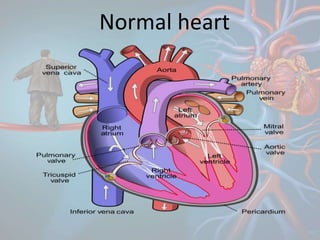
Normal heart
Introduction
• Heart failure is defined as a state in which the
ventricles at normal filling pressures cannot
maintain an adequate cardiac output to meet
the metabolic needs of peripheral tissue or
can do so only with an elevated filling
pressure.
• Heart failure is a chronic condition in which
heart does not pump well as it was supposed
to be.
• It results from any structural or functional
impairment of ventricles filling or ejection of
blood.
INCIDENCE
• More than 20 million people have heart failure
worldwide.
• Prevalence of heart failure in India due to CHD,
hypertension, RHD ,obesity to range from 1.3 to
4.6 million, with an annual incidence of
491600-1.8 million.
• Heart failure is leading cause of hospitalization
in people older than 65.
Pathology
• Preload – refers to pressure that fills the left
ventricles during diastole.
• After-load- refers to pressure against which
the left ventricle contracts.
• Myocardial contractility- this mainly depends
upon the adrenergic nervous activity and the
levels of circulating catecholamines.
• In heart failure there is an increase in preload
, increase in after load, decrease myocardial
contractility.
• cardiac output(CO)= stroke volume(SV)x heart rate(HR)
• SV determined by preload , after load, myocardial
contractility.
Types of heart failure
1. Acute or chronic
2. Low output or high output
3. Left side or right sided or biventricular
4. Forward or backward
5. Systolic or diastolic
Acute heart failure
• develops suddenly
• Sudden reduction in CO which results in
systemic hypotension.
• Example- acute MI,
rupture of valve,
block blood flow to heart muscle.
Chronic heart failure
• develops gradually , aortic pressure is
maintained but edema accmulate.
• Example – dilated cardiomyopathy
multivalvular disease
Low output heart failure
• Associated with a low CO.
• Heart fails to generate adequate output or can
do so with high filling pressure.
• Example – IHD, pericardial disease,
cardiomyopathy
High output heart failure
• Heart fails to maintain sufficient circulation
despite an increase CO.
• Example – hyperthyroidsm, anemia,
pregnancy, paget’s disease.
Left-sided heart failure
• Reduction or decrease ventricular output
• Increase in left atrial pressure
• Increase pulmonary venous pressure
• Example – MI , aortic stenosis
Right-sided heart failure
• Excess fluid accumulates upstream behind the
failing right ventricle.
• There is reduction in right ventricular output
and increase in right atrial & systemic venous
pressure.
• Decrease right ventricle output results in
systemic venous congestion.
• Example – pulmonary valvular stenosis,
multiple pulmonary emboli.
Biventricular heart failure
• Failure of both right and right side ventricles.
• Example – IHD, dilated cardiomyopathy.
• Forward heart failure - Decrease in CO and
inadequate perfusion of organs leading to
poor tissue perfusion.
• Backward heart failure- normal CO, but
marked salt, water retention, pulmonary &
systemic venous congestion.
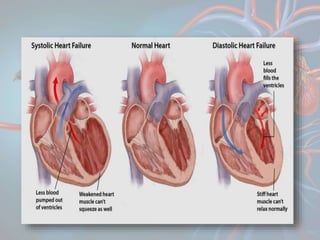
• Systolic heart failure- abnormal ventricular
contraction
• Diastolic heart failure- impaired ventricular
relaxation and increase ventricular stiffness
results in diastolic dysfunction.
Risk factors
• Hypertension
• Diabetes mellitus
• Thyroid
• CAD
• Hyperlipidaemia
Etiology
• Pressure overload of ventricles
aortic stenosis , pulmonary stenosis, pulmonary
hypertension.
• Volume overload of ventricles
aortic regurgitation, ASD, PDA, mitral
regurgitation.
• Inflow obstruction of ventricle
mitral stenosis, tricuspid stenosis,
endomyocardial fibrosis.
• Impaired ventricular function
diffuse myocardial disease, myocarditis, IHD,
cardiomyopathy , segmental myocardial
disease.
Aggravating factors
• Myocardial infarction
• Intercurrent illness
• Arrhythmia
• Pulmonary embolism
• Systemic hypertension
• Condition associated with increase metabolic
demand ( pregnancy, anemia)
Clinical features
• Dyspnoea
• Orthopnoea
• Paronysmal noctural dyspnoea
• Cardiac asthma
• Cheyne-stokes ( periodic breathing)
• Nocturia (frequent urination at night)
• Cerebral symptoms( confusion, headache,
insomia)
• Acute pulmonary edema
Non-specific features
• Nausea
• fatigue
• Anorexia
• Cardiac cachexia
• Jugular venous pressure increase
• Oliguria
• Pleural effusion, ascities , pericardial effusion
• liver (hepatomegaly, enlarged liver, jaundice)
Complications
• Renal heart failure
• Hyopkalaemia
• Hyperkalaemia
• Imparied liver function
• Hyonatraemia
• Thromboembolism
• Atrial and ventricular arrhytmias
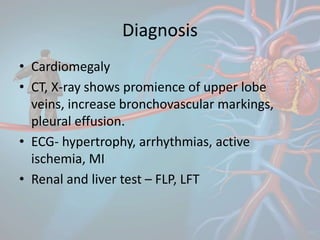
Diagnosis
• Cardiomegaly
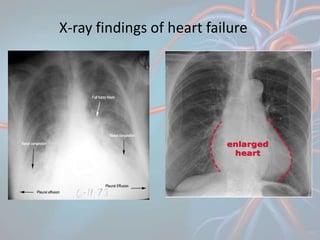
• CT, X-ray shows promience of upper lobe
veins, increase bronchovascular markings,
pleural effusion.
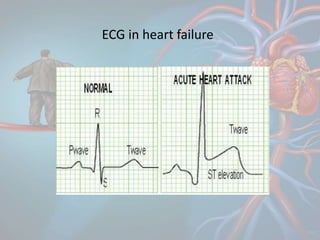
• ECG- hypertrophy, arrhythmias, active
ischemia, MI
• Renal and liver test – FLP, LFT
X-ray findings of heart failure
ECG in heart failure
Management
• Life style changes
• Physical & emotional rest
• Diet changes
• Medical management
• Surgery
Medical management
• NSAIDS
• ACE inhibitors
• Beta-blockers
• Diuretics
• Vasodilators
• Digoxin
• Sympathominetics amines
• Dopamine used in acute heart failure
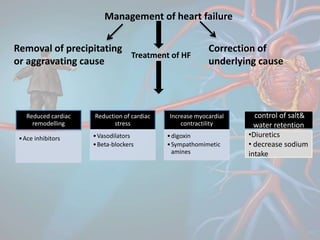
Management of heart failure
Removal of precipitating
or aggravating cause
Correction of
underlying cause
Treatment of HF
Reduced cardiac
remodelling
•Ace inhibitors
Reduction of cardiac
stress
•Vasodilators
•Beta-blockers
Increase myocardial
contractility
•digoxin
•Sympathomimetic
amines
control of salt&
water retention
•Diuretics
• decrease sodium
intake
Thank you

Heart failure

  • 1.
  • 2.
  • 3.
    Introduction • Heart failureis defined as a state in which the ventricles at normal filling pressures cannot maintain an adequate cardiac output to meet the metabolic needs of peripheral tissue or can do so only with an elevated filling pressure.
  • 4.
    • Heart failureis a chronic condition in which heart does not pump well as it was supposed to be. • It results from any structural or functional impairment of ventricles filling or ejection of blood.
  • 5.
    INCIDENCE • More than20 million people have heart failure worldwide. • Prevalence of heart failure in India due to CHD, hypertension, RHD ,obesity to range from 1.3 to 4.6 million, with an annual incidence of 491600-1.8 million. • Heart failure is leading cause of hospitalization in people older than 65.
  • 6.
    Pathology • Preload –refers to pressure that fills the left ventricles during diastole. • After-load- refers to pressure against which the left ventricle contracts. • Myocardial contractility- this mainly depends upon the adrenergic nervous activity and the levels of circulating catecholamines.
  • 7.
    • In heartfailure there is an increase in preload , increase in after load, decrease myocardial contractility. • cardiac output(CO)= stroke volume(SV)x heart rate(HR) • SV determined by preload , after load, myocardial contractility.
  • 8.
    Types of heartfailure 1. Acute or chronic 2. Low output or high output 3. Left side or right sided or biventricular 4. Forward or backward 5. Systolic or diastolic
  • 9.
    Acute heart failure •develops suddenly • Sudden reduction in CO which results in systemic hypotension. • Example- acute MI, rupture of valve, block blood flow to heart muscle.
  • 10.
    Chronic heart failure •develops gradually , aortic pressure is maintained but edema accmulate. • Example – dilated cardiomyopathy multivalvular disease
  • 11.
    Low output heartfailure • Associated with a low CO. • Heart fails to generate adequate output or can do so with high filling pressure. • Example – IHD, pericardial disease, cardiomyopathy
  • 12.
    High output heartfailure • Heart fails to maintain sufficient circulation despite an increase CO. • Example – hyperthyroidsm, anemia, pregnancy, paget’s disease.
  • 13.
    Left-sided heart failure •Reduction or decrease ventricular output • Increase in left atrial pressure • Increase pulmonary venous pressure • Example – MI , aortic stenosis
  • 14.
    Right-sided heart failure •Excess fluid accumulates upstream behind the failing right ventricle. • There is reduction in right ventricular output and increase in right atrial & systemic venous pressure. • Decrease right ventricle output results in systemic venous congestion. • Example – pulmonary valvular stenosis, multiple pulmonary emboli.
  • 15.
    Biventricular heart failure •Failure of both right and right side ventricles. • Example – IHD, dilated cardiomyopathy.
  • 16.
    • Forward heartfailure - Decrease in CO and inadequate perfusion of organs leading to poor tissue perfusion. • Backward heart failure- normal CO, but marked salt, water retention, pulmonary & systemic venous congestion.
  • 17.
    • Systolic heartfailure- abnormal ventricular contraction • Diastolic heart failure- impaired ventricular relaxation and increase ventricular stiffness results in diastolic dysfunction.
  • 19.
    Risk factors • Hypertension •Diabetes mellitus • Thyroid • CAD • Hyperlipidaemia
  • 20.
    Etiology • Pressure overloadof ventricles aortic stenosis , pulmonary stenosis, pulmonary hypertension. • Volume overload of ventricles aortic regurgitation, ASD, PDA, mitral regurgitation. • Inflow obstruction of ventricle mitral stenosis, tricuspid stenosis, endomyocardial fibrosis.
  • 21.
    • Impaired ventricularfunction diffuse myocardial disease, myocarditis, IHD, cardiomyopathy , segmental myocardial disease.
  • 22.
    Aggravating factors • Myocardialinfarction • Intercurrent illness • Arrhythmia • Pulmonary embolism • Systemic hypertension • Condition associated with increase metabolic demand ( pregnancy, anemia)
  • 23.
    Clinical features • Dyspnoea •Orthopnoea • Paronysmal noctural dyspnoea • Cardiac asthma • Cheyne-stokes ( periodic breathing) • Nocturia (frequent urination at night) • Cerebral symptoms( confusion, headache, insomia) • Acute pulmonary edema
  • 24.
    Non-specific features • Nausea •fatigue • Anorexia • Cardiac cachexia • Jugular venous pressure increase • Oliguria • Pleural effusion, ascities , pericardial effusion • liver (hepatomegaly, enlarged liver, jaundice)
  • 26.
    Complications • Renal heartfailure • Hyopkalaemia • Hyperkalaemia • Imparied liver function • Hyonatraemia • Thromboembolism • Atrial and ventricular arrhytmias
  • 27.
    Diagnosis • Cardiomegaly • CT,X-ray shows promience of upper lobe veins, increase bronchovascular markings, pleural effusion. • ECG- hypertrophy, arrhythmias, active ischemia, MI • Renal and liver test – FLP, LFT
  • 28.
    X-ray findings ofheart failure
  • 29.
    ECG in heartfailure
  • 30.
    Management • Life stylechanges • Physical & emotional rest • Diet changes • Medical management • Surgery
  • 31.
    Medical management • NSAIDS •ACE inhibitors • Beta-blockers • Diuretics • Vasodilators • Digoxin • Sympathominetics amines • Dopamine used in acute heart failure
  • 32.
    Management of heartfailure Removal of precipitating or aggravating cause Correction of underlying cause Treatment of HF Reduced cardiac remodelling •Ace inhibitors Reduction of cardiac stress •Vasodilators •Beta-blockers Increase myocardial contractility •digoxin •Sympathomimetic amines control of salt& water retention •Diuretics • decrease sodium intake
  • 33.