

DR.SAMIR JADAV (PT)
 DEFINITION
 AETIOLOGY
 PATHOLOGY
 PATHOPHYSIOLOGY
 CLINICAL FEATURES
 INVESTIGATIONS
 TREATMENT
 PT ASSESSMENT
 PT MANAGEMENT
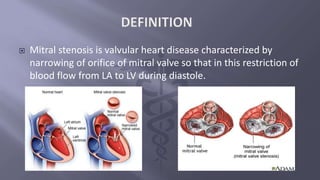
 Mitral stenosis is valvular heart disease characterized by
narrowing of orifice of mitral valve so that in this restriction of
blood flow from LA to LV during diastole.
 Rheumatic fever
- Usually severe mitral stenosis takes about 22 to 30
years to develop after the last known bout of
rheumatic fever.
 Calcium deposits
 Other causes
- congenital defect
- chest radiation (rare)
- autoimmune disease such as lupus.
 Rheumatic fever produces a widespread manifestation in in the
heart.
 It affects all 3 layers.
 Endocarditis produces ulceration of the endocardium along the
ages of valve leaflets where they normally appose in systole.
 Tiny nodules of fibrin and platelets accumulates and gradually progress
to fusion of leaflets at the commissures.
 The above mentioned nodules are called Ashchoff nodules.
 Gradually, the valve cups become more swollen and roughened.
 Later, fibrosis and calcification occurs.
 So valve leaflets become thickened, rigid and immobile.
 Calcified and functionless valve are seen.
 It restricts blood flow.
 Severity increases gradually over many years.
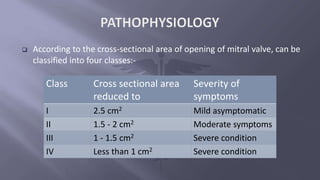
 According to the cross-sectional area of opening of mitral valve, can be
classified into four classes:-
Class Cross sectional area
reduced to
Severity of
symptoms
I 2.5 cm2 Mild asymptomatic
II 1.5 - 2 cm2 Moderate symptoms
III 1 - 1.5 cm2 Severe condition
IV Less than 1 cm2 Severe condition
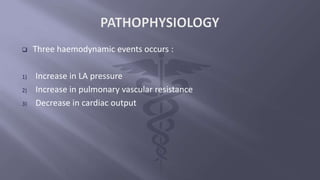
 Three haemodynamic events occurs :
1) Increase in LA pressure
2) Increase in pulmonary vascular resistance
3) Decrease in cardiac output
 Symptoms :
oDysponea
oPulmonary oedema
oChronic cough
oOrthopnea
oCough with or without blood
oPeripheral oedema
oArterial embolism
oAngina pectoris
oRespiratory infections
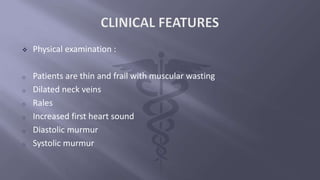
 Physical examination :
o Patients are thin and frail with muscular wasting
o Dilated neck veins
o Rales
o Increased first heart sound
o Diastolic murmur
o Systolic murmur
1) Echocardiography
2) Chest radiography
3)Electrocardiogram
- increased p-wave due to atrial hypertrophy
4) Cardiac catheterization
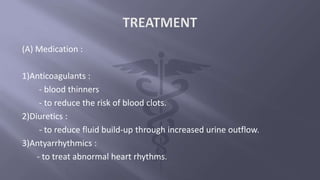
(A) Medication :
1)Anticoagulants :
- blood thinners
- to reduce the risk of blood clots.
2)Diuretics :
- to reduce fluid build-up through increased urine outflow.
3)Antyarrhythmics :
- to treat abnormal heart rhythms.
4)Beta blockers : to slow HR.
(B) Valvotomy/Valvuloplasty :
- The mitral valve is corrected by balloon.
-Once, in the mitral valve, the Surgeon inflates the balloon to expand the
valve.
(C) Surgery :
- Mitral valve replacement :
- The valve prosthesis is placed.
- If the valve is so rigid or calcified that correction can not occur.
- Regular follow-up: at 1-2 yearly intervals because restenosis may occur.
 DEMOGRAPHIC DETAILS
 CHIEF COMPLAINTS
o Chest pain/discomfort
o Problem in breathing
o Cough at night
 HISTORY
 H/O PRESENT ILLNESS: Rheumatic fever in childhood.
 MEDICAL HISTORY : Any recurrent infections or systemic
illness.
 DRUG HISTORY : Medicines taken by patients
 FAMILY HISTORY : Any family member with disease.
 SOCIOECONOMIC HISTORY : Patient belongs to middleclass family.
 SUBJECTIVE ASSESSMENT
 DYSPNOEA : -Present
-Assess severity with NYHA scale.
 COUGH :Present at night
 HAEMOPTYSIS : present in class 3 & 4
 CHEST PAIN : Type - Angina pectoris
Site – Parasternal, also jaw, neck, shoulder and
forearm.
 OBJECTIVE ASSESSMENT
 Cyanosis : Type – Peripheral
 Body built
 Oedema : Pulmonary
 Breathing pattern : Normal
 ON EXAMINATION
 BP : Increased
 HR : Increased
 RR : Normal
 TEMPRATURE : Reduce
 ON PALPATION
TENDERNESS : Parasternal in left side. (RV hypertrophy)
 ON AUSCULTATION :
 Breath sounds : - Absent
- low pitched sound
 Heart sound : - Abnormal
- first sound is large
 INVESTIGATIONS
 Chest X-ray
 ECG : Abnormal ‘P’ wave.
 Cardiac catheterization
 Echocardiograph
 DIAGNOSIS
 Physiotherapy not done in class 1 and 2.
 Therapy is given when there is operative condition is there.
1) Pre-operative therapy :
 Relaxation is given
 Breathing exercise
 Stretching
 Strengthening exs. – peripheral and respiratory.
2) Post-operative therapy :
 CARDIAC REHAB
MITRAL STENOSIS

MITRAL STENOSIS

  • 1.
  • 2.
     DEFINITION  AETIOLOGY PATHOLOGY  PATHOPHYSIOLOGY  CLINICAL FEATURES  INVESTIGATIONS  TREATMENT  PT ASSESSMENT  PT MANAGEMENT
  • 3.
     Mitral stenosisis valvular heart disease characterized by narrowing of orifice of mitral valve so that in this restriction of blood flow from LA to LV during diastole.
  • 4.
     Rheumatic fever -Usually severe mitral stenosis takes about 22 to 30 years to develop after the last known bout of rheumatic fever.  Calcium deposits  Other causes - congenital defect - chest radiation (rare) - autoimmune disease such as lupus.
  • 5.
     Rheumatic feverproduces a widespread manifestation in in the heart.  It affects all 3 layers.  Endocarditis produces ulceration of the endocardium along the ages of valve leaflets where they normally appose in systole.  Tiny nodules of fibrin and platelets accumulates and gradually progress to fusion of leaflets at the commissures.  The above mentioned nodules are called Ashchoff nodules.  Gradually, the valve cups become more swollen and roughened.
  • 6.
     Later, fibrosisand calcification occurs.  So valve leaflets become thickened, rigid and immobile.  Calcified and functionless valve are seen.  It restricts blood flow.  Severity increases gradually over many years.
  • 7.
     According tothe cross-sectional area of opening of mitral valve, can be classified into four classes:- Class Cross sectional area reduced to Severity of symptoms I 2.5 cm2 Mild asymptomatic II 1.5 - 2 cm2 Moderate symptoms III 1 - 1.5 cm2 Severe condition IV Less than 1 cm2 Severe condition
  • 8.
     Three haemodynamicevents occurs : 1) Increase in LA pressure 2) Increase in pulmonary vascular resistance 3) Decrease in cardiac output
  • 9.
     Symptoms : oDysponea oPulmonaryoedema oChronic cough oOrthopnea oCough with or without blood oPeripheral oedema oArterial embolism oAngina pectoris oRespiratory infections
  • 10.
     Physical examination: o Patients are thin and frail with muscular wasting o Dilated neck veins o Rales o Increased first heart sound o Diastolic murmur o Systolic murmur
  • 11.
    1) Echocardiography 2) Chestradiography 3)Electrocardiogram - increased p-wave due to atrial hypertrophy 4) Cardiac catheterization
  • 12.
    (A) Medication : 1)Anticoagulants: - blood thinners - to reduce the risk of blood clots. 2)Diuretics : - to reduce fluid build-up through increased urine outflow. 3)Antyarrhythmics : - to treat abnormal heart rhythms.
  • 13.
    4)Beta blockers :to slow HR. (B) Valvotomy/Valvuloplasty : - The mitral valve is corrected by balloon. -Once, in the mitral valve, the Surgeon inflates the balloon to expand the valve. (C) Surgery :
  • 14.
    - Mitral valvereplacement : - The valve prosthesis is placed. - If the valve is so rigid or calcified that correction can not occur. - Regular follow-up: at 1-2 yearly intervals because restenosis may occur.
  • 15.
     DEMOGRAPHIC DETAILS CHIEF COMPLAINTS o Chest pain/discomfort o Problem in breathing o Cough at night  HISTORY
  • 16.
     H/O PRESENTILLNESS: Rheumatic fever in childhood.  MEDICAL HISTORY : Any recurrent infections or systemic illness.  DRUG HISTORY : Medicines taken by patients  FAMILY HISTORY : Any family member with disease.  SOCIOECONOMIC HISTORY : Patient belongs to middleclass family.
  • 17.
     SUBJECTIVE ASSESSMENT DYSPNOEA : -Present -Assess severity with NYHA scale.  COUGH :Present at night  HAEMOPTYSIS : present in class 3 & 4  CHEST PAIN : Type - Angina pectoris Site – Parasternal, also jaw, neck, shoulder and forearm.
  • 18.
     OBJECTIVE ASSESSMENT Cyanosis : Type – Peripheral  Body built  Oedema : Pulmonary  Breathing pattern : Normal
  • 19.
     ON EXAMINATION BP : Increased  HR : Increased  RR : Normal  TEMPRATURE : Reduce  ON PALPATION TENDERNESS : Parasternal in left side. (RV hypertrophy)
  • 20.
     ON AUSCULTATION:  Breath sounds : - Absent - low pitched sound  Heart sound : - Abnormal - first sound is large
  • 21.
     INVESTIGATIONS  ChestX-ray  ECG : Abnormal ‘P’ wave.  Cardiac catheterization  Echocardiograph  DIAGNOSIS
  • 22.
     Physiotherapy notdone in class 1 and 2.  Therapy is given when there is operative condition is there. 1) Pre-operative therapy :  Relaxation is given  Breathing exercise  Stretching  Strengthening exs. – peripheral and respiratory.
  • 23.
    2) Post-operative therapy:  CARDIAC REHAB