ANGINA PECTORIS
Presented by:
Sk.samiya
Y16MPH273
Dept of Pharmacology
HINDU COLLEGE OF PHARMACY
• Definition
• Classification
• Signs and symptoms
• Causes
• Pathophysiology
• Diagnosis
• Treatment
• Drug therapy
Contents
A type of chest pain caused by reduced
blood flow to the heart.
• Angina pectoris is a clinical syndrome of IHD resulting from
transient myocardial ischemia.
• It is characterized by paroxysmal pain in the substernal or
precordial region of the chest which is aggravated by an increase in
the demand of the heart and relieved by a decrease in the work of
the heart.
• Often, the pain radiates to the left arm, neck, jaw or right arm.
• It is more common in men past 5th decade of life.
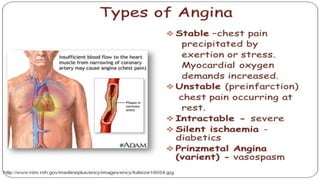
ANGINA
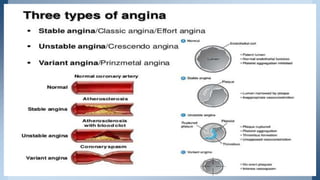
• Stable angina is the most common type of angina.
• It occurs when the heart is working harder than usual.
• Stable angina has a regular pattern. (“Pattern” refers to how
often the angina occurs, how severe it is, and what factors
trigger it.)
• The pain usually goes away a few minutes after you rest or take
your angina medicine.
• Stable angina isn't a heart attack, but it suggests that a heart
attack is more likely to happen in the future.
Stable angina
• Unstable angina doesn't follow a pattern.
• It may occur more often and be more severe than stable angina.
• Unstable angina also can occur with or without physical exertion, and
rest or medicine may not relieve the pain.
• Unstable angina is very dangerous and requires emergency
treatment.
• This type of angina is a sign that a heart attack may happen soon.
Unstable Angina
• Variant angina is rare.
• A spasm in a coronary artery causes this type of angina.
• Variant angina usually occurs while you're at rest, and the pain
can be severe.
• It usually happens between midnight and early morning.
• Medicine can relieve this type of angina.
Variant (Prinzmetal's) Angina
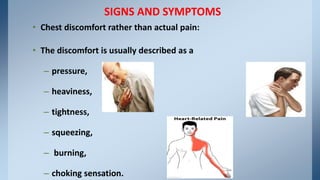
• Chest discomfort rather than actual pain:
• The discomfort is usually described as a
– pressure,
– heaviness,
– tightness,
– squeezing,
– burning,
– choking sensation.
SIGNS AND SYMPTOMS
• Apart from chest discomfort, anginal pains
may also be experienced in
the epigastrium (upper central abdomen),
back, neck area, jaw, or shoulders.
• It is exacerbated by having a full stomach
and by cold temperatures.
• Pain may be accompanied by
breathlessness, sweating, and nausea in
some cases.
1) Major risk factors
CAUSES
2) Other medical problems
• Hyperthyroidism
• Hypoxemia
• Profound anemia
• Uncontrolled hypertension
3) Other cardiac problems
• Tachyarrhythmia
• Bradyarrhythmia
• Valvular heart disease
• Hypertrophic cardiomyopathy
• Angina results when there is an imbalance between the heart's
oxygen demand and supply.
• This imbalance can result from an increase in demand (e.g.,
during exercise) without a proportional increase in supply (e.g.,
due to obstruction or atherosclerosis of the coronary arteries).
• However, the pathophysiology of angina in females varies
significantly as compared to males Non-obstructive coronary
disease is more common in females
Pathophysiology
Diagnosis
• Organic nitrates are prodrugs and they release nitric oxide.
• Nitrates are mainly venodilators also cause arteriolar dilation
and as a result reduces both preload and afterload.
• These compounds cause a rapid reduction in myocardial oxygen
demand, followed by rapid relief of symptoms.
Organic nitrates
Administered nitrates
Increased nitrates in the blood
Increased formation of nitric oxide
Increased cGMP formation
increased dephosphorylation of myosin
Vascular smooth muscle relaxation
• vasodilation
• The nitrates are inactivated in liver by
glutathione or ganic nitrate reductase.
• Therefore their oral bioavailability is
considerably less due to their first-pass
metabolism.
• The sublingual route, which avoids first pass
effect, is therefore preferred.
• Duration of action lasts for about 25-30min
pharmacokinetics
On other smooth muscles:
• Smooth muscles of bronchi, oesophagus, biliary tract, etc are
relaxed by nitrates.
Pharmacological actions of nitrates:
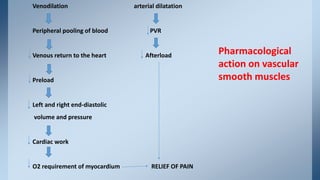
Venodilation arterial dilatation
Peripheral pooling of blood PVR
Venous return to the heart Afterload
Preload
Left and right end-diastolic
volume and pressure
Cardiac work
O2 requirement of myocardium RELIEF OF PAIN
Pharmacological
action on vascular
smooth muscles
• The most common adverse effect of nitroglycerin, as well as of
the other nitrates, is headache.
• High doses of organic nitrates can also cause postural
hypotension, facial flushing, and tachycardia. Sildenafil
potentiates the action of the nitrates.
• Over doses may cause methaemoglobinaemia.
Adverse drug reactions
• Continuous exposure to nitrates in the chemical industry results
in development of tolerance.
• Workers may experience headache and dizziness on starting
work during first few days.
• As there is no exposure to chemicals over the weekend ,
tolerance disappears.
• Symptoms disappear when they start work on Monday– “
Monday disease”.
Tolerance
• Angina pectoris
• Heart failure
• Myocardial infarction
• Cyanide poisoning
• Oesophageal spasm
• Biliary colic
Therapeutic uses
• Sildenafil and other vasodilators potentiate the hypotensive
action of nitrates
• MI and sudden death have occurred.
Drug interactions
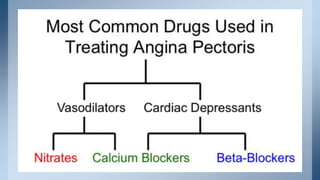
Calcium channel
Nifedipine
• Functions mainly as an arteriolar vasodilator.
• This drug has minimal effect on cardiac conduction or heart rate.
• Nifedipine is administered orally, usually as extended-release tablets.
It undergoes hepatic metabolism to products that are eliminated in
both urine and the feces.
• The vasodilation effect of nifedipine is useful in the treatment of
variant angina caused by spontaneous coronary spasm.
• Nifedipine can cause flushing, headache, hypotension, and
peripheral edema
• The diphenylalkylamine verapamil slows cardiac atrioventricular (AV)
conduction directly, and decreases heart rate, contractility, blood pressure,
and oxygen demand.
• Verapamil causes greater negative inotropic effects than nifedipine, but it
is a weaker vasodilator.
• The drug is extensively metabolized by the liver; therefore, care must be
taken to adjust the dose in patients with liver dysfunction.
Verapamil
• Verapamil is contraindicated in patients with preexisting depressed
cardiac function or AV conduction abnormalities.
• It also causes constipation.
• Verapamil should be used with caution in patients taking digoxin,
because verapamil increases digoxin levels.
• It dilates peripheral and coronary arteries but its dilating
property is less marked than DHPs.
• It also causes negative inotropic, chronotropic and dromotropic
effects.
• It is used in the treatment of angina, hypertension and
supraventricular arrhythmias.
Diltiazem
• Verapamil or diltiazem should not be given with beta blockers as
SA nodal depression, conduction defects or asystole may occur
or be aggravated.
• These should not be used with other cardiac depressants drugs
like quinidine or disopyramide.
• These drugs increase plasma digoxin levels by decreasing its
excretion.
DRUG INTERACTIONS
• All CCBs are well absorbed through GI tract but they undergo
varying degree of first pass metabolism.
• All are highly bound to plasma proteins, metabolized in the liver
and excreted in urine.
Pharmacokinetics
• Angina pectoris
• Variant angina
• Unstable angina
• Supraventricular arrhythmias
• Hypertension
• Hypertropic cardiomyopathy
• Migraine
• Raynaud’s phenomenon
Uses of CCBs
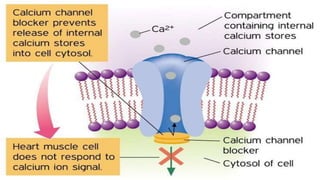
Mechanism of action
• They are, however, contraindicated in patients with asthma,
diabetes, severe bradycardia, peripheral vascular disease, or chronic
obstructive pulmonary disease.
Adverse effects:
• Bradycardia
• Heart block
• Bronchospasm
• hypoglycaemia
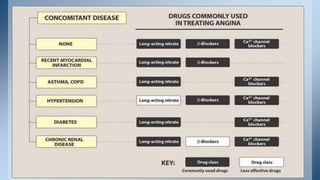
• Nitrates × beta blockers
• Nifedipine × β-blockers
• Β-blockers × verapamil/diltiazem
• Calcium channel blockers × nitrates
• Nitrates + β-blockers + CCBs
Combination therapy
• Voltage gated K channels: These channels open when the cell is
depolarized and therefore help in the process of repolarization. These are
present mainly in vascular and other smooth muscles
• Calcium activated K channels: An increase in intracellular ca+2
concentration causes opening of these channels, causes repolarization.
• ATP sensitive K channels: These are present in cardiac muscle and beta
cells of islets of Langerhans of pancreas
Potassium channels
Cytoprotective drugs
ANTIPLATELET DRUGS
1. Lippincott's Illustrated Reviews
Pharmacology, 4th Edition
2. https://en.wikipedia.org/wiki/Angina_pe
ctoris
3. Principles of Pharmacology SHARMA AND
SHARMA
4. Pharmacology by Tara V Shanbhag.
REFERENCES
Angina

Angina

  • 1.
    ANGINA PECTORIS Presented by: Sk.samiya Y16MPH273 Deptof Pharmacology HINDU COLLEGE OF PHARMACY
  • 2.
    • Definition • Classification •Signs and symptoms • Causes • Pathophysiology • Diagnosis • Treatment • Drug therapy Contents
  • 3.
    A type ofchest pain caused by reduced blood flow to the heart.
  • 4.
    • Angina pectorisis a clinical syndrome of IHD resulting from transient myocardial ischemia. • It is characterized by paroxysmal pain in the substernal or precordial region of the chest which is aggravated by an increase in the demand of the heart and relieved by a decrease in the work of the heart. • Often, the pain radiates to the left arm, neck, jaw or right arm. • It is more common in men past 5th decade of life. ANGINA
  • 7.
    • Stable anginais the most common type of angina. • It occurs when the heart is working harder than usual. • Stable angina has a regular pattern. (“Pattern” refers to how often the angina occurs, how severe it is, and what factors trigger it.) • The pain usually goes away a few minutes after you rest or take your angina medicine. • Stable angina isn't a heart attack, but it suggests that a heart attack is more likely to happen in the future. Stable angina
  • 8.
    • Unstable anginadoesn't follow a pattern. • It may occur more often and be more severe than stable angina. • Unstable angina also can occur with or without physical exertion, and rest or medicine may not relieve the pain. • Unstable angina is very dangerous and requires emergency treatment. • This type of angina is a sign that a heart attack may happen soon. Unstable Angina
  • 9.
    • Variant anginais rare. • A spasm in a coronary artery causes this type of angina. • Variant angina usually occurs while you're at rest, and the pain can be severe. • It usually happens between midnight and early morning. • Medicine can relieve this type of angina. Variant (Prinzmetal's) Angina
  • 10.
    • Chest discomfortrather than actual pain: • The discomfort is usually described as a – pressure, – heaviness, – tightness, – squeezing, – burning, – choking sensation. SIGNS AND SYMPTOMS
  • 11.
    • Apart fromchest discomfort, anginal pains may also be experienced in the epigastrium (upper central abdomen), back, neck area, jaw, or shoulders. • It is exacerbated by having a full stomach and by cold temperatures. • Pain may be accompanied by breathlessness, sweating, and nausea in some cases.
  • 12.
    1) Major riskfactors CAUSES
  • 13.
    2) Other medicalproblems • Hyperthyroidism • Hypoxemia • Profound anemia • Uncontrolled hypertension 3) Other cardiac problems • Tachyarrhythmia • Bradyarrhythmia • Valvular heart disease • Hypertrophic cardiomyopathy
  • 14.
    • Angina resultswhen there is an imbalance between the heart's oxygen demand and supply. • This imbalance can result from an increase in demand (e.g., during exercise) without a proportional increase in supply (e.g., due to obstruction or atherosclerosis of the coronary arteries). • However, the pathophysiology of angina in females varies significantly as compared to males Non-obstructive coronary disease is more common in females Pathophysiology
  • 16.
  • 20.
    • Organic nitratesare prodrugs and they release nitric oxide. • Nitrates are mainly venodilators also cause arteriolar dilation and as a result reduces both preload and afterload. • These compounds cause a rapid reduction in myocardial oxygen demand, followed by rapid relief of symptoms. Organic nitrates
  • 21.
    Administered nitrates Increased nitratesin the blood Increased formation of nitric oxide Increased cGMP formation increased dephosphorylation of myosin Vascular smooth muscle relaxation • vasodilation
  • 22.
    • The nitratesare inactivated in liver by glutathione or ganic nitrate reductase. • Therefore their oral bioavailability is considerably less due to their first-pass metabolism. • The sublingual route, which avoids first pass effect, is therefore preferred. • Duration of action lasts for about 25-30min pharmacokinetics
  • 23.
    On other smoothmuscles: • Smooth muscles of bronchi, oesophagus, biliary tract, etc are relaxed by nitrates. Pharmacological actions of nitrates:
  • 24.
    Venodilation arterial dilatation Peripheralpooling of blood PVR Venous return to the heart Afterload Preload Left and right end-diastolic volume and pressure Cardiac work O2 requirement of myocardium RELIEF OF PAIN Pharmacological action on vascular smooth muscles
  • 25.
    • The mostcommon adverse effect of nitroglycerin, as well as of the other nitrates, is headache. • High doses of organic nitrates can also cause postural hypotension, facial flushing, and tachycardia. Sildenafil potentiates the action of the nitrates. • Over doses may cause methaemoglobinaemia. Adverse drug reactions
  • 26.
    • Continuous exposureto nitrates in the chemical industry results in development of tolerance. • Workers may experience headache and dizziness on starting work during first few days. • As there is no exposure to chemicals over the weekend , tolerance disappears. • Symptoms disappear when they start work on Monday– “ Monday disease”. Tolerance
  • 27.
    • Angina pectoris •Heart failure • Myocardial infarction • Cyanide poisoning • Oesophageal spasm • Biliary colic Therapeutic uses
  • 28.
    • Sildenafil andother vasodilators potentiate the hypotensive action of nitrates • MI and sudden death have occurred. Drug interactions
  • 31.
  • 33.
    Nifedipine • Functions mainlyas an arteriolar vasodilator. • This drug has minimal effect on cardiac conduction or heart rate. • Nifedipine is administered orally, usually as extended-release tablets. It undergoes hepatic metabolism to products that are eliminated in both urine and the feces.
  • 34.
    • The vasodilationeffect of nifedipine is useful in the treatment of variant angina caused by spontaneous coronary spasm. • Nifedipine can cause flushing, headache, hypotension, and peripheral edema
  • 35.
    • The diphenylalkylamineverapamil slows cardiac atrioventricular (AV) conduction directly, and decreases heart rate, contractility, blood pressure, and oxygen demand. • Verapamil causes greater negative inotropic effects than nifedipine, but it is a weaker vasodilator. • The drug is extensively metabolized by the liver; therefore, care must be taken to adjust the dose in patients with liver dysfunction. Verapamil
  • 36.
    • Verapamil iscontraindicated in patients with preexisting depressed cardiac function or AV conduction abnormalities. • It also causes constipation. • Verapamil should be used with caution in patients taking digoxin, because verapamil increases digoxin levels.
  • 37.
    • It dilatesperipheral and coronary arteries but its dilating property is less marked than DHPs. • It also causes negative inotropic, chronotropic and dromotropic effects. • It is used in the treatment of angina, hypertension and supraventricular arrhythmias. Diltiazem
  • 38.
    • Verapamil ordiltiazem should not be given with beta blockers as SA nodal depression, conduction defects or asystole may occur or be aggravated. • These should not be used with other cardiac depressants drugs like quinidine or disopyramide. • These drugs increase plasma digoxin levels by decreasing its excretion. DRUG INTERACTIONS
  • 39.
    • All CCBsare well absorbed through GI tract but they undergo varying degree of first pass metabolism. • All are highly bound to plasma proteins, metabolized in the liver and excreted in urine. Pharmacokinetics
  • 40.
    • Angina pectoris •Variant angina • Unstable angina • Supraventricular arrhythmias • Hypertension • Hypertropic cardiomyopathy • Migraine • Raynaud’s phenomenon Uses of CCBs
  • 42.
  • 43.
    • They are,however, contraindicated in patients with asthma, diabetes, severe bradycardia, peripheral vascular disease, or chronic obstructive pulmonary disease. Adverse effects: • Bradycardia • Heart block • Bronchospasm • hypoglycaemia
  • 44.
    • Nitrates ×beta blockers • Nifedipine × β-blockers • Β-blockers × verapamil/diltiazem • Calcium channel blockers × nitrates • Nitrates + β-blockers + CCBs Combination therapy
  • 46.
    • Voltage gatedK channels: These channels open when the cell is depolarized and therefore help in the process of repolarization. These are present mainly in vascular and other smooth muscles • Calcium activated K channels: An increase in intracellular ca+2 concentration causes opening of these channels, causes repolarization. • ATP sensitive K channels: These are present in cardiac muscle and beta cells of islets of Langerhans of pancreas Potassium channels
  • 49.
  • 51.
  • 54.
    1. Lippincott's IllustratedReviews Pharmacology, 4th Edition 2. https://en.wikipedia.org/wiki/Angina_pe ctoris 3. Principles of Pharmacology SHARMA AND SHARMA 4. Pharmacology by Tara V Shanbhag. REFERENCES