
PREPARED BY-SAYAMDEEP 
ROY 
B.PHARM 
3rd YEAR, 6th SEM 
REG NO.-112080210015 
ROLL NO.-20801911015
 CHF 
 ETIOLOGY OF CHF 
 EPIDEMIOLOGY OF CHF IN INDIA 
 PATHOPHYSIOLOGY OF CHF 
 SYMPTOM ,MANAGEMENT OF CHF 
 VARIOUS DRUGS USED IN CHF 
 MECHANISM OF ACTION, ADVERSE 
EFFECT OF THE DRUGS 
 REFERENCE
 Heart failure (HF) is a complex, progressive 
disorder in which the heart is unable to pump 
sufficient blood to meet the need of the body. 
HF is due to an impaired ability of the heart 
to adequately fill with and/or eject blood. It is 
often accompanied by abnormal increases in 
blood volume and interstitial fluid in cardio-pulmonary 
system, hence the term 
‘congestive’.
 Intrinsic pump failure 
 Increased workload on 
the heart 
 Impaired filling of cardiac 
chamber 
 Systolic dysfunction 
 Diastolic dysfunction 
 Poor supply of O2 & 
nutrients
1 2
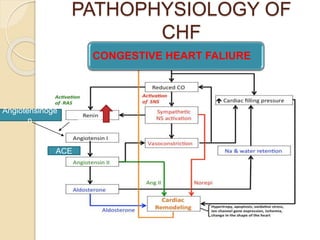
PATHOPHYSIOLOGY OF 
CHF 
CONGESTIVE HEART FALIURE 
Angiotensinoge 
ACE 
n
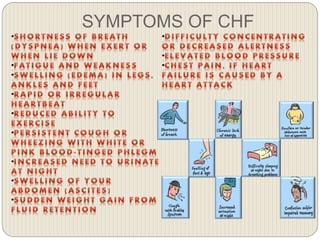
SYMPTOMS OF CHF
 Weigh yourself daily. 
 Try to read food labels. 
 Follow a low-sodium diet. Keep total sodium intake to less than 
2,000 mg (2g) per day. 
 Exercise. 
 Take prescribed medicine. 
 Do not take NSAIDS—Advil® (Ibuprofen), Aleve® (Naproxen), Orudis® 
(Ketoprofen), or other anti-inflammatory drugs. 
 Avoid: Alka-Seltzer®, Metamucil Instant®, and all effervescent drugs. 
 Lose weight (if overweight). 
 Get support of friends and family. 
 Quit smoking. 
 Limit alcohol (if your heart failure is caused by alcohol, avoid it 
completely). 
 Take care of other medical conditions such as high blood pressure 
and diabetes. 
 Consult with a registered doctor.
DRUGS USED IN CHF 
 RENIN-ANGIOTENSIN 
SYSTEM BLOCKERS 
ACE inhibitors ARBs 
 ß-BLOCKERS 
 DIURETICS 
thiazides 
High ceiling 
K+sparing 
/loop diuretics 
 VASODILATORS 
mixed 
dilator Venodilator 
Arteriolar 
dilator 
 CARDIAC 
GLYCOSIDES / 
INOTROPIC AGENTS 
 ALDOSTERONE 
ANTAGONISTS
 ACE inhibitors – 
CAPTOPRIL 
ENALAPRIL 
QUINAPRIL 
RAMIPRIL 
 ANGIOTENSIN RECEPTOR 
BLOCKER-LOSARTAN 
VALSARTAN 
TELMISARTAN 
 β-BLOCKERS-ATENOLOL 
PROPRANOLOL 
CARVEDILOL 
METOPROLOL 
 HIGH CEILING /LOOP DIURETICS-FUROSEMIDE 
TORSEMIDE 
 K+ SPARING-SPIRONOLACTONE 
 THIAZIDE DIURETICS-HYDROCHLOROTHIAZIDE 
 VENODILATOR-ISOSORBIDE 
DINITRATE 
GLYCERYL TRINITRATE 
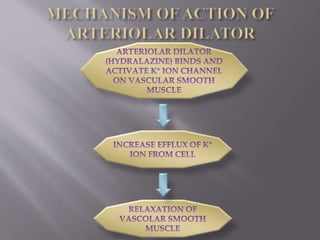
 ARTERIOLAR DILATOR-HYDRALAZINE 
MINOXIDIL 
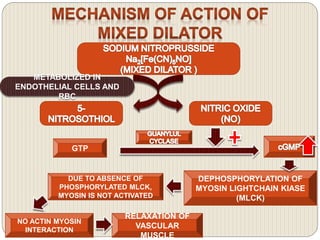
 MIXED DILATOR-SODIUM 
NITROPRUSSIDE 
 CARDIAC GLYCOSIDE-DIGITOXIN 
DIGOXIN 
PHOSPHODIESTERASE III (PDE III) 
INHIBITOR-MILRINONE 
AMRINONE
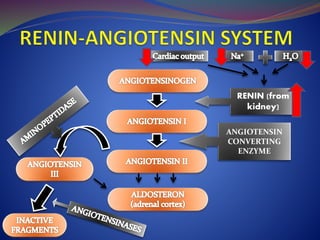
RENIN (from 
kidney) 
ANGIOTENSIN 
CONVERTING 
ENZYME
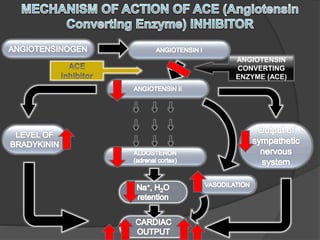
ANGIOTENSIN 
CONVERTING 
ENZYME (ACE)
 These include postural hypotension, 
renal insufficiency, hyperkalemia, 
angioedema, and a persistent dry 
cough. The potential for symptomatic 
hypotension with ACE inhibitor therapy 
requires careful monitoring. ACE 
inhibitors should not be used in pregnant 
women, because they are fetotoxic.
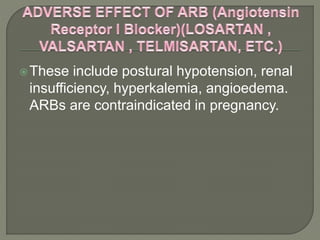
These include postural hypotension, renal 
insufficiency, hyperkalemia, angioedema. 
ARBs are contraindicated in pregnancy.
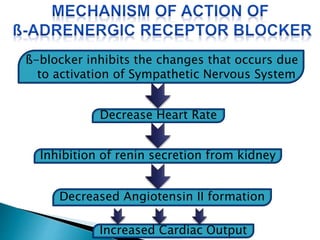
ß-blocker inhibits the changes that occurs due 
to activation of Sympathetic Nervous System 
Decrease Heart Rate 
Inhibition of renin secretion from kidney 
Decreased Angiotensin II formation 
Increased Cardiac Output
ß-blocker is not a drug of choice in CHF , 
because it have various adverse effects-- 
 BRADYCARDIA 
 INCREASED FREQUENCY OF URINATION 
Etc.
DIURETIC 
S 
Decrease 
circulating 
volume of heart 
Decrease venous 
return to heart 
(preload) 
Improve ventricular 
efficiency 
Decrease cardiac 
workload & O2 demand 
of heart 
Decrease 
afterload 
by 
decreasin 
g plasma 
volume 
Decrease 
the blood 
pressure 
Removin 
g 
periphera 
l edema 
& 
pulmonar 
y 
congesti 
on
Some adverse effects are – 
THIAZIDE GROUP- LOSS OF Na+ 
LOOP DIURETICS GROUP- LOSS OF 
ELECTROLYTE 
INSTEAD OF THIS- 
 INCREASED FREQUENCY OF URINATION, 
 HYPOTENSION, 
Etc.
MECHANISM OF ACTION OF 
VENODILATORS 
ORGANIC NITRATES (GLYCERYL TRINITRATE , 
ISOSORBIDE DINITRATE) 
Metabolized in vascular 
endothelial cell 
5-NITROSOTHIOL NITRIC OXIDE 
GUANYLYL 
CYCLASE 
GTP cGMP 
Decreased Ca2+ entry in 
Vascular cell 
RELAXATION 
DEPHOSPHORYLATION OF 
MYOSIN LIGHTCHAIN KIASE 
(MLCK) 
DUE TO ABSENCE OF 
PHOSPHORYLATED MLCK, 
MYOSIN IS NOT ACTIVATED 
NO ACTIN MYOSIN 
INTERACTION
METABOLIZED IN 
ENDOTHELIAL CELLS AND 
RBC 
GTP 
RELAXATION OF 
VASCULAR 
MUSCLE 
DEPHOSPHORYLATION OF 
MYOSIN LIGHTCHAIN KIASE 
(MLCK) 
DUE TO ABSENCE OF 
PHOSPHORYLATED MLCK, 
MYOSIN IS NOT ACTIVATED 
NO ACTIN MYOSIN 
INTERACTION
MECHANISM OF ACTION OF 
PHOSPHODIESTERASE III (PDE III) INHIBITOR 
PDE III 
ATP cAMP 5’AMP 
PDE III inhibitor 
(milrinone , amrinone) 
Increase Ca2+ influx 
in myocardial muscle 
Increase force of contraction of 
heart (positive inotropic effect)
Some adverse effects are-- 
 THROMBOCYTOPENIA 
 NAUSEA 
 DIARRHOEA 
 ABDOMINAL PAIN 
 LIVER DAMAGE 
 FEVER 
 CARDIAC ARRHYTHMIA
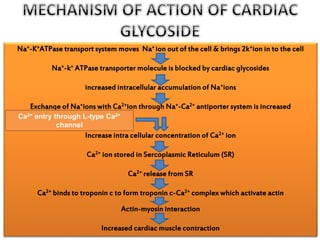
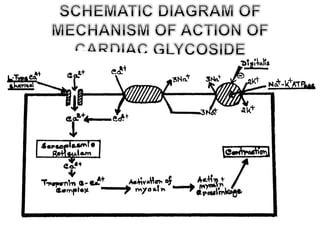
Na+-K+ATPase transport system moves Na+ ion out of the cell & brings 2k+ion in to the cell 
Na+-k+ ATPase transporter molecule is blocked by cardiac glycosides 
increased intracellular accumulation of Na+ions 
Exchange of Na+ions with Ca2+ion through Na+-Ca2+ antiporter system is increased 
Ca2+ entry through L-type Ca2+ 
Increase intra cellular concentration of Ca2+ ion 
Ca2+ ion stored in Sercoplasmic Reticulum (SR) 
Ca2+ release from SR 
Ca2+ binds to troponin c to form troponin c-Ca2+ complex which activate actin 
Actin-myosin interaction 
Increased cardiac muscle contraction 
channel
Occurrence of adverse drug reaction is common 
due to its narrow therapeutic index. Some adverse 
effects are -- 
Extra cardiac adverse effects-anorexia, 
nausea, vomiting, diarrhoea, fatigue, headache, 
mental confusion, restlessness, depression, blurred vision 
Cardiac adverse effect-all 
types of cardiac arrhythmia occurs like ventricular 
extrasystole, ventricular tachycardia etc.
REFERENCE 
• ESSENTIALS OF MEDICAL PHARMACOLOGY 
KD TRIPATHI 
6th edition , pp.-493-507 
• LIPPINCOTT’S ILLUSTRATED REVIEWS 
PHARMACOLOGY 
RICHARD FINKEL, LUIGI X. CUBEDDU, MICHELLE A. CLARK 
6th edition , pp.-151-157
CHF BY SAYAMDEEP ROY B.PHARM

CHF BY SAYAMDEEP ROY B.PHARM

  • 1.
    PREPARED BY-SAYAMDEEP ROY B.PHARM 3rd YEAR, 6th SEM REG NO.-112080210015 ROLL NO.-20801911015
  • 2.
     CHF ETIOLOGY OF CHF  EPIDEMIOLOGY OF CHF IN INDIA  PATHOPHYSIOLOGY OF CHF  SYMPTOM ,MANAGEMENT OF CHF  VARIOUS DRUGS USED IN CHF  MECHANISM OF ACTION, ADVERSE EFFECT OF THE DRUGS  REFERENCE
  • 3.
     Heart failure(HF) is a complex, progressive disorder in which the heart is unable to pump sufficient blood to meet the need of the body. HF is due to an impaired ability of the heart to adequately fill with and/or eject blood. It is often accompanied by abnormal increases in blood volume and interstitial fluid in cardio-pulmonary system, hence the term ‘congestive’.
  • 4.
     Intrinsic pumpfailure  Increased workload on the heart  Impaired filling of cardiac chamber  Systolic dysfunction  Diastolic dysfunction  Poor supply of O2 & nutrients
  • 5.
  • 6.
    PATHOPHYSIOLOGY OF CHF CONGESTIVE HEART FALIURE Angiotensinoge ACE n
  • 7.
  • 8.
     Weigh yourselfdaily.  Try to read food labels.  Follow a low-sodium diet. Keep total sodium intake to less than 2,000 mg (2g) per day.  Exercise.  Take prescribed medicine.  Do not take NSAIDS—Advil® (Ibuprofen), Aleve® (Naproxen), Orudis® (Ketoprofen), or other anti-inflammatory drugs.  Avoid: Alka-Seltzer®, Metamucil Instant®, and all effervescent drugs.  Lose weight (if overweight).  Get support of friends and family.  Quit smoking.  Limit alcohol (if your heart failure is caused by alcohol, avoid it completely).  Take care of other medical conditions such as high blood pressure and diabetes.  Consult with a registered doctor.
  • 9.
    DRUGS USED INCHF  RENIN-ANGIOTENSIN SYSTEM BLOCKERS ACE inhibitors ARBs  ß-BLOCKERS  DIURETICS thiazides High ceiling K+sparing /loop diuretics  VASODILATORS mixed dilator Venodilator Arteriolar dilator  CARDIAC GLYCOSIDES / INOTROPIC AGENTS  ALDOSTERONE ANTAGONISTS
  • 10.
     ACE inhibitors– CAPTOPRIL ENALAPRIL QUINAPRIL RAMIPRIL  ANGIOTENSIN RECEPTOR BLOCKER-LOSARTAN VALSARTAN TELMISARTAN  β-BLOCKERS-ATENOLOL PROPRANOLOL CARVEDILOL METOPROLOL  HIGH CEILING /LOOP DIURETICS-FUROSEMIDE TORSEMIDE  K+ SPARING-SPIRONOLACTONE  THIAZIDE DIURETICS-HYDROCHLOROTHIAZIDE  VENODILATOR-ISOSORBIDE DINITRATE GLYCERYL TRINITRATE  ARTERIOLAR DILATOR-HYDRALAZINE MINOXIDIL  MIXED DILATOR-SODIUM NITROPRUSSIDE  CARDIAC GLYCOSIDE-DIGITOXIN DIGOXIN PHOSPHODIESTERASE III (PDE III) INHIBITOR-MILRINONE AMRINONE
  • 11.
    RENIN (from kidney) ANGIOTENSIN CONVERTING ENZYME
  • 12.
  • 13.
     These includepostural hypotension, renal insufficiency, hyperkalemia, angioedema, and a persistent dry cough. The potential for symptomatic hypotension with ACE inhibitor therapy requires careful monitoring. ACE inhibitors should not be used in pregnant women, because they are fetotoxic.
  • 15.
    These include posturalhypotension, renal insufficiency, hyperkalemia, angioedema. ARBs are contraindicated in pregnancy.
  • 16.
    ß-blocker inhibits thechanges that occurs due to activation of Sympathetic Nervous System Decrease Heart Rate Inhibition of renin secretion from kidney Decreased Angiotensin II formation Increased Cardiac Output
  • 17.
    ß-blocker is nota drug of choice in CHF , because it have various adverse effects--  BRADYCARDIA  INCREASED FREQUENCY OF URINATION Etc.
  • 18.
    DIURETIC S Decrease circulating volume of heart Decrease venous return to heart (preload) Improve ventricular efficiency Decrease cardiac workload & O2 demand of heart Decrease afterload by decreasin g plasma volume Decrease the blood pressure Removin g periphera l edema & pulmonar y congesti on
  • 19.
    Some adverse effectsare – THIAZIDE GROUP- LOSS OF Na+ LOOP DIURETICS GROUP- LOSS OF ELECTROLYTE INSTEAD OF THIS-  INCREASED FREQUENCY OF URINATION,  HYPOTENSION, Etc.
  • 20.
    MECHANISM OF ACTIONOF VENODILATORS ORGANIC NITRATES (GLYCERYL TRINITRATE , ISOSORBIDE DINITRATE) Metabolized in vascular endothelial cell 5-NITROSOTHIOL NITRIC OXIDE GUANYLYL CYCLASE GTP cGMP Decreased Ca2+ entry in Vascular cell RELAXATION DEPHOSPHORYLATION OF MYOSIN LIGHTCHAIN KIASE (MLCK) DUE TO ABSENCE OF PHOSPHORYLATED MLCK, MYOSIN IS NOT ACTIVATED NO ACTIN MYOSIN INTERACTION
  • 22.
    METABOLIZED IN ENDOTHELIALCELLS AND RBC GTP RELAXATION OF VASCULAR MUSCLE DEPHOSPHORYLATION OF MYOSIN LIGHTCHAIN KIASE (MLCK) DUE TO ABSENCE OF PHOSPHORYLATED MLCK, MYOSIN IS NOT ACTIVATED NO ACTIN MYOSIN INTERACTION
  • 23.
    MECHANISM OF ACTIONOF PHOSPHODIESTERASE III (PDE III) INHIBITOR PDE III ATP cAMP 5’AMP PDE III inhibitor (milrinone , amrinone) Increase Ca2+ influx in myocardial muscle Increase force of contraction of heart (positive inotropic effect)
  • 24.
    Some adverse effectsare--  THROMBOCYTOPENIA  NAUSEA  DIARRHOEA  ABDOMINAL PAIN  LIVER DAMAGE  FEVER  CARDIAC ARRHYTHMIA
  • 25.
    Na+-K+ATPase transport systemmoves Na+ ion out of the cell & brings 2k+ion in to the cell Na+-k+ ATPase transporter molecule is blocked by cardiac glycosides increased intracellular accumulation of Na+ions Exchange of Na+ions with Ca2+ion through Na+-Ca2+ antiporter system is increased Ca2+ entry through L-type Ca2+ Increase intra cellular concentration of Ca2+ ion Ca2+ ion stored in Sercoplasmic Reticulum (SR) Ca2+ release from SR Ca2+ binds to troponin c to form troponin c-Ca2+ complex which activate actin Actin-myosin interaction Increased cardiac muscle contraction channel
  • 27.
    Occurrence of adversedrug reaction is common due to its narrow therapeutic index. Some adverse effects are -- Extra cardiac adverse effects-anorexia, nausea, vomiting, diarrhoea, fatigue, headache, mental confusion, restlessness, depression, blurred vision Cardiac adverse effect-all types of cardiac arrhythmia occurs like ventricular extrasystole, ventricular tachycardia etc.
  • 28.
    REFERENCE • ESSENTIALSOF MEDICAL PHARMACOLOGY KD TRIPATHI 6th edition , pp.-493-507 • LIPPINCOTT’S ILLUSTRATED REVIEWS PHARMACOLOGY RICHARD FINKEL, LUIGI X. CUBEDDU, MICHELLE A. CLARK 6th edition , pp.-151-157