Definition
 Mechanism
 Significance
 Treatment

Second degree heart block implies
intermittent conduction
 Some impulses are conducted to
ventricles whereas others are not

Myocardial infarction
 Myocarditis
 Rheumatic fever
 Drugs i.e beta blockers and digitalis
 Hyperkalemia

Mobitz type I
 Mobitz type II
 2:1 block

Conduction defect in the AV node
 AV conduction time progressively
lengthens before a blocked beat

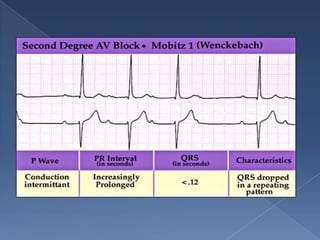
Progressive lengthening of PR interval
 One non-conducted P wave
 Next conducted beat has a shorter PR
interval than the preceding conducted
beat ,cycle repeats
 Normal QRS complexes



Mobitz type I is usually benign and
prognosis is good
Usually due to block within the bundle of
His
 Most beats are conducted but
occasionally there’s atrial contraction
without subsequent ventricular
contraction

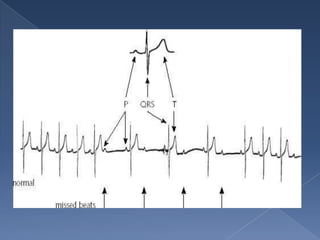
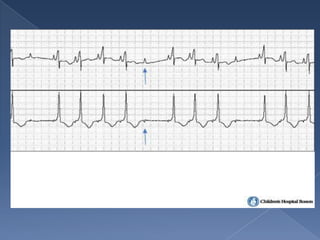
PR interval remains constant
 Some P waves are not conducted( i.e
more P waves than QRS complexes)
 QRS complexes are wide



Risk of progression to complete heart
block is greater than type I
May represent as type I or type II block
 Two p waves to each QRS complex
therefore called 2:1 block

Asymptomatic Mobitz type I doesn’t
require any treatment
 Atropine for pt’s presenting with asystole
 pacemaker

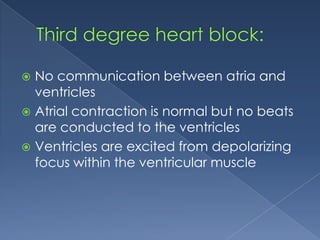
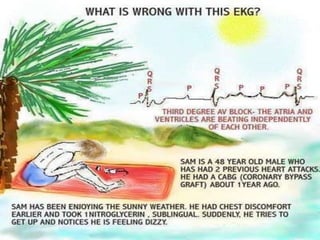
No communication between atria and
ventricles
 Atrial contraction is normal but no beats
are conducted to the ventricles
 Ventricles are excited from depolarizing
focus within the ventricular muscle

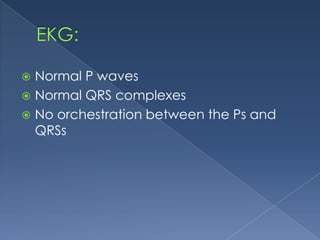
Normal P waves
 Normal QRS complexes
 No orchestration between the Ps and
QRSs

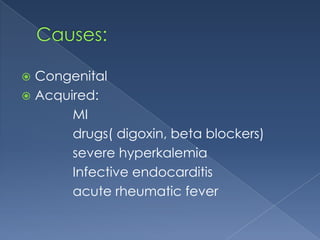
Congenital
 Acquired:
MI
drugs( digoxin, beta blockers)
severe hyperkalemia
Infective endocarditis
acute rheumatic fever

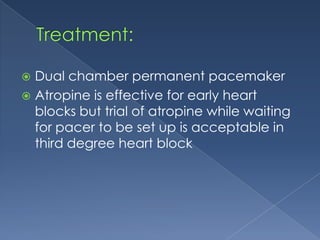
Dual chamber permanent pacemaker
 Atropine is effective for early heart
blocks but trial of atropine while waiting
for pacer to be set up is acceptable in
third degree heart block

Heart block
Heart block

Heart block

  • 2.
  • 3.
    Second degree heartblock implies intermittent conduction  Some impulses are conducted to ventricles whereas others are not 
  • 4.
    Myocardial infarction  Myocarditis Rheumatic fever  Drugs i.e beta blockers and digitalis  Hyperkalemia 
  • 5.
    Mobitz type I Mobitz type II  2:1 block 
  • 6.
    Conduction defect inthe AV node  AV conduction time progressively lengthens before a blocked beat 
  • 7.
    Progressive lengthening ofPR interval  One non-conducted P wave  Next conducted beat has a shorter PR interval than the preceding conducted beat ,cycle repeats  Normal QRS complexes 
  • 9.
     Mobitz type Iis usually benign and prognosis is good
  • 10.
    Usually due toblock within the bundle of His  Most beats are conducted but occasionally there’s atrial contraction without subsequent ventricular contraction 
  • 11.
    PR interval remainsconstant  Some P waves are not conducted( i.e more P waves than QRS complexes)  QRS complexes are wide 
  • 14.
     Risk of progressionto complete heart block is greater than type I
  • 15.
    May represent astype I or type II block  Two p waves to each QRS complex therefore called 2:1 block 
  • 16.
    Asymptomatic Mobitz typeI doesn’t require any treatment  Atropine for pt’s presenting with asystole  pacemaker 
  • 17.
    No communication betweenatria and ventricles  Atrial contraction is normal but no beats are conducted to the ventricles  Ventricles are excited from depolarizing focus within the ventricular muscle 
  • 18.
    Normal P waves Normal QRS complexes  No orchestration between the Ps and QRSs 
  • 19.
    Congenital  Acquired: MI drugs( digoxin,beta blockers) severe hyperkalemia Infective endocarditis acute rheumatic fever 
  • 20.
    Dual chamber permanentpacemaker  Atropine is effective for early heart blocks but trial of atropine while waiting for pacer to be set up is acceptable in third degree heart block 