Definition
An abnormal heartrhythm where the heart beats
too slowly (bradycardia).
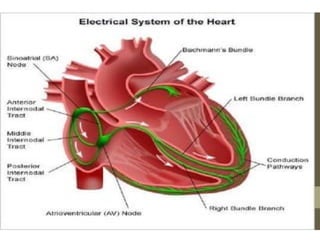
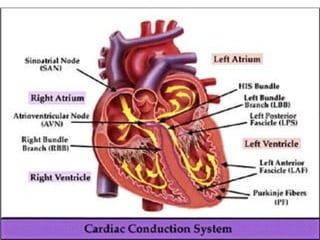
In this condition, the electrical signals to the heart to
contract are partially or totally blocked between
the upper chambers (atria) and the lower
chambers (ventricles).
6.
• A delayin conduction between the atria and
ventricles results in an ATRIO VENTRICULAR
CONDUCTION BLOCK/HEART BLOCK.
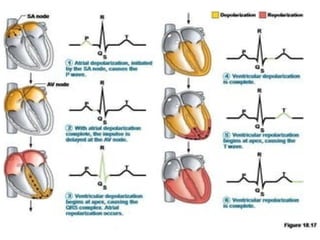
• This is indicated by a prolongation of the PR
interval on electrocardiogram.
• Conduction blocks are classified as either first-
degree, second-degree, or third-degree blocks.
7.
Types of heartblock
1. First degree heart block ( first degree AV
block)
2. Second degree heart block (second degree
AV block)
3. Third degree heart block (third degree AV
block)
8.
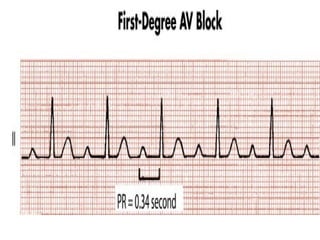
First degree AVblock
• PR prolongation, significant characteristics of first degree AV block
in which the PR interval is lengthened beyond 0.20 seconds.
• The following are the most common causes of first- degree AV
block:
Intrinsic AVN disease
Acute myocardial infarction (MI), particularly acute inferior wall
MI
Myocarditis
Electrolyte disturbances (eg, hypokalemia, hypomagnesemia)
Drugs (especially those drugs that increase the refractory time of
the AVN, thereby slowing conduction)
9.
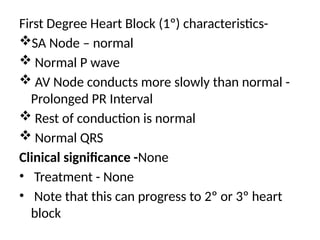
First Degree HeartBlock (1º) characteristics-
SA Node – normal
Normal P wave
AV Node conducts more slowly than normal -
Prolonged PR Interval
Rest of conduction is normal
Normal QRS
Clinical significance -None
• Treatment - None
• Note that this can progress to 2º or 3º heart
block
Mobitz Type I(Wenkebach)
Conduction through the AV Node –
progressively delayed until a drop beat is seen
characterized by disturbance, delay, or
interruption of atrial impulse conduction
through the AV node to the ventricles.
Characteristics of MobitzType I (Wenkebach)
PR Interval prolongs with each beat until a
dropped beat is seen
The PR Interval is NOT constant
After each dropped beat, the PR interval is
normal and the cycle starts again
Clinical Significance
Slight symptoms e.g.. Lethargy, Confusion
Treatment
• Pacemaker
Note that this can progress to 3º Heart Block
17.
Second Degree HeartBlock (2º) Mobitz Type
II
• Conduction through the AV node is constant.
• PR interval is normal and constant
• Occasionally a dropped beat is seen
• Clinical significance – this is more significant disease
Treatment – pacemaker
Note that this can progress to 3º Heart Block
19.
Third Degree HeartBlock(3º)
Third-degree atrioventricular (AV)block, also referred to as third-
degree heart block or complete heart block, is a disorder of the
cardiac conduction system where there is no conduction through the
atrioventricular node.
Complete failure of the AV Node
No impulses from Sinus Node will pass through to the ventricles
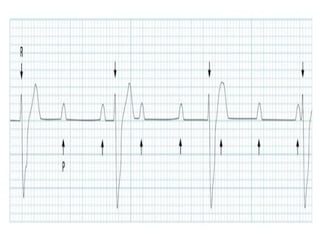
Third Degree Heart block characteristics
• P wave rate – normal
• Ventricular rate – slow
• Ventricular complex may be broad
• Idioventricular rhythm
• Complete dissociation between P waves & QRS
20.
clinical significance- mostsignificant
• Symptoms LOC, Confusion, Dizziness, Low BP
• Can lead to VT or VF (stokes Adams)
• Treatment - pacemaker
23.
NURSING MANAGEMENT
1. Assessthe high risk patients
2. Monitor ECG of the patient
3. Assess the family history of heart disease
4. Assess the history of smoking and alcoholism
5. Monitor lab values frequently especially serum
cholesterol levels.
6. Assess for CAD
7. Monitor vital signs
8. Instruct to avoid high fat and oil rich diet








![Shadechapter12.ppt [read only]](https://cdn.slidesharecdn.com/ss_thumbnails/shadechapter12-150421103821-conversion-gate02-thumbnail.jpg?width=640&height=640&fit=bounds)


