Ventricular tachycardiaDr.Praveen Nagula
Sir William Osler It is much more important to know what sort of a patient has a disease than what sort of a disease a patient has.
Medicine is a science of uncertainty and an art of probability.
The young physician starts life with 20 drugs for each disease, and the old physician ends life with one drug for 20 diseasesLouis GallavardinLa Tension artérielle en Clinique, the standard text on the measurement of blood pressure. Realised the importance of electrocardiography, and published on arrhythmias, particularly ventricular tachycardia. described a type of aortic stenosis which was not rheumatic in origin, and described effort syncope in the condition.
Dr.PedroBrugadaThe Brugada syndrome is a genetic disease  and an increased risk of sudden cardiac death. named by the Spanish cardiologists Pedro Brugada and JosepBrugada. It is the major cause of Sudden Unexpected Death Syndrome (SUDS), and is the most common cause of sudden death in young men without known underlying cardiac disease in Thailand and Laos.
Bazett’s FormulaQTcB=QT⁄√RRHenry cuthbertbazett
Fridericia FormulaQTcF=QT⁄3√RRNormal QTc interval is 0.46 secFemales>malesIncreases with age.
Hodge’s formulaWith increasing heart rate and younger age the Bazett and Hodges formulae overcorrect the QTc whereas the Fridericia and Framingham formulae undercorrect. The Hodges formula correlated best with the RR interval.Hodges formula: QT + 0.00175 (HR – 60)
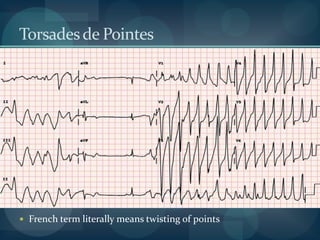
Torsades de PointesFrench term literally means twisting of points
Conduction System of the HeartSA node ----internodal pathways ---AV node ----AV bundle (bundle of HIS )----LBB,RBB----purkinjeefibres---cardiac muscle fibres.0.03sec---0.09sec---0.04 sec  ---total 0.16 sec..
SINO ATRIAL node action potentialResting membrane potential -55 to -60 mVCellular fibres are permeable  to sodium and calcium ions …Fast Na channels are inactiveAbsent of plateau phase as inactivation of slow Na and Ca current take place.
Ventricular muscle action potential Resting membrane action potential is -85 to -90 mVFast Na channels are responsible for depolarisationPlateau phase present.No hyperpolarization
Capture beatWhen there is interference dissociation between sinus rhythm and faster subsidiary rhythm,the interference occurs in the AV node.Both the impulses cannot be conducted due to the refractoriness of the AV node as a result of the wave from each focus.At a particular time the slow sinus waves passes through the AV node when it is no longer  refractory and hence conducts down the ventricles..ventricularcapture beat..momentary activation of the ventricles by sinus impulse in AV dissosciation.
Fusion beatIt is due to the combination of the sinus impulse and the ectopic impulse leading to a QRS c0mplex that varies in the morphology with the change in the occurrence of fusion from the AVnode.Summation complex or fusion complex or combination beatIt may be like that of sinus impulseQRS ,or ectopic one,or intermediate..location  can be known by morphology.
Pause dependent VT It is due to the afterdepolarizationsthat occur during the phase 3 of the action potential early after depolarization.When they reach the threshold potential of the cardiac cell –cause another action potential.Related to long QT syndromeHypokalemiaClass 1 a antiarryhthmic drugs use.Prolonged repolarization.The longer the QT interval the more abberation is the TU wave.Long coupling interval.
Reentry circuitTwo potentially conduction pathways or more.Unidirectional block must occur in  one pathwayAn activation front that passes around the zone of unidirectional block over the alternate pathway.Activation of the myocardium distal to block with delay.The activation wavefront to activate the block by retrogradely and reexcite the tissue where the actviationwavefront originated.For reentry to occur the wavefront should find the tissue to be excitable in the direction of its propagation.
Triggered activityIs due to the depolarization  phase changesOccur in bursts…But may turn up into VF /VFLTwo syndromesPause dependentCatecholaminergic dependentPhase3 –depends upon QT intervalPhase 4 --- depends upon the sympathetic tone.
AutomaticityAbnormal automaticityOccurs in the setting of acute ischemiaIt is due to the physiologiccal ion channel changes rather than morphological.Transient…Takes up the role of pacemaker and discharges the impulses.
Burst pacingAlso called as overdrive pacingHere we pace the ectopic focus (suppress it )by a external device –pacemakerUsually pacing done by transvenous placement  of an electrode in the right ventricle..
Ventricular tachycardia
IntroductionDefinitionEtiologyClassificationClinical symptomsAlgorithm of approachDiagnosisDifferential diagnosisTreatmentConclusionTake home messageFuture
IntroductionMost common cause of wide complex tachycardia.(80%)Major cause of morbidity and mortality in patients with structural heart disease.Major cause of sudden cardiac death –60 % cases on holter monitoring.Relatively organisedtachyarryhthmias with discrete QRS complexes.Diagnosis still a challenge ….on presentation.Reentry is the most common mechanism.Recurrence is more common in less than one year of onset.ICD implantation is a the absolute indication in presence of LVEF <30%.
Questions1 Do all cases of VT lead to hemodynamic collapse?2.what is capture beat ?what does it signify?3.bidirectional VT is due to ?4.what is the drug of choice in case of idiopathic bundle branch tachycardia?5.which VT does not revert on usual catheter ablation?6.which VT cannot be produced on programmed stimulation?7.what is the etiology when  PVT dose not occur along with QT prolongation?8.drugs causing QT prolongation?9.which is better formula for QTc interval estimation?10.LV <30 % is ICD indicated?
DefinitionThe occurrence of three or more VPC complexes with a rate of > 120 bpm in succession is called as VT. Non sustained is termination of VT  by self less than 30 sec.Sustained VT is presence of VT for > 30 sec.orhemodynamically unstable but terminated in less than 30 sec.Slow VT –HR >100 < 120 bpm.Pulseless VT –  VT  with hemodynamic collapse that requires DC cardioversion.Refractory VT –that does not revert to sinus rhythm on medication use or use of three shocks.VT storm --- repeated VT episodes requiring the DC shocks/ICD shocks .Rate is 100—300 bpmRate >220 bpm –VF
EtiologyAcute MI After chronic infarction Ischaemic heart diseaseDilated cardiomyopathyHypertrophic cardiomyopathyPost CABGPost TOF surgeryElectrolyte abnormalitiesIdiopathicSpecific etiology-- genetic
Etiology Usually as a complication of severe heart disease,can occur in structurally normal hearts.In healthy individuals---RVOT,L V posterior/anterior fascicle—catheter ablation.Major  complication of IHD,acutely following MI, chronically after a large infarction..Early hours VT---VF epicardial injury..Fleicainide ---convert non sustained VT to sustained VT.Sotalol- prolong QT interval--TDP
Mechanism of occurrence of  VT REENTRYENHANCED AUTOMATICITYTRIGGERED ACTIVITY
Classification of VT Sustained /non sustained VT Monomorphic VT/polymorphic VTPulseless VT/hemodynamic stable VTStructural heart disease/idiopathicUnique VT syndromes
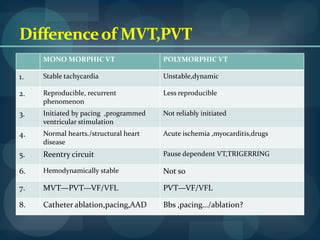
Difference of MVT,PVT
Monomorphic VT with RBBB morphology,hr 180bpm,north west axis.
The morphology of  the qrs complex is not uniform…
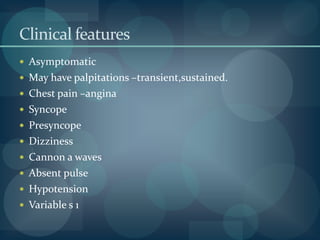
Clinical featuresAsymptomaticMay have palpitations –transient,sustained.Chest pain –anginaSyncopePresyncopeDizzinessCannon a wavesAbsent pulse HypotensionVariable s 1
DiagnosisAlgorithm basedECG –12 Lead  with long rhythm strip of lead II.The focus can be known.24 hr holter monitoring in case of transient episode2d echo for the etiology.Routine investigationsSerum electrolytes,calcium,magnesiumABG
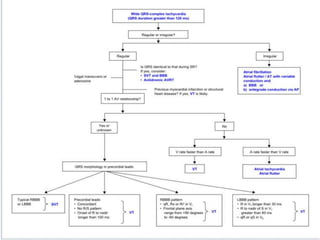
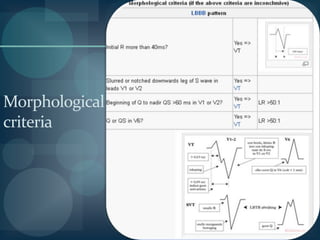
DIAGNOSTIC CRITERIA OF VT AV dissosciation(capture,fusion beats)QRS duration>140 ms for RBBB type V1morphology:QRS duration>160 ms for LBBB type V1 morphology.FRONTAL PLANE AXIS ---90 to 180 Delayed activation during initial phase of QRS complex:LBBB pattern –R wave in V1,V2 >40 msRBBB pattern –onset of R wave to nadir of S wave > 100 ms Bizzare QRS pattern that does not mimic typical RBBB or LBBB type QRS complex concordance of QRS complex in all precordial leads.RS or dominant S in V6for RBBB vtQwave in V6  with LBBB patternMonophasic R or biphasic qR or R/S in V1 with RBBB PATTERN
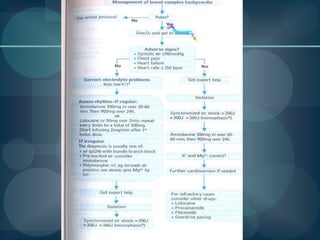
Approach to broad complex tachycardia
Morphological criteria
RBBB morphology
Brugadaalgortihm
Vereckei algorithm
More likely to be VT Brugada signJosephson’s sign
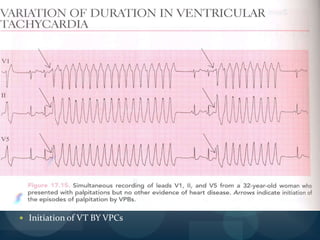
Initiation of VT BY VPCs
Torsades de pointes due to hypokalemia
Reversible causes of VT HypoxiaHyperthyroidismcatecholaminesHypokalemiaMetabolic acidosisHypomagenesemiaHypocalcemiaDrugsAlcoholStarvationwww.torsades.org,www.qtdrugs.org,
Differential diagnosisSVT with aberration due to BBBWPW syndrome with AF/AFLAIVR
Management    NON SUSTAINED VT :No treatment in absence of heart disease.Look for reversible factors.In termination of episodes –IV BBs can be used.For preventing recurrences –oral BBs /CCB s.
MONOMORPHIC VT  with hemodynamic compromise Severity of underlying structural heart diseaseVentricular rate Origin of arryhthmiaLVD Hypotension,pulmonaryedema,MI.Synchronised R wave shock is given. With appropriate sedation.100j—200-300-360 jAfter SR rhythm lidocaine 2-4 mg/min iv infusion.ACC/AHA/ESC guidelines 2006 for ventricular arrythmias/STEMI
Sustained monomorphic VT ,stableDC cardioversion –effective in terminationIV antiarryhthmic drugs can also be used.—no response—cardioversion. presence /abscence LVD1.with preserved LVF:only one drug to be used.IV PROCAINAMIDE---class II a recommendationMore effective than amiodarone in termination.<50 mg/min---1-4 mg/minPreferred over other drugs.Rapid infusion causes hypotension.ACC/AHA/ESC guidelines for Ventricular arryhthmias/STEMI
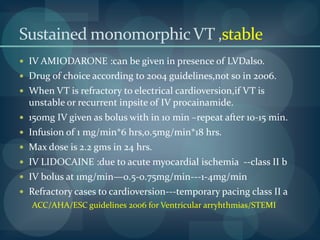
Sustained monomorphic VT ,stableIV AMIODARONE :can be given in presence of LVDalso.Drug of choice according to 2004 guidelines,not so in 2006.When VT is refractory to electrical cardioversion,if VT is unstable or recurrent inpsite of IV procainamide.150mg IV given as bolus with in 10 min –repeat after 10-15 min.Infusion of 1 mg/min*6 hrs,0.5mg/min*18 hrs.Max dose is 2.2 gms in 24 hrs.IV LIDOCAINE :due to acute myocardial ischemia  --class II b IV bolus at 1mg/min—0.5-0.75mg/min---1-4mg/minRefractory cases to cardioversion---temporary pacing class II aACC/AHA/ESC guidelines 2006 for Ventricular arryhthmias/STEMI
Sustained monomorphic VT ,stable2.in presence of LVD –LVD EF <40%-- amiodarone/lignocaineDose is same .
SUSTAINED POLYMORPHIC VT Usually hemodynamically unstable if sustained.Should be given asynchronous defibrillation.Minimal is 200 j monophasic /100 j biphasic.Asynchronous to avoid delay related to sensing of QRS complex.If persists repeat shocks with -200j—300j-360jPharmacological therapy depending upon QT interval normal/prolongedNormal QT interval :myocardial ischemiaReversible ischemia---coroanryangio,IABPBBs in case of recurrent .IV amiodarone class I recommendationif recurrentIV lidocaine  class II b recommendation in case of MI
SUSTAINED POLYMORPHIC VT Torsades de pointes:IV BBs to be used as congenital QTc prolongation is adrenergic mediated.baseline therapy.Correct electrolyte abn.Antiarrhythmicagents:class IA and class III are avoided.Magnesium –class II b ,1-2gm of mgso4 diluted in 5% D loading dose—rapidly—10-20 gm in 24 hrs.Lidocaine—does not prolong QT intervalIsoproterenol ---bridge befor temporary pacemakerPause dependent VT,bradycardia 2-10 mcg/minPhenytoin—250mg in NS iv—100 mg every 5 min—max dose of 500 mg ,no dextrose.not to be given in continous infusion.Temporary pacemaker—pause dependent.
PREVENTION OF  VT --- ICD + antiarryhthmic drug to be used.sotalol /amiodarone –monomorphic VT/polymorphic VTEvaluate the patient in case of nonsustained VT in presence of structural heart disease. Sotalol--20-120 mg (0.5-1.5 mg/kg) given by inj over 10 min, may repeat every 6 hr if needed.
Catheter ablation Cure rate > 90 % in absence of structural heart diseaseUse both endocardial and epicardial pacing.Recurrent VT For prevention of ICD shocks
VT storm >2 episodes in 24 hrs ,repeated VT episodes requiring  external cardioversion,defibrillation.,repeatedICDshcok therapy.Recurrent polymorphic VT ,no QT prolongation IV amiodarone/IV lignocaineQT prolonged VT –removal of offending drug.Brugada syndrome –IV quinidine ,IV isoproterenolAcute ischemia –IABPVpc s –ablationMonomorphic VT ---empirical treatmentCatheter ablation
prognosisRisk of SCD can be decreased by ICD implantation in structurally heart disease patients.Normal hearts ,malignant VT,risk of SCD –prolonged QTc,BRUGADA,ARVD—ICDMost common cause of death in acute MI
ICDsACC/AHA/ESC guidelines 2006 for management of arryhthmias
Unique VT syndromes
Idiopathic outflow tract VT No structural heart disease.RV 80%,LV 20%More in women.(hormonal triggers)Not associated with SCD.Symptoms on exercise,stress, caffeine ingestion.Vagalmanuevres ,adenosine,BBs terminate the VTs .Calcium dependent triggered activity.Large monophasic R waves in inferior leads.LBBB pattern in V1 –RVOTRBBB pattern in V1 ---LVOT
TreatmentHemodynamically stable and nonsustained..IV bb s useful in terminationBBs and CCBs  --chronic therapyClass Ia,Ic,sotalolCatheter ablation in resistant cases.site by 12 lead ECGEfficacy of therapy by treadmill testing and ECG monitoring.EPS only when the diagnosis is in question or to perform catheter  ablation.
Idiopathic LV septal /fascicular VT Second most common.Macroreentry involving calcium dependent slow response fibres/automaticity.Narrow RBBB+ LAD ---posterior fasciclesNarrow RBBB+RAD – anterior fasciclesUnique nature –suppression by verapamilCatheter ablation therapy effective.
VT assosciated with LV DCM Monomorphic/polymorhic can occur.Mitral and aortic areas involved.Drug therapy ineffective After ICD implantation –sotalol/amiodaroneLess amenable to catheter ablationVT origin is from epicardium.EF <30% --prophylactic ICD
Bundle branch reentrant tachycardiaMacro reentry circuitAntegrade direction down the right branchRetrograde up the left posterior or anterior fascicles/LBBMimic RV pacing with LBBB pattern,leftward superior axis.Opposite occurrence then RBBB Readily amenable to catheter ablation therapy.Coupled with ICD   due to  risk of SCD.Occurs in nonischemiccardiomyopathy or valvularcardiomyopathy.
VT assosciated with HOCMICD is usually indicated in presence of HOCM,h/o sustained VT/VF,nexplainedsyncope,a strong family history of SCD,LV septal thickness >30 mm –risk of SCD.High frequency of VT/VF in sarciodosis,chagas,amyloidosis,kearnesayre syndrome.AV conduction disturbances existICD implantation
Arrythmogenic RV dysplasiaGenetically determined dysplastic process or after a suspected viral myocarditis.Sporadic nonfamilialnondysplastic is more common.
OTHERSVT after operation of fallot repairFascicular tachycardia caused by digoxin toxicity.Genetically determined are :Long QT syndromeAcquired LQTSShort QT syndromeBrugada syndromeCatecholaminergic polymorphic VT
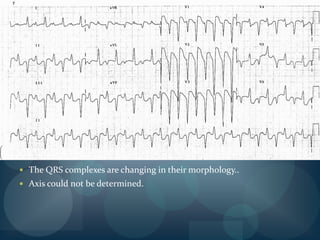
Bidirectional VT The QRS complexes are varying in their morphology and axis  cannot be determined
Lets have a look at the ECGs
The ladder diagramA-atriaAV – av nodeV –ventricleCircle –focus of impulsePerpendicular line ---block.
The ladder diagram for ventricular arryhthmias
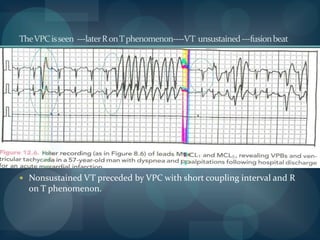
The VPC is seen  ---later R on T phenomenon----VT  unsustained ---fusion beat Nonsustained VT preceded by VPC with short coupling interval and R on T phenomenon.
Occurs in the setting of digoxin use..the signature  VT of digoxin toxicity.—triggered activity—calcium overload,inhibiton of na,k pump Originates from LBBanterior and posterior fascicles –alternating change in axisIv infusion of digoxin specific Fab fragments
Preceded by long pause and then short cycles..
The QRS complexes are changing in their morphology..Axis could not be determined.
Positive concordance in VT
Negative concordance of VTSee the pointed ones they are predominantly downward.
Brugadasign,rabbit ear sign
Trials1.Biventricular Tachycardias Outcome Trial (BITAC)2. Cardiac Denervation Surgery for Prevention of Ventricular Tachycardia (PREVENT VT)3. The Efficacy and Safety of CARTO 3D Mapping System Versus Conventional Method in AF and VT (CARTOAF&VT)4. RIGHT: Rhythm ID Going Head-to-Head Trial5.Ventricular Tachycardia (VT) Ablation Versus Enhanced Drug Therapy (VANISH)6.Optimal Anti-tachycardia Therapy in Implantable Cardioverter-defibrillator (ICD) Patients Without Pacing Indications (OPTION)7.AVID trial8.CASH trialLot moreLog onto www.clinicaltrials.gov
Questions1 Do all cases of VT lead to hemodynamic collapse?2.Are there cases of VT with narrow complex configuration?3.what is capture beat ?what does it signify?4.what is the drug of choice in case of idiopathic bundlebranch tachycardia?5.which VT does not revert on usual catheter ablation?6.which VT cannot be produced on programmed stimulation?7.what is the etiology when  PVT dose not occur along with QT prolongation?8.drugs causing Qt prolongation?9.which is better formula for QTc interval estimation?10.LV <30 % is ICD indicated?
answers1.no.2.fascicular VT,bidirectional VT3.capture beat signifies the presence of AV dissosciation.4. no drug –catheter ablation is effective.5.VT  assosciated with DCM6.idiopathic outflow tract VT7.ACUTE MI8.class Ia,class III drugs.9.hodges formula.10.class I recommendation
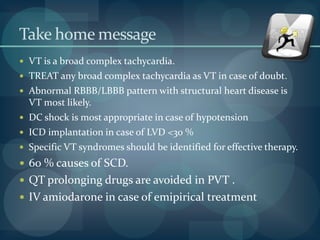
Take home messageVT is a broad complex tachycardia.TREAT any broad complex tachycardia as VT in case of doubt.Abnormal RBBB/LBBB pattern with structural heart disease is VT most likely.DC shock is most appropriate in case of hypotensionICD implantation in case of LVD <30 %Specific VT syndromes should be identified for effective therapy.60 % causes of SCD.QT prolonging drugs are avoided in PVT .IV amiodarone in case of emipirical treatment
ReferencesHARRISON’S  Principles of Internal Medicine ,17thedBasic and Bedside electrocardiography,Romulo.F.BaltazarIntroduction to Electrocardiography –Schamroth.www.emedicine.comCardiovascular Medicines pdf fileswww.ecglibrary.comOxford handbook of Clinical Medicine,8thedOxford book of Principles of Critical Care by Farokh.k.Udwadiawww.ecgblog.comwww.clinicaltrials.govPost  Graduate Medicine,2008Medicine Update,2005Marriot’s Practical Electrocardiography---Galen.S.WagnerNEJM,JACC,CARDIOLOGY,HEART VARIOUS OTHER SITES ON NET…..
Do you know?VT is frequently referenced in the 1970s television series Emergency!In the 2006 film Casino Royale, the protagonist, James Bond, suffers ventricular tachycardia from intoxication of digitalis and goes into cardiac arrest."V-Tach" is what "The Satin Slayer" from the American soap opera All My Children used to kill his victims

Ventricular tachycardia

  • 1.
  • 2.
    Sir William OslerIt is much more important to know what sort of a patient has a disease than what sort of a disease a patient has.
  • 3.
    Medicine is ascience of uncertainty and an art of probability.
  • 4.
    The young physicianstarts life with 20 drugs for each disease, and the old physician ends life with one drug for 20 diseasesLouis GallavardinLa Tension artérielle en Clinique, the standard text on the measurement of blood pressure. Realised the importance of electrocardiography, and published on arrhythmias, particularly ventricular tachycardia. described a type of aortic stenosis which was not rheumatic in origin, and described effort syncope in the condition.
  • 5.
    Dr.PedroBrugadaThe Brugada syndromeis a genetic disease and an increased risk of sudden cardiac death. named by the Spanish cardiologists Pedro Brugada and JosepBrugada. It is the major cause of Sudden Unexpected Death Syndrome (SUDS), and is the most common cause of sudden death in young men without known underlying cardiac disease in Thailand and Laos.
  • 6.
  • 7.
    Fridericia FormulaQTcF=QT⁄3√RRNormal QTcinterval is 0.46 secFemales>malesIncreases with age.
  • 8.
    Hodge’s formulaWith increasingheart rate and younger age the Bazett and Hodges formulae overcorrect the QTc whereas the Fridericia and Framingham formulae undercorrect. The Hodges formula correlated best with the RR interval.Hodges formula: QT + 0.00175 (HR – 60)
  • 9.
    Torsades de PointesFrenchterm literally means twisting of points
  • 10.
    Conduction System ofthe HeartSA node ----internodal pathways ---AV node ----AV bundle (bundle of HIS )----LBB,RBB----purkinjeefibres---cardiac muscle fibres.0.03sec---0.09sec---0.04 sec ---total 0.16 sec..
  • 11.
    SINO ATRIAL nodeaction potentialResting membrane potential -55 to -60 mVCellular fibres are permeable to sodium and calcium ions …Fast Na channels are inactiveAbsent of plateau phase as inactivation of slow Na and Ca current take place.
  • 12.
    Ventricular muscle actionpotential Resting membrane action potential is -85 to -90 mVFast Na channels are responsible for depolarisationPlateau phase present.No hyperpolarization
  • 13.
    Capture beatWhen thereis interference dissociation between sinus rhythm and faster subsidiary rhythm,the interference occurs in the AV node.Both the impulses cannot be conducted due to the refractoriness of the AV node as a result of the wave from each focus.At a particular time the slow sinus waves passes through the AV node when it is no longer refractory and hence conducts down the ventricles..ventricularcapture beat..momentary activation of the ventricles by sinus impulse in AV dissosciation.
  • 14.
    Fusion beatIt isdue to the combination of the sinus impulse and the ectopic impulse leading to a QRS c0mplex that varies in the morphology with the change in the occurrence of fusion from the AVnode.Summation complex or fusion complex or combination beatIt may be like that of sinus impulseQRS ,or ectopic one,or intermediate..location can be known by morphology.
  • 15.
    Pause dependent VTIt is due to the afterdepolarizationsthat occur during the phase 3 of the action potential early after depolarization.When they reach the threshold potential of the cardiac cell –cause another action potential.Related to long QT syndromeHypokalemiaClass 1 a antiarryhthmic drugs use.Prolonged repolarization.The longer the QT interval the more abberation is the TU wave.Long coupling interval.
  • 16.
    Reentry circuitTwo potentiallyconduction pathways or more.Unidirectional block must occur in one pathwayAn activation front that passes around the zone of unidirectional block over the alternate pathway.Activation of the myocardium distal to block with delay.The activation wavefront to activate the block by retrogradely and reexcite the tissue where the actviationwavefront originated.For reentry to occur the wavefront should find the tissue to be excitable in the direction of its propagation.
  • 17.
    Triggered activityIs dueto the depolarization phase changesOccur in bursts…But may turn up into VF /VFLTwo syndromesPause dependentCatecholaminergic dependentPhase3 –depends upon QT intervalPhase 4 --- depends upon the sympathetic tone.
  • 18.
    AutomaticityAbnormal automaticityOccurs inthe setting of acute ischemiaIt is due to the physiologiccal ion channel changes rather than morphological.Transient…Takes up the role of pacemaker and discharges the impulses.
  • 19.
    Burst pacingAlso calledas overdrive pacingHere we pace the ectopic focus (suppress it )by a external device –pacemakerUsually pacing done by transvenous placement of an electrode in the right ventricle..
  • 20.
  • 21.
    IntroductionDefinitionEtiologyClassificationClinical symptomsAlgorithm ofapproachDiagnosisDifferential diagnosisTreatmentConclusionTake home messageFuture
  • 22.
    IntroductionMost common causeof wide complex tachycardia.(80%)Major cause of morbidity and mortality in patients with structural heart disease.Major cause of sudden cardiac death –60 % cases on holter monitoring.Relatively organisedtachyarryhthmias with discrete QRS complexes.Diagnosis still a challenge ….on presentation.Reentry is the most common mechanism.Recurrence is more common in less than one year of onset.ICD implantation is a the absolute indication in presence of LVEF <30%.
  • 23.
    Questions1 Do allcases of VT lead to hemodynamic collapse?2.what is capture beat ?what does it signify?3.bidirectional VT is due to ?4.what is the drug of choice in case of idiopathic bundle branch tachycardia?5.which VT does not revert on usual catheter ablation?6.which VT cannot be produced on programmed stimulation?7.what is the etiology when PVT dose not occur along with QT prolongation?8.drugs causing QT prolongation?9.which is better formula for QTc interval estimation?10.LV <30 % is ICD indicated?
  • 24.
    DefinitionThe occurrence ofthree or more VPC complexes with a rate of > 120 bpm in succession is called as VT. Non sustained is termination of VT by self less than 30 sec.Sustained VT is presence of VT for > 30 sec.orhemodynamically unstable but terminated in less than 30 sec.Slow VT –HR >100 < 120 bpm.Pulseless VT – VT with hemodynamic collapse that requires DC cardioversion.Refractory VT –that does not revert to sinus rhythm on medication use or use of three shocks.VT storm --- repeated VT episodes requiring the DC shocks/ICD shocks .Rate is 100—300 bpmRate >220 bpm –VF
  • 25.
    EtiologyAcute MI Afterchronic infarction Ischaemic heart diseaseDilated cardiomyopathyHypertrophic cardiomyopathyPost CABGPost TOF surgeryElectrolyte abnormalitiesIdiopathicSpecific etiology-- genetic
  • 26.
    Etiology Usually asa complication of severe heart disease,can occur in structurally normal hearts.In healthy individuals---RVOT,L V posterior/anterior fascicle—catheter ablation.Major complication of IHD,acutely following MI, chronically after a large infarction..Early hours VT---VF epicardial injury..Fleicainide ---convert non sustained VT to sustained VT.Sotalol- prolong QT interval--TDP
  • 27.
    Mechanism of occurrenceof VT REENTRYENHANCED AUTOMATICITYTRIGGERED ACTIVITY
  • 28.
    Classification of VTSustained /non sustained VT Monomorphic VT/polymorphic VTPulseless VT/hemodynamic stable VTStructural heart disease/idiopathicUnique VT syndromes
  • 29.
  • 30.
    Monomorphic VT withRBBB morphology,hr 180bpm,north west axis.
  • 31.
    The morphology of the qrs complex is not uniform…
  • 32.
    Clinical featuresAsymptomaticMay havepalpitations –transient,sustained.Chest pain –anginaSyncopePresyncopeDizzinessCannon a wavesAbsent pulse HypotensionVariable s 1
  • 33.
    DiagnosisAlgorithm basedECG –12Lead with long rhythm strip of lead II.The focus can be known.24 hr holter monitoring in case of transient episode2d echo for the etiology.Routine investigationsSerum electrolytes,calcium,magnesiumABG
  • 35.
    DIAGNOSTIC CRITERIA OFVT AV dissosciation(capture,fusion beats)QRS duration>140 ms for RBBB type V1morphology:QRS duration>160 ms for LBBB type V1 morphology.FRONTAL PLANE AXIS ---90 to 180 Delayed activation during initial phase of QRS complex:LBBB pattern –R wave in V1,V2 >40 msRBBB pattern –onset of R wave to nadir of S wave > 100 ms Bizzare QRS pattern that does not mimic typical RBBB or LBBB type QRS complex concordance of QRS complex in all precordial leads.RS or dominant S in V6for RBBB vtQwave in V6 with LBBB patternMonophasic R or biphasic qR or R/S in V1 with RBBB PATTERN
  • 37.
    Approach to broadcomplex tachycardia
  • 39.
  • 40.
  • 41.
  • 42.
  • 43.
    More likely tobe VT Brugada signJosephson’s sign
  • 44.
  • 45.
    Torsades de pointesdue to hypokalemia
  • 47.
    Reversible causes ofVT HypoxiaHyperthyroidismcatecholaminesHypokalemiaMetabolic acidosisHypomagenesemiaHypocalcemiaDrugsAlcoholStarvationwww.torsades.org,www.qtdrugs.org,
  • 48.
    Differential diagnosisSVT withaberration due to BBBWPW syndrome with AF/AFLAIVR
  • 49.
    Management NON SUSTAINED VT :No treatment in absence of heart disease.Look for reversible factors.In termination of episodes –IV BBs can be used.For preventing recurrences –oral BBs /CCB s.
  • 50.
    MONOMORPHIC VT with hemodynamic compromise Severity of underlying structural heart diseaseVentricular rate Origin of arryhthmiaLVD Hypotension,pulmonaryedema,MI.Synchronised R wave shock is given. With appropriate sedation.100j—200-300-360 jAfter SR rhythm lidocaine 2-4 mg/min iv infusion.ACC/AHA/ESC guidelines 2006 for ventricular arrythmias/STEMI
  • 51.
    Sustained monomorphic VT,stableDC cardioversion –effective in terminationIV antiarryhthmic drugs can also be used.—no response—cardioversion. presence /abscence LVD1.with preserved LVF:only one drug to be used.IV PROCAINAMIDE---class II a recommendationMore effective than amiodarone in termination.<50 mg/min---1-4 mg/minPreferred over other drugs.Rapid infusion causes hypotension.ACC/AHA/ESC guidelines for Ventricular arryhthmias/STEMI
  • 52.
    Sustained monomorphic VT,stableIV AMIODARONE :can be given in presence of LVDalso.Drug of choice according to 2004 guidelines,not so in 2006.When VT is refractory to electrical cardioversion,if VT is unstable or recurrent inpsite of IV procainamide.150mg IV given as bolus with in 10 min –repeat after 10-15 min.Infusion of 1 mg/min*6 hrs,0.5mg/min*18 hrs.Max dose is 2.2 gms in 24 hrs.IV LIDOCAINE :due to acute myocardial ischemia --class II b IV bolus at 1mg/min—0.5-0.75mg/min---1-4mg/minRefractory cases to cardioversion---temporary pacing class II aACC/AHA/ESC guidelines 2006 for Ventricular arryhthmias/STEMI
  • 53.
    Sustained monomorphic VT,stable2.in presence of LVD –LVD EF <40%-- amiodarone/lignocaineDose is same .
  • 54.
    SUSTAINED POLYMORPHIC VTUsually hemodynamically unstable if sustained.Should be given asynchronous defibrillation.Minimal is 200 j monophasic /100 j biphasic.Asynchronous to avoid delay related to sensing of QRS complex.If persists repeat shocks with -200j—300j-360jPharmacological therapy depending upon QT interval normal/prolongedNormal QT interval :myocardial ischemiaReversible ischemia---coroanryangio,IABPBBs in case of recurrent .IV amiodarone class I recommendationif recurrentIV lidocaine class II b recommendation in case of MI
  • 55.
    SUSTAINED POLYMORPHIC VTTorsades de pointes:IV BBs to be used as congenital QTc prolongation is adrenergic mediated.baseline therapy.Correct electrolyte abn.Antiarrhythmicagents:class IA and class III are avoided.Magnesium –class II b ,1-2gm of mgso4 diluted in 5% D loading dose—rapidly—10-20 gm in 24 hrs.Lidocaine—does not prolong QT intervalIsoproterenol ---bridge befor temporary pacemakerPause dependent VT,bradycardia 2-10 mcg/minPhenytoin—250mg in NS iv—100 mg every 5 min—max dose of 500 mg ,no dextrose.not to be given in continous infusion.Temporary pacemaker—pause dependent.
  • 56.
    PREVENTION OF VT --- ICD + antiarryhthmic drug to be used.sotalol /amiodarone –monomorphic VT/polymorphic VTEvaluate the patient in case of nonsustained VT in presence of structural heart disease. Sotalol--20-120 mg (0.5-1.5 mg/kg) given by inj over 10 min, may repeat every 6 hr if needed.
  • 57.
    Catheter ablation Curerate > 90 % in absence of structural heart diseaseUse both endocardial and epicardial pacing.Recurrent VT For prevention of ICD shocks
  • 58.
    VT storm >2episodes in 24 hrs ,repeated VT episodes requiring external cardioversion,defibrillation.,repeatedICDshcok therapy.Recurrent polymorphic VT ,no QT prolongation IV amiodarone/IV lignocaineQT prolonged VT –removal of offending drug.Brugada syndrome –IV quinidine ,IV isoproterenolAcute ischemia –IABPVpc s –ablationMonomorphic VT ---empirical treatmentCatheter ablation
  • 62.
    prognosisRisk of SCDcan be decreased by ICD implantation in structurally heart disease patients.Normal hearts ,malignant VT,risk of SCD –prolonged QTc,BRUGADA,ARVD—ICDMost common cause of death in acute MI
  • 63.
    ICDsACC/AHA/ESC guidelines 2006for management of arryhthmias
  • 64.
  • 65.
    Idiopathic outflow tractVT No structural heart disease.RV 80%,LV 20%More in women.(hormonal triggers)Not associated with SCD.Symptoms on exercise,stress, caffeine ingestion.Vagalmanuevres ,adenosine,BBs terminate the VTs .Calcium dependent triggered activity.Large monophasic R waves in inferior leads.LBBB pattern in V1 –RVOTRBBB pattern in V1 ---LVOT
  • 66.
    TreatmentHemodynamically stable andnonsustained..IV bb s useful in terminationBBs and CCBs --chronic therapyClass Ia,Ic,sotalolCatheter ablation in resistant cases.site by 12 lead ECGEfficacy of therapy by treadmill testing and ECG monitoring.EPS only when the diagnosis is in question or to perform catheter ablation.
  • 67.
    Idiopathic LV septal/fascicular VT Second most common.Macroreentry involving calcium dependent slow response fibres/automaticity.Narrow RBBB+ LAD ---posterior fasciclesNarrow RBBB+RAD – anterior fasciclesUnique nature –suppression by verapamilCatheter ablation therapy effective.
  • 68.
    VT assosciated withLV DCM Monomorphic/polymorhic can occur.Mitral and aortic areas involved.Drug therapy ineffective After ICD implantation –sotalol/amiodaroneLess amenable to catheter ablationVT origin is from epicardium.EF <30% --prophylactic ICD
  • 69.
    Bundle branch reentranttachycardiaMacro reentry circuitAntegrade direction down the right branchRetrograde up the left posterior or anterior fascicles/LBBMimic RV pacing with LBBB pattern,leftward superior axis.Opposite occurrence then RBBB Readily amenable to catheter ablation therapy.Coupled with ICD due to risk of SCD.Occurs in nonischemiccardiomyopathy or valvularcardiomyopathy.
  • 70.
    VT assosciated withHOCMICD is usually indicated in presence of HOCM,h/o sustained VT/VF,nexplainedsyncope,a strong family history of SCD,LV septal thickness >30 mm –risk of SCD.High frequency of VT/VF in sarciodosis,chagas,amyloidosis,kearnesayre syndrome.AV conduction disturbances existICD implantation
  • 71.
    Arrythmogenic RV dysplasiaGeneticallydetermined dysplastic process or after a suspected viral myocarditis.Sporadic nonfamilialnondysplastic is more common.
  • 72.
    OTHERSVT after operationof fallot repairFascicular tachycardia caused by digoxin toxicity.Genetically determined are :Long QT syndromeAcquired LQTSShort QT syndromeBrugada syndromeCatecholaminergic polymorphic VT
  • 73.
    Bidirectional VT TheQRS complexes are varying in their morphology and axis cannot be determined
  • 74.
    Lets have alook at the ECGs
  • 75.
    The ladder diagramA-atriaAV– av nodeV –ventricleCircle –focus of impulsePerpendicular line ---block.
  • 76.
    The ladder diagramfor ventricular arryhthmias
  • 77.
    The VPC isseen ---later R on T phenomenon----VT unsustained ---fusion beat Nonsustained VT preceded by VPC with short coupling interval and R on T phenomenon.
  • 78.
    Occurs in thesetting of digoxin use..the signature VT of digoxin toxicity.—triggered activity—calcium overload,inhibiton of na,k pump Originates from LBBanterior and posterior fascicles –alternating change in axisIv infusion of digoxin specific Fab fragments
  • 79.
    Preceded by longpause and then short cycles..
  • 80.
    The QRS complexesare changing in their morphology..Axis could not be determined.
  • 82.
  • 83.
    Negative concordance ofVTSee the pointed ones they are predominantly downward.
  • 84.
  • 85.
    Trials1.Biventricular Tachycardias OutcomeTrial (BITAC)2. Cardiac Denervation Surgery for Prevention of Ventricular Tachycardia (PREVENT VT)3. The Efficacy and Safety of CARTO 3D Mapping System Versus Conventional Method in AF and VT (CARTOAF&VT)4. RIGHT: Rhythm ID Going Head-to-Head Trial5.Ventricular Tachycardia (VT) Ablation Versus Enhanced Drug Therapy (VANISH)6.Optimal Anti-tachycardia Therapy in Implantable Cardioverter-defibrillator (ICD) Patients Without Pacing Indications (OPTION)7.AVID trial8.CASH trialLot moreLog onto www.clinicaltrials.gov
  • 86.
    Questions1 Do allcases of VT lead to hemodynamic collapse?2.Are there cases of VT with narrow complex configuration?3.what is capture beat ?what does it signify?4.what is the drug of choice in case of idiopathic bundlebranch tachycardia?5.which VT does not revert on usual catheter ablation?6.which VT cannot be produced on programmed stimulation?7.what is the etiology when PVT dose not occur along with QT prolongation?8.drugs causing Qt prolongation?9.which is better formula for QTc interval estimation?10.LV <30 % is ICD indicated?
  • 87.
    answers1.no.2.fascicular VT,bidirectional VT3.capturebeat signifies the presence of AV dissosciation.4. no drug –catheter ablation is effective.5.VT assosciated with DCM6.idiopathic outflow tract VT7.ACUTE MI8.class Ia,class III drugs.9.hodges formula.10.class I recommendation
  • 88.
    Take home messageVTis a broad complex tachycardia.TREAT any broad complex tachycardia as VT in case of doubt.Abnormal RBBB/LBBB pattern with structural heart disease is VT most likely.DC shock is most appropriate in case of hypotensionICD implantation in case of LVD <30 %Specific VT syndromes should be identified for effective therapy.60 % causes of SCD.QT prolonging drugs are avoided in PVT .IV amiodarone in case of emipirical treatment
  • 89.
    ReferencesHARRISON’S Principlesof Internal Medicine ,17thedBasic and Bedside electrocardiography,Romulo.F.BaltazarIntroduction to Electrocardiography –Schamroth.www.emedicine.comCardiovascular Medicines pdf fileswww.ecglibrary.comOxford handbook of Clinical Medicine,8thedOxford book of Principles of Critical Care by Farokh.k.Udwadiawww.ecgblog.comwww.clinicaltrials.govPost Graduate Medicine,2008Medicine Update,2005Marriot’s Practical Electrocardiography---Galen.S.WagnerNEJM,JACC,CARDIOLOGY,HEART VARIOUS OTHER SITES ON NET…..
  • 90.
    Do you know?VTis frequently referenced in the 1970s television series Emergency!In the 2006 film Casino Royale, the protagonist, James Bond, suffers ventricular tachycardia from intoxication of digitalis and goes into cardiac arrest."V-Tach" is what "The Satin Slayer" from the American soap opera All My Children used to kill his victims