CASE REPORT CARDIOLOGY DEPARTMENT

UNSTABLE
ANGINA PECTORIS (UAP)
Presented by:
Faradhillah A Suryadi
C11108340
Supervisor:
dr. Muzakkir Amir, SP.JP, FIHA. FICA.
CARDIOLOGY DEPARTMENT
MEDICAL FACULTY
MAKASSAR
2013
UAP - CASE REPORT
CARDIOLOGY DEPARTMENT

PATIENT’S IDENTITY
 Name

: Mr. I
 Gender
: Male
 Umur
: 64 y.o
 Reg. Number
: 595424
 Admitted Date : 25th, April 2013
UAP - CASE REPORT
CARDIOLOGY DEPARTMENT

HISTORY TAKING
 Chief

Complaint : Chest pain
 Structural anamnesis
It was felt since 2 hours before admitted to the
hospital. The pain was felt in right chest then
radiated to the left chest, with the characteristic of
pressure sensation. Pain was last more than 20
minutes. Chest pain accompanied by shortness of
breath and sweating (+). The patient complaint
about tightness while walking since 5 months ago,
which became worse, and it was not relieved by
rest. DOE (+) PND (-) orthopneu (-)
UAP - CASE REPORT
CARDIOLOGY DEPARTMENT

PAST MEDICAL HISTORY
 History

of hypertension (-)
 History of Diabetes (-)
 History of chest pain (-)
 Family History of having CVD (-)
 History of Smoking (+) 30 years, 1
pack/day and stop since last 2 years
UAP - CASE REPORT
CARDIOLOGY DEPARTMENT

PHYSICAL EXAMINATION
 General

Appearance :

Moderate-illness /Malnutrition/composmentis
 Vital Sign
 BP
 Pulse
 RR
 Temp

:
: 150/100 mmHg
: 108 x/minute, regular
: 28 x/minute ;
: 36,7º C (per axilla)

 Head Examination :
 Eyes : anemia(-), icterus(-),
 Neck : JVP R+1 cmH20

cyanosis(-)
UAP - CASE REPORT
CARDIOLOGY DEPARTMENT


Thoracic Examination :
 Inspection
: Symmetric left and right
 Palpation
: No mass, no tenderness
 Percussion
: Sonor
 Auscultation
: Breath Sound : vesicular,
Rh -/-, wh -/-



Cardiac Examination :
 Inspection
: Ictus Cordis not visible
 Palpation
: Ictus Cordis not palpable
 Percussion
: left border  1 finger from ICS VI
midclavicularis line sinistra
right border  ICS IV parasternalis
line
dextra
 Auscultation
: Regular of I/II Heart Sound,
murmur (-) gallop (-)
UAP - CASE REPORT
CARDIOLOGY DEPARTMENT

 Abdominal Examination :
 Inspection
: Convex,

following breath

movement
 Palpation
: Liver and spleen unpalpable
 Percussion
: Tympani
 Auscultation: Peristaltic sound (+), normal

 Extremities :
 Oedema (-)
CHEST X-RAY


 Male

>55 y. o
 Cigarette Smoking
 Dislipidemia
 Hypertension






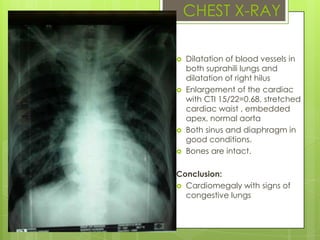
Dilatation of blood vessels in
both suprahili lungs and
dilatation of right hilus
Enlargement of the cardiac
with CTI 15/22=0.68, stretched
cardiac waist , embedded
apex, normal aorta
Both sinus and diaphragm in
good conditions.
Bones are intact.

Conclusion:
 Cardiomegaly with signs of
congestive lungs
ECG 25/4/13

ECG (25/4/2013)
UAP - CASE REPORT
CARDIOLOGY DEPARTMENT

ECG INTERPRETATION
Rhythm
: Sinus Rhythm
QRS Rate
: 89 bpm
PR interval
: 0.12 sec
Axis
: normoaxis
P Wave
: 0,12 sec
QRS complex : 0,08 sec
ST segment : normal
Conclusion : Sinus rhytm, HR 89x/ minute
normoaxis, poor R wave progression
-
UAP - CASE REPORT
CARDIOLOGY DEPARTMENT

LABORATORY FINDINGS
Complete Blood Count
WBC : 9,48x10³ uL
HB: 13,2 g/dl
HCT : 38,9%
PLT : 290x103 uL


Electrolyte
Natrium : 145
Kalium : 3,44
Chloride : 105


Enzymes
CK : 43 u/L
CK-MB : 10,5 u/L
Troponin T : negatif


Blood chemistry
SGOT : 18
SGPT : 16
Ureum : 31
Creatinin : 0,5
Uric acid : 7,3
Glucose :120 mg/dl


Lipid Profile
Trigliserida : 209
LDL : 154
HDL : 30
Total Cholesterol : 204

ECHOCARDIOGRAM

DESCRIPTION OF WALL MOTION,
MASSES, VALVES, PERICARDIUM
Conclusion :
• LV sistolic and diastolic dysfunction
• Akinetic basal mid septal, anterior septal, other

segment hipokinetic
• MR Mild
• AR Mild
• TR Mild
• PR Mild
• PH Moderate
UAP - CASE REPORT
CARDIOLOGY DEPARTMENT

WORKING DIAGNOSIS
UNSTABLE ANGINA PECTORIS
&
HYPERTENSION GR.I
UAP - CASE REPORT
CARDIOLOGY DEPARTMENT

MANAGEMENT
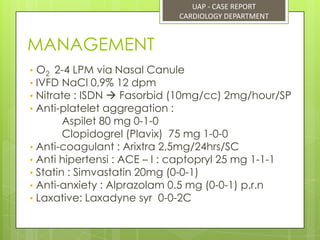
O2 2-4 LPM via Nasal Canule
IVFD NaCl 0,9% 12 dpm
Nitrate : ISDN  Fasorbid (10mg/cc) 2mg/hour/SP
Anti-platelet aggregation :
Aspilet 80 mg 0-1-0
Clopidogrel (Plavix) 75 mg 1-0-0
• Anti-coagulant : Arixtra 2,5mg/24hrs/SC
• Anti hipertensi : ACE – I : captopryl 25 mg 1-1-1
• Statin : Simvastatin 20mg (0-0-1)
• Anti-anxiety : Alprazolam 0.5 mg (0-0-1) p.r.n
• Laxative: Laxadyne syr 0-0-2C
•
•
•
•
UAP - CASE REPORT
CARDIOLOGY DEPARTMENT

PLANNING
 ECG

/ day
UAP - CASE REPORT
CARDIOLOGY DEPARTMENT

DISCUSSION

UAP
UAP - CASE REPORT
CARDIOLOGY DEPARTMENT

DEFINITION
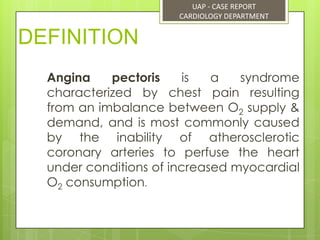
Angina
pectoris
is
a
syndrome
characterized by chest pain resulting
from an imbalance between O2 supply &
demand, and is most commonly caused
by the inability of atherosclerotic
coronary arteries to perfuse the heart
under conditions of increased myocardial
O2 consumption.
PATHOGENESIS

UAP - CASE REPORT
CARDIOLOGY DEPARTMENT

 Plaque

rupture
 Thrombus formation
 Incomplete/ intermittent
occlusion of the infactrelated vessel to the
presence of collateral
channels/ to small size of
affected vessel

Cardiology, Desmond G. Julian, J.Campbell Cowan, James M.
McLenachan, 8th edition, Elsevier, 2005
UAP - CASE REPORT
CARDIOLOGY DEPARTMENT
Figure 1. Pathophysiologic Events
Culminating in the Clinical
Syndrome of Unstable Angina.
Numerous physiologic triggers
probably initiate the rupture of a
vulnerable plaque. Rupture leads
to the activation, adhesion, and aggregation of
platelets and the activation of the
clotting cascade, resulting in the
formation of an occlusive
thrombus. If this process leads to
complete occlusion of the
artery, then acute myocardial
infarction with ST-segment
elevation occurs. Alternatively, if
the process leads to severe
stenosis but the artery nonetheless
remains patent, then
unstable angina occurs.
UAP - CASE REPORT
CARDIOLOGY DEPARTMENT

CAUSES
 Reduction in oxygen supply to myocardium
 Coronary artery narrowing from non-occlusive thrombus on a
disrupted atherosclerotic plaque
 Dynamic obstruction by coronary vasospasm or vasoconstriction
 Severe narrowing without thrombus or spasm
 progressive atherosclerosis
 Restenosis after Percutaneous coronary intervention
 Arterial inflammation and /infection

 Increased myocardial oxygen demand in the presence
of fixed restricted oxygen supply
 Fever, tachycardia, thyrotoxicosis, anemia
UAP - CASE REPORT
CARDIOLOGY DEPARTMENT

Ischemic symptoms


Prolonged pain (usually >20 mins) – constricting,
crushing, squeezing



Usually retrosternal location, radiating to left chest,
left arm, can be epigastric



Dyspnea



Diaphoresis



Palpitations



Nausea/vomiting



Mild headache
UAP - CASE REPORT
CARDIOLOGY DEPARTMENT

UAP
If the plaque become unstable caused
by bleeding, rupture, or fissure and result
in thrombus formation which blocked the
vascularisation, angina may occur.
Angina become progressive crescendo
and have no relation to activity.
Moreover, angina can occur anytime,
even resting time. This kind of angina
called by the Unstable Angina Pectoris
UAP - CASE REPORT
CARDIOLOGY DEPARTMENT

DIAGNOSIS
 Clinical
-

history:
Increase frequency and severity of the pain
Pre-existing angina
Last longer than 10 minutes to several hours
Not related to activities
Pain may be intermitten
Not relieve by nitrate

Cardiology, Desmond G. Julian, J.Campbell Cowan, James M.
McLenachan, 8th edition, Elsevier, 2005
BRAUNWALD
CLASSIFICATION
Characteristic
Severity

UAP - CASE REPORT
CARDIOLOGY DEPARTMENT

Class/Category

Details

Subacute symptoms at rest (2-30 d prior)

III

Acute symptoms at rest (within prior 48 h)

A

Secondary

B

Primary

C

Postinfarction

1

No treatment

2

Usual angina therapy

3

Therapy during symptoms

Symptoms with exertion

II

Clinical precipitating factor

I

Maximal therapy

Tan, A Walter. Unsta ble Angina Pectoris Clinical Presentation (updated 7th Dec 2011)
http://emedicine.medscape.com/article/159383-overview#showall
UAP - CASE REPORT
CARDIOLOGY DEPARTMENT

CANADIAN CARDIOVASCULAR SOCIETY
FUNCTIONAL CLASSIFICATION
The grading system is as follows:
 Grade I - Angina with strenuous, rapid, or prolonged
exertion (Ordinary physical activity such as climbing stairs
does not provoke angina.)
 Grade II - Slight limitation of ordinary activity (Angina
occurs with postprandial, uphill, or rapid walking; when
walking more than 2 blocks of level ground or climbing
more than 1 flight of stairs; during emotional stress; or in the
early hours after awakening.)
 Grade III - Marked limitation of ordinary activity (Angina
occurs with walking 1-2 blocks or climbing a flight of stairs
at a normal pace.)
 Grade IV - Inability to carry on any physical activity
without discomfort (Rest pain occurs.)
Tan, A Walter. Unsta ble Angina Pectoris Clinical Presentation (updated 7th Dec 2011)
http://emedicine.medscape.com/article/159383-overview#showall
ACS RISK ASSESMENT
UAP - CASE REPORT
CARDIOLOGY DEPARTMENT

CORONARY ARTERY
DISEASE

UAP

ACS

NSTEMI

Stable Angina
Pectoris

STEMI

CAD
UAP - CASE REPORT
CARDIOLOGY DEPARTMENT

CLASSIFICATION

ACS describe a group of conditions resulting from acute myocardial
ischemia (insufficient blood flow to heart muscle) ranging from
unstable angina to myocardial infarction.
DIAGNOSIS

Oxford Handbook of Clinical Medicine 6th
DIAGNOSIS

ECG
Yes

No

Lab
Yes

No
PROGNOSIS
UAP - CASE REPORT
CARDIOLOGY DEPARTMENT

PROGNOSIS
The presence of any of the following variables constitutes 1 point,
with the sum constituting the patient risk score on a scale of 0-7:
- Aged 65 years or older
- Use of aspirin in the last 7 days
- Known coronary stenosis of 50% or greater
- Elevated serum cardiac markers
- At least 3 risk factors for coronary artery disease (including
diabetes mellitus, active smoker, family history of coronary artery
disease, hypertension, hypercholesterolemia)
- Severe anginal symptoms (2 or more anginal events in the last
24 h)
- ST deviation on ECG
The inflection point for myocardial infarction or death starts at a
TIMI Risk Score of 3. Therefore, patients with a score of 3-7 should
be considered for use of intravenous glycoprotein IIb/IIIa agents,
heparin (low molecular weight or unfractionated), and early
cardiac catheterization
UAP - CASE REPORT
CARDIOLOGY DEPARTMENT

RISK FACTORS
Modifiable:

Non-modifiable:

 Hypertension



 Diabetes



Mellitus
 Dyslipidemia
 Smoking
 Obesity





Gender: male
Age >45 years old
Personal history of
Coronary Artery
Disease
Family history of
Coronary Artery
Disease
UAP - CASE REPORT
CARDIOLOGY DEPARTMENT

Unstable Angina
Therapeutic Goals
Treatment for unstable angina focuses on three
goals:
• Stabilizing any plaques that may have
ruptured in order to prevent a heart attack,
• Relieving symptoms
• Treating the underlying coronary artery
disease (CAD).
34
Yeghazartan, Y., Braunstein, J., Stone, P. Unstable Angina Pectoris (review article) NEJM Vol.342(2):101114. January, 2000. Massachusets Medical Society
Patient Characteristics
Recurrent angina/ischemia at
rest or with low-level activities
despite intensive medical
therapy
Elevated cardiac biomarkers (TnT
or TnI)
New or presumably new STsegment depression
Signs or symptoms of heart failure
or new or worsening mitral
regurgitation
High-risk findings on noninvasive
stress testing
High-risk score (eg, TIMI, GRACE)
Reduced LV systolic function
(LVEF less than 40%)
Hemodynamic instability
Sustained ventricular
tachycardia
PCI within 6 months
Previous CABG
Conservative

Low-risk score
(eg, TIMI,
GRACE)

Patient or
physician
preference in
the absence
of high-risk
features
UAP - CASE REPORT
CARDIOLOGY DEPARTMENT

MANAGEMENT

http://www.cardiosmart.org/HeartDisease
UAP - CASE REPORT
CARDIOLOGY DEPARTMENT

THANK YOU
 dr.

Muzakkir Amir, Sp.JP, FIHA, FICA

Unstable Angina Pectoris

  • 1.
    CASE REPORT CARDIOLOGYDEPARTMENT UNSTABLE ANGINA PECTORIS (UAP) Presented by: Faradhillah A Suryadi C11108340 Supervisor: dr. Muzakkir Amir, SP.JP, FIHA. FICA. CARDIOLOGY DEPARTMENT MEDICAL FACULTY MAKASSAR 2013
  • 2.
    UAP - CASEREPORT CARDIOLOGY DEPARTMENT PATIENT’S IDENTITY  Name : Mr. I  Gender : Male  Umur : 64 y.o  Reg. Number : 595424  Admitted Date : 25th, April 2013
  • 3.
    UAP - CASEREPORT CARDIOLOGY DEPARTMENT HISTORY TAKING  Chief Complaint : Chest pain  Structural anamnesis It was felt since 2 hours before admitted to the hospital. The pain was felt in right chest then radiated to the left chest, with the characteristic of pressure sensation. Pain was last more than 20 minutes. Chest pain accompanied by shortness of breath and sweating (+). The patient complaint about tightness while walking since 5 months ago, which became worse, and it was not relieved by rest. DOE (+) PND (-) orthopneu (-)
  • 4.
    UAP - CASEREPORT CARDIOLOGY DEPARTMENT PAST MEDICAL HISTORY  History of hypertension (-)  History of Diabetes (-)  History of chest pain (-)  Family History of having CVD (-)  History of Smoking (+) 30 years, 1 pack/day and stop since last 2 years
  • 5.
    UAP - CASEREPORT CARDIOLOGY DEPARTMENT PHYSICAL EXAMINATION  General Appearance : Moderate-illness /Malnutrition/composmentis  Vital Sign  BP  Pulse  RR  Temp : : 150/100 mmHg : 108 x/minute, regular : 28 x/minute ; : 36,7º C (per axilla)  Head Examination :  Eyes : anemia(-), icterus(-),  Neck : JVP R+1 cmH20 cyanosis(-)
  • 6.
    UAP - CASEREPORT CARDIOLOGY DEPARTMENT  Thoracic Examination :  Inspection : Symmetric left and right  Palpation : No mass, no tenderness  Percussion : Sonor  Auscultation : Breath Sound : vesicular, Rh -/-, wh -/-  Cardiac Examination :  Inspection : Ictus Cordis not visible  Palpation : Ictus Cordis not palpable  Percussion : left border  1 finger from ICS VI midclavicularis line sinistra right border  ICS IV parasternalis line dextra  Auscultation : Regular of I/II Heart Sound, murmur (-) gallop (-)
  • 7.
    UAP - CASEREPORT CARDIOLOGY DEPARTMENT  Abdominal Examination :  Inspection : Convex, following breath movement  Palpation : Liver and spleen unpalpable  Percussion : Tympani  Auscultation: Peristaltic sound (+), normal  Extremities :  Oedema (-)
  • 8.
    CHEST X-RAY   Male >55y. o  Cigarette Smoking  Dislipidemia  Hypertension    Dilatation of blood vessels in both suprahili lungs and dilatation of right hilus Enlargement of the cardiac with CTI 15/22=0.68, stretched cardiac waist , embedded apex, normal aorta Both sinus and diaphragm in good conditions. Bones are intact. Conclusion:  Cardiomegaly with signs of congestive lungs
  • 9.
  • 10.
    UAP - CASEREPORT CARDIOLOGY DEPARTMENT ECG INTERPRETATION Rhythm : Sinus Rhythm QRS Rate : 89 bpm PR interval : 0.12 sec Axis : normoaxis P Wave : 0,12 sec QRS complex : 0,08 sec ST segment : normal Conclusion : Sinus rhytm, HR 89x/ minute normoaxis, poor R wave progression -
  • 11.
    UAP - CASEREPORT CARDIOLOGY DEPARTMENT LABORATORY FINDINGS Complete Blood Count WBC : 9,48x10³ uL HB: 13,2 g/dl HCT : 38,9% PLT : 290x103 uL  Electrolyte Natrium : 145 Kalium : 3,44 Chloride : 105  Enzymes CK : 43 u/L CK-MB : 10,5 u/L Troponin T : negatif  Blood chemistry SGOT : 18 SGPT : 16 Ureum : 31 Creatinin : 0,5 Uric acid : 7,3 Glucose :120 mg/dl  Lipid Profile Trigliserida : 209 LDL : 154 HDL : 30 Total Cholesterol : 204 
  • 12.
    ECHOCARDIOGRAM DESCRIPTION OF WALLMOTION, MASSES, VALVES, PERICARDIUM Conclusion : • LV sistolic and diastolic dysfunction • Akinetic basal mid septal, anterior septal, other segment hipokinetic • MR Mild • AR Mild • TR Mild • PR Mild • PH Moderate
  • 13.
    UAP - CASEREPORT CARDIOLOGY DEPARTMENT WORKING DIAGNOSIS UNSTABLE ANGINA PECTORIS & HYPERTENSION GR.I
  • 14.
    UAP - CASEREPORT CARDIOLOGY DEPARTMENT MANAGEMENT O2 2-4 LPM via Nasal Canule IVFD NaCl 0,9% 12 dpm Nitrate : ISDN  Fasorbid (10mg/cc) 2mg/hour/SP Anti-platelet aggregation : Aspilet 80 mg 0-1-0 Clopidogrel (Plavix) 75 mg 1-0-0 • Anti-coagulant : Arixtra 2,5mg/24hrs/SC • Anti hipertensi : ACE – I : captopryl 25 mg 1-1-1 • Statin : Simvastatin 20mg (0-0-1) • Anti-anxiety : Alprazolam 0.5 mg (0-0-1) p.r.n • Laxative: Laxadyne syr 0-0-2C • • • •
  • 15.
    UAP - CASEREPORT CARDIOLOGY DEPARTMENT PLANNING  ECG / day
  • 16.
    UAP - CASEREPORT CARDIOLOGY DEPARTMENT DISCUSSION UAP
  • 17.
    UAP - CASEREPORT CARDIOLOGY DEPARTMENT DEFINITION Angina pectoris is a syndrome characterized by chest pain resulting from an imbalance between O2 supply & demand, and is most commonly caused by the inability of atherosclerotic coronary arteries to perfuse the heart under conditions of increased myocardial O2 consumption.
  • 18.
    PATHOGENESIS UAP - CASEREPORT CARDIOLOGY DEPARTMENT  Plaque rupture  Thrombus formation  Incomplete/ intermittent occlusion of the infactrelated vessel to the presence of collateral channels/ to small size of affected vessel Cardiology, Desmond G. Julian, J.Campbell Cowan, James M. McLenachan, 8th edition, Elsevier, 2005
  • 19.
    UAP - CASEREPORT CARDIOLOGY DEPARTMENT Figure 1. Pathophysiologic Events Culminating in the Clinical Syndrome of Unstable Angina. Numerous physiologic triggers probably initiate the rupture of a vulnerable plaque. Rupture leads to the activation, adhesion, and aggregation of platelets and the activation of the clotting cascade, resulting in the formation of an occlusive thrombus. If this process leads to complete occlusion of the artery, then acute myocardial infarction with ST-segment elevation occurs. Alternatively, if the process leads to severe stenosis but the artery nonetheless remains patent, then unstable angina occurs.
  • 20.
    UAP - CASEREPORT CARDIOLOGY DEPARTMENT CAUSES  Reduction in oxygen supply to myocardium  Coronary artery narrowing from non-occlusive thrombus on a disrupted atherosclerotic plaque  Dynamic obstruction by coronary vasospasm or vasoconstriction  Severe narrowing without thrombus or spasm  progressive atherosclerosis  Restenosis after Percutaneous coronary intervention  Arterial inflammation and /infection  Increased myocardial oxygen demand in the presence of fixed restricted oxygen supply  Fever, tachycardia, thyrotoxicosis, anemia
  • 21.
    UAP - CASEREPORT CARDIOLOGY DEPARTMENT Ischemic symptoms  Prolonged pain (usually >20 mins) – constricting, crushing, squeezing  Usually retrosternal location, radiating to left chest, left arm, can be epigastric  Dyspnea  Diaphoresis  Palpitations  Nausea/vomiting  Mild headache
  • 22.
    UAP - CASEREPORT CARDIOLOGY DEPARTMENT UAP If the plaque become unstable caused by bleeding, rupture, or fissure and result in thrombus formation which blocked the vascularisation, angina may occur. Angina become progressive crescendo and have no relation to activity. Moreover, angina can occur anytime, even resting time. This kind of angina called by the Unstable Angina Pectoris
  • 23.
    UAP - CASEREPORT CARDIOLOGY DEPARTMENT DIAGNOSIS  Clinical - history: Increase frequency and severity of the pain Pre-existing angina Last longer than 10 minutes to several hours Not related to activities Pain may be intermitten Not relieve by nitrate Cardiology, Desmond G. Julian, J.Campbell Cowan, James M. McLenachan, 8th edition, Elsevier, 2005
  • 24.
    BRAUNWALD CLASSIFICATION Characteristic Severity UAP - CASEREPORT CARDIOLOGY DEPARTMENT Class/Category Details Subacute symptoms at rest (2-30 d prior) III Acute symptoms at rest (within prior 48 h) A Secondary B Primary C Postinfarction 1 No treatment 2 Usual angina therapy 3 Therapy during symptoms Symptoms with exertion II Clinical precipitating factor I Maximal therapy Tan, A Walter. Unsta ble Angina Pectoris Clinical Presentation (updated 7th Dec 2011) http://emedicine.medscape.com/article/159383-overview#showall
  • 25.
    UAP - CASEREPORT CARDIOLOGY DEPARTMENT CANADIAN CARDIOVASCULAR SOCIETY FUNCTIONAL CLASSIFICATION The grading system is as follows:  Grade I - Angina with strenuous, rapid, or prolonged exertion (Ordinary physical activity such as climbing stairs does not provoke angina.)  Grade II - Slight limitation of ordinary activity (Angina occurs with postprandial, uphill, or rapid walking; when walking more than 2 blocks of level ground or climbing more than 1 flight of stairs; during emotional stress; or in the early hours after awakening.)  Grade III - Marked limitation of ordinary activity (Angina occurs with walking 1-2 blocks or climbing a flight of stairs at a normal pace.)  Grade IV - Inability to carry on any physical activity without discomfort (Rest pain occurs.) Tan, A Walter. Unsta ble Angina Pectoris Clinical Presentation (updated 7th Dec 2011) http://emedicine.medscape.com/article/159383-overview#showall
  • 26.
  • 27.
    UAP - CASEREPORT CARDIOLOGY DEPARTMENT CORONARY ARTERY DISEASE UAP ACS NSTEMI Stable Angina Pectoris STEMI CAD
  • 28.
    UAP - CASEREPORT CARDIOLOGY DEPARTMENT CLASSIFICATION ACS describe a group of conditions resulting from acute myocardial ischemia (insufficient blood flow to heart muscle) ranging from unstable angina to myocardial infarction.
  • 29.
    DIAGNOSIS Oxford Handbook ofClinical Medicine 6th
  • 30.
  • 31.
  • 32.
    UAP - CASEREPORT CARDIOLOGY DEPARTMENT PROGNOSIS The presence of any of the following variables constitutes 1 point, with the sum constituting the patient risk score on a scale of 0-7: - Aged 65 years or older - Use of aspirin in the last 7 days - Known coronary stenosis of 50% or greater - Elevated serum cardiac markers - At least 3 risk factors for coronary artery disease (including diabetes mellitus, active smoker, family history of coronary artery disease, hypertension, hypercholesterolemia) - Severe anginal symptoms (2 or more anginal events in the last 24 h) - ST deviation on ECG The inflection point for myocardial infarction or death starts at a TIMI Risk Score of 3. Therefore, patients with a score of 3-7 should be considered for use of intravenous glycoprotein IIb/IIIa agents, heparin (low molecular weight or unfractionated), and early cardiac catheterization
  • 33.
    UAP - CASEREPORT CARDIOLOGY DEPARTMENT RISK FACTORS Modifiable: Non-modifiable:  Hypertension   Diabetes  Mellitus  Dyslipidemia  Smoking  Obesity   Gender: male Age >45 years old Personal history of Coronary Artery Disease Family history of Coronary Artery Disease
  • 34.
    UAP - CASEREPORT CARDIOLOGY DEPARTMENT Unstable Angina Therapeutic Goals Treatment for unstable angina focuses on three goals: • Stabilizing any plaques that may have ruptured in order to prevent a heart attack, • Relieving symptoms • Treating the underlying coronary artery disease (CAD). 34
  • 35.
    Yeghazartan, Y., Braunstein,J., Stone, P. Unstable Angina Pectoris (review article) NEJM Vol.342(2):101114. January, 2000. Massachusets Medical Society
  • 36.
    Patient Characteristics Recurrent angina/ischemiaat rest or with low-level activities despite intensive medical therapy Elevated cardiac biomarkers (TnT or TnI) New or presumably new STsegment depression Signs or symptoms of heart failure or new or worsening mitral regurgitation High-risk findings on noninvasive stress testing High-risk score (eg, TIMI, GRACE) Reduced LV systolic function (LVEF less than 40%) Hemodynamic instability Sustained ventricular tachycardia PCI within 6 months Previous CABG
  • 37.
    Conservative Low-risk score (eg, TIMI, GRACE) Patientor physician preference in the absence of high-risk features
  • 38.
    UAP - CASEREPORT CARDIOLOGY DEPARTMENT MANAGEMENT http://www.cardiosmart.org/HeartDisease
  • 39.
    UAP - CASEREPORT CARDIOLOGY DEPARTMENT THANK YOU  dr. Muzakkir Amir, Sp.JP, FIHA, FICA