ECG
&
HEART
BLOCK
•

•
•

•

A recording of the electrical activity of the heart over
time
Gold standard for diagnosis of cardiac arrhythmias
Helps detect electrolyte disturbances (hyper- &
hypokalemia)
Allows for detection of conduction abnormalities

•

Screening tool for ischemic heart disease during stress
tests

•

Helpful with non-cardiac diseases (e.g. pulmonary
embolism or
hypothermia


Is a recording of electrical activity of heart conducted thru
ions in body to surface
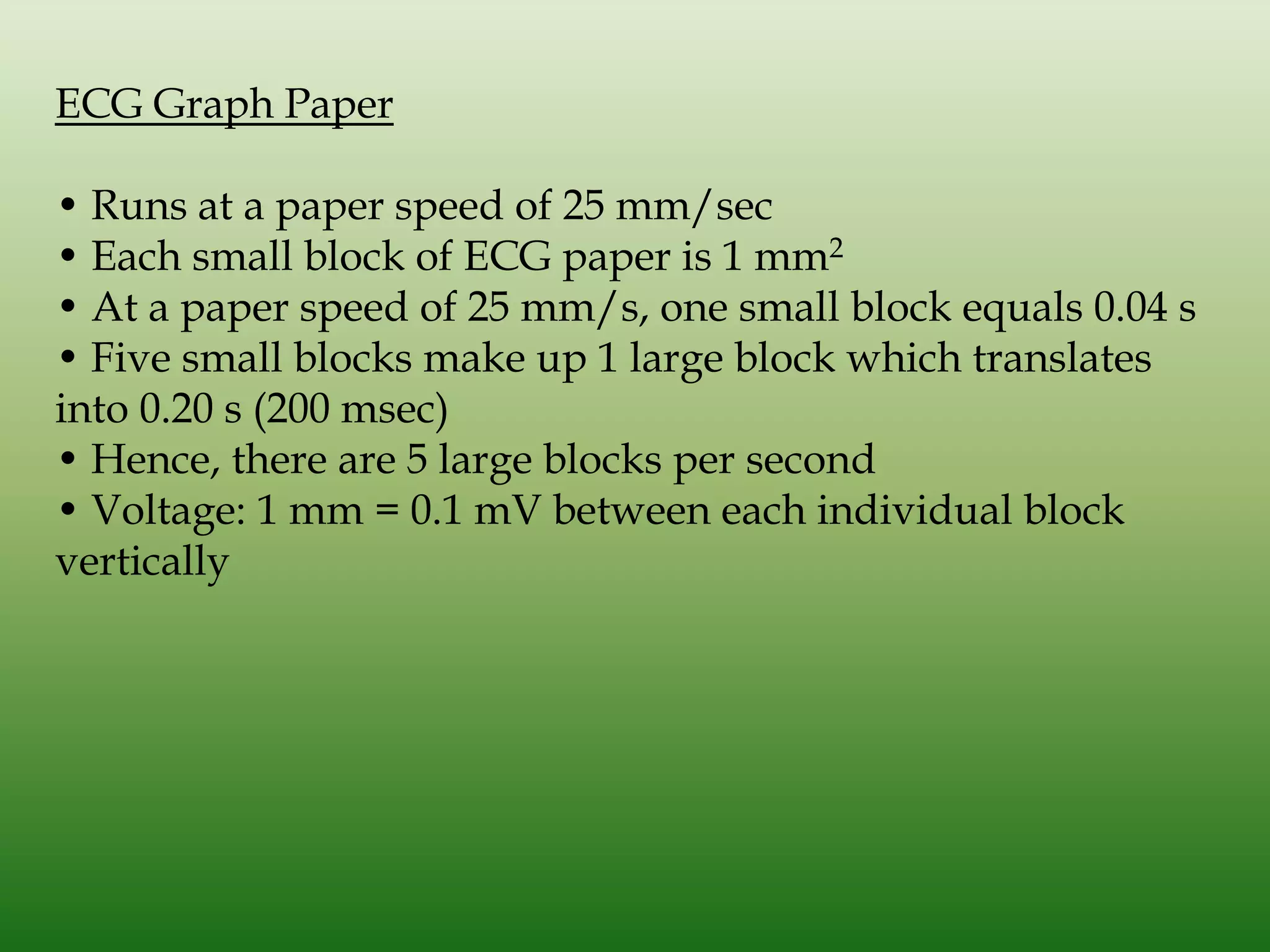
ECG Graph Paper
• Runs at a paper speed of 25 mm/sec
• Each small block of ECG paper is 1 mm2
• At a paper speed of 25 mm/s, one small block equals 0.04 s
• Five small blocks make up 1 large block which translates
into 0.20 s (200 msec)
• Hence, there are 5 large blocks per second
• Voltage: 1 mm = 0.1 mV between each individual block
vertically
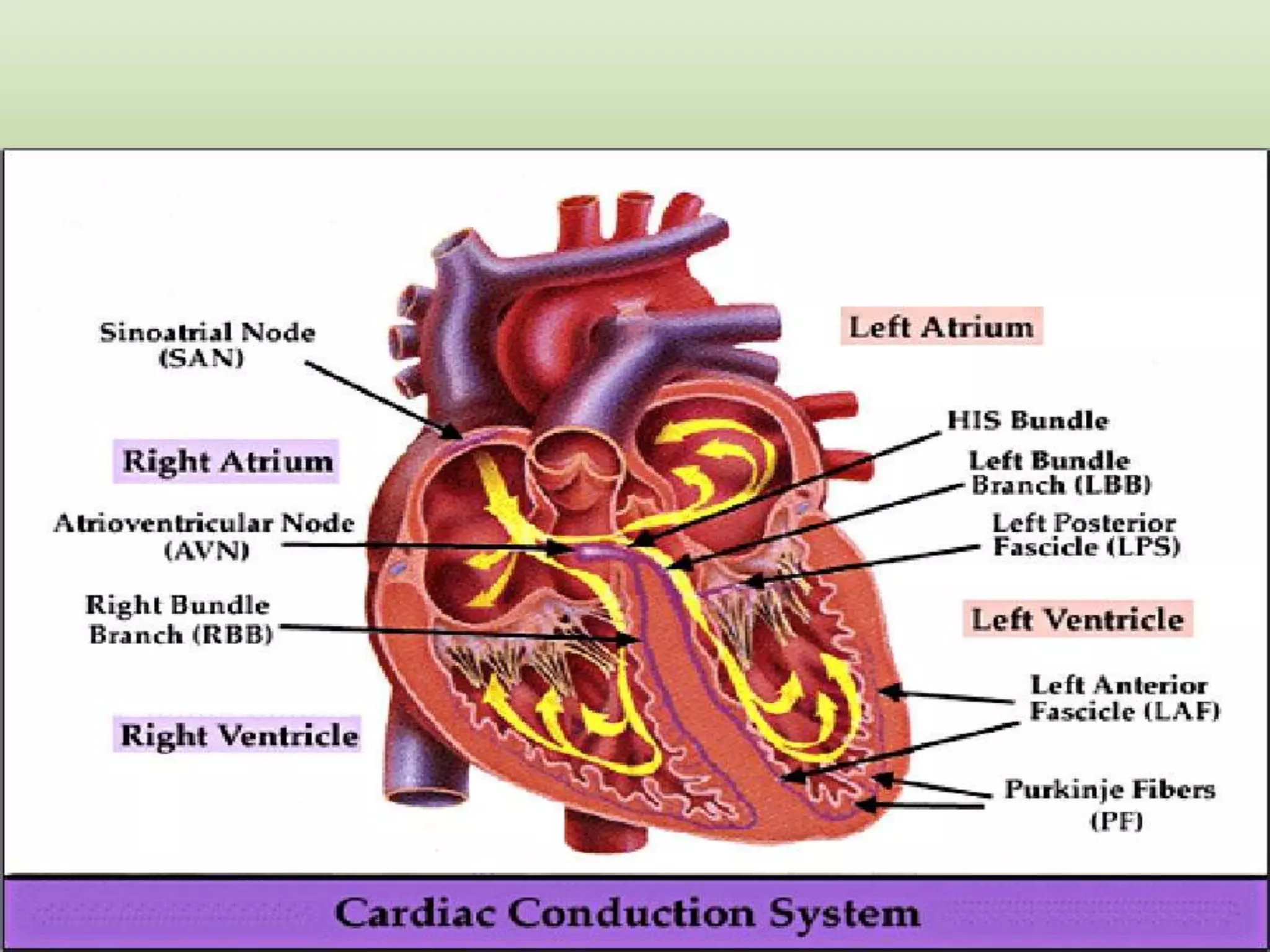
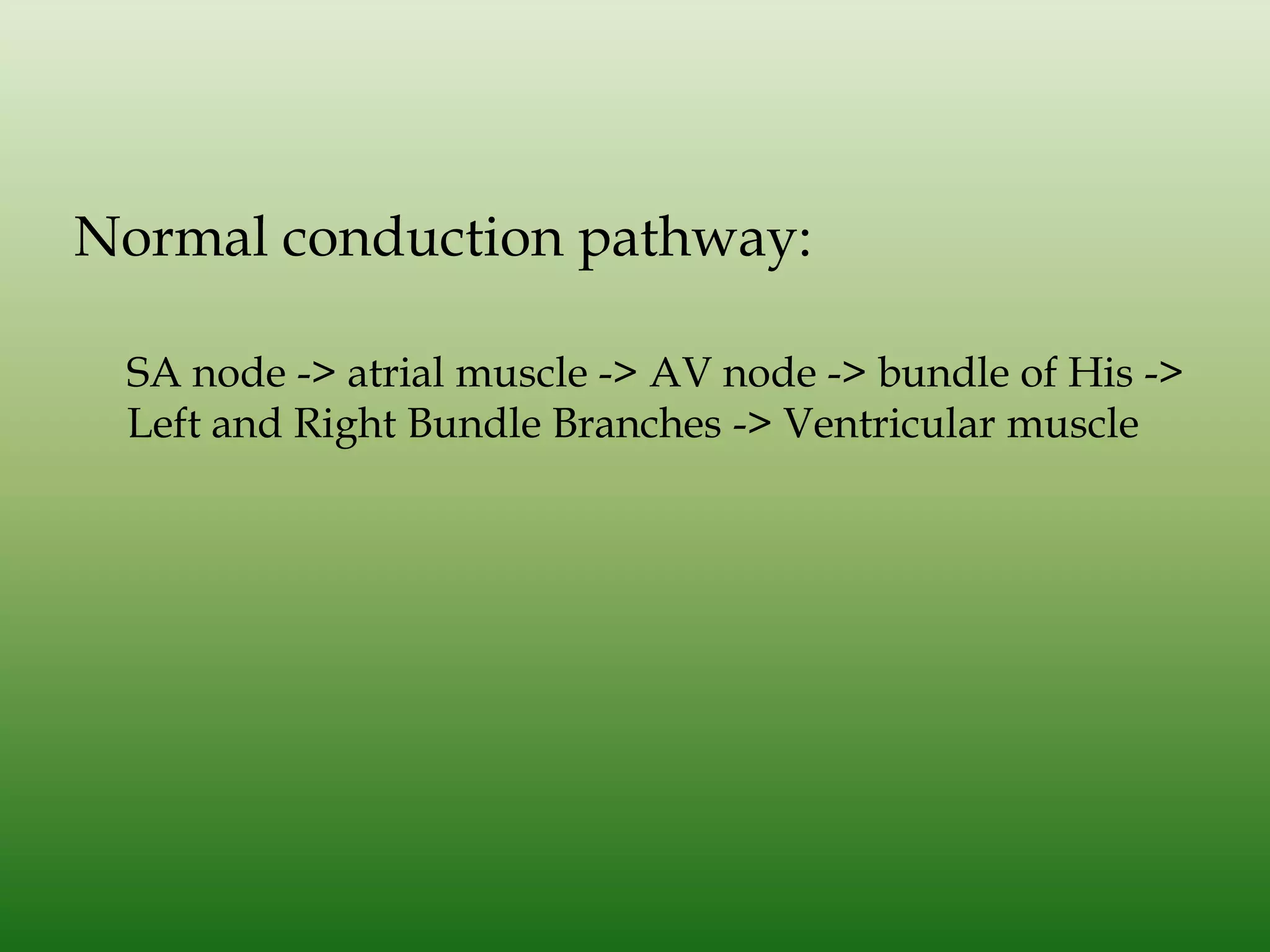
Normal conduction pathway:
SA node -> atrial muscle -> AV node -> bundle of His ->
Left and Right Bundle Branches -> Ventricular muscle
Recording of the ECG:
Leads used:
• Limb leads are I, II, II. So called because at one time
subjects had to literally place arms and legs in buckets of salt
water.
• Each of the leads are bipolar; i.e., it requires two sensors
on the skin to make a lead.
• If one connects a line between two sensors, one has a
vector.
• There will be a positive end at one electrode and
negative at the other.
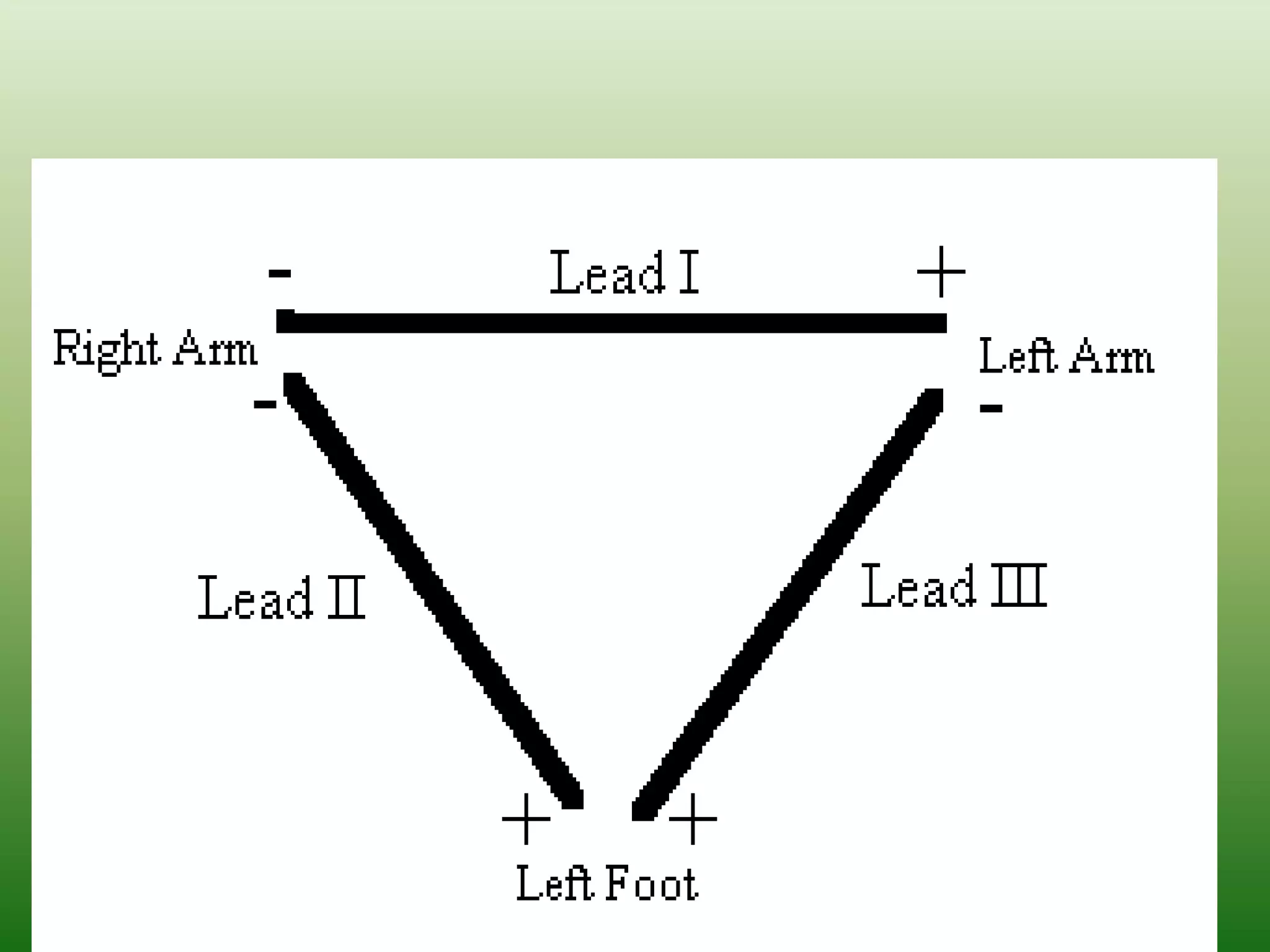
• The positioning for leads I, II, and III were first given by
Einthoven. Form the basis of Einthoven’s triangle.








Bipolar leads record
voltage between
electrodes placed on
wrists & legs (right leg is
ground)
Lead I records between
right arm & left arm
Lead II: right arm & left
leg
Lead III: left arm & left
leg
Limb Leads

Placement

Lead I

Connects the right arm with the
left arm

Lead II

Connects the right arm with the
left leg
Connects the left arm with the left
leg

Lead III

aVR

Right arm

aVL

Left arm

aVF

Left leg
Precordial Leads

Placement

V1

Fourth intercostals space, just to the right of the sternum

V2

Opposite V1, over the fourth intercostals space at the left
sterna border

V3

Midway between V2 and V4

V4

Over the fifth intercostals space at the left midclavicular line

V5

Over the fifth intercostals space at the left anterior axillary
line

V6

Over the fifth intercostals space at the left mid axillary line

Goldberger AL. Electrocardiography. In: Kasper DL, Braunwald E, Fauci AS, Hauser SL, Longo DL, Jameson JL, editors. Harrison’s principles of internal medicine(16th ed).
McGraw-Hill;2005.p.1311-1319.
Electrocardiogram analysis. In: Levine J, Munden J, Schaeffer L, Thompson G,editors. Portable ECGinterpretation. Lippincott Williams & Wilkins; 2007. P.257-364.
ECG








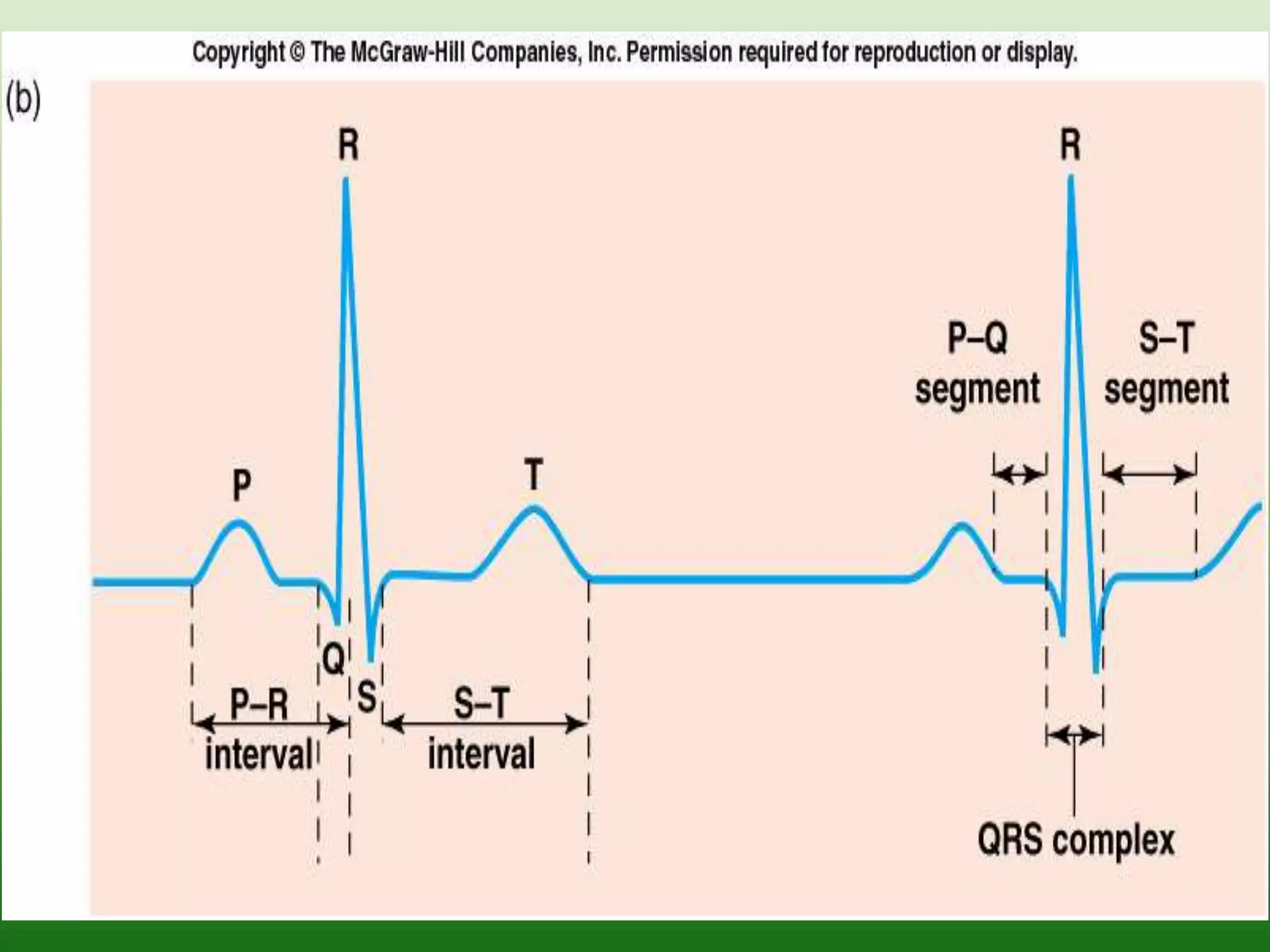
3 distinct waves are
produced during
cardiac cycle
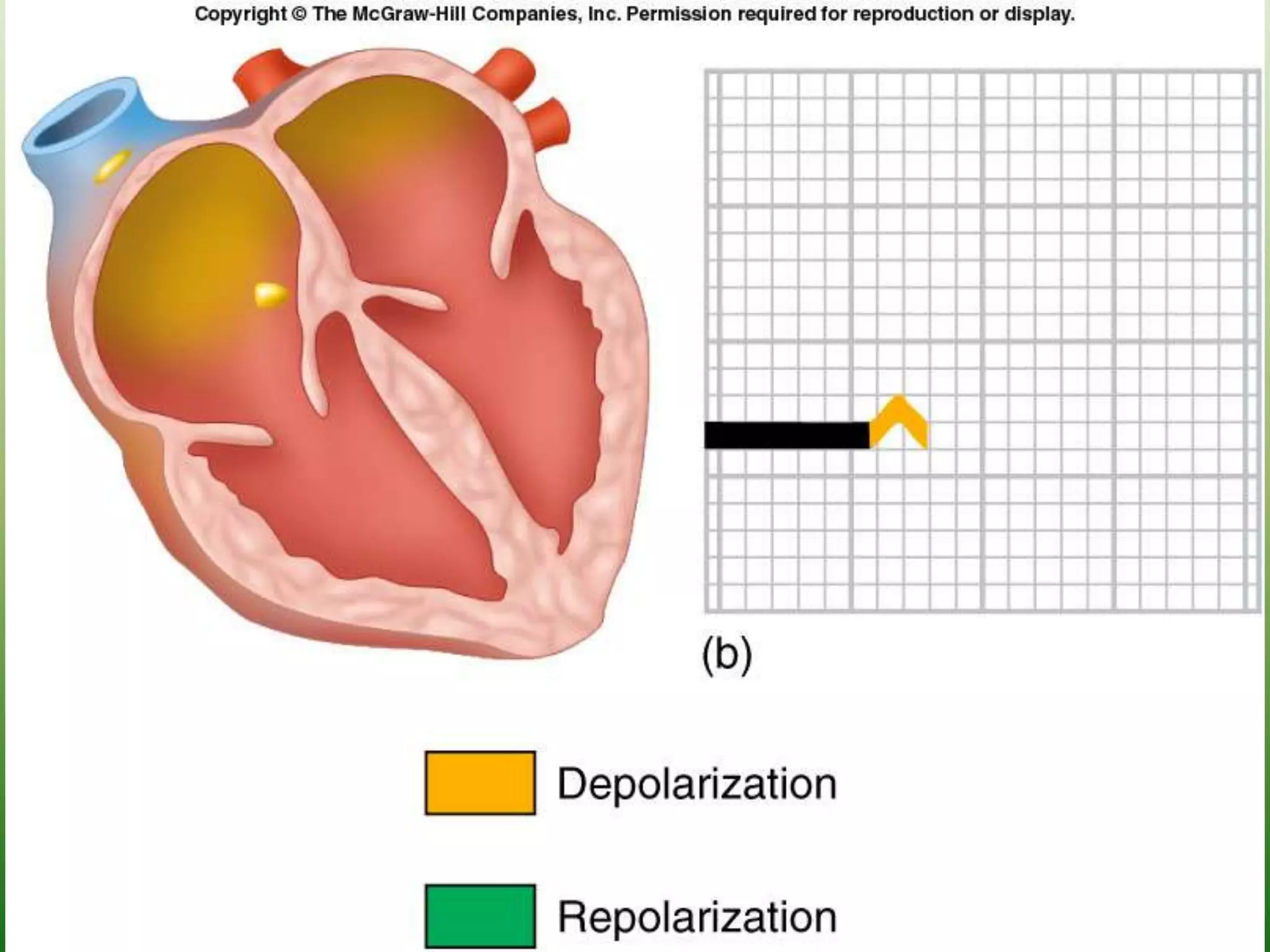
P wave caused by
atrial depolarization
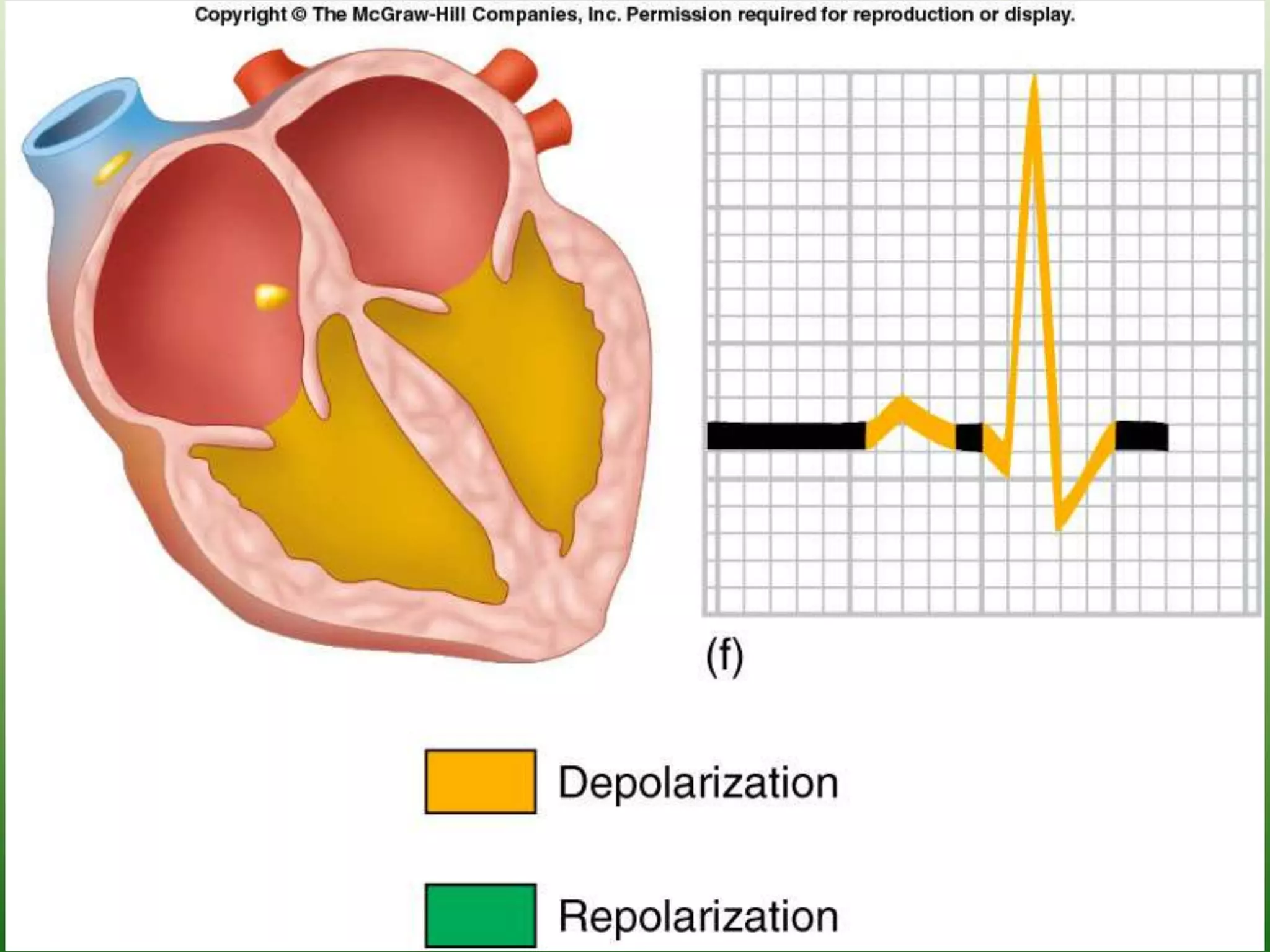
QRS complex caused
by ventricular
depolarization
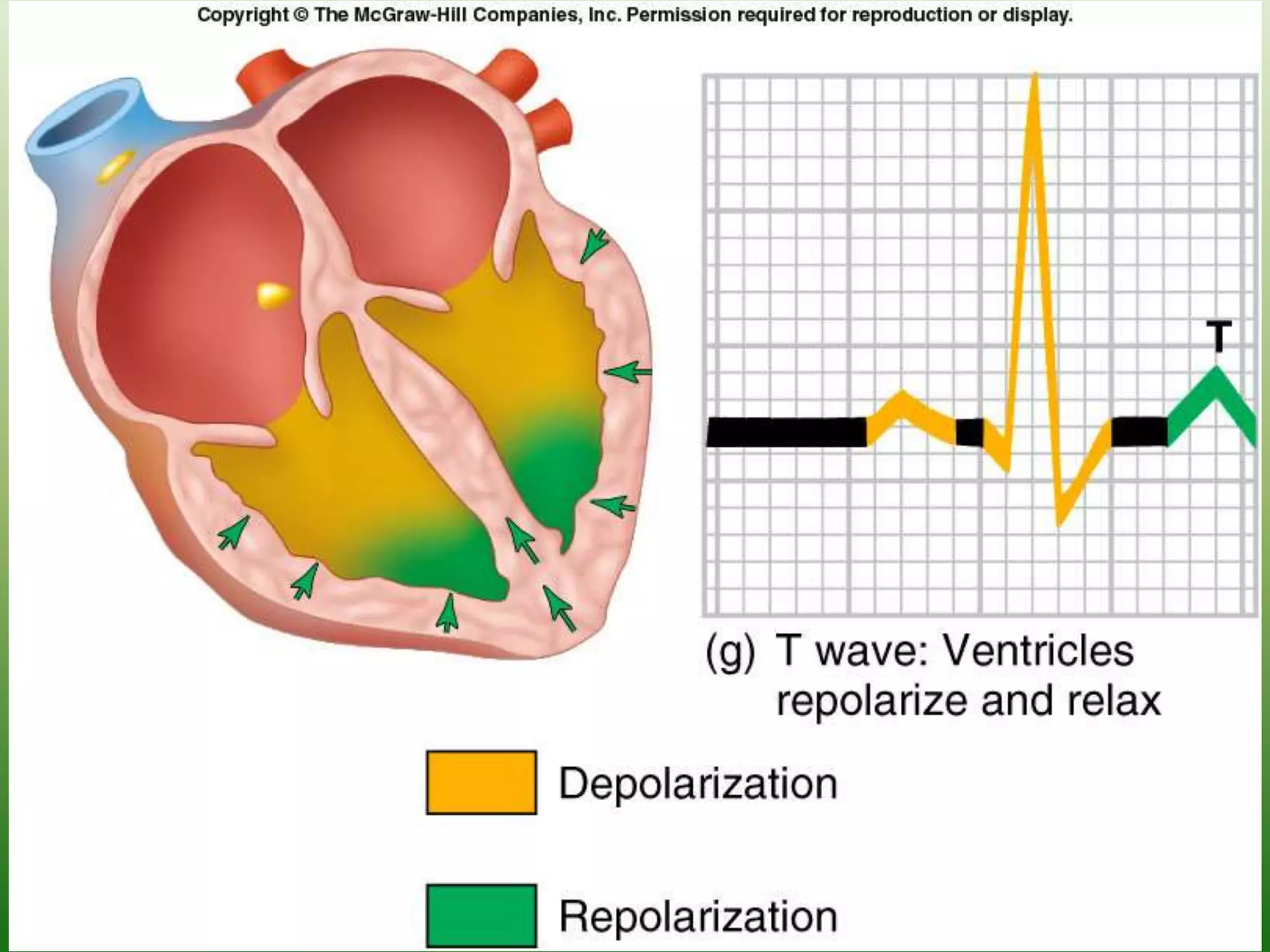
T wave results from
ventricular
repolarization
•

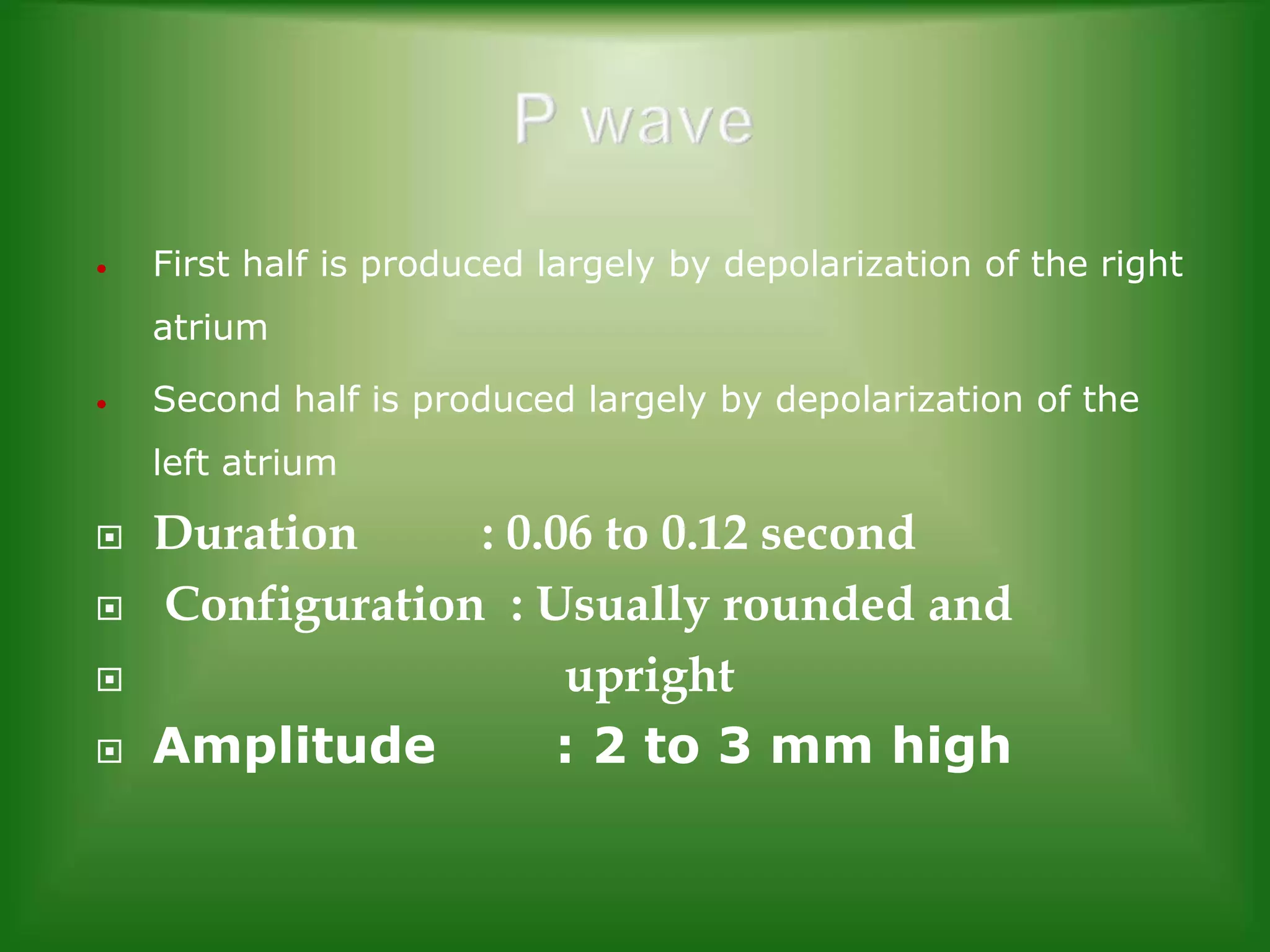
First half is produced largely by depolarization of the right

atrium
•

Second half is produced largely by depolarization of the
left atrium






Duration
: 0.06 to 0.12 second
Configuration : Usually rounded and
upright
Amplitude
: 2 to 3 mm high


Includes the P wave and P-R segment0.12-2.0

sec



Represents the time of transmission of the electrical
impulse from the atria to ventricle



Location : From the beginning of the P wave
to the beginning of the QRS complex

Basic concept and the normal electrocardiogram. In: Weinberg RW, Miller KC, Somers J, editors. Rapid analysis Of Electrocardiogram: a self study
programme. Lippincott Williams And Wilkins; 1999.p.3-17.
•QRS complex:
• Represents ventricular depolarization
• Larger than P wave because of greater muscle mass of
ventricles
• Normal duration = 0.08-0.12 seconds
• Its duration, amplitude, and morphology are useful in
diagnosing cardiac arrhythmias, ventricular
hypertrophy, MI, electrolyte derangement, etc.
• Q wave greater than 1/3 the height of the R
wave, greater than 0.04 sec are abnormal and may
represent MI
•

Represents the earlier phase of repolarization of both the
ventricles

Basic concept and the normal electrocardiogram. In: Weinberg RW, Miller KC, Somers J, editors. Rapid analysis Of Electrocardiogram: a self
study programme. Lippincott Williams And Wilkins; 1999.p.3-17.
•

Extends from the end of QRS complex to the beginning of T

wave
•

Usually isoelectric or on the baseline

•

Neither elevated (positive) nor depressed (negative)

•

The point at which the ST segment joints the QRS complex
is known as the J (junction) point

Basic concept and the normal electrocardiogram. In: Weinberg RW, Miller KC, Somers J, editors. Rapid analysis Of Electrocardiogram: a self
study programme. Lippincott Williams And Wilkins; 1999.p.3-17.
T wave:
• Represents repolarization or recovery of ventricles
• Interval from beginning of QRS to apex of T is
referred to as the absolute refractory period
ST segment:
• Connects the QRS complex and T wave
• Duration of 0.08-0.12 sec (80-120 msec
QT Interval
• Measured from beginning of QRS to the end of the T
wave
• Normal QT is usually about 0.40 sec
• QT interval varies based on heart rate






Disturbances of the conduction through the
heart, occurring at the AV Node
AV Node – damaged/diseased – delay or total
block of impulses at the AV Node
This conduction defect can be seen on the ECG








Increased vagal tone (parasympathetic nervous
system)
IHD (MI)
Endocarditis
Degeneration (age)
Sclerosis (Aortic)
Cardiac surgery trauma




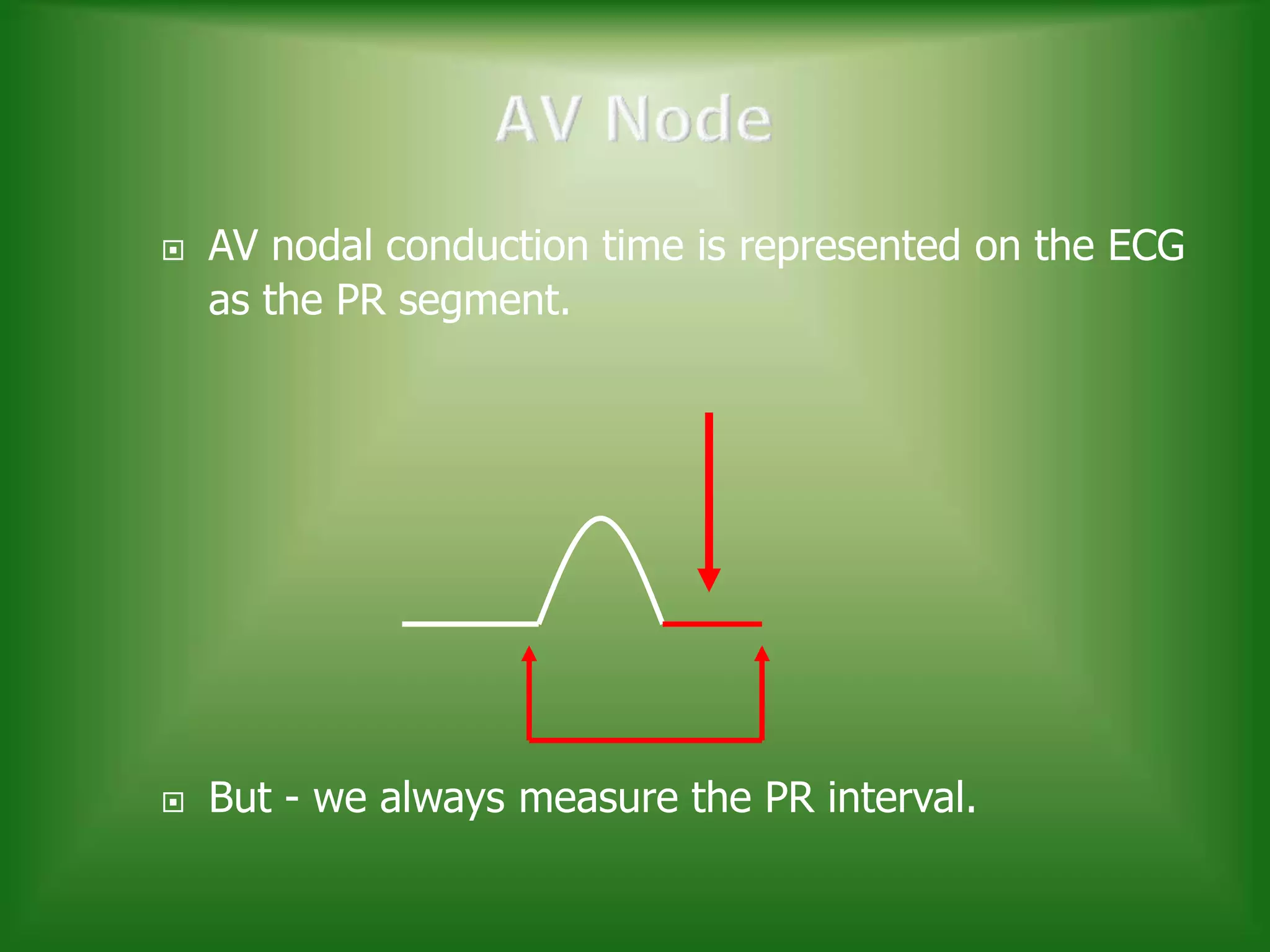
AV nodal conduction time is represented on the ECG
as the PR segment.

But - we always measure the PR interval.






SA Node – normal

 Normal P wave
AV Node conducts more slowly than normal
 Prolonged PR Interval
Rest of conduction is normal
 Normal QRS


PR Interval > 0.2 seconds (5 small sq)



Note – the PR Interval is constant






Clinical significance
 None

Treatment
 None
Note – this can progress to 2º or 3º heart block


Mobitz Type I (Wenkebach)



Mobitz Type II



2:1


Conduction through the AV Node – progressively
delayed until a drop beat is seen





PR Interval prolongs with each beat until a
dropped beat is seen
The PR Interval is NOT constant
After each dropped beat, the PR interval is
normal and the cycle starts again
PR

PR

PR

DROPPED BEAT
nd
2

Degree AV block Mobitz 1


Clinical Significance

 Slight symptoms e.g..

Lethargy, Confusion



Treatment

 Pacemaker if during day &/or

symptoms
 No treatment if at night


Note – this can progress to 3º Heart Block




Conduction through the AV node is constant.
PR interval is normal and constant
Occasionally a dropped beat is seen
PR

PR

DROPPED BEAT

PR


Clinical significance – this is more significant
disease



Treatment – pacemaker



Note – this can progress to 3º Heart Block


Unable to strictly classify as Mobitz Type I or II



Particular type of second degree Heart Block



Ratio 2 P waves : 1 QRS


Clinical significance – unable to classify as
Mobitz type I or II
 Will be associated with
symptoms, dizziness, lethargy etc.



Treatment – pacemaker



Note – this can deteriorate to 3º Heart Block






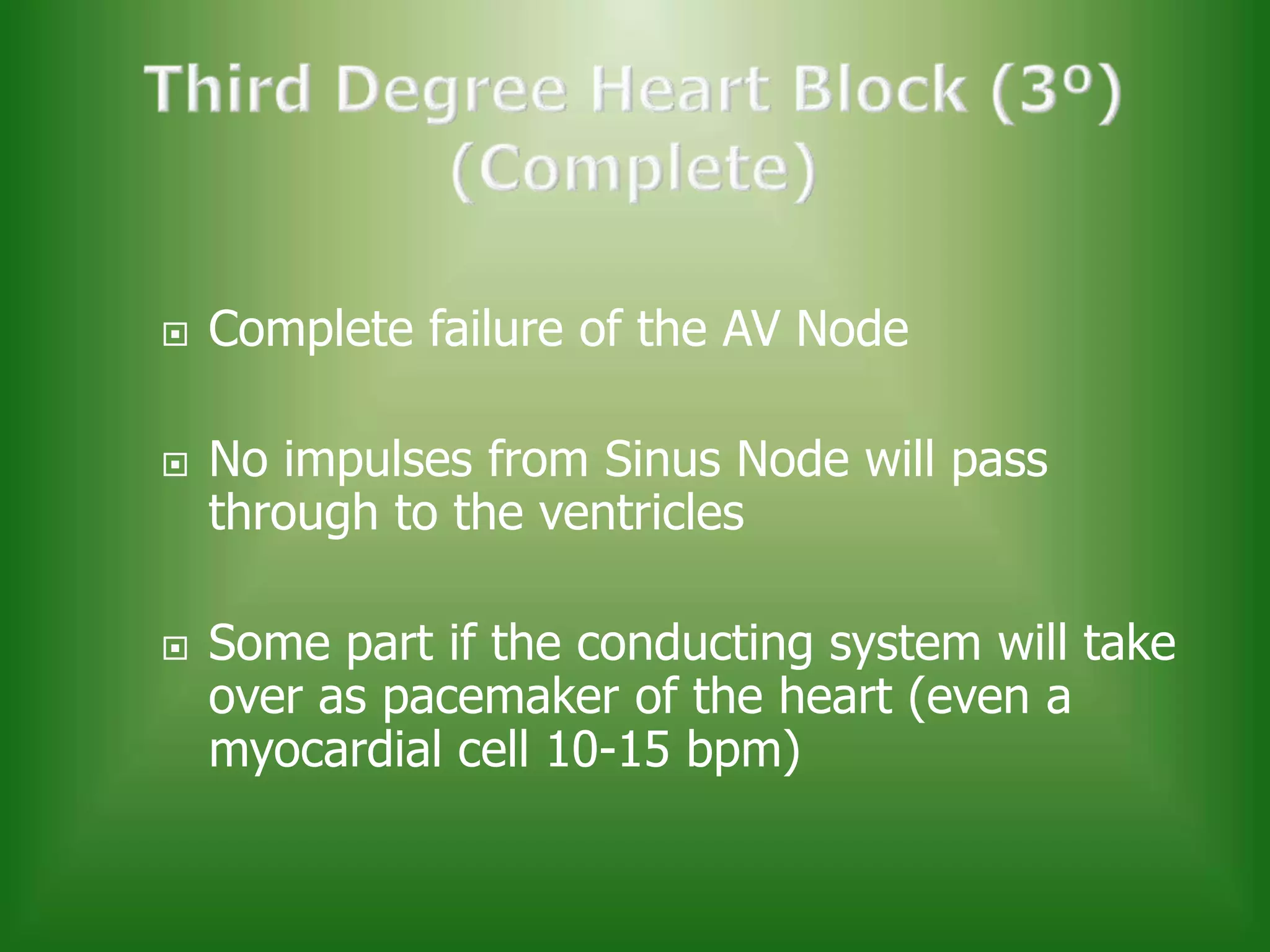
Complete failure of the AV Node
No impulses from Sinus Node will pass
through to the ventricles
Some part if the conducting system will take
over as pacemaker of the heart (even a
myocardial cell 10-15 bpm)


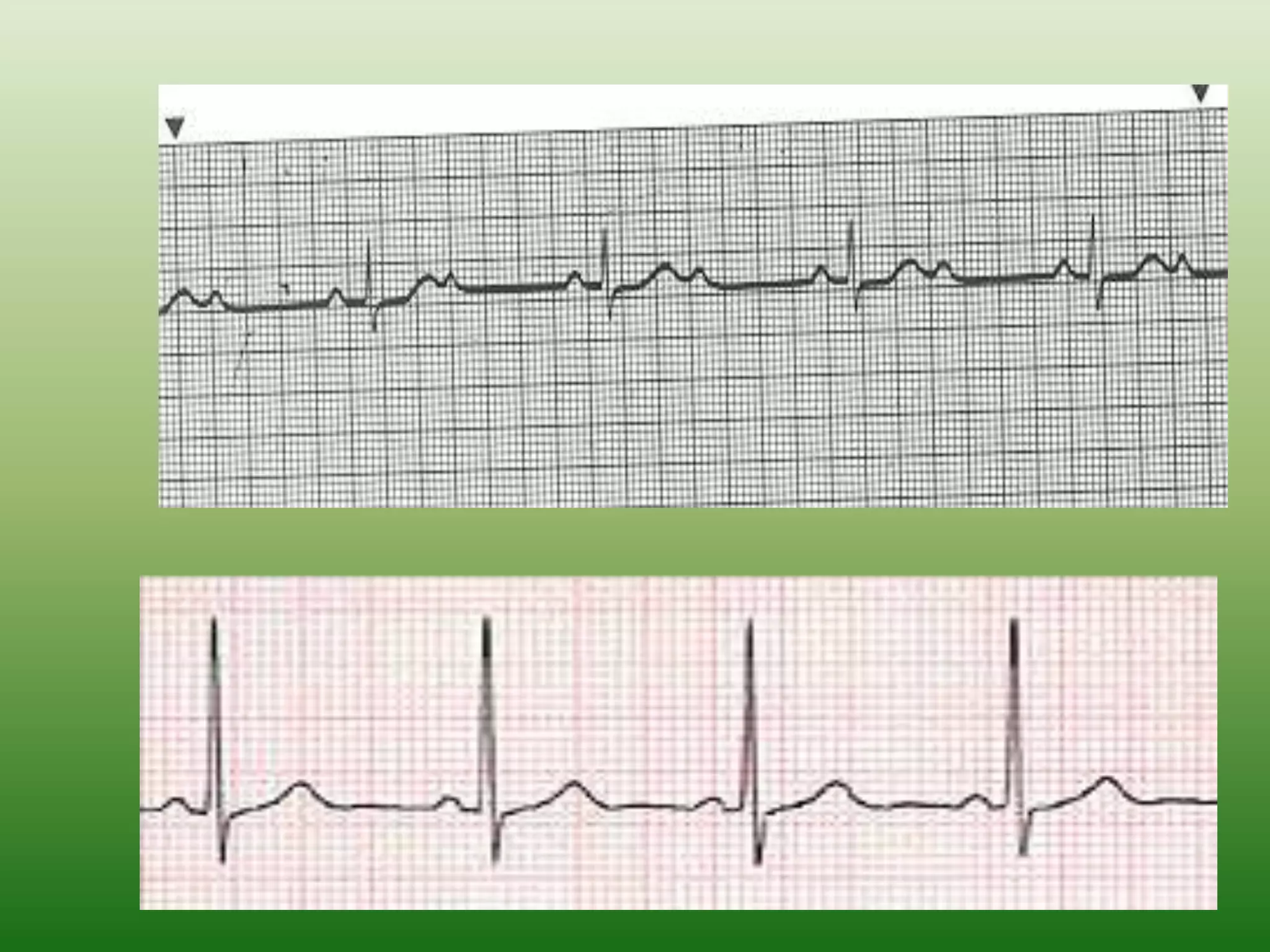
P wave rate – normal



Ventricular rate – slow



Ventricular complex may be broad

 Idioventricular rhythm


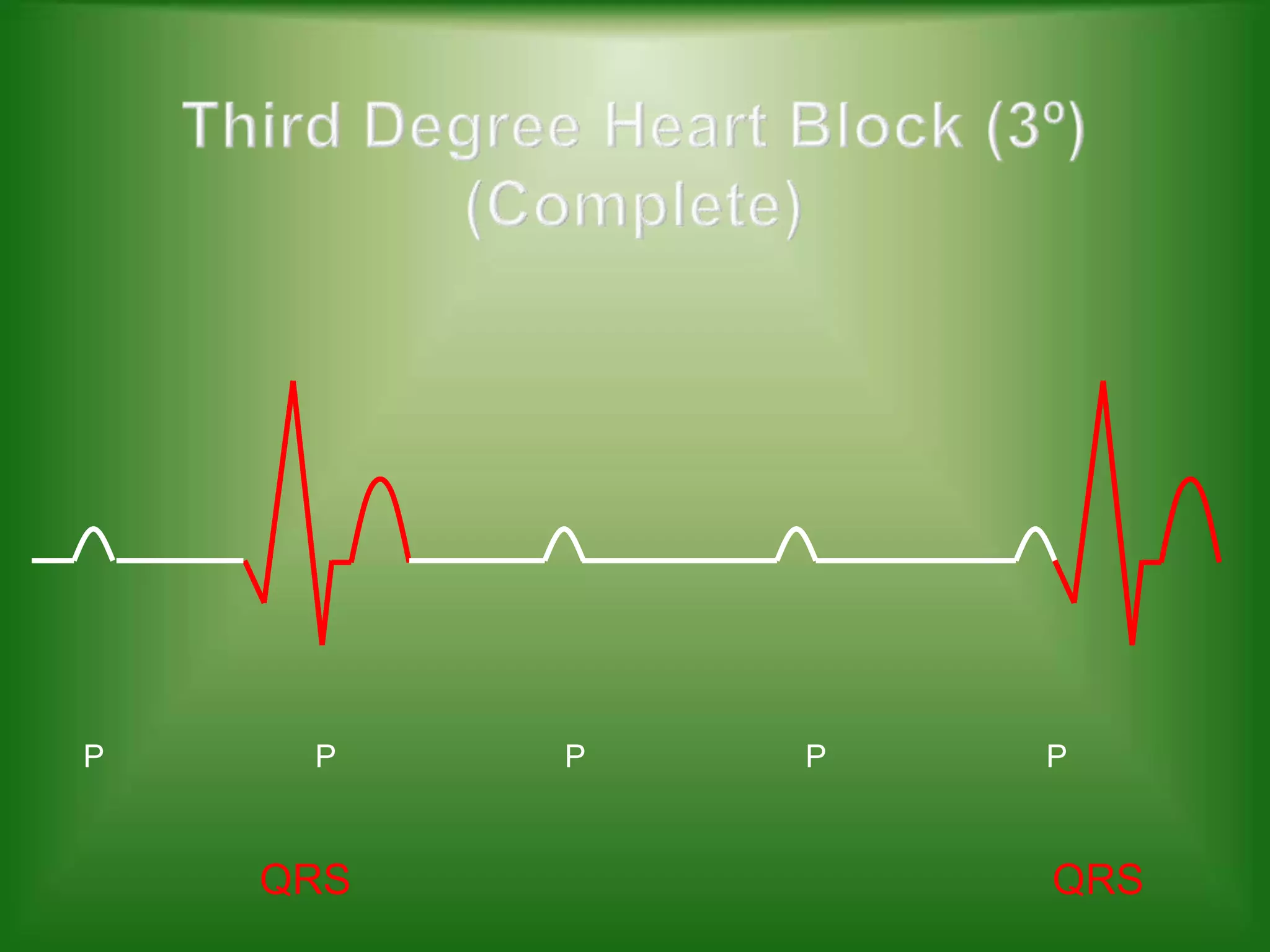
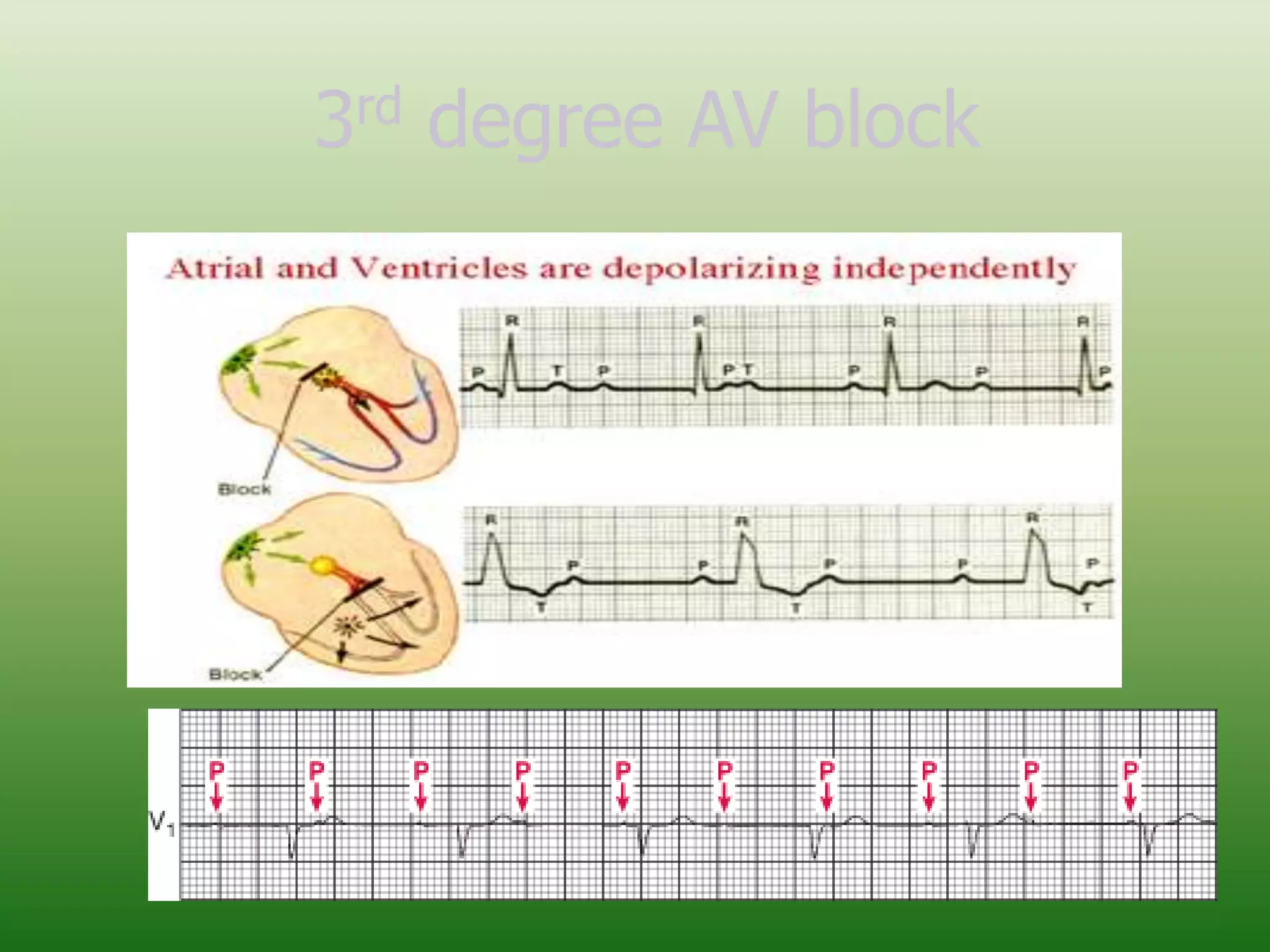
Complete dissociation between P waves &
QRS
P

P

QRS

P

P

P

QRS
3rd degree AV block


clinical significance

 Symptoms LOC, Confusion,

Dizziness, Low BP
 Can lead to standstill, VT or VF
(stokes Adams)


Treatment - pacemaker










1º - prolongation of PR Interval

ALL

2º - Mobitz I – Increasing PR Interval until dropped beat is seen
SOME
Mobitz II – Constant PR Interval with more P waves to QRS

2 : 1 – Constant PR Interval with more P waves to QRS
3º - Complete dissociation between P waves & QRS

NONE

ECG & Heart block [doctors online]

  • 1.
  • 2.
    • • • • A recording ofthe electrical activity of the heart over time Gold standard for diagnosis of cardiac arrhythmias Helps detect electrolyte disturbances (hyper- & hypokalemia) Allows for detection of conduction abnormalities • Screening tool for ischemic heart disease during stress tests • Helpful with non-cardiac diseases (e.g. pulmonary embolism or hypothermia
  • 3.
     Is a recordingof electrical activity of heart conducted thru ions in body to surface
  • 4.
    ECG Graph Paper •Runs at a paper speed of 25 mm/sec • Each small block of ECG paper is 1 mm2 • At a paper speed of 25 mm/s, one small block equals 0.04 s • Five small blocks make up 1 large block which translates into 0.20 s (200 msec) • Hence, there are 5 large blocks per second • Voltage: 1 mm = 0.1 mV between each individual block vertically
  • 7.
    Normal conduction pathway: SAnode -> atrial muscle -> AV node -> bundle of His -> Left and Right Bundle Branches -> Ventricular muscle
  • 8.
    Recording of theECG: Leads used: • Limb leads are I, II, II. So called because at one time subjects had to literally place arms and legs in buckets of salt water. • Each of the leads are bipolar; i.e., it requires two sensors on the skin to make a lead. • If one connects a line between two sensors, one has a vector. • There will be a positive end at one electrode and negative at the other. • The positioning for leads I, II, and III were first given by Einthoven. Form the basis of Einthoven’s triangle.
  • 10.
        Bipolar leads record voltagebetween electrodes placed on wrists & legs (right leg is ground) Lead I records between right arm & left arm Lead II: right arm & left leg Lead III: left arm & left leg
  • 11.
    Limb Leads Placement Lead I Connectsthe right arm with the left arm Lead II Connects the right arm with the left leg Connects the left arm with the left leg Lead III aVR Right arm aVL Left arm aVF Left leg
  • 12.
    Precordial Leads Placement V1 Fourth intercostalsspace, just to the right of the sternum V2 Opposite V1, over the fourth intercostals space at the left sterna border V3 Midway between V2 and V4 V4 Over the fifth intercostals space at the left midclavicular line V5 Over the fifth intercostals space at the left anterior axillary line V6 Over the fifth intercostals space at the left mid axillary line Goldberger AL. Electrocardiography. In: Kasper DL, Braunwald E, Fauci AS, Hauser SL, Longo DL, Jameson JL, editors. Harrison’s principles of internal medicine(16th ed). McGraw-Hill;2005.p.1311-1319. Electrocardiogram analysis. In: Levine J, Munden J, Schaeffer L, Thompson G,editors. Portable ECGinterpretation. Lippincott Williams & Wilkins; 2007. P.257-364.
  • 14.
    ECG     3 distinct wavesare produced during cardiac cycle P wave caused by atrial depolarization QRS complex caused by ventricular depolarization T wave results from ventricular repolarization
  • 16.
    • First half isproduced largely by depolarization of the right atrium • Second half is produced largely by depolarization of the left atrium     Duration : 0.06 to 0.12 second Configuration : Usually rounded and upright Amplitude : 2 to 3 mm high
  • 20.
     Includes the Pwave and P-R segment0.12-2.0 sec  Represents the time of transmission of the electrical impulse from the atria to ventricle  Location : From the beginning of the P wave to the beginning of the QRS complex Basic concept and the normal electrocardiogram. In: Weinberg RW, Miller KC, Somers J, editors. Rapid analysis Of Electrocardiogram: a self study programme. Lippincott Williams And Wilkins; 1999.p.3-17.
  • 22.
    •QRS complex: • Representsventricular depolarization • Larger than P wave because of greater muscle mass of ventricles • Normal duration = 0.08-0.12 seconds • Its duration, amplitude, and morphology are useful in diagnosing cardiac arrhythmias, ventricular hypertrophy, MI, electrolyte derangement, etc. • Q wave greater than 1/3 the height of the R wave, greater than 0.04 sec are abnormal and may represent MI
  • 24.
    • Represents the earlierphase of repolarization of both the ventricles Basic concept and the normal electrocardiogram. In: Weinberg RW, Miller KC, Somers J, editors. Rapid analysis Of Electrocardiogram: a self study programme. Lippincott Williams And Wilkins; 1999.p.3-17.
  • 25.
    • Extends from theend of QRS complex to the beginning of T wave • Usually isoelectric or on the baseline • Neither elevated (positive) nor depressed (negative) • The point at which the ST segment joints the QRS complex is known as the J (junction) point Basic concept and the normal electrocardiogram. In: Weinberg RW, Miller KC, Somers J, editors. Rapid analysis Of Electrocardiogram: a self study programme. Lippincott Williams And Wilkins; 1999.p.3-17.
  • 27.
    T wave: • Representsrepolarization or recovery of ventricles • Interval from beginning of QRS to apex of T is referred to as the absolute refractory period
  • 28.
    ST segment: • Connectsthe QRS complex and T wave • Duration of 0.08-0.12 sec (80-120 msec QT Interval • Measured from beginning of QRS to the end of the T wave • Normal QT is usually about 0.40 sec • QT interval varies based on heart rate
  • 29.
       Disturbances of theconduction through the heart, occurring at the AV Node AV Node – damaged/diseased – delay or total block of impulses at the AV Node This conduction defect can be seen on the ECG
  • 30.
          Increased vagal tone(parasympathetic nervous system) IHD (MI) Endocarditis Degeneration (age) Sclerosis (Aortic) Cardiac surgery trauma
  • 31.
      AV nodal conductiontime is represented on the ECG as the PR segment. But - we always measure the PR interval.
  • 32.
       SA Node –normal  Normal P wave AV Node conducts more slowly than normal  Prolonged PR Interval Rest of conduction is normal  Normal QRS
  • 33.
     PR Interval >0.2 seconds (5 small sq)  Note – the PR Interval is constant
  • 35.
       Clinical significance  None Treatment None Note – this can progress to 2º or 3º heart block
  • 36.
     Mobitz Type I(Wenkebach)  Mobitz Type II  2:1
  • 37.
     Conduction through theAV Node – progressively delayed until a drop beat is seen
  • 38.
       PR Interval prolongswith each beat until a dropped beat is seen The PR Interval is NOT constant After each dropped beat, the PR interval is normal and the cycle starts again
  • 39.
  • 40.
  • 41.
     Clinical Significance  Slightsymptoms e.g.. Lethargy, Confusion  Treatment  Pacemaker if during day &/or symptoms  No treatment if at night  Note – this can progress to 3º Heart Block
  • 42.
       Conduction through theAV node is constant. PR interval is normal and constant Occasionally a dropped beat is seen
  • 43.
  • 45.
     Clinical significance –this is more significant disease  Treatment – pacemaker  Note – this can progress to 3º Heart Block
  • 46.
     Unable to strictlyclassify as Mobitz Type I or II  Particular type of second degree Heart Block  Ratio 2 P waves : 1 QRS
  • 48.
     Clinical significance –unable to classify as Mobitz type I or II  Will be associated with symptoms, dizziness, lethargy etc.  Treatment – pacemaker  Note – this can deteriorate to 3º Heart Block
  • 49.
       Complete failure ofthe AV Node No impulses from Sinus Node will pass through to the ventricles Some part if the conducting system will take over as pacemaker of the heart (even a myocardial cell 10-15 bpm)
  • 50.
     P wave rate– normal  Ventricular rate – slow  Ventricular complex may be broad  Idioventricular rhythm  Complete dissociation between P waves & QRS
  • 51.
  • 52.
  • 53.
     clinical significance  SymptomsLOC, Confusion, Dizziness, Low BP  Can lead to standstill, VT or VF (stokes Adams)  Treatment - pacemaker
  • 56.
         1º - prolongationof PR Interval ALL 2º - Mobitz I – Increasing PR Interval until dropped beat is seen SOME Mobitz II – Constant PR Interval with more P waves to QRS 2 : 1 – Constant PR Interval with more P waves to QRS 3º - Complete dissociation between P waves & QRS NONE

Editor's Notes

  • #13 Placement of chest leads (Precordial leads)V1- Fourth intercostals space, just to the right of the sternum3V2- Just opposite V1, over the fourth intercostals space at the left sterna borderV3- Midway between V2 and V4V4- Over the fifth intercostals space at the left midclavicular lineV5- Over the fifth intercostals space at the left anterior axillary lineV6- Over the fifth intercostals space at the left anterior axillary line
  • #21 P-R interval includes the P wave and P-R segment. It represents the time of transmission of the electrical impulse from the atria to ventricles.
  • #25 ST segment represents the earlier phase of repolarization of both the ventricles.
  • #26 ST segment extends from the end of QRS complex to the beginning of T wave. The ST segment is generally isoelectric (at the same level as the resting baseline. It is neither elevated (positive) nor depressed (negative). The point at which the ST segment joints the QRS complex is known as the J (junction) point