AORTIC
DISSECTION
Dr.Bhargav kiran
MD.General Medicine
Introduction
– Acute aortic syndromes include
– Classic aortic dissection
– Aortic intramuralhematoma (IMH)
– Penetrating atherosclerotic ulcer (PAU)
– In approximately 90% of acute aortic syndromes, classic
aortic dissection is present, with intimal disruption leading to
a dissection plane in the aortic wall that may propagate
anterogradely (orless commonly, retrogradely) throughout
the length of the aorta.
Incidence
– Population studies in the United States have
estimated the incidence of aortic dissection to
range from 2 to 3.5 cases per 100,000
personyears.
– 14 Aortic dissection occurs at least twice as
often in males as in females
– There are two main hypotheses for acute aortic dissection
– (1) a primary tear in the aortic intima with blood from the
aortic lumen penetrating into the diseased media and leading
to dissection and creation of the true and false lumina
– (2) primary rupture of the vasa vasorum leading to
hemorrhage in the aortic wall, with subsequent intimal
disruption creating the intimal tear and aortic dissection
– The pressure of the pulsatile blood within the aortic wall
after dissection leads to extension of the dissection.
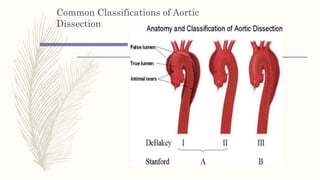
Common Classifications of Aortic
Dissection
Variants of Aortic
Dissection
Predisposing Factors
• Men/Female Ratio 2:1 to 5:1
• Chronic Systemic HTN (62-78%)
• Proximal Dissection:
• Peak age 50-55 years
• MC on initial presentation to have HTN 70%
• Distal Dissection:
• Peak Age 60-70 years
• Direct Iatrogenic Trauma: 5% of cases
• Indirect Trauma (eg sudden
deceleration)
Predisposing Factors
• Hereditary Connective Tissue Diseases
• Marfan Syndrome
• Ehler Danlos Syndrome
• Chromosomal Aberrations
• Turners Syndrome
• Noonans Syndrome
• Aortic Diseases
• Aortic Dilatation
• Aortic Aneurysm
• Anuloaortic ectasia
• Aortic Arteritis
• Bicuspid Aortic Valve
Predisposing Factors
• Females in 3rd Trimester Pregnancy or
1stStage of Labor
• Case Reports of:
– Cocaine (
(Eber et• Abrupt Discontinuation of Beta Blockers
• Probably Secondary to rapid rise in first derivative of
pressure (dp/dt) on aortic wall.
Cystic Medial Degeneration
• Medial Degeneration predisposes dissection
by decreasing cohesiveness of layers of
aortic wall
• More extensive in patients with:
• HTN
• Marfan Syndrome
• Bicuspid Aortic Valves
• But, even in other causes of dissection, medial
degeneration is much greater than expected
with normal aging.
Pathogenesis
• Intimal tears occur in regions of aorta
subjected to greatest dp/dt and pressure
fluctuations.
• MC sites for initiation of intimal tear:
• Ascending Aorta
• 1st Portion Descending Aorta
Proposed Mechanism of Initiation of
Dissection
Natural History
• Hydrodynamic forces propagate the dissection until
rupture occurs either:
• Back into the lumen of the aorta
• Through the adventitia (causing death)
• Mortality Rates if untreated:
• 1-3% per hour
• 90% within 3 months
• Death usually caused by:
• Acute aortic regurgitation
• Major branch vessel obstruction
• Aortic Rupture ( into pericardium, L pleural cavity, or mediastinum)
Proximal Dissection
• Substernal chest pain
• Neck, jaw, throat or face pain
• Aortic Insufficiency
• Decreased pulse or blood pressure in R arm
• Decreased R carotid pulse
• Pulse abnormalities are seen in 50% of
proximal dissections
• Ischemic EKG changes
• AMI – Inferior (5%)
• Marfans Syndrome
• Hypotension
• Syncope – 12%
• CVA – 5-10%
Aortic Regurgitation
• AR in 18-50% cases
• Diastolic murmur reported in 25% pts.
• Acute Severe AR – 2nd MC cause of death
AD.
• Murmur can wax and wane and intensity
will vary with BP
• 3 possible mechanisms for acute AR
in dissection
Hagan et al. IRAD. JAMA 2000;283:897-903.
Mechanisms of Aortic
Regurgitation in Proximal AD
Hypotension with Proximal
Dissection
• Cardiac tamponade
• Severe acute Aortic regurgitation with
cardiogenic shock
• Myocardial Infarction with resultant LV systo
dysfunction – usually RCA.
• Acute Aortic Rupture.
• Pseudohypotension by involving
brachiocephalic artery
• Interscapular pain
• HTN less commonly associated about 35%
• Left Pleural effusion
• Pulse defecits are less frequent about 15%
• Usually involve femoral or left subclavian
• Spinal Cord Ischemia (10%)
• Transverse Myelitis
• Paraplegia
• Quadriplegia
Distal Dissection
Laboratory Findings
• The chest radiograph may be the first clue to the diagnosis of aortic dissection
• The most common abnormality seen on a chest radiograph in a patient with
aortic dissection is an abnormal aortic contour or widening of the aortic
silhouette, which appears in 80% to 90% of cases
• Nonspecific widening of the superior mediastinum may be present.
• If calcification of the aortic knob occurs, one may detect separation of the
intimal calcification from the outer aortic soft tissue border by more than 0.5 to
1.0 cm—the “calcium sign”
• Pleural effusions occur in approximately 20% of dissections
Enlargement of the Aortic
Knob
A Case of Proximal Aortic Dissection
ECG
Biomarkers
– Release of smooth muscle proteins, soluble elastin fragments, myosin heavy
chain and the BB isoform of creatine kinase, and TGF-β occurs after aortic
dissection.
– These markers have limited usefulness because of sensitivity, specificity, or
time delay and are not currently available for clinical use.
– Patients with acute aortic dissection have elevated D-dimer Levels
– A D-dimer level higher than 1600 ng/mL within the first 6 hours after
– The recent thoracic aortic disease guideline writing committee did not
recommend D-dimer screening for all patients being evaluated for aortic
dissection.
Aortography
• Sensitivity: 86-88%
• Specificity: 75-94%
• False negatives if intramural
hematoma or thrombosis of false
lumen
• Good at detecting branch vessel
involvement and Coronary
Artery invovlvement.
Thoracic Aortagram in AP view
CT
• Sensitivity 83-94%
• Specificity of 100%
• Spiral CT increased sensitivity to 96%
• Non-invasive with rapid availability (MC initial
imaging modality in IRAD pts)
• Needs contrast to be effective
• Disadvantages:
• Cannot Detect AR
• Does not detect Site of Intimal Tear well
• Cannot detect Coronary Artery Involvement
Contrast-Enhanced CT at level of
Ventricle
TEE
• Non-Invasive, Performed Quickly at Bedside
• Sensitivity 98 – 99%
• Specificity: 94 – 95% (biplane or multiplane TEE)
• Good at detecting Coronary Artery
Involvement
• Disadvantage: does not evaluate distal ascending
aorta and proximal arch (because of the interposition of air filled trachea
and main stem bronchus)
Descend Aorta – Communication
back into true lumen
MRI
• Gold Standard for Diagnosis
• Sensitivity and Specificity of 98-100%
• Disadvantages:
• Limited Availability
• Limit the presences of monitoring and support devices
• Relatively CI in unstable patients.
• CI:
• Pacemakers
• Certain types of vascular clips
• Older metallic heart valves
MANAGEMENT
• Therapy is targeted at halting the progression
of the dissection
• It is the course of the tear not the tear itself that
leads to compromise of vasculature or rupture
• Goal:
• Reduction of SBP (100-120)
• Dimunition of dp/dt (reflects force of LV ejection)
through use of a beta blocker.
Sodium Nitroprusside
• Sodium Nitroprusside for acute reduction starting
10 – 20 mcg/min and titrated upward
• Must initiate BB prior to instituion of Nipride due
to its effect on raising dP/dT when used alone
• Adding IV BB prior until desired effect such as HR
60 – 80s (propranolol 1 mg Q 3-5 minutes max 10
mg)
• Then Q 4-6 hrs at a dose of 2 – 6 mg
Labetolol
• Effectively lowers dP/dT as well as
reducing arterial pressure
• Initial dose is 20mg followed by 40 to 80
mg Q 10 – 15 minutes (max 300mg IV)
• Once BP controlled maintenance
by continuous infusion
• Infusion at 2mg/min titrating up to 5 –
10 mg/min
Esmolol
• Ultra short acting BB for those with labile
blood pressure or those that are surgical
candidates. (Long acting medications may affect intraoperative
bp management)
• Load with 500 mcg/kg bolus
• Infusion starts @ 50mcg/kg/min titrate to
200 mcg/kg/min for control
• Controls dP/dT as well as blood pressure
• Can be used in patients with uncertain risk
for bronchospasm
Contraindications to BB
• Patients with severe Brady or AV block or
bronchospasm BB may be CI
• Calcium channel blockers specifically Cardizem and
Diltiazem can be used if bronchospasm
• Provide negative Inotrope and Chronotropic effects
• If Dissection involves the renal arteries patients may
develop high renin HTN
• Treat with IV enalapril
Other Considerations
• Hypotension must ensure if its true or false
• May be secondary to compromise of artery by
dissection (pseudohypotension) so check both arms
• If true hypotension may indicate rupture or
tamponade
• Fluids first then use levophed (norepinephrine) or
phenylephrine (neosynephrine)
• Dopamine should be avoided since it can raise dP/dT
unless used at low doses for renal perfusion
Cardiac
Tamponade
• Increase in Intraaortic pressure after pericardiocentesis
causing a reopening of the closed communication
between the false lumen and pericardial space, leading to
lethal cardiac tamponade.
• Prudent to do Pericardiocentesis in AD only if in EMD or
marked hypotension, and aspirate only enough
pericardial fluid to raise bp.
Indications for Definitive Surgical
and Medical Therapy in AD
Thank

Aortic dissctn

  • 1.
  • 2.
    Introduction – Acute aorticsyndromes include – Classic aortic dissection – Aortic intramuralhematoma (IMH) – Penetrating atherosclerotic ulcer (PAU) – In approximately 90% of acute aortic syndromes, classic aortic dissection is present, with intimal disruption leading to a dissection plane in the aortic wall that may propagate anterogradely (orless commonly, retrogradely) throughout the length of the aorta.
  • 3.
    Incidence – Population studiesin the United States have estimated the incidence of aortic dissection to range from 2 to 3.5 cases per 100,000 personyears. – 14 Aortic dissection occurs at least twice as often in males as in females
  • 4.
    – There aretwo main hypotheses for acute aortic dissection – (1) a primary tear in the aortic intima with blood from the aortic lumen penetrating into the diseased media and leading to dissection and creation of the true and false lumina – (2) primary rupture of the vasa vasorum leading to hemorrhage in the aortic wall, with subsequent intimal disruption creating the intimal tear and aortic dissection – The pressure of the pulsatile blood within the aortic wall after dissection leads to extension of the dissection.
  • 5.
    Common Classifications ofAortic Dissection
  • 6.
  • 7.
    Predisposing Factors • Men/FemaleRatio 2:1 to 5:1 • Chronic Systemic HTN (62-78%) • Proximal Dissection: • Peak age 50-55 years • MC on initial presentation to have HTN 70% • Distal Dissection: • Peak Age 60-70 years • Direct Iatrogenic Trauma: 5% of cases • Indirect Trauma (eg sudden deceleration)
  • 8.
    Predisposing Factors • HereditaryConnective Tissue Diseases • Marfan Syndrome • Ehler Danlos Syndrome • Chromosomal Aberrations • Turners Syndrome • Noonans Syndrome • Aortic Diseases • Aortic Dilatation • Aortic Aneurysm • Anuloaortic ectasia • Aortic Arteritis • Bicuspid Aortic Valve
  • 9.
    Predisposing Factors • Femalesin 3rd Trimester Pregnancy or 1stStage of Labor • Case Reports of: – Cocaine ( (Eber et• Abrupt Discontinuation of Beta Blockers • Probably Secondary to rapid rise in first derivative of pressure (dp/dt) on aortic wall.
  • 10.
    Cystic Medial Degeneration •Medial Degeneration predisposes dissection by decreasing cohesiveness of layers of aortic wall • More extensive in patients with: • HTN • Marfan Syndrome • Bicuspid Aortic Valves • But, even in other causes of dissection, medial degeneration is much greater than expected with normal aging.
  • 11.
    Pathogenesis • Intimal tearsoccur in regions of aorta subjected to greatest dp/dt and pressure fluctuations. • MC sites for initiation of intimal tear: • Ascending Aorta • 1st Portion Descending Aorta
  • 12.
    Proposed Mechanism ofInitiation of Dissection
  • 13.
    Natural History • Hydrodynamicforces propagate the dissection until rupture occurs either: • Back into the lumen of the aorta • Through the adventitia (causing death) • Mortality Rates if untreated: • 1-3% per hour • 90% within 3 months • Death usually caused by: • Acute aortic regurgitation • Major branch vessel obstruction • Aortic Rupture ( into pericardium, L pleural cavity, or mediastinum)
  • 14.
    Proximal Dissection • Substernalchest pain • Neck, jaw, throat or face pain • Aortic Insufficiency • Decreased pulse or blood pressure in R arm • Decreased R carotid pulse • Pulse abnormalities are seen in 50% of proximal dissections • Ischemic EKG changes • AMI – Inferior (5%) • Marfans Syndrome • Hypotension • Syncope – 12% • CVA – 5-10%
  • 15.
    Aortic Regurgitation • ARin 18-50% cases • Diastolic murmur reported in 25% pts. • Acute Severe AR – 2nd MC cause of death AD. • Murmur can wax and wane and intensity will vary with BP • 3 possible mechanisms for acute AR in dissection Hagan et al. IRAD. JAMA 2000;283:897-903.
  • 16.
  • 17.
    Hypotension with Proximal Dissection •Cardiac tamponade • Severe acute Aortic regurgitation with cardiogenic shock • Myocardial Infarction with resultant LV systo dysfunction – usually RCA. • Acute Aortic Rupture. • Pseudohypotension by involving brachiocephalic artery
  • 18.
    • Interscapular pain •HTN less commonly associated about 35% • Left Pleural effusion • Pulse defecits are less frequent about 15% • Usually involve femoral or left subclavian • Spinal Cord Ischemia (10%) • Transverse Myelitis • Paraplegia • Quadriplegia Distal Dissection
  • 19.
    Laboratory Findings • Thechest radiograph may be the first clue to the diagnosis of aortic dissection • The most common abnormality seen on a chest radiograph in a patient with aortic dissection is an abnormal aortic contour or widening of the aortic silhouette, which appears in 80% to 90% of cases • Nonspecific widening of the superior mediastinum may be present. • If calcification of the aortic knob occurs, one may detect separation of the intimal calcification from the outer aortic soft tissue border by more than 0.5 to 1.0 cm—the “calcium sign” • Pleural effusions occur in approximately 20% of dissections
  • 20.
    Enlargement of theAortic Knob A Case of Proximal Aortic Dissection
  • 21.
  • 22.
    Biomarkers – Release ofsmooth muscle proteins, soluble elastin fragments, myosin heavy chain and the BB isoform of creatine kinase, and TGF-β occurs after aortic dissection. – These markers have limited usefulness because of sensitivity, specificity, or time delay and are not currently available for clinical use. – Patients with acute aortic dissection have elevated D-dimer Levels – A D-dimer level higher than 1600 ng/mL within the first 6 hours after – The recent thoracic aortic disease guideline writing committee did not recommend D-dimer screening for all patients being evaluated for aortic dissection.
  • 23.
    Aortography • Sensitivity: 86-88% •Specificity: 75-94% • False negatives if intramural hematoma or thrombosis of false lumen • Good at detecting branch vessel involvement and Coronary Artery invovlvement.
  • 24.
  • 25.
    CT • Sensitivity 83-94% •Specificity of 100% • Spiral CT increased sensitivity to 96% • Non-invasive with rapid availability (MC initial imaging modality in IRAD pts) • Needs contrast to be effective • Disadvantages: • Cannot Detect AR • Does not detect Site of Intimal Tear well • Cannot detect Coronary Artery Involvement
  • 26.
    Contrast-Enhanced CT atlevel of Ventricle
  • 27.
    TEE • Non-Invasive, PerformedQuickly at Bedside • Sensitivity 98 – 99% • Specificity: 94 – 95% (biplane or multiplane TEE) • Good at detecting Coronary Artery Involvement • Disadvantage: does not evaluate distal ascending aorta and proximal arch (because of the interposition of air filled trachea and main stem bronchus)
  • 28.
    Descend Aorta –Communication back into true lumen
  • 29.
    MRI • Gold Standardfor Diagnosis • Sensitivity and Specificity of 98-100% • Disadvantages: • Limited Availability • Limit the presences of monitoring and support devices • Relatively CI in unstable patients. • CI: • Pacemakers • Certain types of vascular clips • Older metallic heart valves
  • 32.
    MANAGEMENT • Therapy istargeted at halting the progression of the dissection • It is the course of the tear not the tear itself that leads to compromise of vasculature or rupture • Goal: • Reduction of SBP (100-120) • Dimunition of dp/dt (reflects force of LV ejection) through use of a beta blocker.
  • 33.
    Sodium Nitroprusside • SodiumNitroprusside for acute reduction starting 10 – 20 mcg/min and titrated upward • Must initiate BB prior to instituion of Nipride due to its effect on raising dP/dT when used alone • Adding IV BB prior until desired effect such as HR 60 – 80s (propranolol 1 mg Q 3-5 minutes max 10 mg) • Then Q 4-6 hrs at a dose of 2 – 6 mg
  • 34.
    Labetolol • Effectively lowersdP/dT as well as reducing arterial pressure • Initial dose is 20mg followed by 40 to 80 mg Q 10 – 15 minutes (max 300mg IV) • Once BP controlled maintenance by continuous infusion • Infusion at 2mg/min titrating up to 5 – 10 mg/min
  • 35.
    Esmolol • Ultra shortacting BB for those with labile blood pressure or those that are surgical candidates. (Long acting medications may affect intraoperative bp management) • Load with 500 mcg/kg bolus • Infusion starts @ 50mcg/kg/min titrate to 200 mcg/kg/min for control • Controls dP/dT as well as blood pressure • Can be used in patients with uncertain risk for bronchospasm
  • 36.
    Contraindications to BB •Patients with severe Brady or AV block or bronchospasm BB may be CI • Calcium channel blockers specifically Cardizem and Diltiazem can be used if bronchospasm • Provide negative Inotrope and Chronotropic effects • If Dissection involves the renal arteries patients may develop high renin HTN • Treat with IV enalapril
  • 37.
    Other Considerations • Hypotensionmust ensure if its true or false • May be secondary to compromise of artery by dissection (pseudohypotension) so check both arms • If true hypotension may indicate rupture or tamponade • Fluids first then use levophed (norepinephrine) or phenylephrine (neosynephrine) • Dopamine should be avoided since it can raise dP/dT unless used at low doses for renal perfusion
  • 38.
    Cardiac Tamponade • Increase inIntraaortic pressure after pericardiocentesis causing a reopening of the closed communication between the false lumen and pericardial space, leading to lethal cardiac tamponade. • Prudent to do Pericardiocentesis in AD only if in EMD or marked hypotension, and aspirate only enough pericardial fluid to raise bp.
  • 39.
    Indications for DefinitiveSurgical and Medical Therapy in AD
  • 42.