RESUSCITATION OF
THE
NEWBORN BABY
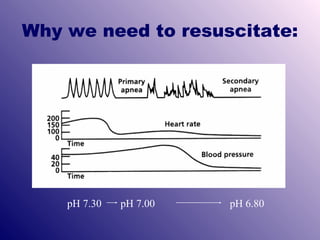
Why we need to resuscitate:

pH 7.30

pH 7.00

pH 6.80
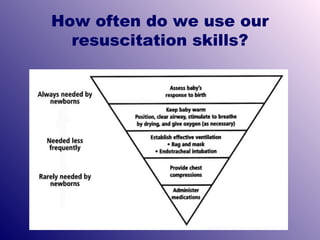
How often do we use our
resuscitation skills?
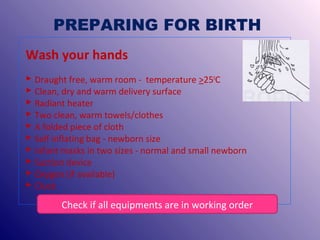
PREPARING FOR BIRTH
Wash your hands
 Draught free, warm room - temperature >250C
 Clean, dry and warm delivery surface
 Radiant heater
 Two clean, warm towels/clothes
 A folded piece of cloth
 Self inflating bag - newborn size
 Infant masks in two sizes - normal and small newborn
 Suction device
 Oxygen (if available)
 Clock

Check if all equipments are in working order
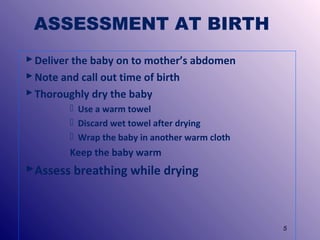
ASSESSMENT AT BIRTH
 Deliver the baby on to mother’s abdomen
 Note and call out time of birth
 Thoroughly dry the baby
 Use a warm towel
 Discard wet towel after drying
 Wrap the baby in another warm cloth

Keep the baby warm

Assess breathing while drying

5
CARE OF THE BABY AT
BIRTH
Assess breathing:
Assessment
Baby is crying

Decision

Baby is not crying, but breathing at
30 to 60 times per minute
Baby is gasping

No need for resuscitation or
suctioning;
Start skin-to-skin contact and
breastfeeding
No need for resuscitation or
suctioning
Start resuscitation immediately

Baby is not breathing

Start resuscitation immediately

H- 6
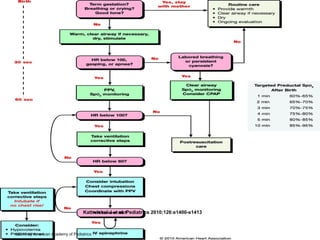
Newborn Resuscitation Algorithm.

Kattwinkel J et al. Pediatrics 2010;126:e1400-e1413

©2010 by American Academy of Pediatrics
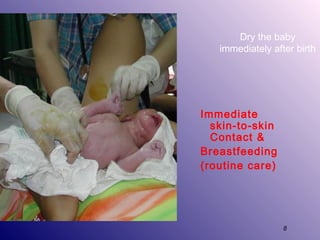
Dry the baby
immediately after birth

Immediate
skin-to-skin
Contact &
Breastfeeding
(routine care)

8
Steps of resuscitation
If the baby is not breathing or gasping
◦ Call for help!
◦ Cut cord quickly, transfer to a firm, warm surface
[under a radiant heater]
◦ Inform the mother that baby has difficulty breathing
and you will help the baby to breathe
◦ Start newborn resuscitation

9
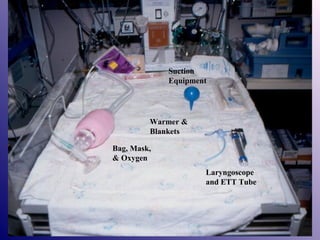
Suction
Equipment

Warmer &
Blankets
Bag, Mask,
& Oxygen
Laryngoscope
and ETT Tube
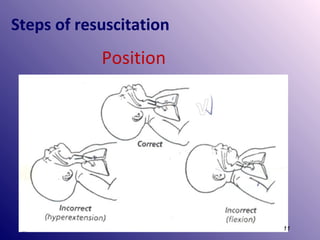
Steps of resuscitation

Position

11
Steps of resuscitation
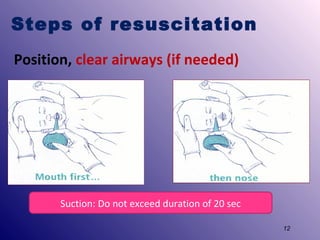
Position, clear airways (if needed)

Suction: Do not exceed duration of 20 sec
12
Steps of resuscitation
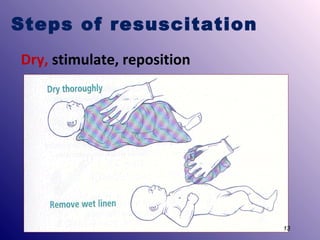
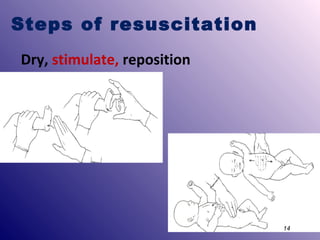
Dry, stimulate, reposition

13
Steps of resuscitation
Dry, stimulate, reposition

14
Steps of resuscitation
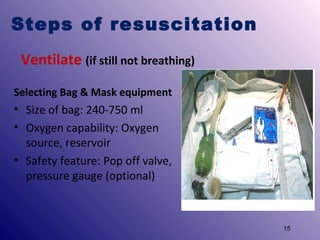
Ventilate (if still not breathing)
Selecting Bag & Mask equipment

• Size of bag: 240-750 ml
• Oxygen capability: Oxygen
source, reservoir
• Safety feature: Pop off valve,
pressure gauge (optional)

15
Steps of resuscitation
Ventilate
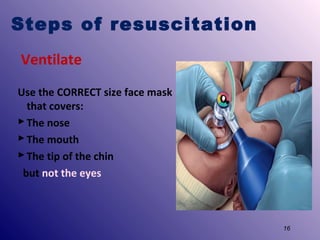
Use the CORRECT size face mask
that covers:
 The nose
 The mouth
 The tip of the chin
but not the eyes

16
Steps of resuscitation
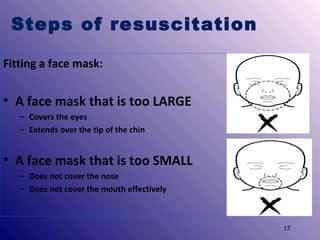
Fitting a face mask:

• A face mask that is too LARGE
– Covers the eyes
– Extends over the tip of the chin

• A face mask that is too SMALL
– Does not cover the nose
– Does not cover the mouth effectively

17
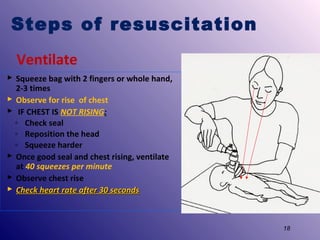
Steps of resuscitation
Ventilate
 Squeeze bag with 2 fingers or whole hand,
2-3 times
 Observe for rise of chest
 IF CHEST IS NOT RISING:
◦ Check seal
◦ Reposition the head
◦ Squeeze harder
 Once good seal and chest rising, ventilate
at 40 squeezes per minute
 Observe chest rise
 Check heart rate after 30 seconds

18
Steps of resuscitation
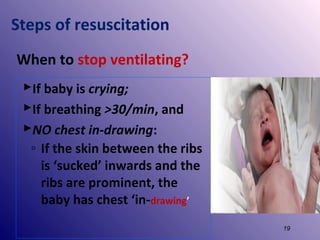
When to stop ventilating?
If baby is crying;
If breathing >30/min, and
NO chest in-drawing:
◦ If the skin between the ribs
is ‘sucked’ inwards and the
ribs are prominent, the
baby has chest ‘in-drawing’
19
Steps of resuscitation
After stopping ventilation
 Put the baby in skin-to-skin contact on mother’s
chest
 Monitor every 15 minutes for breathing and
warmth
 Tell the mother the baby will probably be well
 Encourage the mother to start breastfeeding as
soon as possible
NEVER leave the baby alone

20
Steps of resuscitation
When to continue ventilating?
If the baby
– is breathing at a rate of <30/min,
– is gasping
– has severe chest in-drawing
• Arrange for immediate referral

21
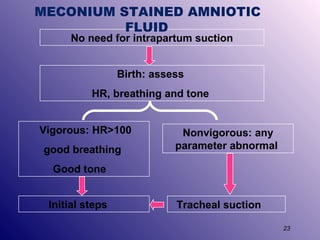
MECONIUM STAINED AMNIOTIC
FLUID
No need for intrapartum suction
Birth: assess
HR, breathing and tone
Vigorous: HR>100
good breathing

Nonvigorous: any
parameter abnormal

Good tone
Initial steps

Tracheal suction
23
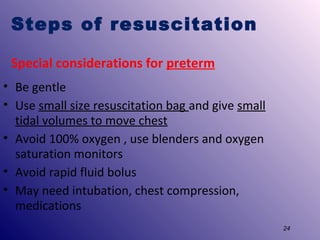
Steps of resuscitation
Special considerations for preterm
• Be gentle
• Use small size resuscitation bag and give small
tidal volumes to move chest
• Avoid 100% oxygen , use blenders and oxygen
saturation monitors
• Avoid rapid fluid bolus
• May need intubation, chest compression,
medications
24
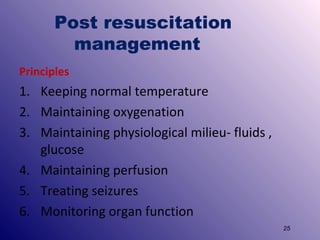
Post resuscitation
management
Principles

1. Keeping normal temperature
2. Maintaining oxygenation
3. Maintaining physiological milieu- fluids ,
glucose
4. Maintaining perfusion
5. Treating seizures
6. Monitoring organ function
25
Care after resuscitation
•
•
•
•
•

Place baby in skin-to-skin contact with mother
Keep the baby warm
Monitor every 15 minutes
Start breastfeeding as soon as possible
Discuss what has happened with the parents be positive!
• Do not separate the mother and baby unless
the baby has difficult breathing
26

Resuscitation enc-3

  • 1.
  • 2.
    Why we needto resuscitate: pH 7.30 pH 7.00 pH 6.80
  • 3.
    How often dowe use our resuscitation skills?
  • 4.
    PREPARING FOR BIRTH Washyour hands  Draught free, warm room - temperature >250C  Clean, dry and warm delivery surface  Radiant heater  Two clean, warm towels/clothes  A folded piece of cloth  Self inflating bag - newborn size  Infant masks in two sizes - normal and small newborn  Suction device  Oxygen (if available)  Clock Check if all equipments are in working order
  • 5.
    ASSESSMENT AT BIRTH Deliver the baby on to mother’s abdomen  Note and call out time of birth  Thoroughly dry the baby  Use a warm towel  Discard wet towel after drying  Wrap the baby in another warm cloth Keep the baby warm Assess breathing while drying 5
  • 6.
    CARE OF THEBABY AT BIRTH Assess breathing: Assessment Baby is crying Decision Baby is not crying, but breathing at 30 to 60 times per minute Baby is gasping No need for resuscitation or suctioning; Start skin-to-skin contact and breastfeeding No need for resuscitation or suctioning Start resuscitation immediately Baby is not breathing Start resuscitation immediately H- 6
  • 7.
    Newborn Resuscitation Algorithm. KattwinkelJ et al. Pediatrics 2010;126:e1400-e1413 ©2010 by American Academy of Pediatrics
  • 8.
    Dry the baby immediatelyafter birth Immediate skin-to-skin Contact & Breastfeeding (routine care) 8
  • 9.
    Steps of resuscitation Ifthe baby is not breathing or gasping ◦ Call for help! ◦ Cut cord quickly, transfer to a firm, warm surface [under a radiant heater] ◦ Inform the mother that baby has difficulty breathing and you will help the baby to breathe ◦ Start newborn resuscitation 9
  • 10.
    Suction Equipment Warmer & Blankets Bag, Mask, &Oxygen Laryngoscope and ETT Tube
  • 11.
  • 12.
    Steps of resuscitation Position,clear airways (if needed) Suction: Do not exceed duration of 20 sec 12
  • 13.
    Steps of resuscitation Dry,stimulate, reposition 13
  • 14.
    Steps of resuscitation Dry,stimulate, reposition 14
  • 15.
    Steps of resuscitation Ventilate(if still not breathing) Selecting Bag & Mask equipment • Size of bag: 240-750 ml • Oxygen capability: Oxygen source, reservoir • Safety feature: Pop off valve, pressure gauge (optional) 15
  • 16.
    Steps of resuscitation Ventilate Usethe CORRECT size face mask that covers:  The nose  The mouth  The tip of the chin but not the eyes 16
  • 17.
    Steps of resuscitation Fittinga face mask: • A face mask that is too LARGE – Covers the eyes – Extends over the tip of the chin • A face mask that is too SMALL – Does not cover the nose – Does not cover the mouth effectively 17
  • 18.
    Steps of resuscitation Ventilate Squeeze bag with 2 fingers or whole hand, 2-3 times  Observe for rise of chest  IF CHEST IS NOT RISING: ◦ Check seal ◦ Reposition the head ◦ Squeeze harder  Once good seal and chest rising, ventilate at 40 squeezes per minute  Observe chest rise  Check heart rate after 30 seconds 18
  • 19.
    Steps of resuscitation Whento stop ventilating? If baby is crying; If breathing >30/min, and NO chest in-drawing: ◦ If the skin between the ribs is ‘sucked’ inwards and the ribs are prominent, the baby has chest ‘in-drawing’ 19
  • 20.
    Steps of resuscitation Afterstopping ventilation  Put the baby in skin-to-skin contact on mother’s chest  Monitor every 15 minutes for breathing and warmth  Tell the mother the baby will probably be well  Encourage the mother to start breastfeeding as soon as possible NEVER leave the baby alone 20
  • 21.
    Steps of resuscitation Whento continue ventilating? If the baby – is breathing at a rate of <30/min, – is gasping – has severe chest in-drawing • Arrange for immediate referral 21
  • 23.
    MECONIUM STAINED AMNIOTIC FLUID Noneed for intrapartum suction Birth: assess HR, breathing and tone Vigorous: HR>100 good breathing Nonvigorous: any parameter abnormal Good tone Initial steps Tracheal suction 23
  • 24.
    Steps of resuscitation Specialconsiderations for preterm • Be gentle • Use small size resuscitation bag and give small tidal volumes to move chest • Avoid 100% oxygen , use blenders and oxygen saturation monitors • Avoid rapid fluid bolus • May need intubation, chest compression, medications 24
  • 25.
    Post resuscitation management Principles 1. Keepingnormal temperature 2. Maintaining oxygenation 3. Maintaining physiological milieu- fluids , glucose 4. Maintaining perfusion 5. Treating seizures 6. Monitoring organ function 25
  • 26.
    Care after resuscitation • • • • • Placebaby in skin-to-skin contact with mother Keep the baby warm Monitor every 15 minutes Start breastfeeding as soon as possible Discuss what has happened with the parents be positive! • Do not separate the mother and baby unless the baby has difficult breathing 26

Editor's Notes

  • #8 Newborn Resuscitation Algorithm.