HEART BLOCK
Presented By - NITESH RAWAT
TABLE OF CONTENTS
What is Heart Block?
Normal Cardiac Conduction Review
Causes and Risk Factors
Types of Heart Block:
First-Degree AV Block
Second-Degree AV Block (Mobitz Type I & II)
Third-Degree (Complete) AV Block
Symptoms
Diagnosis
Management & Treatment
Complications
INTRODUCTION
Definition: Heart block (or atrioventricular (AV)
block) is a condition where the electrical signals
that tell your heart to beat are either delayed or
completely blocked from reaching the ventricles.
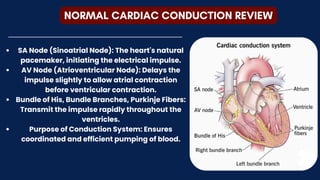
NORMAL CARDIAC CONDUCTION REVIEW
SA Node (Sinoatrial Node): The heart's natural
pacemaker, initiating the electrical impulse.
AV Node (Atrioventricular Node): Delays the
impulse slightly to allow atrial contraction
before ventricular contraction.
Bundle of His, Bundle Branches, Purkinje Fibers:
Transmit the impulse rapidly throughout the
ventricles.
Purpose of Conduction System: Ensures
coordinated and efficient pumping of blood.
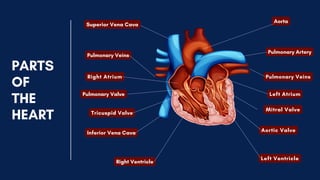
PARTS
OF
THE
HEART
Pulmonary Veins
Right Atrium
Tricuspid Valve
Right Ventricle
Inferior Vena Cava
Left Ventricle
Pulmonary Veins
Pulmonary Artery
Aorta
Left Atrium
Superior Vena Cava
Mitral Valve
Pulmonary Valve
Aortic Valve
The heart wall is composed of three layers:
Epicardium: The outer protective layer.
Myocardium: The muscular middle layer responsible
for contraction.
Endocardium: The inner lining that contacts the
blood.
The Septum: The septum is a muscular wall that
divides the heart into left and right sides, preventing
the mixing of oxygen-rich and oxygen-poor blood.
WALLS OF THE HEART
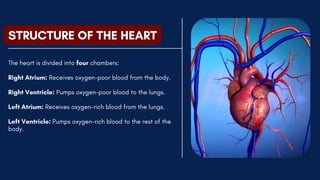
STRUCTURE OF THE HEART
The heart is divided into four chambers:
Right Atrium: Receives oxygen-poor blood from the body.
Right Ventricle: Pumps oxygen-poor blood to the lungs.
Left Atrium: Receives oxygen-rich blood from the lungs.
Left Ventricle: Pumps oxygen-rich blood to the rest of the
body.
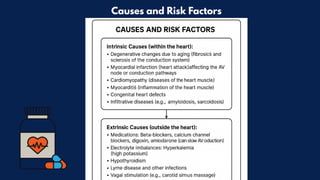
Causes and Risk Factors
Types of Heart Block -
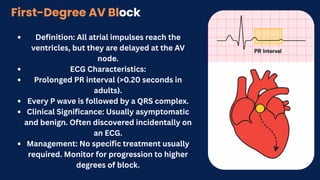
Definition: All atrial impulses reach the
ventricles, but they are delayed at the AV
node.
ECG Characteristics:
Prolonged PR interval (>0.20 seconds in
adults).
Every P wave is followed by a QRS complex.
Clinical Significance: Usually asymptomatic
and benign. Often discovered incidentally on
an ECG.
Management: No specific treatment usually
required. Monitor for progression to higher
degrees of block.
First-Degree AV Block
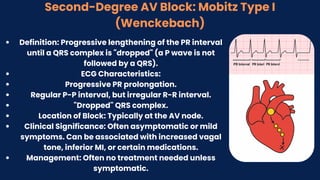
Second-Degree AV Block: Mobitz Type I
(Wenckebach)
Definition: Progressive lengthening of the PR interval
until a QRS complex is "dropped" (a P wave is not
followed by a QRS).
ECG Characteristics:
Progressive PR prolongation.
Regular P-P interval, but irregular R-R interval.
"Dropped" QRS complex.
Location of Block: Typically at the AV node.
Clinical Significance: Often asymptomatic or mild
symptoms. Can be associated with increased vagal
tone, inferior MI, or certain medications.
Management: Often no treatment needed unless
symptomatic.
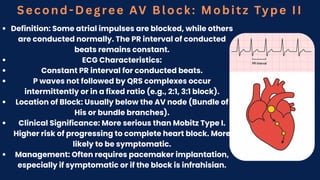
Second-Degree AV Block: Mobitz Type II
Definition: Some atrial impulses are blocked, while others
are conducted normally. The PR interval of conducted
beats remains constant.
ECG Characteristics:
Constant PR interval for conducted beats.
P waves not followed by QRS complexes occur
intermittently or in a fixed ratio (e.g., 2:1, 3:1 block).
Location of Block: Usually below the AV node (Bundle of
His or bundle branches).
Clinical Significance: More serious than Mobitz Type I.
Higher risk of progressing to complete heart block. More
likely to be symptomatic.
Management: Often requires pacemaker implantation,
especially if symptomatic or if the block is infrahisian.
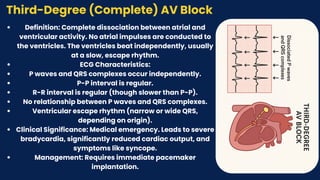
Third-Degree (Complete) AV Block
Definition: Complete dissociation between atrial and
ventricular activity. No atrial impulses are conducted to
the ventricles. The ventricles beat independently, usually
at a slow, escape rhythm.
ECG Characteristics:
P waves and QRS complexes occur independently.
P-P interval is regular.
R-R interval is regular (though slower than P-P).
No relationship between P waves and QRS complexes.
Ventricular escape rhythm (narrow or wide QRS,
depending on origin).
Clinical Significance: Medical emergency. Leads to severe
bradycardia, significantly reduced cardiac output, and
symptoms like syncope.
Management: Requires immediate pacemaker
implantation.
Symptoms of Heart Block
Often depend on the degree of block and heart
rate.
Mild/Asymptomatic (First-degree, some Mobitz
I): May have no noticeable symptoms.
Moderate/Severe Symptoms (Mobitz II, Third-
degree):
Fatigue
Dizziness or lightheadedness
Syncope (fainting) or near-syncope
Shortness of breath, especially with exertion
Chest pain (angina)
Palpitations (awareness of slow heart beat)
Confusion
Diagnosis
Medical History & Physical Examination: Assessing
symptoms, medical conditions, and medications.
Electrocardiogram (ECG/EKG): The primary diagnostic
tool. Reveals the specific type and degree of heart block.
Holter Monitor (Ambulatory ECG): 24-48 hour continuous
ECG recording to capture intermittent blocks.
Event Monitor: Worn for weeks or months to record rare,
symptomatic events.
Electrophysiology (EP) Study: Invasive procedure to
pinpoint the exact location and mechanism of the block,
especially in complex cases.
Blood Tests: To check for underlying causes (e.g.,
electrolytes, thyroid function, Lyme titers).
Management & Treatment
Observation: For asymptomatic First-Degree and some
Mobitz Type I blocks.
Medication Review: Discontinue or adjust medications that
might be contributing to the block (e.g., beta-blockers,
calcium channel blockers).
Treating Underlying Causes: Address any reversible
conditions like electrolyte imbalances, hypothyroidism, or
infections.
Pacemaker Implantation:
Temporary Pacemaker: Used in acute situations (e.g.,
immediately after an MI with symptomatic block).
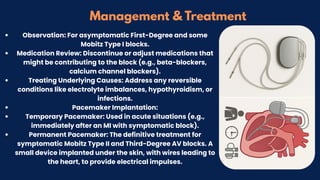
Permanent Pacemaker: The definitive treatment for
symptomatic Mobitz Type II and Third-Degree AV blocks. A
small device implanted under the skin, with wires leading to
the heart, to provide electrical impulses.
Progression to higher degrees of heart
block (e.g., Mobitz I to Mobitz II or Third-
degree).
Cardiac arrest (in severe cases of
third-degree block).
Heart failure due to prolonged
bradycardia and inadequate cardiac
output.
Falls and injuries due to syncope.
Reduced quality of life due to chronic
fatigue and other symptoms.
Complications
The heart block presentation simple  .pdf

The heart block presentation simple .pdf

  • 1.
  • 2.
    TABLE OF CONTENTS Whatis Heart Block? Normal Cardiac Conduction Review Causes and Risk Factors Types of Heart Block: First-Degree AV Block Second-Degree AV Block (Mobitz Type I & II) Third-Degree (Complete) AV Block Symptoms Diagnosis Management & Treatment Complications
  • 3.
    INTRODUCTION Definition: Heart block(or atrioventricular (AV) block) is a condition where the electrical signals that tell your heart to beat are either delayed or completely blocked from reaching the ventricles.
  • 4.
    NORMAL CARDIAC CONDUCTIONREVIEW SA Node (Sinoatrial Node): The heart's natural pacemaker, initiating the electrical impulse. AV Node (Atrioventricular Node): Delays the impulse slightly to allow atrial contraction before ventricular contraction. Bundle of His, Bundle Branches, Purkinje Fibers: Transmit the impulse rapidly throughout the ventricles. Purpose of Conduction System: Ensures coordinated and efficient pumping of blood.
  • 5.
    PARTS OF THE HEART Pulmonary Veins Right Atrium TricuspidValve Right Ventricle Inferior Vena Cava Left Ventricle Pulmonary Veins Pulmonary Artery Aorta Left Atrium Superior Vena Cava Mitral Valve Pulmonary Valve Aortic Valve
  • 6.
    The heart wallis composed of three layers: Epicardium: The outer protective layer. Myocardium: The muscular middle layer responsible for contraction. Endocardium: The inner lining that contacts the blood. The Septum: The septum is a muscular wall that divides the heart into left and right sides, preventing the mixing of oxygen-rich and oxygen-poor blood. WALLS OF THE HEART
  • 7.
    STRUCTURE OF THEHEART The heart is divided into four chambers: Right Atrium: Receives oxygen-poor blood from the body. Right Ventricle: Pumps oxygen-poor blood to the lungs. Left Atrium: Receives oxygen-rich blood from the lungs. Left Ventricle: Pumps oxygen-rich blood to the rest of the body.
  • 8.
  • 9.
  • 10.
    Definition: All atrialimpulses reach the ventricles, but they are delayed at the AV node. ECG Characteristics: Prolonged PR interval (>0.20 seconds in adults). Every P wave is followed by a QRS complex. Clinical Significance: Usually asymptomatic and benign. Often discovered incidentally on an ECG. Management: No specific treatment usually required. Monitor for progression to higher degrees of block. First-Degree AV Block
  • 11.
    Second-Degree AV Block:Mobitz Type I (Wenckebach) Definition: Progressive lengthening of the PR interval until a QRS complex is "dropped" (a P wave is not followed by a QRS). ECG Characteristics: Progressive PR prolongation. Regular P-P interval, but irregular R-R interval. "Dropped" QRS complex. Location of Block: Typically at the AV node. Clinical Significance: Often asymptomatic or mild symptoms. Can be associated with increased vagal tone, inferior MI, or certain medications. Management: Often no treatment needed unless symptomatic.
  • 12.
    Second-Degree AV Block:Mobitz Type II Definition: Some atrial impulses are blocked, while others are conducted normally. The PR interval of conducted beats remains constant. ECG Characteristics: Constant PR interval for conducted beats. P waves not followed by QRS complexes occur intermittently or in a fixed ratio (e.g., 2:1, 3:1 block). Location of Block: Usually below the AV node (Bundle of His or bundle branches). Clinical Significance: More serious than Mobitz Type I. Higher risk of progressing to complete heart block. More likely to be symptomatic. Management: Often requires pacemaker implantation, especially if symptomatic or if the block is infrahisian.
  • 13.
    Third-Degree (Complete) AVBlock Definition: Complete dissociation between atrial and ventricular activity. No atrial impulses are conducted to the ventricles. The ventricles beat independently, usually at a slow, escape rhythm. ECG Characteristics: P waves and QRS complexes occur independently. P-P interval is regular. R-R interval is regular (though slower than P-P). No relationship between P waves and QRS complexes. Ventricular escape rhythm (narrow or wide QRS, depending on origin). Clinical Significance: Medical emergency. Leads to severe bradycardia, significantly reduced cardiac output, and symptoms like syncope. Management: Requires immediate pacemaker implantation.
  • 14.
    Symptoms of HeartBlock Often depend on the degree of block and heart rate. Mild/Asymptomatic (First-degree, some Mobitz I): May have no noticeable symptoms. Moderate/Severe Symptoms (Mobitz II, Third- degree): Fatigue Dizziness or lightheadedness Syncope (fainting) or near-syncope Shortness of breath, especially with exertion Chest pain (angina) Palpitations (awareness of slow heart beat) Confusion
  • 15.
    Diagnosis Medical History &Physical Examination: Assessing symptoms, medical conditions, and medications. Electrocardiogram (ECG/EKG): The primary diagnostic tool. Reveals the specific type and degree of heart block. Holter Monitor (Ambulatory ECG): 24-48 hour continuous ECG recording to capture intermittent blocks. Event Monitor: Worn for weeks or months to record rare, symptomatic events. Electrophysiology (EP) Study: Invasive procedure to pinpoint the exact location and mechanism of the block, especially in complex cases. Blood Tests: To check for underlying causes (e.g., electrolytes, thyroid function, Lyme titers).
  • 16.
    Management & Treatment Observation:For asymptomatic First-Degree and some Mobitz Type I blocks. Medication Review: Discontinue or adjust medications that might be contributing to the block (e.g., beta-blockers, calcium channel blockers). Treating Underlying Causes: Address any reversible conditions like electrolyte imbalances, hypothyroidism, or infections. Pacemaker Implantation: Temporary Pacemaker: Used in acute situations (e.g., immediately after an MI with symptomatic block). Permanent Pacemaker: The definitive treatment for symptomatic Mobitz Type II and Third-Degree AV blocks. A small device implanted under the skin, with wires leading to the heart, to provide electrical impulses.
  • 17.
    Progression to higherdegrees of heart block (e.g., Mobitz I to Mobitz II or Third- degree). Cardiac arrest (in severe cases of third-degree block). Heart failure due to prolonged bradycardia and inadequate cardiac output. Falls and injuries due to syncope. Reduced quality of life due to chronic fatigue and other symptoms. Complications