Rheumatic Heart Disease Submitted by: Calvento, Jamie Lyn G.  A315(JRU)
 
I. Identification A systemic inflammatory disease of childhood, acute rheumatic fever develops after infection of the upper respiratory tract with Group A Beta- Hemolytic streptococci.
Rheumatic fever principally involves the heart, joints, CNS (Central Nervous System), skin, subcutaneous tissues.  The term Rheumatic heart disease refers to the cardiac involvement develops to 50% of patients and may affect the endocardium, myocardium or pericardium. It may later affect the heart valves, causing chronic valvular disease. The extent of  damage to the heart depends on where the disorder strikes.
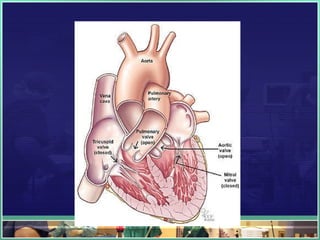
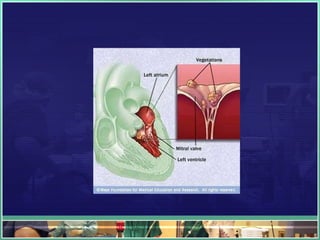
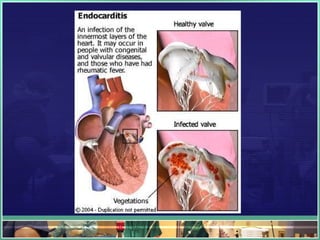
Endocarditis Causes valve leaflet, swelling, erosion along the lines of leaflet closure and blood, platelet and fibrin deposits, which form beadlike vegetation.
 
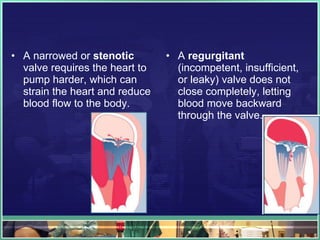
A narrowed or  stenotic  valve requires the heart to pump harder, which can strain the heart and reduce blood flow to the body.  A  regurgitant  (incompetent, insufficient, or leaky) valve does not close completely, letting blood move backward through the valve.
II. Causative Factors GABS (Group A Beta- Hemolytic Streptococci) Rheumatic fever
III. Risk Factors 5-15 years old Family history of RF Low socioeconomic status (poverty, poor hygiene, medical deprivation) Untreated  strepthroat
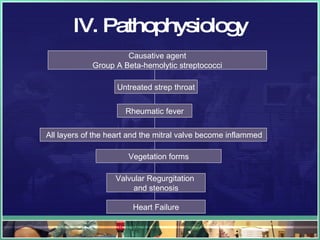
IV. Pathophysiology Causative agent Group A Beta-hemolytic streptococci Untreated strep throat Rheumatic fever All layers of the heart and the mitral valve become inflammed Vegetation forms Valvular Regurgitation  and stenosis Heart Failure
 
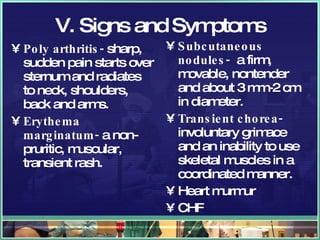
V. Signs and Symptoms Poly arthritis-  sharp, sudden pain starts over sternum and radiates to neck, shoulders, back and arms. Erythema marginatum-  a non- pruritic, muscular, transient rash.  Subcutaneous nodules-   a firm, movable, nontender and about 3 mm-2 cm in diameter. Transient chorea-  involuntary grimace and an inability to use skeletal muscles in a coordinated manner. Heart murmur CHF
VI. Laboratory and Diagnostic Test There is  no   diagnostic studies are   specific  for rheumatic heart disease, but the following can support the diagnosis:
WBC count and ESR is elevated C- reactive protein is positive. Cardiac enzmes levels may increase in severe carditis. Anti streptolysin- O titser is elevated 95% of patients with in 2 months onset. Throat cultures continue to presence of GABS; however they usually occur in small numbers. Isolating them is difficult. ECG reveals no diagnostic changes, but 20% of patient show a prolonged PR interval.
Echocardiography helps evaluate valvular damage, chamber size, ventricular function and the presence of a pericardial effusion. Cardiac catheter evaluates valvular damage and left ventricular function in severe cardiac dysfunction.
Nursing Diagnosis Acute Pain related to migratory inflammation of the joints. Activity Intolerance related to joint pain. Hyperthermia related to inflammatory process
Nursing Intervention Acute Pain related to  migratory inflammation of the joints. -Provide adequate rest periods.  To prevent fatigue. - Suggest parent be present   during procedures . To comfort child Activity Intolerance related to joint pain. Check vital signs before and immediately after activity   Orthostatic hypotension can occur with activity because of compromised cardiac pumping function.
Hyperthermia related to inflammatory process Administer medication as indicated,  to treat the underlying cause , such as antibiotics  (for infection). Provide supplemental oxygen  to offset increased oxygen demand. Administer replacement fluids and electrolytes  to support circulating volume and tissue perfusion.
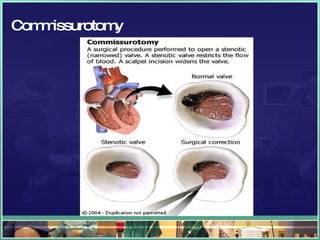
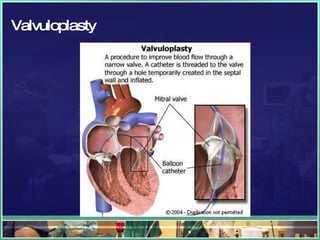
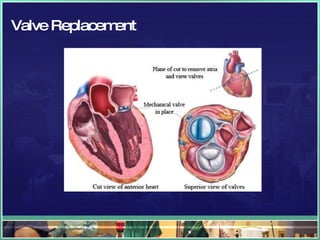
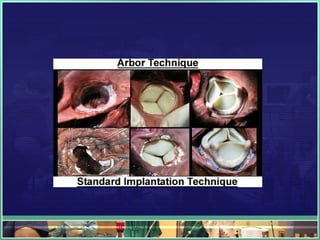
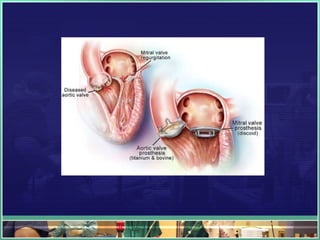
Treatment Severe mitral or aortic valve dysfunction that causes persistent heart failure requires corrective surgery such as: Commissurotomy Valvuloplasty Valve replacement
Commissurotomy
Valvuloplasty
Valve Replacement


Rheumatic Heart Disease

  • 1.
    Rheumatic Heart DiseaseSubmitted by: Calvento, Jamie Lyn G. A315(JRU)
  • 2.
  • 3.
    I. Identification Asystemic inflammatory disease of childhood, acute rheumatic fever develops after infection of the upper respiratory tract with Group A Beta- Hemolytic streptococci.
  • 4.
    Rheumatic fever principallyinvolves the heart, joints, CNS (Central Nervous System), skin, subcutaneous tissues. The term Rheumatic heart disease refers to the cardiac involvement develops to 50% of patients and may affect the endocardium, myocardium or pericardium. It may later affect the heart valves, causing chronic valvular disease. The extent of damage to the heart depends on where the disorder strikes.
  • 5.
    Endocarditis Causes valveleaflet, swelling, erosion along the lines of leaflet closure and blood, platelet and fibrin deposits, which form beadlike vegetation.
  • 6.
  • 7.
    A narrowed or stenotic valve requires the heart to pump harder, which can strain the heart and reduce blood flow to the body. A regurgitant (incompetent, insufficient, or leaky) valve does not close completely, letting blood move backward through the valve.
  • 8.
    II. Causative FactorsGABS (Group A Beta- Hemolytic Streptococci) Rheumatic fever
  • 9.
    III. Risk Factors5-15 years old Family history of RF Low socioeconomic status (poverty, poor hygiene, medical deprivation) Untreated strepthroat
  • 10.
    IV. Pathophysiology Causativeagent Group A Beta-hemolytic streptococci Untreated strep throat Rheumatic fever All layers of the heart and the mitral valve become inflammed Vegetation forms Valvular Regurgitation and stenosis Heart Failure
  • 11.
  • 12.
    V. Signs andSymptoms Poly arthritis- sharp, sudden pain starts over sternum and radiates to neck, shoulders, back and arms. Erythema marginatum- a non- pruritic, muscular, transient rash. Subcutaneous nodules- a firm, movable, nontender and about 3 mm-2 cm in diameter. Transient chorea- involuntary grimace and an inability to use skeletal muscles in a coordinated manner. Heart murmur CHF
  • 13.
    VI. Laboratory andDiagnostic Test There is no diagnostic studies are specific for rheumatic heart disease, but the following can support the diagnosis:
  • 14.
    WBC count andESR is elevated C- reactive protein is positive. Cardiac enzmes levels may increase in severe carditis. Anti streptolysin- O titser is elevated 95% of patients with in 2 months onset. Throat cultures continue to presence of GABS; however they usually occur in small numbers. Isolating them is difficult. ECG reveals no diagnostic changes, but 20% of patient show a prolonged PR interval.
  • 15.
    Echocardiography helps evaluatevalvular damage, chamber size, ventricular function and the presence of a pericardial effusion. Cardiac catheter evaluates valvular damage and left ventricular function in severe cardiac dysfunction.
  • 16.
    Nursing Diagnosis AcutePain related to migratory inflammation of the joints. Activity Intolerance related to joint pain. Hyperthermia related to inflammatory process
  • 17.
    Nursing Intervention AcutePain related to migratory inflammation of the joints. -Provide adequate rest periods. To prevent fatigue. - Suggest parent be present during procedures . To comfort child Activity Intolerance related to joint pain. Check vital signs before and immediately after activity Orthostatic hypotension can occur with activity because of compromised cardiac pumping function.
  • 18.
    Hyperthermia related toinflammatory process Administer medication as indicated, to treat the underlying cause , such as antibiotics (for infection). Provide supplemental oxygen to offset increased oxygen demand. Administer replacement fluids and electrolytes to support circulating volume and tissue perfusion.
  • 19.
    Treatment Severe mitralor aortic valve dysfunction that causes persistent heart failure requires corrective surgery such as: Commissurotomy Valvuloplasty Valve replacement
  • 20.
  • 21.
  • 22.
  • 23.
  • 24.