SECTION 12-2
SURFACE AREAS OF PRISMS AND
CYLINDERS
ESSENTIAL QUESTIONS
• How do you find lateral areas and
surface areas of prisms?
• How do you find lateral areas and
surface areas of cylinders?
VOCABULARY
1. Lateral Face:
2. Lateral Edge:
3. Base Edge:
4. Altitude:
VOCABULARY
1. Lateral Face:
2. Lateral Edge:
3. Base Edge:
4. Altitude:
The surfaces of a polyhedron
that are not bases
VOCABULARY
1. Lateral Face:
2. Lateral Edge:
3. Base Edge:
4. Altitude:
The surfaces of a polyhedron
that are not bases
Formed where the lateral
faces intersect
VOCABULARY
1. Lateral Face:
2. Lateral Edge:
3. Base Edge:
4. Altitude:
The surfaces of a polyhedron
that are not bases
Formed where the lateral
faces intersect
Formed where the lateral faces
intersect the base(s)
VOCABULARY
1. Lateral Face:
2. Lateral Edge:
3. Base Edge:
4. Altitude:
The surfaces of a polyhedron
that are not bases
Formed where the lateral
faces intersect
Formed where the lateral faces
intersect the base(s)
The perpendicular segment that
joins the bases of a prism/cylinder
VOCABULARY
5. Height:
6: Lateral Area:
7. Axis:
VOCABULARY
5. Height:
6: Lateral Area:
7. Axis:
Another word for the altitude of a
prism/cylinder
VOCABULARY
5. Height:
6: Lateral Area:
7. Axis:
Another word for the altitude of a
prism/cylinder
The sum of the areas of the
lateral faces
VOCABULARY
5. Height:
6: Lateral Area:
7. Axis:
Another word for the altitude of a
prism/cylinder
The sum of the areas of the
lateral faces
In a cylinder, this is the segment whose
endpoints are the centers of the circular
bases
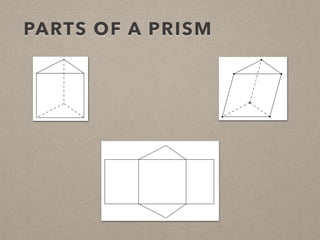
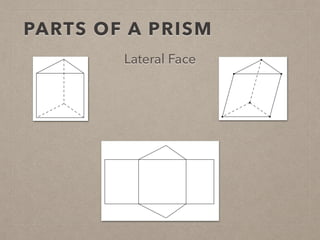
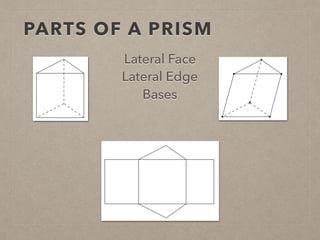
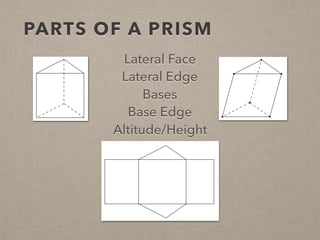
PARTS OF A PRISM
PARTS OF A PRISM
Lateral Face
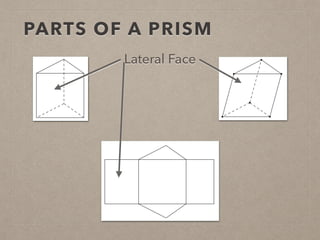
PARTS OF A PRISM
Lateral Face
PARTS OF A PRISM
Lateral Face
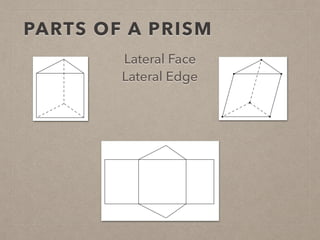
Lateral Edge
PARTS OF A PRISM
Lateral Face
Lateral Edge
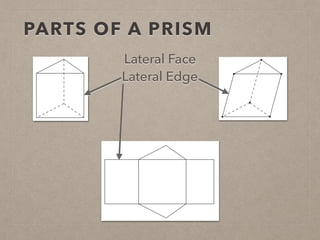
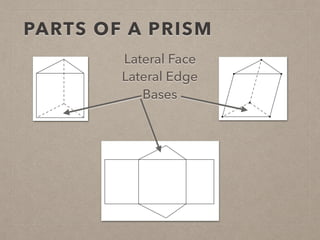
PARTS OF A PRISM
Lateral Face
Lateral Edge
Bases
PARTS OF A PRISM
Lateral Face
Lateral Edge
Bases
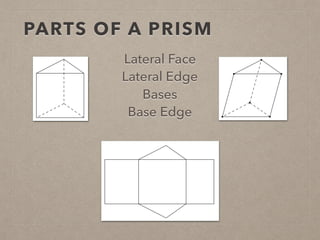
PARTS OF A PRISM
Lateral Face
Lateral Edge
Base Edge
Bases
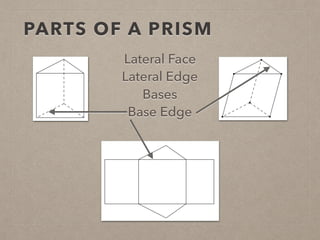
PARTS OF A PRISM
Lateral Face
Lateral Edge
Base Edge
Bases
PARTS OF A PRISM
Lateral Face
Lateral Edge
Base Edge
Altitude/Height
Bases
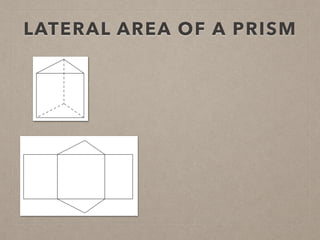
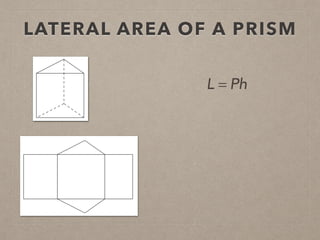
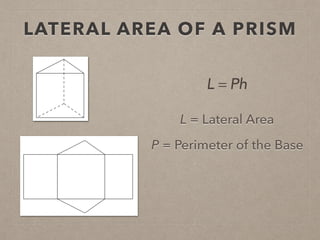
LATERAL AREA OF A PRISM
L = Ph
LATERAL AREA OF A PRISM
L = Lateral Area
L = Ph
LATERAL AREA OF A PRISM
L = Lateral Area
P = Perimeter of the Base
L = Ph
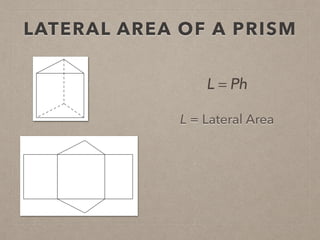
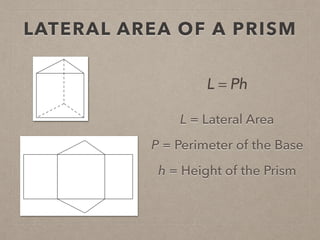
LATERAL AREA OF A PRISM
L = Lateral Area
P = Perimeter of the Base
h = Height of the Prism
L = Ph
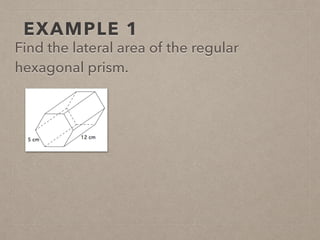
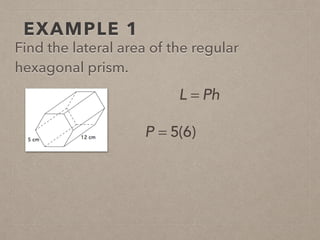
EXAMPLE 1
Find the lateral area of the regular
hexagonal prism.
EXAMPLE 1
Find the lateral area of the regular
hexagonal prism.
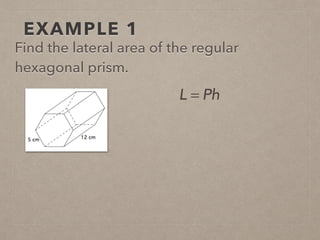
L = Ph
EXAMPLE 1
Find the lateral area of the regular
hexagonal prism.
L = Ph
P = 5(6)
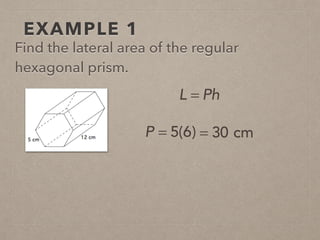
EXAMPLE 1
Find the lateral area of the regular
hexagonal prism.
L = Ph
P = 5(6) = 30 cm
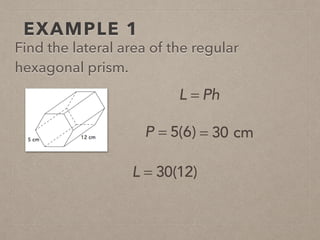
EXAMPLE 1
Find the lateral area of the regular
hexagonal prism.
L = Ph
P = 5(6) = 30 cm
L = 30(12)
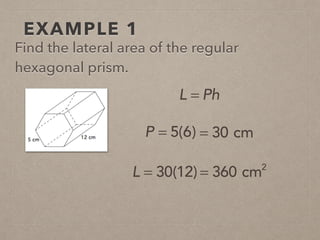
EXAMPLE 1
Find the lateral area of the regular
hexagonal prism.
L = Ph
P = 5(6) = 30 cm
L = 30(12) = 360 cm2
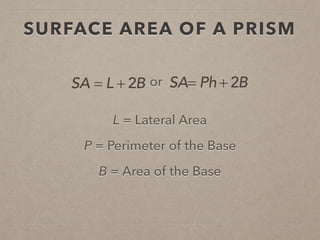
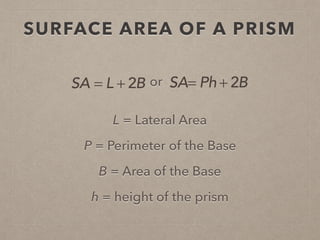
SURFACE AREA OF A PRISM
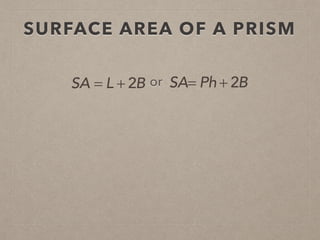
SA = L + 2B or SA= Ph + 2B
SURFACE AREA OF A PRISM
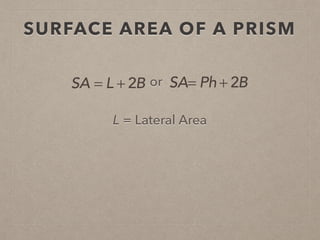
L = Lateral Area
SA = L + 2B or SA= Ph + 2B
SURFACE AREA OF A PRISM
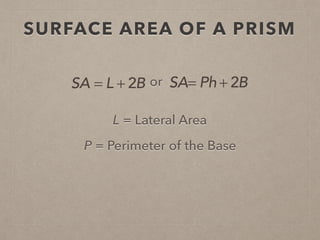
L = Lateral Area
P = Perimeter of the Base
SA = L + 2B or SA= Ph + 2B
SURFACE AREA OF A PRISM
L = Lateral Area
P = Perimeter of the Base
SA = L + 2B or SA= Ph + 2B
B = Area of the Base
SURFACE AREA OF A PRISM
L = Lateral Area
P = Perimeter of the Base
h = height of the prism
SA = L + 2B or SA= Ph + 2B
B = Area of the Base
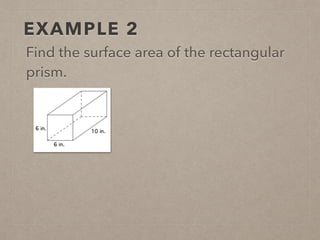
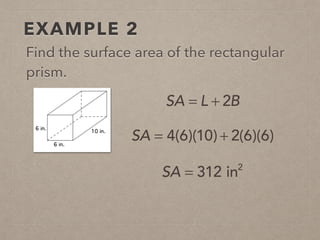
EXAMPLE 2
Find the surface area of the rectangular
prism.
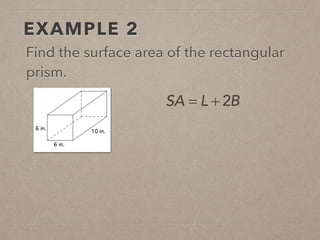
EXAMPLE 2
Find the surface area of the rectangular
prism.
SA = L + 2B
EXAMPLE 2
Find the surface area of the rectangular
prism.
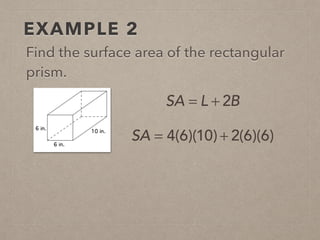
SA = 4(6)(10) + 2(6)(6)
SA = L + 2B
EXAMPLE 2
Find the surface area of the rectangular
prism.
SA = 4(6)(10) + 2(6)(6)
SA = 312 in2
SA = L + 2B
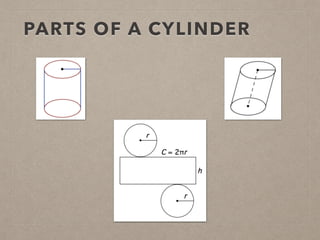
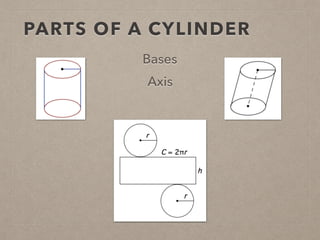
PARTS OF A CYLINDER
PARTS OF A CYLINDER
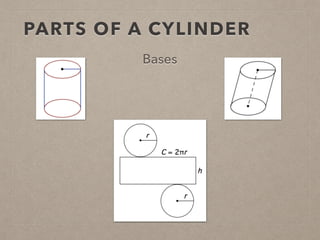
Bases
PARTS OF A CYLINDER
Bases
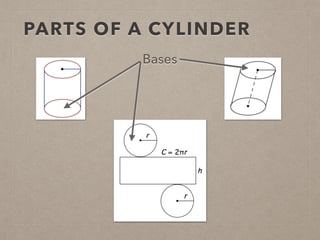
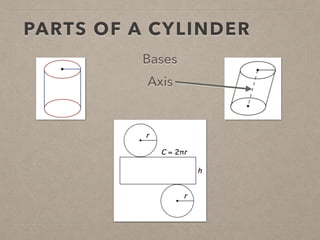
PARTS OF A CYLINDER
Bases
Axis
PARTS OF A CYLINDER
Bases
Axis
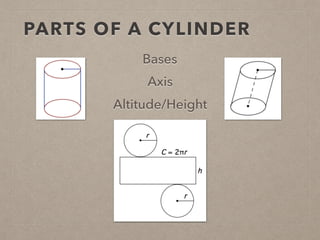
PARTS OF A CYLINDER
Bases
Axis
Altitude/Height
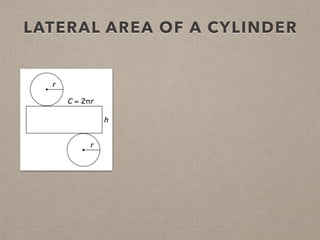
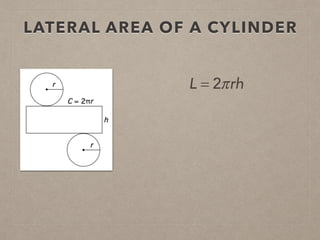
LATERAL AREA OF A CYLINDER
L = 2πrh
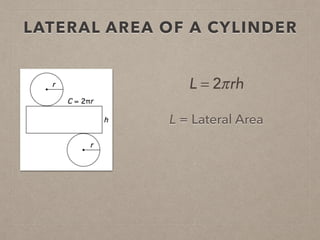
LATERAL AREA OF A CYLINDER
L = Lateral Area
L = 2πrh
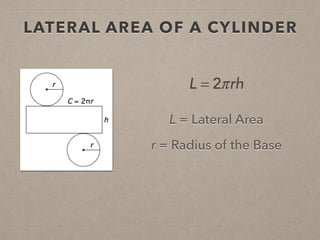
LATERAL AREA OF A CYLINDER
L = Lateral Area
r = Radius of the Base
L = 2πrh
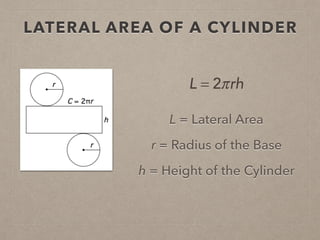
LATERAL AREA OF A CYLINDER
L = Lateral Area
r = Radius of the Base
h = Height of the Cylinder
L = 2πrh
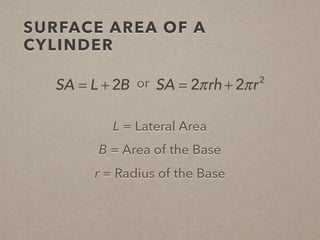
SURFACE AREA OF A
CYLINDER
SURFACE AREA OF A
CYLINDER
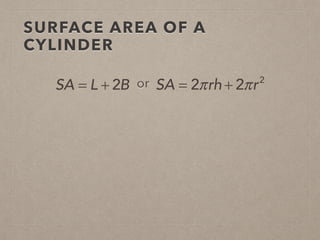
SA = L + 2B or SA = 2πrh + 2πr2
SURFACE AREA OF A
CYLINDER
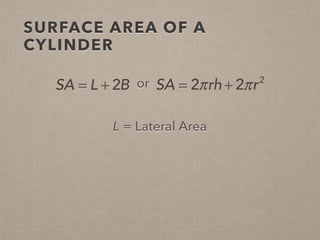
L = Lateral Area
SA = L + 2B or SA = 2πrh + 2πr2
SURFACE AREA OF A
CYLINDER
L = Lateral Area
SA = L + 2B or SA = 2πrh + 2πr2
B = Area of the Base
SURFACE AREA OF A
CYLINDER
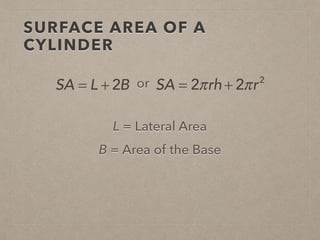
L = Lateral Area
r = Radius of the Base
SA = L + 2B or SA = 2πrh + 2πr2
B = Area of the Base
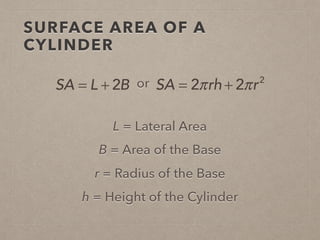
SURFACE AREA OF A
CYLINDER
L = Lateral Area
r = Radius of the Base
h = Height of the Cylinder
SA = L + 2B or SA = 2πrh + 2πr2
B = Area of the Base
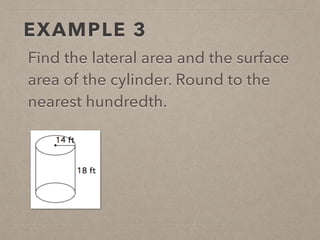
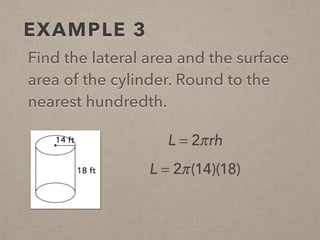
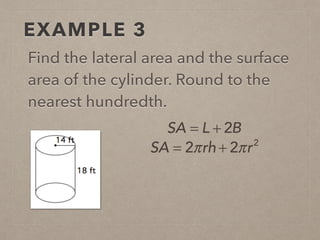
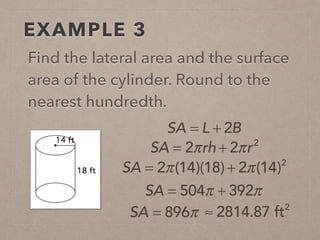
EXAMPLE 3
Find the lateral area and the surface
area of the cylinder. Round to the
nearest hundredth.
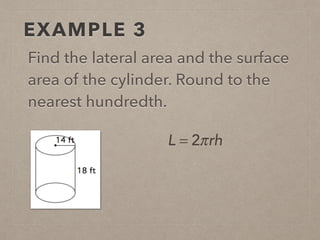
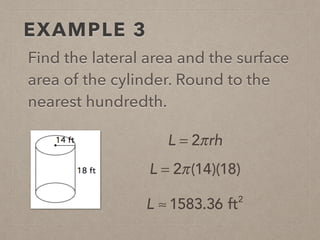
EXAMPLE 3
Find the lateral area and the surface
area of the cylinder. Round to the
nearest hundredth.
L = 2πrh
EXAMPLE 3
Find the lateral area and the surface
area of the cylinder. Round to the
nearest hundredth.
L = 2πrh
L = 2π(14)(18)
EXAMPLE 3
Find the lateral area and the surface
area of the cylinder. Round to the
nearest hundredth.
L = 2πrh
L = 2π(14)(18)
L ≈ 1583.36 ft2
EXAMPLE 3
Find the lateral area and the surface
area of the cylinder. Round to the
nearest hundredth.
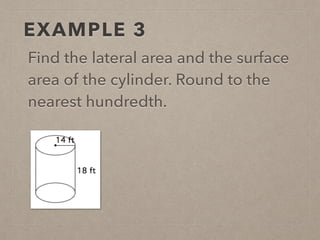
EXAMPLE 3
Find the lateral area and the surface
area of the cylinder. Round to the
nearest hundredth.
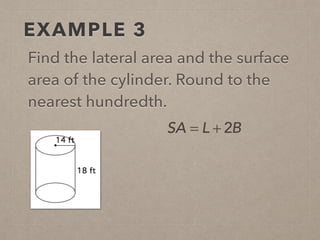
SA = L + 2B
EXAMPLE 3
Find the lateral area and the surface
area of the cylinder. Round to the
nearest hundredth.
SA = L + 2B
SA = 2πrh + 2πr2
EXAMPLE 3
Find the lateral area and the surface
area of the cylinder. Round to the
nearest hundredth.
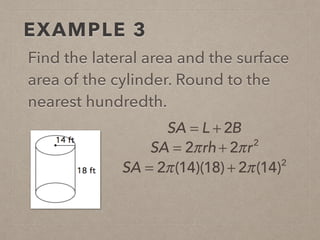
SA = L + 2B
SA = 2π(14)(18) + 2π(14)2
SA = 2πrh + 2πr2
EXAMPLE 3
Find the lateral area and the surface
area of the cylinder. Round to the
nearest hundredth.
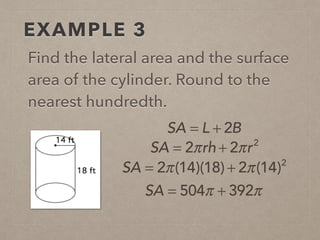
SA = L + 2B
SA = 2π(14)(18) + 2π(14)2
SA = 504π + 392π
SA = 2πrh + 2πr2
EXAMPLE 3
Find the lateral area and the surface
area of the cylinder. Round to the
nearest hundredth.
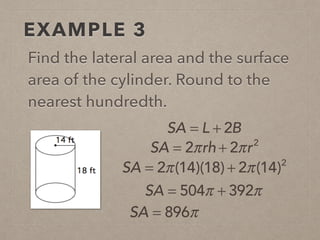
SA = L + 2B
SA = 2π(14)(18) + 2π(14)2
SA = 504π + 392π
SA = 896π
SA = 2πrh + 2πr2
EXAMPLE 3
Find the lateral area and the surface
area of the cylinder. Round to the
nearest hundredth.
SA = L + 2B
SA = 2π(14)(18) + 2π(14)2
SA = 504π + 392π
SA = 896π ≈ 2814.87 ft2
SA = 2πrh + 2πr2
PROBLEM SET
PROBLEM SET
p. 833 #1-23 odd
“No act of kindness, no matter how small, is
ever wasted.” - Aesop

Geometry Section 12-2

  • 1.
    SECTION 12-2 SURFACE AREASOF PRISMS AND CYLINDERS
  • 2.
    ESSENTIAL QUESTIONS • Howdo you find lateral areas and surface areas of prisms? • How do you find lateral areas and surface areas of cylinders?
  • 3.
    VOCABULARY 1. Lateral Face: 2.Lateral Edge: 3. Base Edge: 4. Altitude:
  • 4.
    VOCABULARY 1. Lateral Face: 2.Lateral Edge: 3. Base Edge: 4. Altitude: The surfaces of a polyhedron that are not bases
  • 5.
    VOCABULARY 1. Lateral Face: 2.Lateral Edge: 3. Base Edge: 4. Altitude: The surfaces of a polyhedron that are not bases Formed where the lateral faces intersect
  • 6.
    VOCABULARY 1. Lateral Face: 2.Lateral Edge: 3. Base Edge: 4. Altitude: The surfaces of a polyhedron that are not bases Formed where the lateral faces intersect Formed where the lateral faces intersect the base(s)
  • 7.
    VOCABULARY 1. Lateral Face: 2.Lateral Edge: 3. Base Edge: 4. Altitude: The surfaces of a polyhedron that are not bases Formed where the lateral faces intersect Formed where the lateral faces intersect the base(s) The perpendicular segment that joins the bases of a prism/cylinder
  • 8.
  • 9.
    VOCABULARY 5. Height: 6: LateralArea: 7. Axis: Another word for the altitude of a prism/cylinder
  • 10.
    VOCABULARY 5. Height: 6: LateralArea: 7. Axis: Another word for the altitude of a prism/cylinder The sum of the areas of the lateral faces
  • 11.
    VOCABULARY 5. Height: 6: LateralArea: 7. Axis: Another word for the altitude of a prism/cylinder The sum of the areas of the lateral faces In a cylinder, this is the segment whose endpoints are the centers of the circular bases
  • 12.
  • 13.
    PARTS OF APRISM Lateral Face
  • 14.
    PARTS OF APRISM Lateral Face
  • 15.
    PARTS OF APRISM Lateral Face Lateral Edge
  • 16.
    PARTS OF APRISM Lateral Face Lateral Edge
  • 17.
    PARTS OF APRISM Lateral Face Lateral Edge Bases
  • 18.
    PARTS OF APRISM Lateral Face Lateral Edge Bases
  • 19.
    PARTS OF APRISM Lateral Face Lateral Edge Base Edge Bases
  • 20.
    PARTS OF APRISM Lateral Face Lateral Edge Base Edge Bases
  • 21.
    PARTS OF APRISM Lateral Face Lateral Edge Base Edge Altitude/Height Bases
  • 22.
  • 23.
    LATERAL AREA OFA PRISM L = Ph
  • 24.
    LATERAL AREA OFA PRISM L = Lateral Area L = Ph
  • 25.
    LATERAL AREA OFA PRISM L = Lateral Area P = Perimeter of the Base L = Ph
  • 26.
    LATERAL AREA OFA PRISM L = Lateral Area P = Perimeter of the Base h = Height of the Prism L = Ph
  • 27.
    EXAMPLE 1 Find thelateral area of the regular hexagonal prism.
  • 28.
    EXAMPLE 1 Find thelateral area of the regular hexagonal prism. L = Ph
  • 29.
    EXAMPLE 1 Find thelateral area of the regular hexagonal prism. L = Ph P = 5(6)
  • 30.
    EXAMPLE 1 Find thelateral area of the regular hexagonal prism. L = Ph P = 5(6) = 30 cm
  • 31.
    EXAMPLE 1 Find thelateral area of the regular hexagonal prism. L = Ph P = 5(6) = 30 cm L = 30(12)
  • 32.
    EXAMPLE 1 Find thelateral area of the regular hexagonal prism. L = Ph P = 5(6) = 30 cm L = 30(12) = 360 cm2
  • 33.
  • 34.
    SURFACE AREA OFA PRISM SA = L + 2B or SA= Ph + 2B
  • 35.
    SURFACE AREA OFA PRISM L = Lateral Area SA = L + 2B or SA= Ph + 2B
  • 36.
    SURFACE AREA OFA PRISM L = Lateral Area P = Perimeter of the Base SA = L + 2B or SA= Ph + 2B
  • 37.
    SURFACE AREA OFA PRISM L = Lateral Area P = Perimeter of the Base SA = L + 2B or SA= Ph + 2B B = Area of the Base
  • 38.
    SURFACE AREA OFA PRISM L = Lateral Area P = Perimeter of the Base h = height of the prism SA = L + 2B or SA= Ph + 2B B = Area of the Base
  • 39.
    EXAMPLE 2 Find thesurface area of the rectangular prism.
  • 40.
    EXAMPLE 2 Find thesurface area of the rectangular prism. SA = L + 2B
  • 41.
    EXAMPLE 2 Find thesurface area of the rectangular prism. SA = 4(6)(10) + 2(6)(6) SA = L + 2B
  • 42.
    EXAMPLE 2 Find thesurface area of the rectangular prism. SA = 4(6)(10) + 2(6)(6) SA = 312 in2 SA = L + 2B
  • 43.
    PARTS OF ACYLINDER
  • 44.
    PARTS OF ACYLINDER Bases
  • 45.
    PARTS OF ACYLINDER Bases
  • 46.
    PARTS OF ACYLINDER Bases Axis
  • 47.
    PARTS OF ACYLINDER Bases Axis
  • 48.
    PARTS OF ACYLINDER Bases Axis Altitude/Height
  • 49.
    LATERAL AREA OFA CYLINDER
  • 50.
    LATERAL AREA OFA CYLINDER L = 2πrh
  • 51.
    LATERAL AREA OFA CYLINDER L = Lateral Area L = 2πrh
  • 52.
    LATERAL AREA OFA CYLINDER L = Lateral Area r = Radius of the Base L = 2πrh
  • 53.
    LATERAL AREA OFA CYLINDER L = Lateral Area r = Radius of the Base h = Height of the Cylinder L = 2πrh
  • 54.
    SURFACE AREA OFA CYLINDER
  • 55.
    SURFACE AREA OFA CYLINDER SA = L + 2B or SA = 2πrh + 2πr2
  • 56.
    SURFACE AREA OFA CYLINDER L = Lateral Area SA = L + 2B or SA = 2πrh + 2πr2
  • 57.
    SURFACE AREA OFA CYLINDER L = Lateral Area SA = L + 2B or SA = 2πrh + 2πr2 B = Area of the Base
  • 58.
    SURFACE AREA OFA CYLINDER L = Lateral Area r = Radius of the Base SA = L + 2B or SA = 2πrh + 2πr2 B = Area of the Base
  • 59.
    SURFACE AREA OFA CYLINDER L = Lateral Area r = Radius of the Base h = Height of the Cylinder SA = L + 2B or SA = 2πrh + 2πr2 B = Area of the Base
  • 60.
    EXAMPLE 3 Find thelateral area and the surface area of the cylinder. Round to the nearest hundredth.
  • 61.
    EXAMPLE 3 Find thelateral area and the surface area of the cylinder. Round to the nearest hundredth. L = 2πrh
  • 62.
    EXAMPLE 3 Find thelateral area and the surface area of the cylinder. Round to the nearest hundredth. L = 2πrh L = 2π(14)(18)
  • 63.
    EXAMPLE 3 Find thelateral area and the surface area of the cylinder. Round to the nearest hundredth. L = 2πrh L = 2π(14)(18) L ≈ 1583.36 ft2
  • 64.
    EXAMPLE 3 Find thelateral area and the surface area of the cylinder. Round to the nearest hundredth.
  • 65.
    EXAMPLE 3 Find thelateral area and the surface area of the cylinder. Round to the nearest hundredth. SA = L + 2B
  • 66.
    EXAMPLE 3 Find thelateral area and the surface area of the cylinder. Round to the nearest hundredth. SA = L + 2B SA = 2πrh + 2πr2
  • 67.
    EXAMPLE 3 Find thelateral area and the surface area of the cylinder. Round to the nearest hundredth. SA = L + 2B SA = 2π(14)(18) + 2π(14)2 SA = 2πrh + 2πr2
  • 68.
    EXAMPLE 3 Find thelateral area and the surface area of the cylinder. Round to the nearest hundredth. SA = L + 2B SA = 2π(14)(18) + 2π(14)2 SA = 504π + 392π SA = 2πrh + 2πr2
  • 69.
    EXAMPLE 3 Find thelateral area and the surface area of the cylinder. Round to the nearest hundredth. SA = L + 2B SA = 2π(14)(18) + 2π(14)2 SA = 504π + 392π SA = 896π SA = 2πrh + 2πr2
  • 70.
    EXAMPLE 3 Find thelateral area and the surface area of the cylinder. Round to the nearest hundredth. SA = L + 2B SA = 2π(14)(18) + 2π(14)2 SA = 504π + 392π SA = 896π ≈ 2814.87 ft2 SA = 2πrh + 2πr2
  • 71.
  • 72.
    PROBLEM SET p. 833#1-23 odd “No act of kindness, no matter how small, is ever wasted.” - Aesop