Volume & Surface Area
of Three-Dimensional Figures
       What’s it all about?
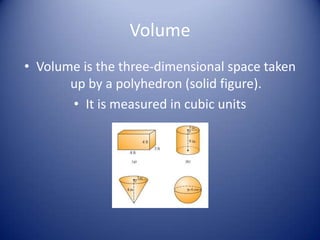
Volume
• Volume is the three-dimensional space taken
       up by a polyhedron (solid figure).
       • It is measured in cubic units
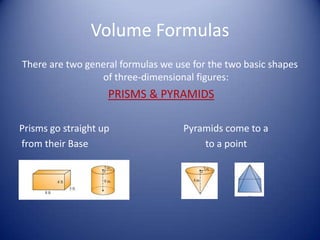
Volume Formulas
There are two general formulas we use for the two basic shapes
                 of three-dimensional figures:
                    PRISMS & PYRAMIDS

Prisms go straight up               Pyramids come to a
from their Base                         to a point
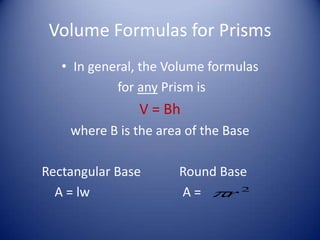
Volume Formulas for Prisms
   • In general, the Volume formulas
            for any Prism is
                V = Bh
    where B is the area of the Base

Rectangular Base      Round Base
  A = lw              A = r 2
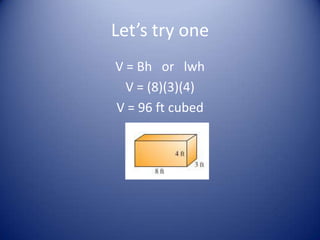
Let’s try one
V = Bh or lwh
  V = (8)(3)(4)
V = 96 ft cubed
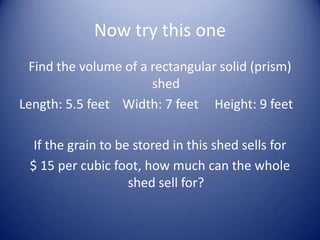
Now try this one
 Find the volume of a rectangular solid (prism)
                      shed
Length: 5.5 feet Width: 7 feet Height: 9 feet

  If the grain to be stored in this shed sells for
 $ 15 per cubic foot, how much can the whole
                    shed sell for?
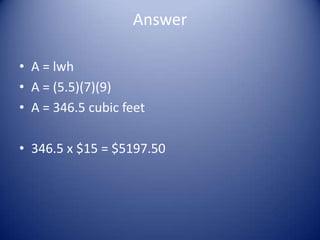
Answer

• A = lwh
• A = (5.5)(7)(9)
• A = 346.5 cubic feet

• 346.5 x $15 = $5197.50
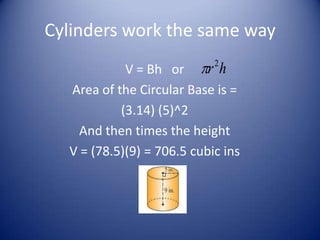
Cylinders work the same way
            V = Bh or r h
                            2


  Area of the Circular Base is =
           (3.14) (5)^2
    And then times the height
  V = (78.5)(9) = 706.5 cubic ins
Again, you try one
1. Find the volume of a cylinder (circular prism)
         with the following dimensions:
      Radius of the circular base is 4 feet,
 height is 10 feet. How much grain can it hold?

2. What if a supporting pole with a radius of one
     foot ran down the center of this flat silo?
      Then how much grain could it hold?
Answer

1) Volume of the original cylinder
   V = (3.14)(4)^2 (10) = 502.4 cubic feet

2) Volume of the pole
    V = 3.14 (1)^2 (10) = 31.4 cubic feet

3) New Volume
   502. 4 – 31.4 = 471 cubic feet
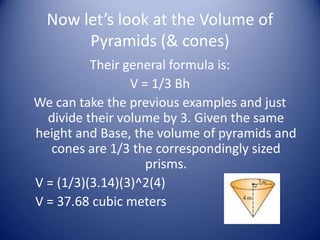
Now let’s look at the Volume of
       Pyramids (& cones)
          Their general formula is:
                 V = 1/3 Bh
We can take the previous examples and just
  divide their volume by 3. Given the same
height and Base, the volume of pyramids and
   cones are 1/3 the correspondingly sized
                    prisms.
V = (1/3)(3.14)(3)^2(4)
V = 37.68 cubic meters
Surface Area
        Surface Area is two-dimensional.
It is the amount of coverage on the outside of
    the figure. It includes the top, bottom, and
                     lateral sides.
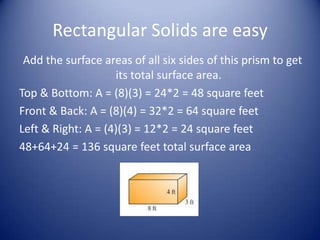
Rectangular Solids are easy
 Add the surface areas of all six sides of this prism to get
                    its total surface area.
Top & Bottom: A = (8)(3) = 24*2 = 48 square feet
Front & Back: A = (8)(4) = 32*2 = 64 square feet
Left & Right: A = (4)(3) = 12*2 = 24 square feet
48+64+24 = 136 square feet total surface area
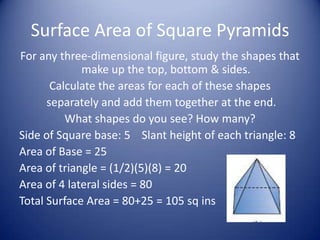
Surface Area of Square Pyramids
For any three-dimensional figure, study the shapes that
             make up the top, bottom & sides.
       Calculate the areas for each of these shapes
      separately and add them together at the end.
          What shapes do you see? How many?
Side of Square base: 5 Slant height of each triangle: 8
Area of Base = 25
Area of triangle = (1/2)(5)(8) = 20
Area of 4 lateral sides = 80
Total Surface Area = 80+25 = 105 sq ins
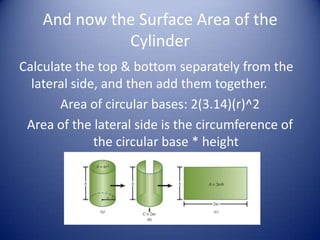
And now the Surface Area of the
              Cylinder
Calculate the top & bottom separately from the
  lateral side, and then add them together.
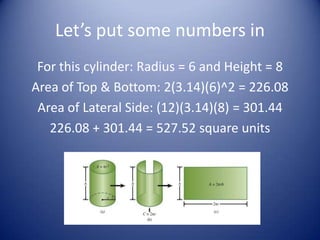
       Area of circular bases: 2(3.14)(r)^2
 Area of the lateral side is the circumference of
              the circular base * height
Let’s put some numbers in
 For this cylinder: Radius = 6 and Height = 8
Area of Top & Bottom: 2(3.14)(6)^2 = 226.08
 Area of Lateral Side: (12)(3.14)(8) = 301.44
   226.08 + 301.44 = 527.52 square units
Now you try
Find the surface area of a cylinder with a radius
      of 3.5 inches and a height of 5 inches.
Answer
Area of top & Bottom: 2(3.14)(3.5)^2 = 76.93
Area of lateral side: (3.14)(7)(5) = 109.9
Add: 76.93 + 109.9 = 186.83 square units
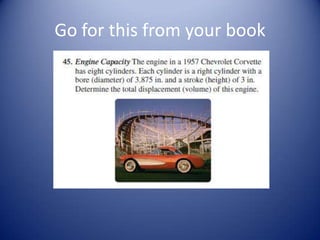
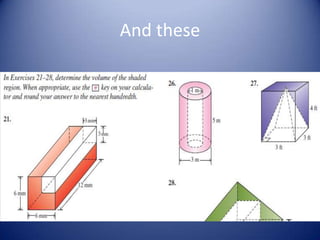
Go for this from your book
And these

Volume & surface area

  • 1.
    Volume & SurfaceArea of Three-Dimensional Figures What’s it all about?
  • 2.
    Volume • Volume isthe three-dimensional space taken up by a polyhedron (solid figure). • It is measured in cubic units
  • 3.
    Volume Formulas There aretwo general formulas we use for the two basic shapes of three-dimensional figures: PRISMS & PYRAMIDS Prisms go straight up Pyramids come to a from their Base to a point
  • 4.
    Volume Formulas forPrisms • In general, the Volume formulas for any Prism is V = Bh where B is the area of the Base Rectangular Base Round Base A = lw A = r 2
  • 5.
    Let’s try one V= Bh or lwh V = (8)(3)(4) V = 96 ft cubed
  • 6.
    Now try thisone Find the volume of a rectangular solid (prism) shed Length: 5.5 feet Width: 7 feet Height: 9 feet If the grain to be stored in this shed sells for $ 15 per cubic foot, how much can the whole shed sell for?
  • 7.
    Answer • A =lwh • A = (5.5)(7)(9) • A = 346.5 cubic feet • 346.5 x $15 = $5197.50
  • 8.
    Cylinders work thesame way V = Bh or r h 2 Area of the Circular Base is = (3.14) (5)^2 And then times the height V = (78.5)(9) = 706.5 cubic ins
  • 9.
    Again, you tryone 1. Find the volume of a cylinder (circular prism) with the following dimensions: Radius of the circular base is 4 feet, height is 10 feet. How much grain can it hold? 2. What if a supporting pole with a radius of one foot ran down the center of this flat silo? Then how much grain could it hold?
  • 10.
    Answer 1) Volume ofthe original cylinder V = (3.14)(4)^2 (10) = 502.4 cubic feet 2) Volume of the pole V = 3.14 (1)^2 (10) = 31.4 cubic feet 3) New Volume 502. 4 – 31.4 = 471 cubic feet
  • 11.
    Now let’s lookat the Volume of Pyramids (& cones) Their general formula is: V = 1/3 Bh We can take the previous examples and just divide their volume by 3. Given the same height and Base, the volume of pyramids and cones are 1/3 the correspondingly sized prisms. V = (1/3)(3.14)(3)^2(4) V = 37.68 cubic meters
  • 12.
    Surface Area Surface Area is two-dimensional. It is the amount of coverage on the outside of the figure. It includes the top, bottom, and lateral sides.
  • 13.
    Rectangular Solids areeasy Add the surface areas of all six sides of this prism to get its total surface area. Top & Bottom: A = (8)(3) = 24*2 = 48 square feet Front & Back: A = (8)(4) = 32*2 = 64 square feet Left & Right: A = (4)(3) = 12*2 = 24 square feet 48+64+24 = 136 square feet total surface area
  • 14.
    Surface Area ofSquare Pyramids For any three-dimensional figure, study the shapes that make up the top, bottom & sides. Calculate the areas for each of these shapes separately and add them together at the end. What shapes do you see? How many? Side of Square base: 5 Slant height of each triangle: 8 Area of Base = 25 Area of triangle = (1/2)(5)(8) = 20 Area of 4 lateral sides = 80 Total Surface Area = 80+25 = 105 sq ins
  • 15.
    And now theSurface Area of the Cylinder Calculate the top & bottom separately from the lateral side, and then add them together. Area of circular bases: 2(3.14)(r)^2 Area of the lateral side is the circumference of the circular base * height
  • 16.
    Let’s put somenumbers in For this cylinder: Radius = 6 and Height = 8 Area of Top & Bottom: 2(3.14)(6)^2 = 226.08 Area of Lateral Side: (12)(3.14)(8) = 301.44 226.08 + 301.44 = 527.52 square units
  • 17.
    Now you try Findthe surface area of a cylinder with a radius of 3.5 inches and a height of 5 inches.
  • 18.
    Answer Area of top& Bottom: 2(3.14)(3.5)^2 = 76.93 Area of lateral side: (3.14)(7)(5) = 109.9 Add: 76.93 + 109.9 = 186.83 square units
  • 19.
    Go for thisfrom your book
  • 20.