Students compute the volumes and surface areas of
 prisms, pyramids, cylinders, cones, and spheres;
 and students commit to memory the formulas for
 prisms, pyramids, and cylinders.
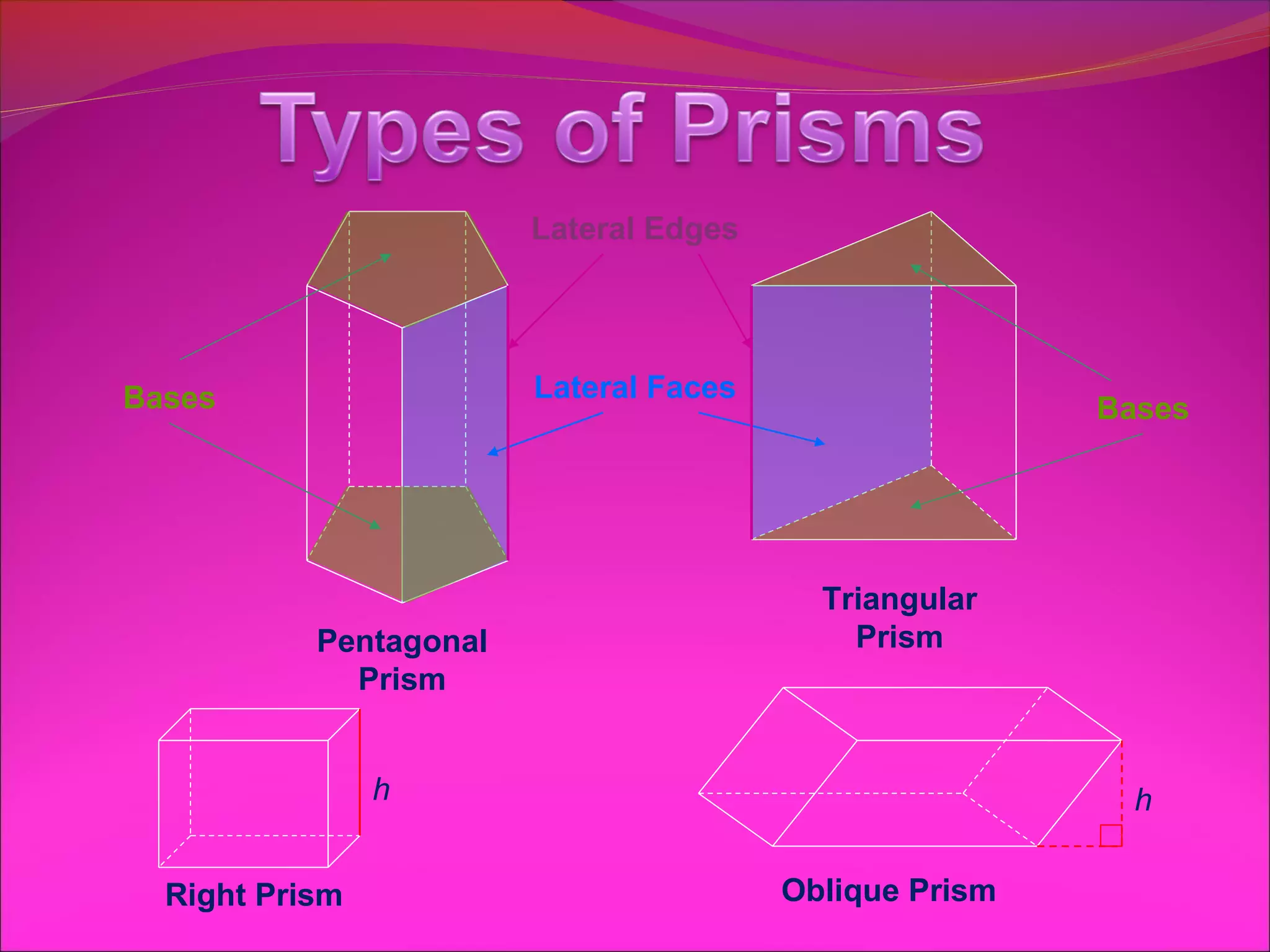
Lateral Edges


Bases                   Lateral Faces
                                                        Bases


                                          Triangular
           Pentagonal                       Prism
             Prism


                h                                         h


  Right Prism                           Oblique Prism
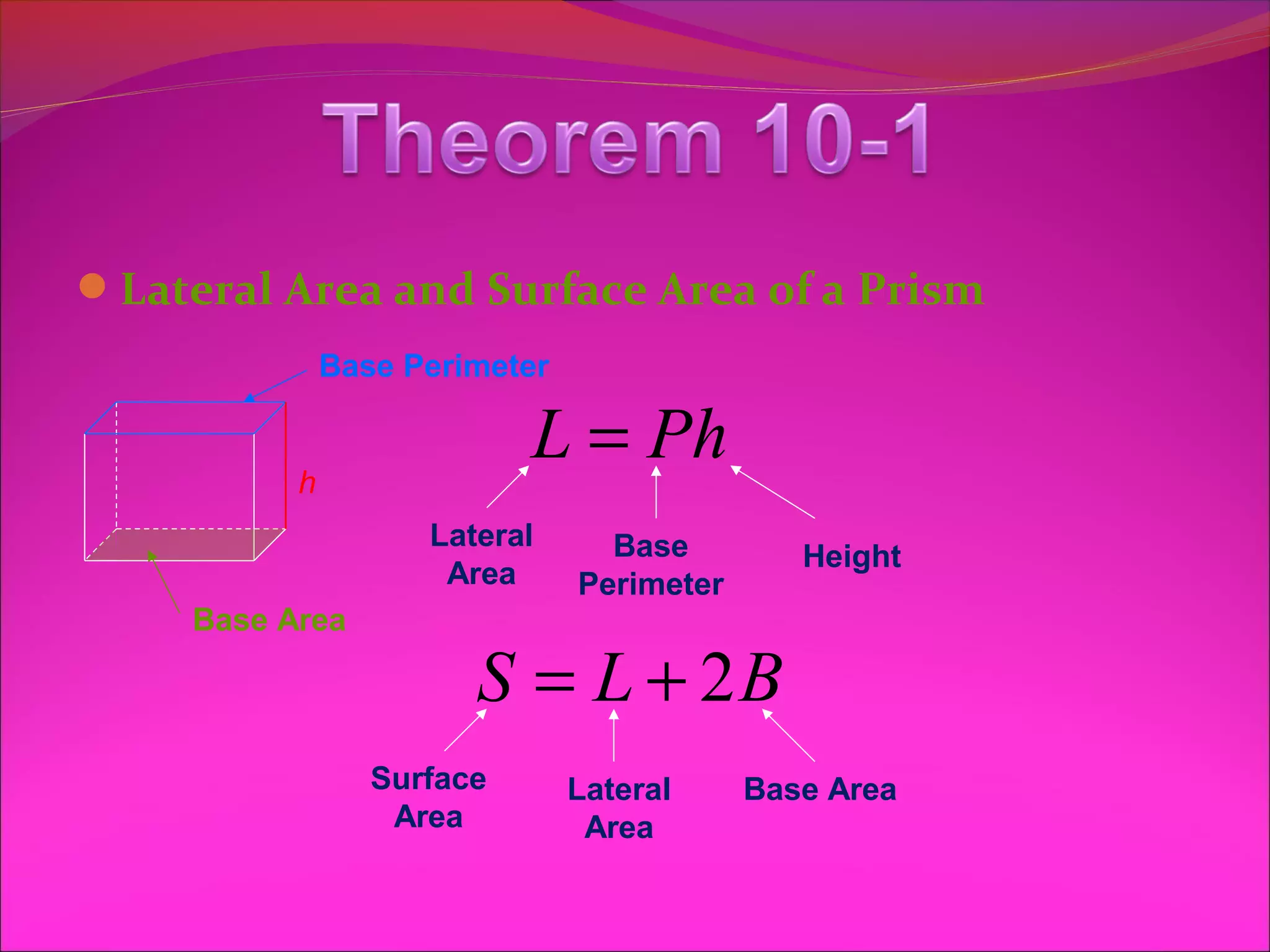
Lateral Area and Surface Area of a Prism
               Base Perimeter


           h
                            L = Ph
                     Lateral      Base         Height
                      Area      Perimeter
     Base Area

                        S = L + 2B
                  Surface       Lateral     Base Area
                   Area          Area
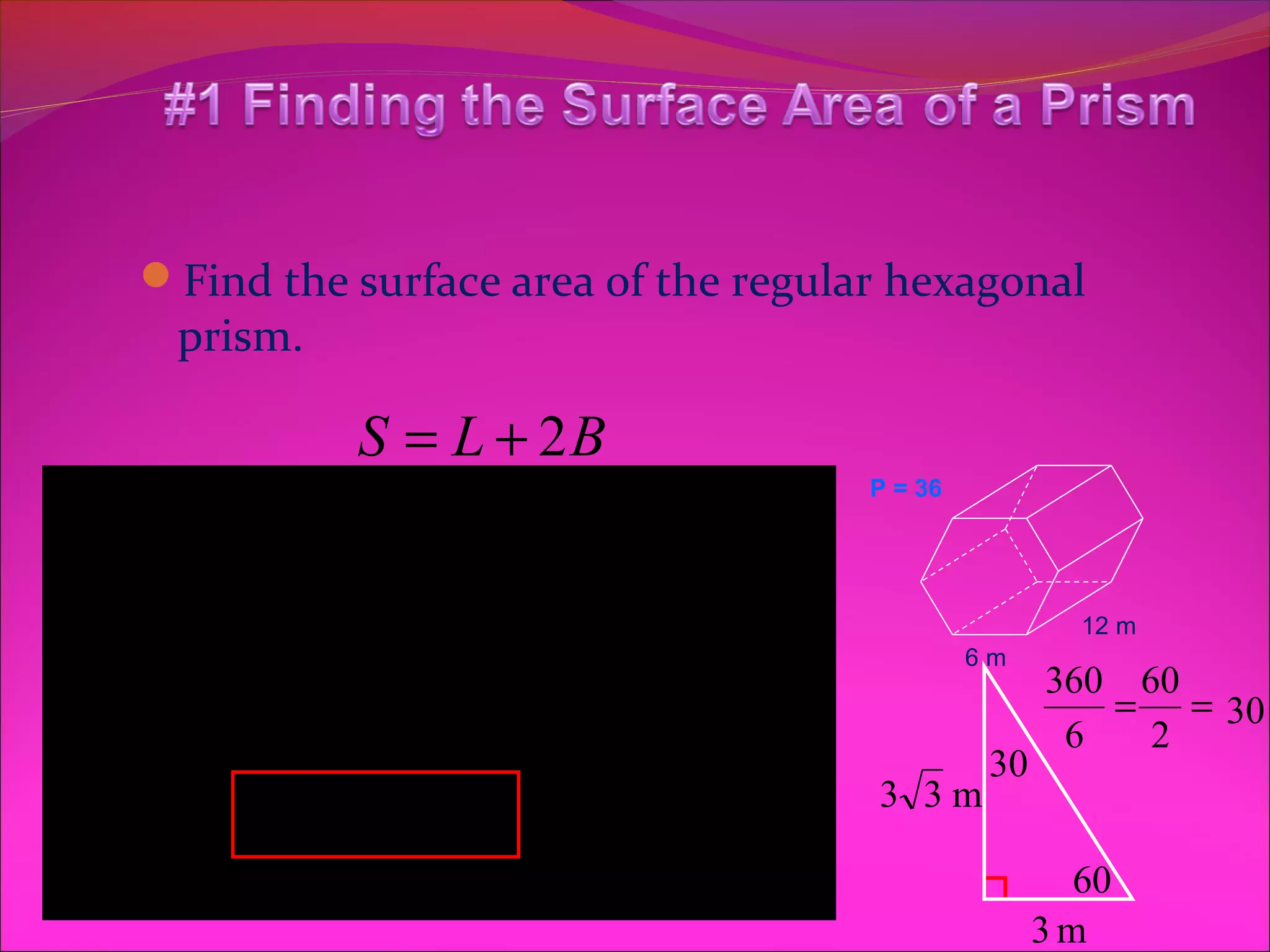
Find the surface area of the regular hexagonal
    prism.

              S = L + 2B
L = Ph                   1             P = 36

 L = 432 m         B = 2 .5
                    B = 93apm 2
            2

P = 6(6) = 36
        S = 432 + 2(93.5)
                        1
                          ( )
                                                        12 m

L = 36(12)         B = 3 3 ( 36 )
                                                6m
                                                      360 60
        S = 432 + 187 2                                6
                                                         = = 30
                                                           2
L = 432 m 2
                                                 30
        S = 619 m B = 54 3
                    2                  3 3m

                    B = 93.5 m 2                      3m
                                                        60
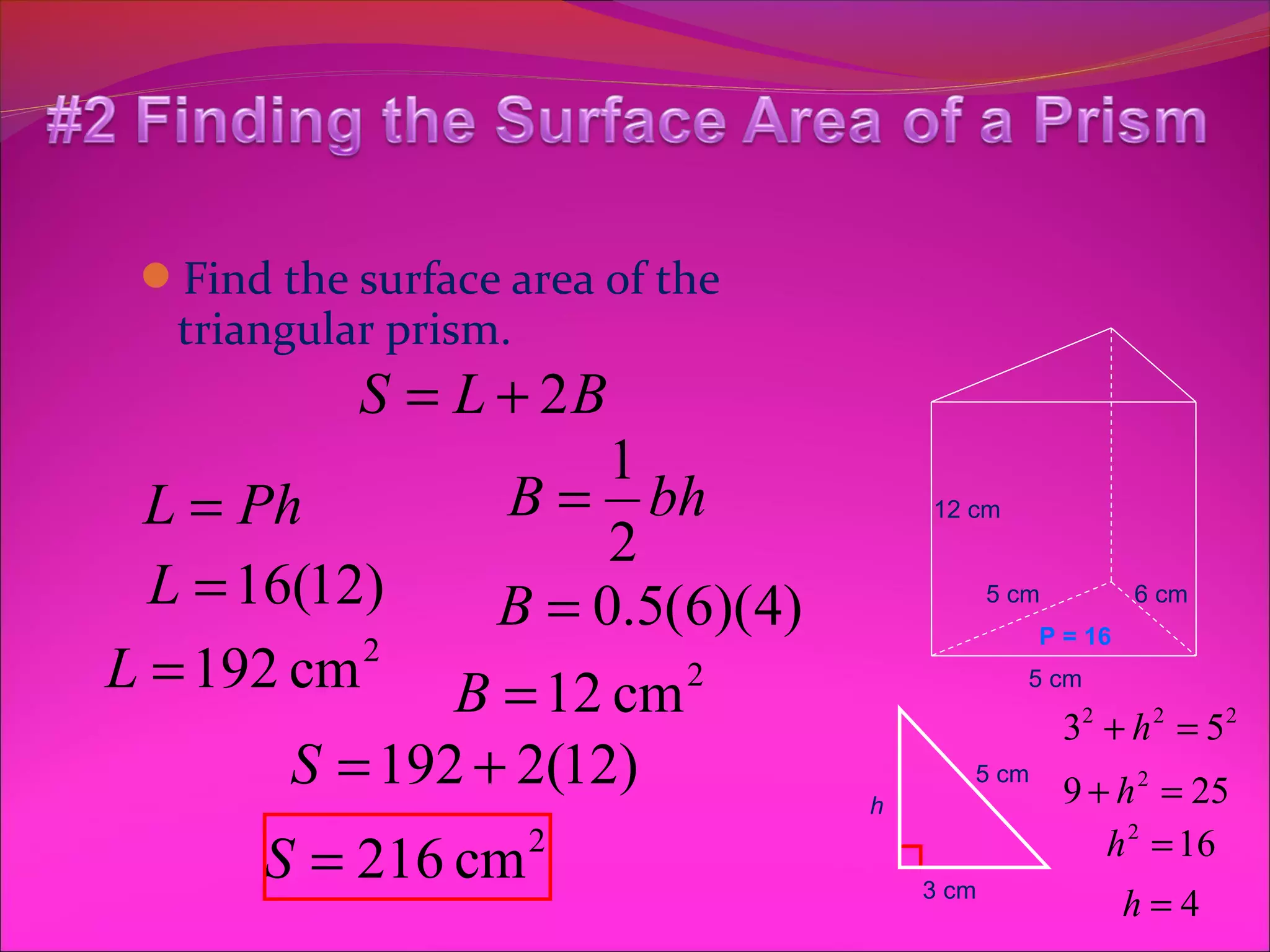
Find the surface area of the
   triangular prism.
            S = L + 2B
                      1
 L = Ph          B = bh              12 cm
                      2
  L = 16(12)     B = 0.5(6)(4)              5 cm        6 cm
                                               P = 16
L = 192 cm 2
               B = 12 cm 2                     5 cm

                                                   32 + h 2 = 5 2
        S = 192 + 2(12)                 5 cm
                                                   9 + h 2 = 25
                                 h
                                                      h 2 = 16
       S = 216 cm      2
                                     3 cm
                                                        h=4
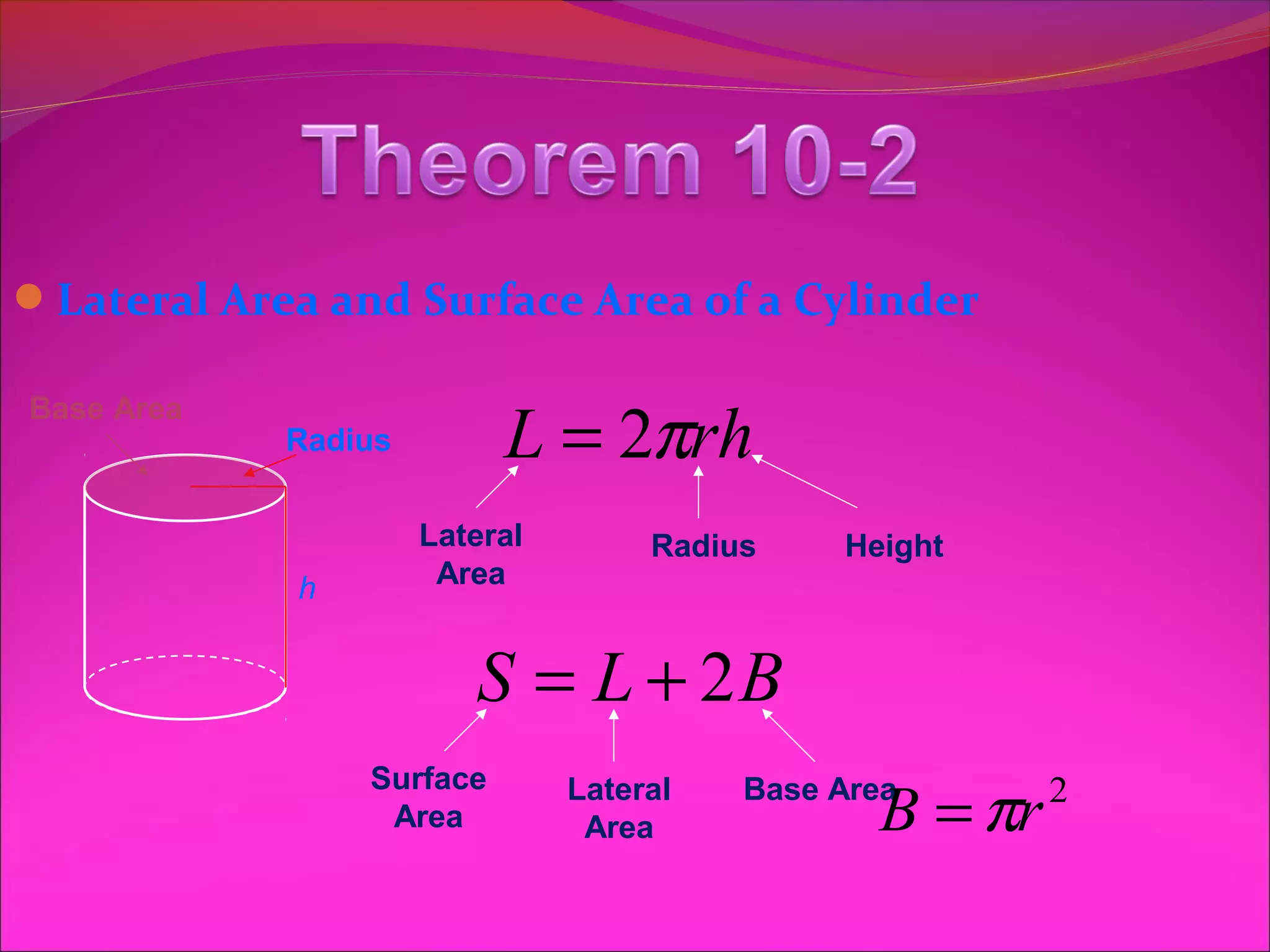
Lateral Area and Surface Area of a Cylinder


                           L = 2πrh
Base Area
            Radius


                     Lateral        Radius    Height
             h        Area


                        S = L + 2B
                 Surface
                  Area
                               Lateral
                                Area            B = πr
                                         Base Area       2
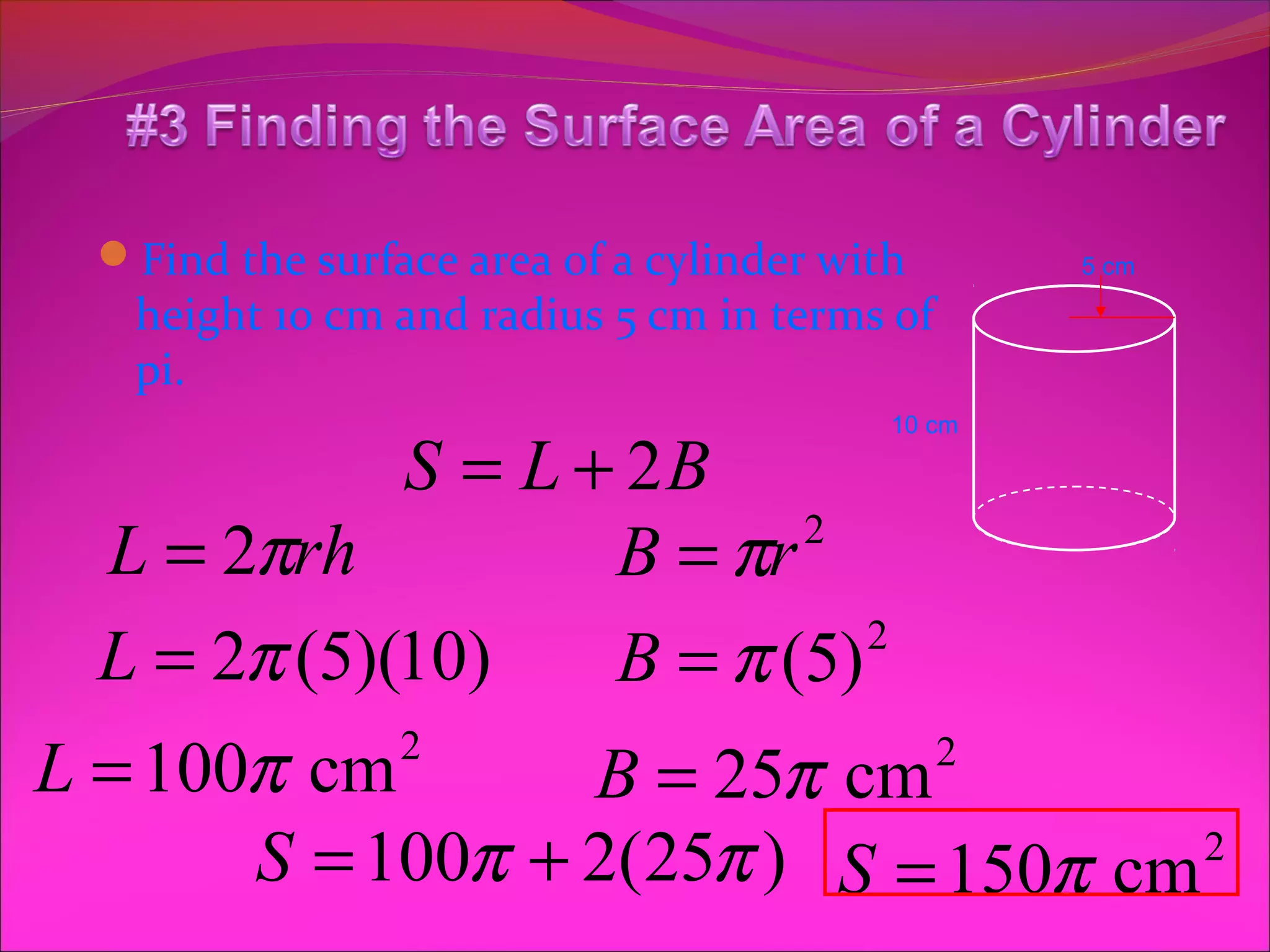
Find the surface area of a cylinder with       5 cm

   height 10 cm and radius 5 cm in terms of
   pi.
                                          10 cm

             S = L + 2B
  L = 2πrh          B = πr 2


  L = 2π (5)(10)    B = π (5) 2


L = 100π cm      2
                  B = 25π cm                  2

       S = 100π + 2(25π ) S = 150π cm 2
Find the surface area of a cylinder with
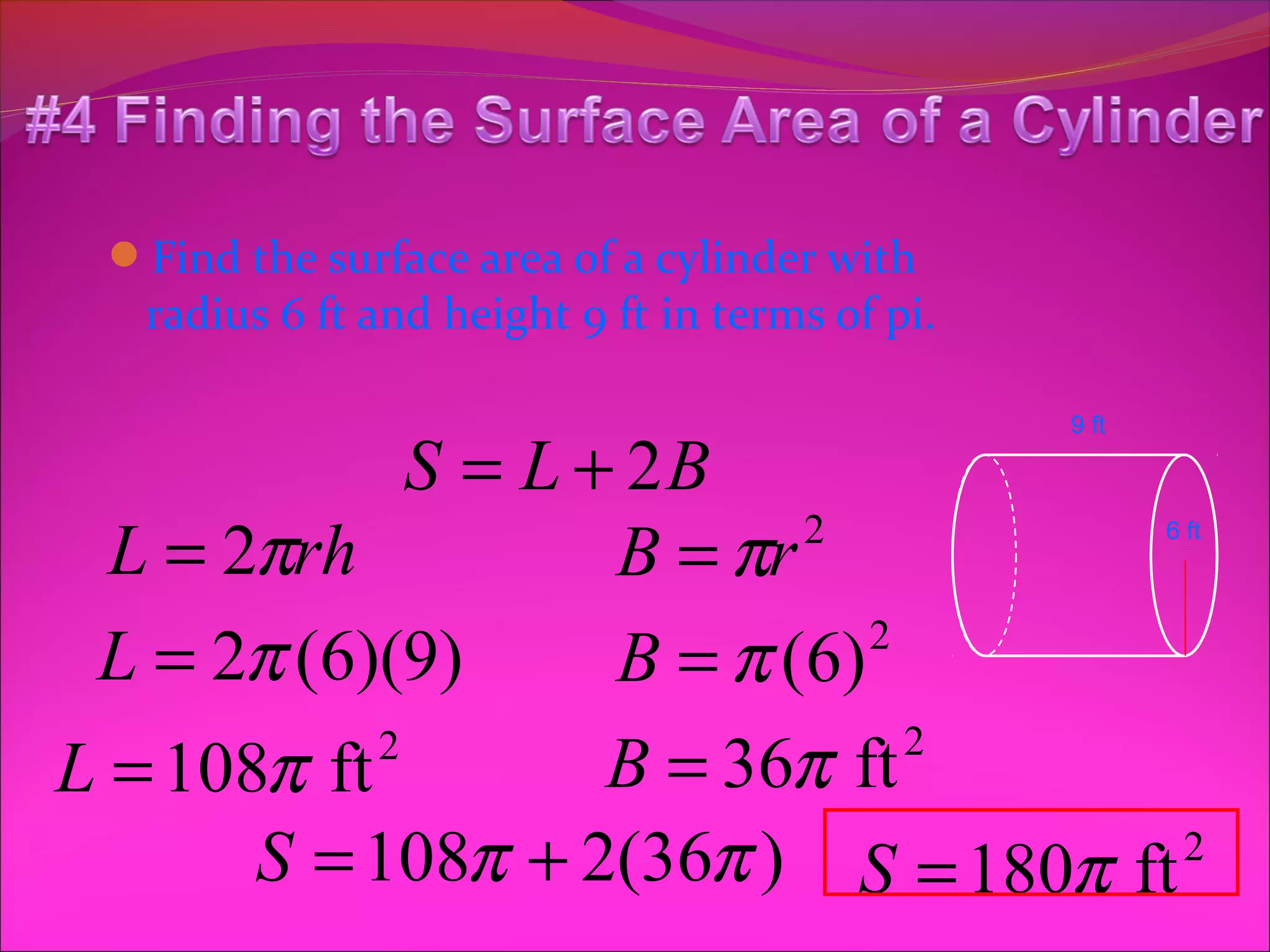
   radius 6 ft and height 9 ft in terms of pi.

                                                 9 ft

              S = L + 2B
  L = 2πrh           B = πr 2                           6 ft


 L = 2π (6)(9)       B = π ( 6) 2


L = 108π ft 2
                     B = 36π ft   2

       S = 108π + 2(36π ) S = 180π ft 2
Find the surface area of a cylinder with
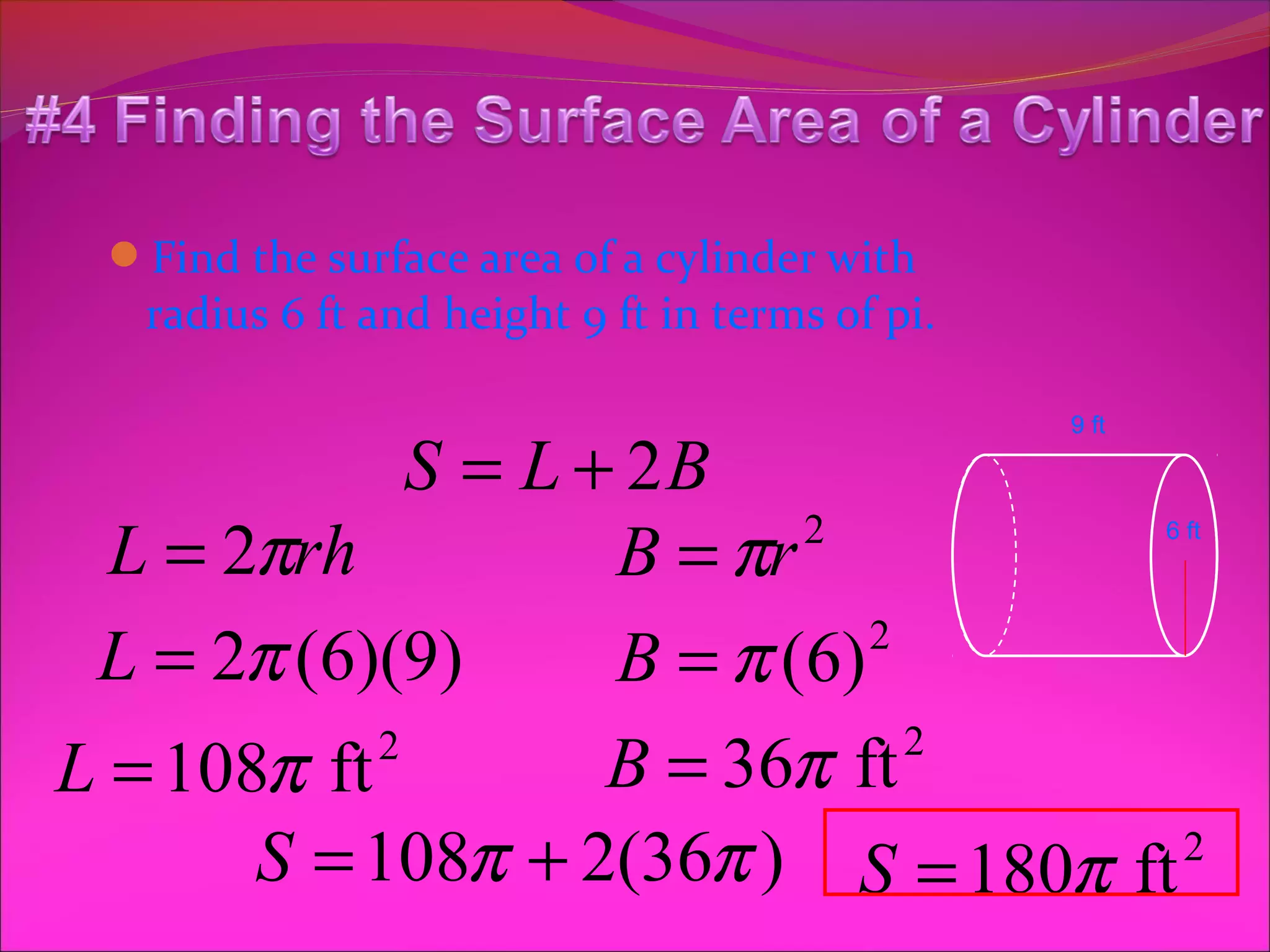
   radius 6 ft and height 9 ft in terms of pi.

                                                 9 ft

              S = L + 2B
  L = 2πrh           B = πr 2                           6 ft


 L = 2π (6)(9)       B = π ( 6) 2


L = 108π ft 2
                     B = 36π ft   2

       S = 108π + 2(36π ) S = 180π ft 2

Surface areas of prisms and cylinders

  • 2.
    Students compute thevolumes and surface areas of prisms, pyramids, cylinders, cones, and spheres; and students commit to memory the formulas for prisms, pyramids, and cylinders.
  • 3.
    Lateral Edges Bases Lateral Faces Bases Triangular Pentagonal Prism Prism h h Right Prism Oblique Prism
  • 4.
    Lateral Area andSurface Area of a Prism Base Perimeter h L = Ph Lateral Base Height Area Perimeter Base Area S = L + 2B Surface Lateral Base Area Area Area
  • 5.
    Find the surfacearea of the regular hexagonal prism. S = L + 2B L = Ph 1 P = 36 L = 432 m B = 2 .5 B = 93apm 2 2 P = 6(6) = 36 S = 432 + 2(93.5) 1 ( ) 12 m L = 36(12) B = 3 3 ( 36 ) 6m 360 60 S = 432 + 187 2 6 = = 30 2 L = 432 m 2 30 S = 619 m B = 54 3 2 3 3m B = 93.5 m 2 3m 60
  • 6.
    Find the surfacearea of the triangular prism. S = L + 2B 1 L = Ph B = bh 12 cm 2 L = 16(12) B = 0.5(6)(4) 5 cm 6 cm P = 16 L = 192 cm 2 B = 12 cm 2 5 cm 32 + h 2 = 5 2 S = 192 + 2(12) 5 cm 9 + h 2 = 25 h h 2 = 16 S = 216 cm 2 3 cm h=4
  • 7.
    Lateral Area andSurface Area of a Cylinder L = 2πrh Base Area Radius Lateral Radius Height h Area S = L + 2B Surface Area Lateral Area B = πr Base Area 2
  • 8.
    Find the surfacearea of a cylinder with 5 cm height 10 cm and radius 5 cm in terms of pi. 10 cm S = L + 2B L = 2πrh B = πr 2 L = 2π (5)(10) B = π (5) 2 L = 100π cm 2 B = 25π cm 2 S = 100π + 2(25π ) S = 150π cm 2
  • 9.
    Find the surfacearea of a cylinder with radius 6 ft and height 9 ft in terms of pi. 9 ft S = L + 2B L = 2πrh B = πr 2 6 ft L = 2π (6)(9) B = π ( 6) 2 L = 108π ft 2 B = 36π ft 2 S = 108π + 2(36π ) S = 180π ft 2
  • 10.
    Find the surfacearea of a cylinder with radius 6 ft and height 9 ft in terms of pi. 9 ft S = L + 2B L = 2πrh B = πr 2 6 ft L = 2π (6)(9) B = π ( 6) 2 L = 108π ft 2 B = 36π ft 2 S = 108π + 2(36π ) S = 180π ft 2