Section 1-4
Angle Measure
Essential Questions
✤ How do you measure and classify angles?
✤ How do you identify and use congruent angles and the bisector of an
angle?
Vocabulary
1. Ray:
2. Opposite Rays:
3. Angle:
4. Side:
5. Vertex:
6. Interior:
Vocabulary
1. Ray: Part of a line; has an endpoint and goes on forever in one
direction; ray AB: AB
2. Opposite Rays:
3. Angle:
4. Side:
5. Vertex:
6. Interior:
Vocabulary
1. Ray: Part of a line; has an endpoint and goes on forever in one
direction; ray AB: AB
2. Opposite Rays: Rays that share an endpoint and are collinear
3. Angle:
4. Side:
5. Vertex:
6. Interior:
Vocabulary
1. Ray: Part of a line; has an endpoint and goes on forever in one
direction; ray AB: AB
2. Opposite Rays: Rays that share an endpoint and are collinear
3. Angle: Two noncollinear rays that share an endpoint; uses three points
or a listed number to name ∠ABC or ∠5
4. Side:
5. Vertex:
6. Interior:
Vocabulary
1. Ray: Part of a line; has an endpoint and goes on forever in one
direction; ray AB: AB
2. Opposite Rays: Rays that share an endpoint and are collinear
3. Angle: Two noncollinear rays that share an endpoint; uses three points
or a listed number to name ∠ABC or ∠5
4. Side: One of the rays that makes up an angle
5. Vertex:
6. Interior:
Vocabulary
1. Ray: Part of a line; has an endpoint and goes on forever in one
direction; ray AB: AB
2. Opposite Rays: Rays that share an endpoint and are collinear
3. Angle: Two noncollinear rays that share an endpoint; uses three points
or a listed number to name ∠ABC or ∠5
4. Side: One of the rays that makes up an angle
5. Vertex: The shared endpoint of the two rays that make up an angle
6. Interior:
Vocabulary
1. Ray: Part of a line; has an endpoint and goes on forever in one
direction; ray AB: AB
2. Opposite Rays: Rays that share an endpoint and are collinear
3. Angle: Two noncollinear rays that share an endpoint; uses three points
or a listed number to name ∠ABC or ∠5
4. Side: One of the rays that makes up an angle
5. Vertex: The shared endpoint of the two rays that make up an angle
6. Interior:The part of an angle that is inside the two rays of the angle
(the part that is less than 180° in measure)
Vocabulary
7. Exterior:
8. Degree:
9. Right Angle:
10. Acute Angle:
11. Obtuse Angle:
12. Angle Bisector:
Vocabulary
7. Exterior: The part of an angle that is outside the two rays of the
angle (the part that is greater than 180° in measure)
8. Degree:
9. Right Angle:
10. Acute Angle:
11. Obtuse Angle:
12. Angle Bisector:
Vocabulary
7. Exterior: The part of an angle that is outside the two rays of the
angle (the part that is greater than 180° in measure)
8. Degree: The unit of measurement of an angle
9. Right Angle:
10. Acute Angle:
11. Obtuse Angle:
12. Angle Bisector:
Vocabulary
7. Exterior: The part of an angle that is outside the two rays of the
angle (the part that is greater than 180° in measure)
8. Degree: The unit of measurement of an angle
9. Right Angle: An angle that is 90° in measure
10. Acute Angle:
11. Obtuse Angle:
12. Angle Bisector:
Vocabulary
7. Exterior: The part of an angle that is outside the two rays of the
angle (the part that is greater than 180° in measure)
8. Degree: The unit of measurement of an angle
9. Right Angle: An angle that is 90° in measure
10. Acute Angle: An angle that is less than 90° in measure
11. Obtuse Angle:
12. Angle Bisector:
Vocabulary
7. Exterior: The part of an angle that is outside the two rays of the
angle (the part that is greater than 180° in measure)
8. Degree: The unit of measurement of an angle
9. Right Angle: An angle that is 90° in measure
10. Acute Angle: An angle that is less than 90° in measure
11. Obtuse Angle: An angle that is more than 90° in measure
12. Angle Bisector:
Vocabulary
7. Exterior: The part of an angle that is outside the two rays of the
angle (the part that is greater than 180° in measure)
8. Degree: The unit of measurement of an angle
9. Right Angle: An angle that is 90° in measure
10. Acute Angle: An angle that is less than 90° in measure
11. Obtuse Angle: An angle that is more than 90° in measure
12. Angle Bisector: A ray and splits an angle into two parts with equal
measure
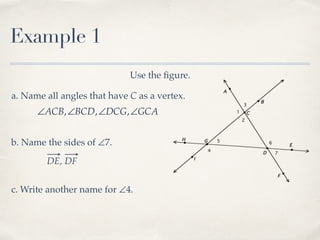
Example 1
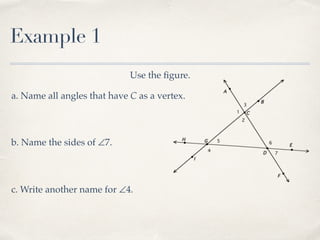
Use the figure.
a. Name all angles that have C as a vertex.
b. Name the sides of ∠7.
c. Write another name for ∠4.
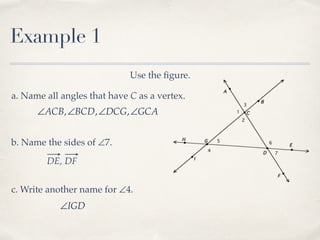
Example 1
Use the figure.
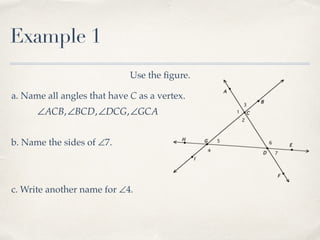
a. Name all angles that have C as a vertex.
∠ACB,∠BCD,∠DCG,∠GCA
b. Name the sides of ∠7.
c. Write another name for ∠4.
Example 1
Use the figure.
a. Name all angles that have C as a vertex.
∠ACB,∠BCD,∠DCG,∠GCA
b. Name the sides of ∠7.
DE, DF
c. Write another name for ∠4.
Example 1
Use the figure.
a. Name all angles that have C as a vertex.
∠ACB,∠BCD,∠DCG,∠GCA
b. Name the sides of ∠7.
DE, DF
c. Write another name for ∠4.
∠IGD
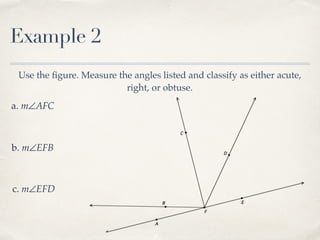
Example 2
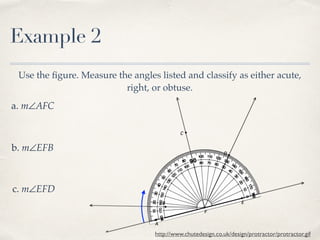
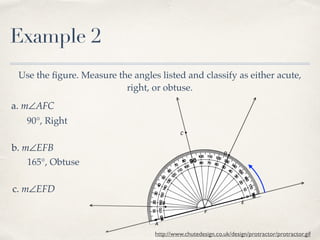
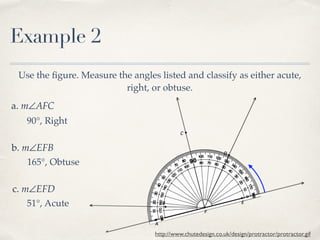
Use the figure. Measure the angles listed and classify as either acute,
right, or obtuse.
a. m∠AFC
b. m∠EFB
c. m∠EFD
Example 2
Use the figure. Measure the angles listed and classify as either acute,
right, or obtuse.
a. m∠AFC
b. m∠EFB
c. m∠EFD
http://www.chutedesign.co.uk/design/protractor/protractor.gif
Example 2
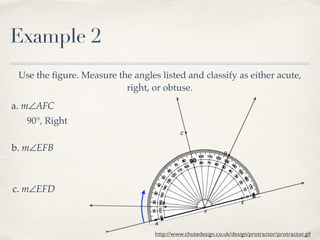
Use the figure. Measure the angles listed and classify as either acute,
right, or obtuse.
a. m∠AFC
b. m∠EFB
c. m∠EFD
http://www.chutedesign.co.uk/design/protractor/protractor.gif
Example 2
Use the figure. Measure the angles listed and classify as either acute,
right, or obtuse.
a. m∠AFC
b. m∠EFB
c. m∠EFD
http://www.chutedesign.co.uk/design/protractor/protractor.gif
90°, Right
Example 2
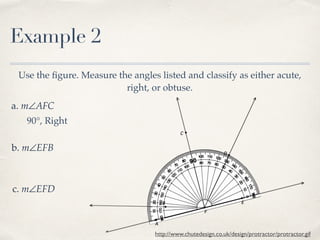
Use the figure. Measure the angles listed and classify as either acute,
right, or obtuse.
a. m∠AFC
b. m∠EFB
c. m∠EFD
http://www.chutedesign.co.uk/design/protractor/protractor.gif
90°, Right
Example 2
Use the figure. Measure the angles listed and classify as either acute,
right, or obtuse.
a. m∠AFC
b. m∠EFB
c. m∠EFD
http://www.chutedesign.co.uk/design/protractor/protractor.gif
90°, Right
Example 2
Use the figure. Measure the angles listed and classify as either acute,
right, or obtuse.
a. m∠AFC
b. m∠EFB
c. m∠EFD
http://www.chutedesign.co.uk/design/protractor/protractor.gif
90°, Right
165°, Obtuse
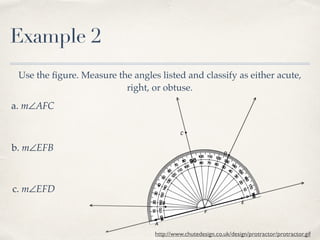
Example 2
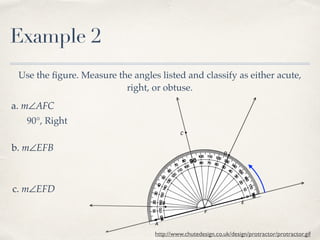
Use the figure. Measure the angles listed and classify as either acute,
right, or obtuse.
a. m∠AFC
b. m∠EFB
c. m∠EFD
http://www.chutedesign.co.uk/design/protractor/protractor.gif
90°, Right
165°, Obtuse
51°, Acute
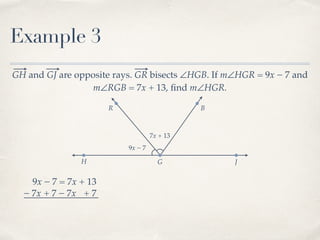
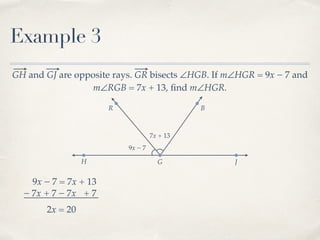
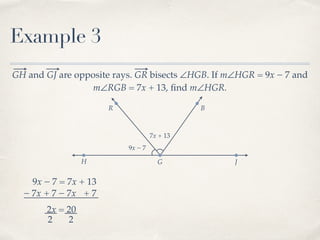
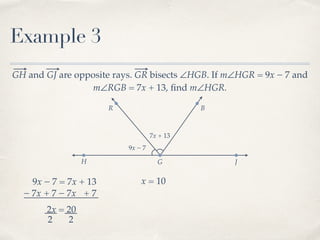
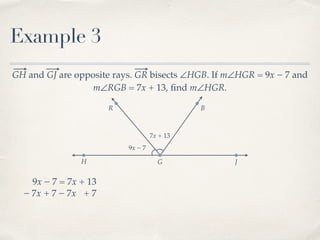
Example 3
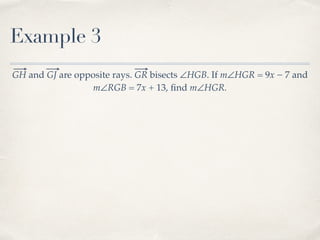
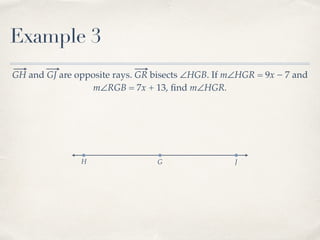
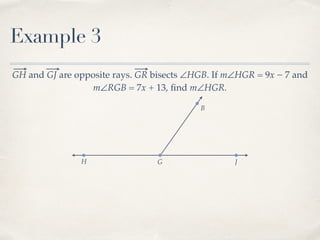
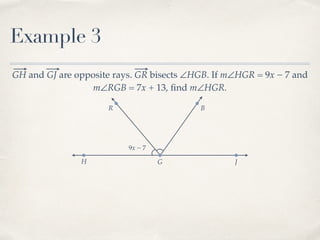
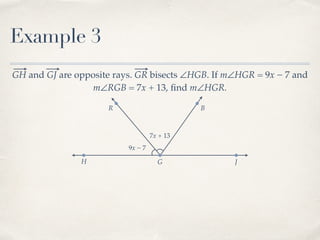
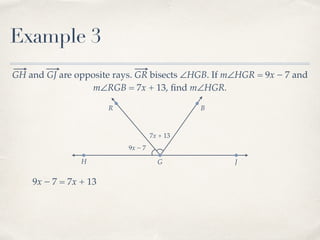
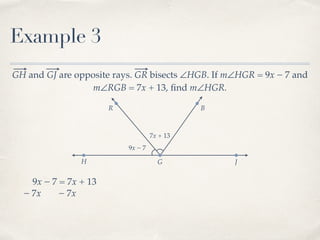
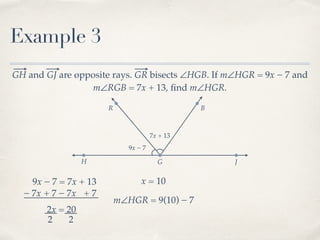
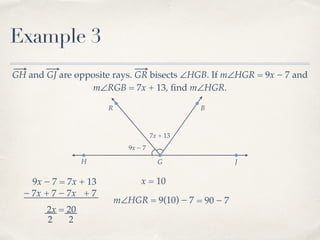
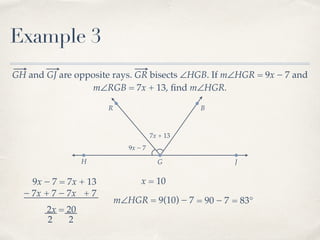
GH and GJ are opposite rays. GR bisects ∠HGB. If m∠HGR = 9x − 7 and
m∠RGB = 7x + 13, find m∠HGR.
Example 3
GH and GJ are opposite rays. GR bisects ∠HGB. If m∠HGR = 9x − 7 and
m∠RGB = 7x + 13, find m∠HGR.
H G J
B
Example 3
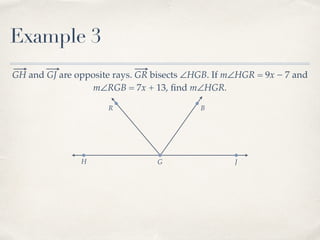
GH and GJ are opposite rays. GR bisects ∠HGB. If m∠HGR = 9x − 7 and
m∠RGB = 7x + 13, find m∠HGR.
H G J
R B
Example 3
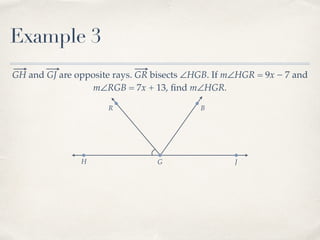
GH and GJ are opposite rays. GR bisects ∠HGB. If m∠HGR = 9x − 7 and
m∠RGB = 7x + 13, find m∠HGR.
H G J
R B
Example 3
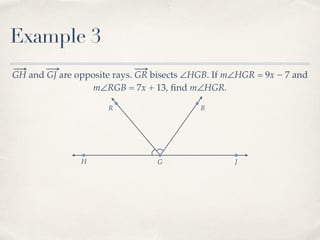
GH and GJ are opposite rays. GR bisects ∠HGB. If m∠HGR = 9x − 7 and
m∠RGB = 7x + 13, find m∠HGR.
H G J
R B
Example 3
GH and GJ are opposite rays. GR bisects ∠HGB. If m∠HGR = 9x − 7 and
m∠RGB = 7x + 13, find m∠HGR.
H G J
R B
Example 3
GH and GJ are opposite rays. GR bisects ∠HGB. If m∠HGR = 9x − 7 and
m∠RGB = 7x + 13, find m∠HGR.
H G J
9x − 7
R B
Example 3
GH and GJ are opposite rays. GR bisects ∠HGB. If m∠HGR = 9x − 7 and
m∠RGB = 7x + 13, find m∠HGR.
H G J
9x − 7
7x + 13
R B
Example 3
GH and GJ are opposite rays. GR bisects ∠HGB. If m∠HGR = 9x − 7 and
m∠RGB = 7x + 13, find m∠HGR.
H G J
9x − 7
7x + 13
9x − 7 = 7x + 13
R B
Example 3
GH and GJ are opposite rays. GR bisects ∠HGB. If m∠HGR = 9x − 7 and
m∠RGB = 7x + 13, find m∠HGR.
H G J
9x − 7
7x + 13
9x − 7 = 7x + 13
− 7x− 7x
R B
Example 3
GH and GJ are opposite rays. GR bisects ∠HGB. If m∠HGR = 9x − 7 and
m∠RGB = 7x + 13, find m∠HGR.
H G J
9x − 7
7x + 13
9x − 7 = 7x + 13
− 7x− 7x + 7 + 7
R B
Example 3
GH and GJ are opposite rays. GR bisects ∠HGB. If m∠HGR = 9x − 7 and
m∠RGB = 7x + 13, find m∠HGR.
H G J
9x − 7
7x + 13
9x − 7 = 7x + 13
− 7x− 7x + 7 + 7
R B
Example 3
GH and GJ are opposite rays. GR bisects ∠HGB. If m∠HGR = 9x − 7 and
m∠RGB = 7x + 13, find m∠HGR.
H G J
9x − 7
7x + 13
9x − 7 = 7x + 13
− 7x− 7x + 7 + 7
2x = 20
R B
Example 3
GH and GJ are opposite rays. GR bisects ∠HGB. If m∠HGR = 9x − 7 and
m∠RGB = 7x + 13, find m∠HGR.
H G J
9x − 7
7x + 13
9x − 7 = 7x + 13
− 7x− 7x + 7 + 7
2x = 20
2 2
R B
Example 3
GH and GJ are opposite rays. GR bisects ∠HGB. If m∠HGR = 9x − 7 and
m∠RGB = 7x + 13, find m∠HGR.
H G J
9x − 7
7x + 13
9x − 7 = 7x + 13
− 7x− 7x + 7 + 7
2x = 20
2 2
x = 10
R B
Example 3
GH and GJ are opposite rays. GR bisects ∠HGB. If m∠HGR = 9x − 7 and
m∠RGB = 7x + 13, find m∠HGR.
H G J
9x − 7
7x + 13
9x − 7 = 7x + 13
− 7x− 7x + 7 + 7
2x = 20
2 2
x = 10
m∠HGR = 9(10) − 7
R B
Example 3
GH and GJ are opposite rays. GR bisects ∠HGB. If m∠HGR = 9x − 7 and
m∠RGB = 7x + 13, find m∠HGR.
H G J
9x − 7
7x + 13
9x − 7 = 7x + 13
− 7x− 7x + 7 + 7
2x = 20
2 2
x = 10
m∠HGR = 9(10) − 7 = 90 − 7
R B
Example 3
GH and GJ are opposite rays. GR bisects ∠HGB. If m∠HGR = 9x − 7 and
m∠RGB = 7x + 13, find m∠HGR.
H G J
9x − 7
7x + 13
9x − 7 = 7x + 13
− 7x− 7x + 7 + 7
2x = 20
2 2
x = 10
m∠HGR = 9(10) − 7 = 90 − 7 = 83°
Geometry Section 1-4

  • 1.
  • 2.
    Essential Questions ✤ Howdo you measure and classify angles? ✤ How do you identify and use congruent angles and the bisector of an angle?
  • 3.
    Vocabulary 1. Ray: 2. OppositeRays: 3. Angle: 4. Side: 5. Vertex: 6. Interior:
  • 4.
    Vocabulary 1. Ray: Partof a line; has an endpoint and goes on forever in one direction; ray AB: AB 2. Opposite Rays: 3. Angle: 4. Side: 5. Vertex: 6. Interior:
  • 5.
    Vocabulary 1. Ray: Partof a line; has an endpoint and goes on forever in one direction; ray AB: AB 2. Opposite Rays: Rays that share an endpoint and are collinear 3. Angle: 4. Side: 5. Vertex: 6. Interior:
  • 6.
    Vocabulary 1. Ray: Partof a line; has an endpoint and goes on forever in one direction; ray AB: AB 2. Opposite Rays: Rays that share an endpoint and are collinear 3. Angle: Two noncollinear rays that share an endpoint; uses three points or a listed number to name ∠ABC or ∠5 4. Side: 5. Vertex: 6. Interior:
  • 7.
    Vocabulary 1. Ray: Partof a line; has an endpoint and goes on forever in one direction; ray AB: AB 2. Opposite Rays: Rays that share an endpoint and are collinear 3. Angle: Two noncollinear rays that share an endpoint; uses three points or a listed number to name ∠ABC or ∠5 4. Side: One of the rays that makes up an angle 5. Vertex: 6. Interior:
  • 8.
    Vocabulary 1. Ray: Partof a line; has an endpoint and goes on forever in one direction; ray AB: AB 2. Opposite Rays: Rays that share an endpoint and are collinear 3. Angle: Two noncollinear rays that share an endpoint; uses three points or a listed number to name ∠ABC or ∠5 4. Side: One of the rays that makes up an angle 5. Vertex: The shared endpoint of the two rays that make up an angle 6. Interior:
  • 9.
    Vocabulary 1. Ray: Partof a line; has an endpoint and goes on forever in one direction; ray AB: AB 2. Opposite Rays: Rays that share an endpoint and are collinear 3. Angle: Two noncollinear rays that share an endpoint; uses three points or a listed number to name ∠ABC or ∠5 4. Side: One of the rays that makes up an angle 5. Vertex: The shared endpoint of the two rays that make up an angle 6. Interior:The part of an angle that is inside the two rays of the angle (the part that is less than 180° in measure)
  • 10.
    Vocabulary 7. Exterior: 8. Degree: 9.Right Angle: 10. Acute Angle: 11. Obtuse Angle: 12. Angle Bisector:
  • 11.
    Vocabulary 7. Exterior: Thepart of an angle that is outside the two rays of the angle (the part that is greater than 180° in measure) 8. Degree: 9. Right Angle: 10. Acute Angle: 11. Obtuse Angle: 12. Angle Bisector:
  • 12.
    Vocabulary 7. Exterior: Thepart of an angle that is outside the two rays of the angle (the part that is greater than 180° in measure) 8. Degree: The unit of measurement of an angle 9. Right Angle: 10. Acute Angle: 11. Obtuse Angle: 12. Angle Bisector:
  • 13.
    Vocabulary 7. Exterior: Thepart of an angle that is outside the two rays of the angle (the part that is greater than 180° in measure) 8. Degree: The unit of measurement of an angle 9. Right Angle: An angle that is 90° in measure 10. Acute Angle: 11. Obtuse Angle: 12. Angle Bisector:
  • 14.
    Vocabulary 7. Exterior: Thepart of an angle that is outside the two rays of the angle (the part that is greater than 180° in measure) 8. Degree: The unit of measurement of an angle 9. Right Angle: An angle that is 90° in measure 10. Acute Angle: An angle that is less than 90° in measure 11. Obtuse Angle: 12. Angle Bisector:
  • 15.
    Vocabulary 7. Exterior: Thepart of an angle that is outside the two rays of the angle (the part that is greater than 180° in measure) 8. Degree: The unit of measurement of an angle 9. Right Angle: An angle that is 90° in measure 10. Acute Angle: An angle that is less than 90° in measure 11. Obtuse Angle: An angle that is more than 90° in measure 12. Angle Bisector:
  • 16.
    Vocabulary 7. Exterior: Thepart of an angle that is outside the two rays of the angle (the part that is greater than 180° in measure) 8. Degree: The unit of measurement of an angle 9. Right Angle: An angle that is 90° in measure 10. Acute Angle: An angle that is less than 90° in measure 11. Obtuse Angle: An angle that is more than 90° in measure 12. Angle Bisector: A ray and splits an angle into two parts with equal measure
  • 17.
    Example 1 Use thefigure. a. Name all angles that have C as a vertex. b. Name the sides of ∠7. c. Write another name for ∠4.
  • 18.
    Example 1 Use thefigure. a. Name all angles that have C as a vertex. ∠ACB,∠BCD,∠DCG,∠GCA b. Name the sides of ∠7. c. Write another name for ∠4.
  • 19.
    Example 1 Use thefigure. a. Name all angles that have C as a vertex. ∠ACB,∠BCD,∠DCG,∠GCA b. Name the sides of ∠7. DE, DF c. Write another name for ∠4.
  • 20.
    Example 1 Use thefigure. a. Name all angles that have C as a vertex. ∠ACB,∠BCD,∠DCG,∠GCA b. Name the sides of ∠7. DE, DF c. Write another name for ∠4. ∠IGD
  • 21.
    Example 2 Use thefigure. Measure the angles listed and classify as either acute, right, or obtuse. a. m∠AFC b. m∠EFB c. m∠EFD
  • 22.
    Example 2 Use thefigure. Measure the angles listed and classify as either acute, right, or obtuse. a. m∠AFC b. m∠EFB c. m∠EFD http://www.chutedesign.co.uk/design/protractor/protractor.gif
  • 23.
    Example 2 Use thefigure. Measure the angles listed and classify as either acute, right, or obtuse. a. m∠AFC b. m∠EFB c. m∠EFD http://www.chutedesign.co.uk/design/protractor/protractor.gif
  • 24.
    Example 2 Use thefigure. Measure the angles listed and classify as either acute, right, or obtuse. a. m∠AFC b. m∠EFB c. m∠EFD http://www.chutedesign.co.uk/design/protractor/protractor.gif 90°, Right
  • 25.
    Example 2 Use thefigure. Measure the angles listed and classify as either acute, right, or obtuse. a. m∠AFC b. m∠EFB c. m∠EFD http://www.chutedesign.co.uk/design/protractor/protractor.gif 90°, Right
  • 26.
    Example 2 Use thefigure. Measure the angles listed and classify as either acute, right, or obtuse. a. m∠AFC b. m∠EFB c. m∠EFD http://www.chutedesign.co.uk/design/protractor/protractor.gif 90°, Right
  • 27.
    Example 2 Use thefigure. Measure the angles listed and classify as either acute, right, or obtuse. a. m∠AFC b. m∠EFB c. m∠EFD http://www.chutedesign.co.uk/design/protractor/protractor.gif 90°, Right 165°, Obtuse
  • 28.
    Example 2 Use thefigure. Measure the angles listed and classify as either acute, right, or obtuse. a. m∠AFC b. m∠EFB c. m∠EFD http://www.chutedesign.co.uk/design/protractor/protractor.gif 90°, Right 165°, Obtuse 51°, Acute
  • 29.
    Example 3 GH andGJ are opposite rays. GR bisects ∠HGB. If m∠HGR = 9x − 7 and m∠RGB = 7x + 13, find m∠HGR.
  • 30.
    Example 3 GH andGJ are opposite rays. GR bisects ∠HGB. If m∠HGR = 9x − 7 and m∠RGB = 7x + 13, find m∠HGR. H G J
  • 31.
    B Example 3 GH andGJ are opposite rays. GR bisects ∠HGB. If m∠HGR = 9x − 7 and m∠RGB = 7x + 13, find m∠HGR. H G J
  • 32.
    R B Example 3 GHand GJ are opposite rays. GR bisects ∠HGB. If m∠HGR = 9x − 7 and m∠RGB = 7x + 13, find m∠HGR. H G J
  • 33.
    R B Example 3 GHand GJ are opposite rays. GR bisects ∠HGB. If m∠HGR = 9x − 7 and m∠RGB = 7x + 13, find m∠HGR. H G J
  • 34.
    R B Example 3 GHand GJ are opposite rays. GR bisects ∠HGB. If m∠HGR = 9x − 7 and m∠RGB = 7x + 13, find m∠HGR. H G J
  • 35.
    R B Example 3 GHand GJ are opposite rays. GR bisects ∠HGB. If m∠HGR = 9x − 7 and m∠RGB = 7x + 13, find m∠HGR. H G J 9x − 7
  • 36.
    R B Example 3 GHand GJ are opposite rays. GR bisects ∠HGB. If m∠HGR = 9x − 7 and m∠RGB = 7x + 13, find m∠HGR. H G J 9x − 7 7x + 13
  • 37.
    R B Example 3 GHand GJ are opposite rays. GR bisects ∠HGB. If m∠HGR = 9x − 7 and m∠RGB = 7x + 13, find m∠HGR. H G J 9x − 7 7x + 13 9x − 7 = 7x + 13
  • 38.
    R B Example 3 GHand GJ are opposite rays. GR bisects ∠HGB. If m∠HGR = 9x − 7 and m∠RGB = 7x + 13, find m∠HGR. H G J 9x − 7 7x + 13 9x − 7 = 7x + 13 − 7x− 7x
  • 39.
    R B Example 3 GHand GJ are opposite rays. GR bisects ∠HGB. If m∠HGR = 9x − 7 and m∠RGB = 7x + 13, find m∠HGR. H G J 9x − 7 7x + 13 9x − 7 = 7x + 13 − 7x− 7x + 7 + 7
  • 40.
    R B Example 3 GHand GJ are opposite rays. GR bisects ∠HGB. If m∠HGR = 9x − 7 and m∠RGB = 7x + 13, find m∠HGR. H G J 9x − 7 7x + 13 9x − 7 = 7x + 13 − 7x− 7x + 7 + 7
  • 41.
    R B Example 3 GHand GJ are opposite rays. GR bisects ∠HGB. If m∠HGR = 9x − 7 and m∠RGB = 7x + 13, find m∠HGR. H G J 9x − 7 7x + 13 9x − 7 = 7x + 13 − 7x− 7x + 7 + 7 2x = 20
  • 42.
    R B Example 3 GHand GJ are opposite rays. GR bisects ∠HGB. If m∠HGR = 9x − 7 and m∠RGB = 7x + 13, find m∠HGR. H G J 9x − 7 7x + 13 9x − 7 = 7x + 13 − 7x− 7x + 7 + 7 2x = 20 2 2
  • 43.
    R B Example 3 GHand GJ are opposite rays. GR bisects ∠HGB. If m∠HGR = 9x − 7 and m∠RGB = 7x + 13, find m∠HGR. H G J 9x − 7 7x + 13 9x − 7 = 7x + 13 − 7x− 7x + 7 + 7 2x = 20 2 2 x = 10
  • 44.
    R B Example 3 GHand GJ are opposite rays. GR bisects ∠HGB. If m∠HGR = 9x − 7 and m∠RGB = 7x + 13, find m∠HGR. H G J 9x − 7 7x + 13 9x − 7 = 7x + 13 − 7x− 7x + 7 + 7 2x = 20 2 2 x = 10 m∠HGR = 9(10) − 7
  • 45.
    R B Example 3 GHand GJ are opposite rays. GR bisects ∠HGB. If m∠HGR = 9x − 7 and m∠RGB = 7x + 13, find m∠HGR. H G J 9x − 7 7x + 13 9x − 7 = 7x + 13 − 7x− 7x + 7 + 7 2x = 20 2 2 x = 10 m∠HGR = 9(10) − 7 = 90 − 7
  • 46.
    R B Example 3 GHand GJ are opposite rays. GR bisects ∠HGB. If m∠HGR = 9x − 7 and m∠RGB = 7x + 13, find m∠HGR. H G J 9x − 7 7x + 13 9x − 7 = 7x + 13 − 7x− 7x + 7 + 7 2x = 20 2 2 x = 10 m∠HGR = 9(10) − 7 = 90 − 7 = 83°