Section 12-4
Volumes of Prisms and Cylinders
Essential Questions
• How do you find volumes of prisms?
• How do you find volumes of cylinders?
Vocabulary Refresh
1.Volume:
Vocabulary Refresh
1.Volume: The amount of space inside a three-dimensional
object
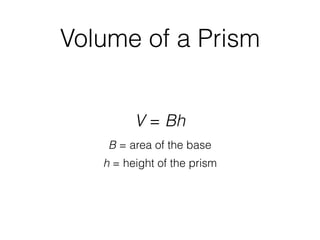
Volume of a Prism
Volume of a Prism
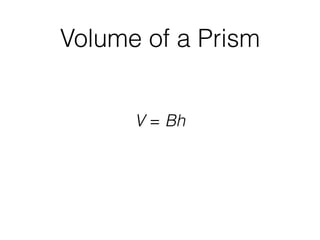
V = Bh
Volume of a Prism
V = Bh
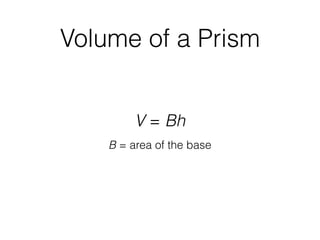
B = area of the base
Volume of a Prism
V = Bh
B = area of the base
h = height of the prism
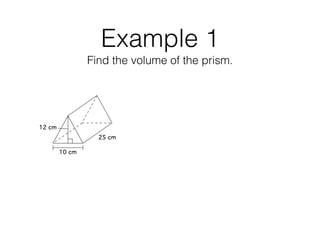
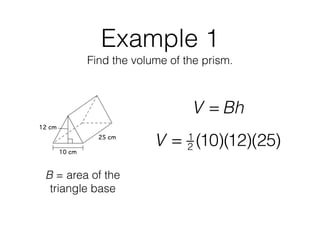
Example 1
Find the volume of the prism.
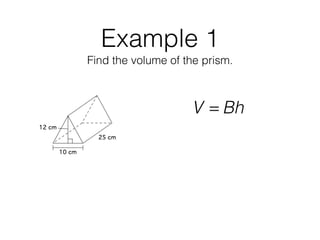
Example 1
Find the volume of the prism.
V = Bh
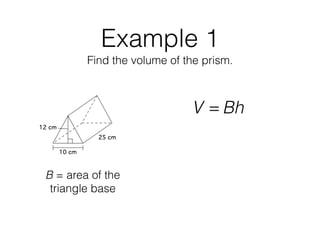
Example 1
Find the volume of the prism.
V = Bh
B = area of the
triangle base
Example 1
Find the volume of the prism.
V = Bh
B = area of the
triangle base
V = 1
2 (10)(12)(25)
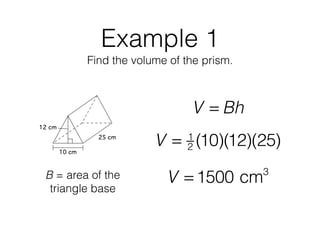
Example 1
Find the volume of the prism.
V = Bh
B = area of the
triangle base
V = 1
2 (10)(12)(25)
V = 1500 cm3
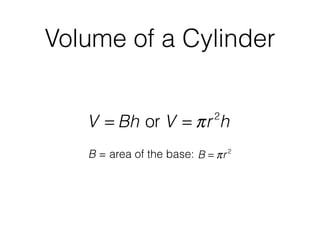
Volume of a Cylinder
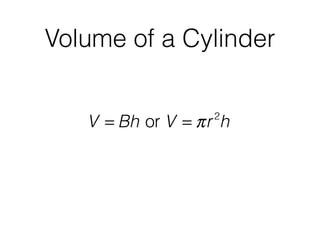
V = Bh or V = πr2
h
Volume of a Cylinder
V = Bh or V = πr2
h
B = area of the base: B = πr2
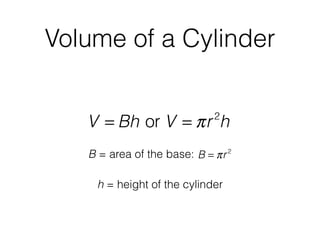
Volume of a Cylinder
h = height of the cylinder
V = Bh or V = πr2
h
B = area of the base: B = πr2
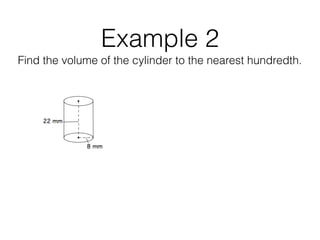
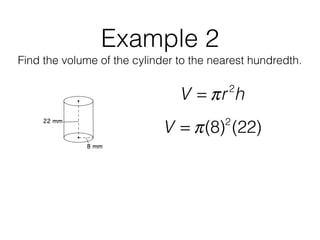
Example 2
Find the volume of the cylinder to the nearest hundredth.
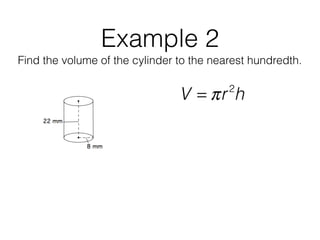
Example 2
Find the volume of the cylinder to the nearest hundredth.
V = πr2
h
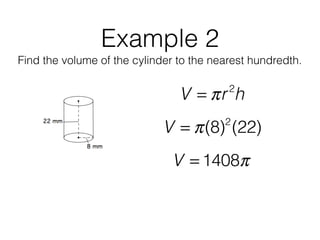
Example 2
Find the volume of the cylinder to the nearest hundredth.
V = πr2
h
V = π(8)2
(22)
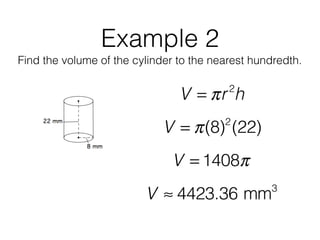
Example 2
Find the volume of the cylinder to the nearest hundredth.
V = πr2
h
V = π(8)2
(22)
V = 1408π
Example 2
Find the volume of the cylinder to the nearest hundredth.
V = πr2
h
V = π(8)2
(22)
V = 1408π
V ≈ 4423.36 mm3
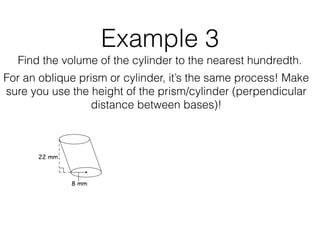
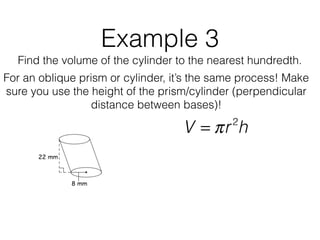
Example 3
Find the volume of the cylinder to the nearest hundredth.
For an oblique prism or cylinder, it’s the same process! Make
sure you use the height of the prism/cylinder (perpendicular
distance between bases)!
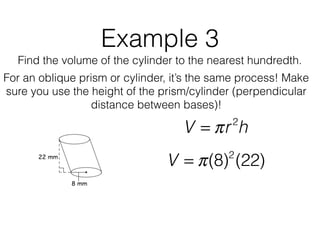
Example 3
Find the volume of the cylinder to the nearest hundredth.
V = πr2
h
For an oblique prism or cylinder, it’s the same process! Make
sure you use the height of the prism/cylinder (perpendicular
distance between bases)!
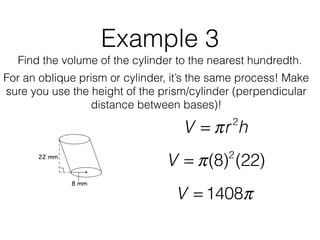
Example 3
Find the volume of the cylinder to the nearest hundredth.
V = πr2
h
V = π(8)2
(22)
For an oblique prism or cylinder, it’s the same process! Make
sure you use the height of the prism/cylinder (perpendicular
distance between bases)!
Example 3
Find the volume of the cylinder to the nearest hundredth.
V = πr2
h
V = π(8)2
(22)
V = 1408π
For an oblique prism or cylinder, it’s the same process! Make
sure you use the height of the prism/cylinder (perpendicular
distance between bases)!
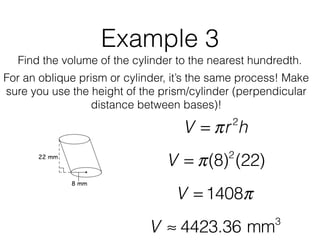
Example 3
Find the volume of the cylinder to the nearest hundredth.
V = πr2
h
V = π(8)2
(22)
V = 1408π
V ≈ 4423.36 mm3
For an oblique prism or cylinder, it’s the same process! Make
sure you use the height of the prism/cylinder (perpendicular
distance between bases)!
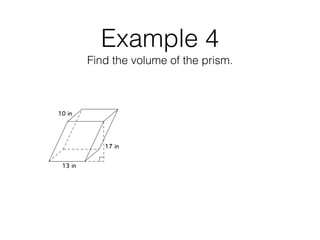
Example 4
Find the volume of the prism.
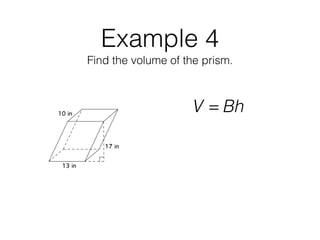
Example 4
Find the volume of the prism.
V = Bh
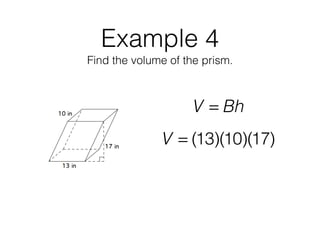
Example 4
Find the volume of the prism.
V = Bh
V = (13)(10)(17)
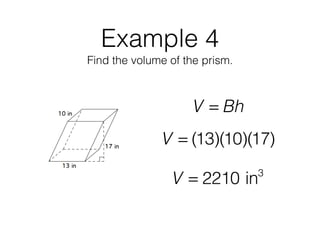
Example 4
Find the volume of the prism.
V = Bh
V = (13)(10)(17)
V = 2210 in3
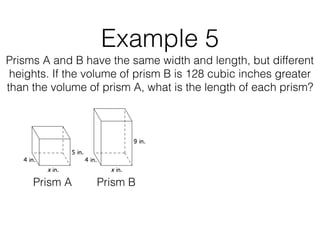
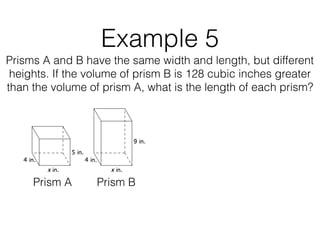
Example 5
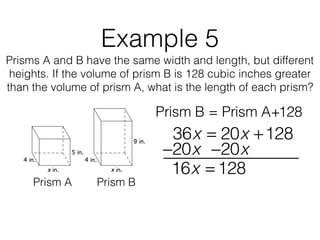
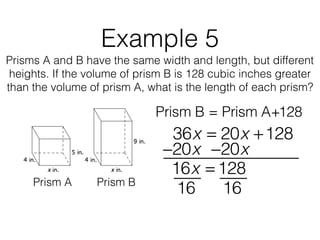
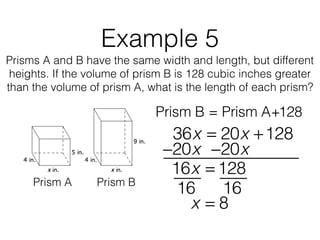
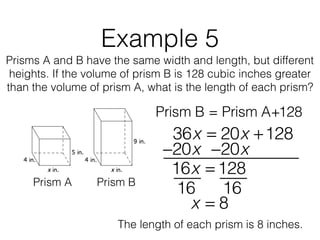
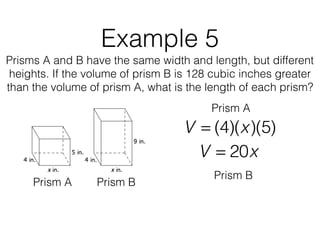
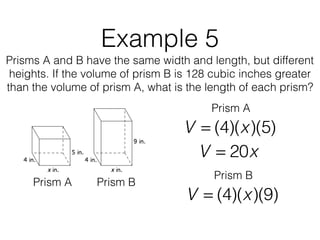
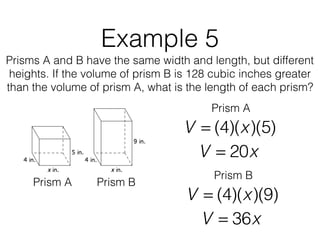
Prisms A and B have the same width and length, but different
heights. If the volume of prism B is 128 cubic inches greater
than the volume of prism A, what is the length of each prism?
Prism A Prism B
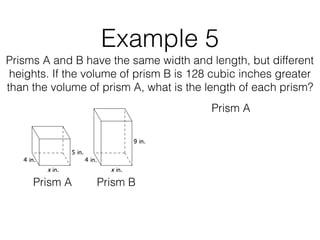
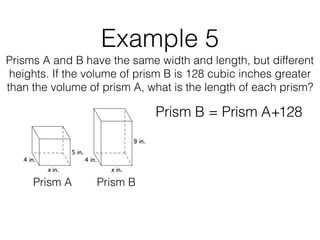
Example 5
Prisms A and B have the same width and length, but different
heights. If the volume of prism B is 128 cubic inches greater
than the volume of prism A, what is the length of each prism?
Prism A Prism B
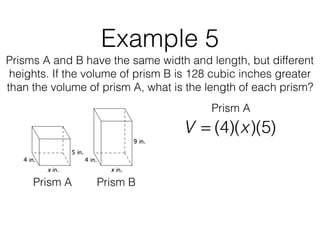
Prism A
Example 5
Prisms A and B have the same width and length, but different
heights. If the volume of prism B is 128 cubic inches greater
than the volume of prism A, what is the length of each prism?
V = (4)(x)(5)
Prism A Prism B
Prism A
Example 5
Prisms A and B have the same width and length, but different
heights. If the volume of prism B is 128 cubic inches greater
than the volume of prism A, what is the length of each prism?
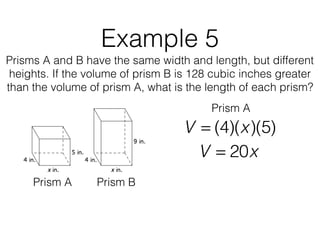
V = (4)(x)(5)
Prism A Prism B
Prism A
V = 20x
Example 5
Prisms A and B have the same width and length, but different
heights. If the volume of prism B is 128 cubic inches greater
than the volume of prism A, what is the length of each prism?
V = (4)(x)(5)
Prism A Prism B
Prism A
V = 20x
Prism B
Example 5
Prisms A and B have the same width and length, but different
heights. If the volume of prism B is 128 cubic inches greater
than the volume of prism A, what is the length of each prism?
V = (4)(x)(5)
Prism A Prism B
Prism A
V = 20x
V = (4)(x)(9)
Prism B
Example 5
Prisms A and B have the same width and length, but different
heights. If the volume of prism B is 128 cubic inches greater
than the volume of prism A, what is the length of each prism?
V = (4)(x)(5)
Prism A Prism B
Prism A
V = 20x
V = (4)(x)(9)
Prism B
V = 36x
Example 5
Prisms A and B have the same width and length, but different
heights. If the volume of prism B is 128 cubic inches greater
than the volume of prism A, what is the length of each prism?
Prism A Prism B
Example 5
Prisms A and B have the same width and length, but different
heights. If the volume of prism B is 128 cubic inches greater
than the volume of prism A, what is the length of each prism?
Prism B = Prism A+128
Prism A Prism B
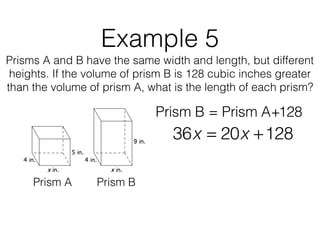
Example 5
Prisms A and B have the same width and length, but different
heights. If the volume of prism B is 128 cubic inches greater
than the volume of prism A, what is the length of each prism?
Prism B = Prism A+128
Prism A Prism B
36x = 20x +128
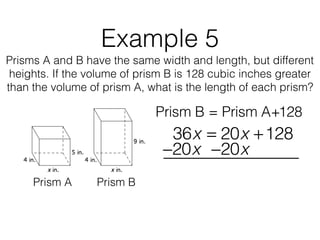
Example 5
Prisms A and B have the same width and length, but different
heights. If the volume of prism B is 128 cubic inches greater
than the volume of prism A, what is the length of each prism?
Prism B = Prism A+128
Prism A Prism B
36x = 20x +128
−20x−20x
Example 5
Prisms A and B have the same width and length, but different
heights. If the volume of prism B is 128 cubic inches greater
than the volume of prism A, what is the length of each prism?
Prism B = Prism A+128
Prism A Prism B
36x = 20x +128
16x = 128
−20x−20x
Example 5
Prisms A and B have the same width and length, but different
heights. If the volume of prism B is 128 cubic inches greater
than the volume of prism A, what is the length of each prism?
Prism B = Prism A+128
Prism A Prism B
36x = 20x +128
16x = 128
−20x−20x
16 16
Example 5
Prisms A and B have the same width and length, but different
heights. If the volume of prism B is 128 cubic inches greater
than the volume of prism A, what is the length of each prism?
Prism B = Prism A+128
Prism A Prism B
36x = 20x +128
16x = 128
−20x−20x
16 16
x = 8
Example 5
Prisms A and B have the same width and length, but different
heights. If the volume of prism B is 128 cubic inches greater
than the volume of prism A, what is the length of each prism?
Prism B = Prism A+128
Prism A Prism B
36x = 20x +128
16x = 128
−20x−20x
16 16
x = 8
The length of each prism is 8 inches.
Problem Set
Problem Set
p. 850 #1-12,16-19 all; skip #4
“It is never too late to be what you might have been.”
- George Eliot

Geometry Section 12-4

  • 1.
    Section 12-4 Volumes ofPrisms and Cylinders
  • 2.
    Essential Questions • Howdo you find volumes of prisms? • How do you find volumes of cylinders?
  • 3.
  • 4.
    Vocabulary Refresh 1.Volume: Theamount of space inside a three-dimensional object
  • 5.
  • 6.
    Volume of aPrism V = Bh
  • 7.
    Volume of aPrism V = Bh B = area of the base
  • 8.
    Volume of aPrism V = Bh B = area of the base h = height of the prism
  • 9.
    Example 1 Find thevolume of the prism.
  • 10.
    Example 1 Find thevolume of the prism. V = Bh
  • 11.
    Example 1 Find thevolume of the prism. V = Bh B = area of the triangle base
  • 12.
    Example 1 Find thevolume of the prism. V = Bh B = area of the triangle base V = 1 2 (10)(12)(25)
  • 13.
    Example 1 Find thevolume of the prism. V = Bh B = area of the triangle base V = 1 2 (10)(12)(25) V = 1500 cm3
  • 14.
    Volume of aCylinder
  • 15.
    Volume of aCylinder V = Bh or V = πr2 h
  • 16.
    Volume of aCylinder V = Bh or V = πr2 h B = area of the base: B = πr2
  • 17.
    Volume of aCylinder h = height of the cylinder V = Bh or V = πr2 h B = area of the base: B = πr2
  • 18.
    Example 2 Find thevolume of the cylinder to the nearest hundredth.
  • 19.
    Example 2 Find thevolume of the cylinder to the nearest hundredth. V = πr2 h
  • 20.
    Example 2 Find thevolume of the cylinder to the nearest hundredth. V = πr2 h V = π(8)2 (22)
  • 21.
    Example 2 Find thevolume of the cylinder to the nearest hundredth. V = πr2 h V = π(8)2 (22) V = 1408π
  • 22.
    Example 2 Find thevolume of the cylinder to the nearest hundredth. V = πr2 h V = π(8)2 (22) V = 1408π V ≈ 4423.36 mm3
  • 23.
    Example 3 Find thevolume of the cylinder to the nearest hundredth. For an oblique prism or cylinder, it’s the same process! Make sure you use the height of the prism/cylinder (perpendicular distance between bases)!
  • 24.
    Example 3 Find thevolume of the cylinder to the nearest hundredth. V = πr2 h For an oblique prism or cylinder, it’s the same process! Make sure you use the height of the prism/cylinder (perpendicular distance between bases)!
  • 25.
    Example 3 Find thevolume of the cylinder to the nearest hundredth. V = πr2 h V = π(8)2 (22) For an oblique prism or cylinder, it’s the same process! Make sure you use the height of the prism/cylinder (perpendicular distance between bases)!
  • 26.
    Example 3 Find thevolume of the cylinder to the nearest hundredth. V = πr2 h V = π(8)2 (22) V = 1408π For an oblique prism or cylinder, it’s the same process! Make sure you use the height of the prism/cylinder (perpendicular distance between bases)!
  • 27.
    Example 3 Find thevolume of the cylinder to the nearest hundredth. V = πr2 h V = π(8)2 (22) V = 1408π V ≈ 4423.36 mm3 For an oblique prism or cylinder, it’s the same process! Make sure you use the height of the prism/cylinder (perpendicular distance between bases)!
  • 28.
    Example 4 Find thevolume of the prism.
  • 29.
    Example 4 Find thevolume of the prism. V = Bh
  • 30.
    Example 4 Find thevolume of the prism. V = Bh V = (13)(10)(17)
  • 31.
    Example 4 Find thevolume of the prism. V = Bh V = (13)(10)(17) V = 2210 in3
  • 32.
    Example 5 Prisms Aand B have the same width and length, but different heights. If the volume of prism B is 128 cubic inches greater than the volume of prism A, what is the length of each prism? Prism A Prism B
  • 33.
    Example 5 Prisms Aand B have the same width and length, but different heights. If the volume of prism B is 128 cubic inches greater than the volume of prism A, what is the length of each prism? Prism A Prism B Prism A
  • 34.
    Example 5 Prisms Aand B have the same width and length, but different heights. If the volume of prism B is 128 cubic inches greater than the volume of prism A, what is the length of each prism? V = (4)(x)(5) Prism A Prism B Prism A
  • 35.
    Example 5 Prisms Aand B have the same width and length, but different heights. If the volume of prism B is 128 cubic inches greater than the volume of prism A, what is the length of each prism? V = (4)(x)(5) Prism A Prism B Prism A V = 20x
  • 36.
    Example 5 Prisms Aand B have the same width and length, but different heights. If the volume of prism B is 128 cubic inches greater than the volume of prism A, what is the length of each prism? V = (4)(x)(5) Prism A Prism B Prism A V = 20x Prism B
  • 37.
    Example 5 Prisms Aand B have the same width and length, but different heights. If the volume of prism B is 128 cubic inches greater than the volume of prism A, what is the length of each prism? V = (4)(x)(5) Prism A Prism B Prism A V = 20x V = (4)(x)(9) Prism B
  • 38.
    Example 5 Prisms Aand B have the same width and length, but different heights. If the volume of prism B is 128 cubic inches greater than the volume of prism A, what is the length of each prism? V = (4)(x)(5) Prism A Prism B Prism A V = 20x V = (4)(x)(9) Prism B V = 36x
  • 39.
    Example 5 Prisms Aand B have the same width and length, but different heights. If the volume of prism B is 128 cubic inches greater than the volume of prism A, what is the length of each prism? Prism A Prism B
  • 40.
    Example 5 Prisms Aand B have the same width and length, but different heights. If the volume of prism B is 128 cubic inches greater than the volume of prism A, what is the length of each prism? Prism B = Prism A+128 Prism A Prism B
  • 41.
    Example 5 Prisms Aand B have the same width and length, but different heights. If the volume of prism B is 128 cubic inches greater than the volume of prism A, what is the length of each prism? Prism B = Prism A+128 Prism A Prism B 36x = 20x +128
  • 42.
    Example 5 Prisms Aand B have the same width and length, but different heights. If the volume of prism B is 128 cubic inches greater than the volume of prism A, what is the length of each prism? Prism B = Prism A+128 Prism A Prism B 36x = 20x +128 −20x−20x
  • 43.
    Example 5 Prisms Aand B have the same width and length, but different heights. If the volume of prism B is 128 cubic inches greater than the volume of prism A, what is the length of each prism? Prism B = Prism A+128 Prism A Prism B 36x = 20x +128 16x = 128 −20x−20x
  • 44.
    Example 5 Prisms Aand B have the same width and length, but different heights. If the volume of prism B is 128 cubic inches greater than the volume of prism A, what is the length of each prism? Prism B = Prism A+128 Prism A Prism B 36x = 20x +128 16x = 128 −20x−20x 16 16
  • 45.
    Example 5 Prisms Aand B have the same width and length, but different heights. If the volume of prism B is 128 cubic inches greater than the volume of prism A, what is the length of each prism? Prism B = Prism A+128 Prism A Prism B 36x = 20x +128 16x = 128 −20x−20x 16 16 x = 8
  • 46.
    Example 5 Prisms Aand B have the same width and length, but different heights. If the volume of prism B is 128 cubic inches greater than the volume of prism A, what is the length of each prism? Prism B = Prism A+128 Prism A Prism B 36x = 20x +128 16x = 128 −20x−20x 16 16 x = 8 The length of each prism is 8 inches.
  • 47.
  • 48.
    Problem Set p. 850#1-12,16-19 all; skip #4 “It is never too late to be what you might have been.” - George Eliot