EXTENDING AREA, SURFACE AREA, AND
VOLUME
CHAPTER 11/12
AREAS OF PARALLELOGRAMS,
TRIANGLES, RHOMBI, AND
TRAPEZOIDS
SECTION 11-1 AND 11-2
ESSENTIAL QUESTIONS
• How do you find perimeters and areas of
parallelograms?
• How do you find perimeters and areas of
triangles?
• How do you find areas of trapezoids?
• How do you find areas of rhombi and kites?
VOCABULARY
1. Base of a Parallelogram:
2. Height of a Parallelogram:
3. Base of a Triangle:
4. Height of a Triangle:
5. Height of a Trapezoid:
VOCABULARY
1. Base of a Parallelogram:
2. Height of a Parallelogram:
3. Base of a Triangle:
4. Height of a Triangle:
5. Height of a Trapezoid:
Can be any side of a parallelogram
VOCABULARY
1. Base of a Parallelogram:
2. Height of a Parallelogram:
3. Base of a Triangle:
4. Height of a Triangle:
5. Height of a Trapezoid:
Can be any side of a parallelogram
The perpendicular distance between
any two parallel bases of a parallelogram
VOCABULARY
1. Base of a Parallelogram:
2. Height of a Parallelogram:
3. Base of a Triangle:
4. Height of a Triangle:
5. Height of a Trapezoid:
Can be any side of a parallelogram
The perpendicular distance between
any two parallel bases of a parallelogram
Can be any side of a triangle
VOCABULARY
1. Base of a Parallelogram:
2. Height of a Parallelogram:
3. Base of a Triangle:
4. Height of a Triangle:
5. Height of a Trapezoid:
Can be any side of a parallelogram
The perpendicular distance between
any two parallel bases of a parallelogram
Can be any side of a triangle
The length of a segment perpendicular to a
base to the opposite vertex
VOCABULARY
1. Base of a Parallelogram:
2. Height of a Parallelogram:
3. Base of a Triangle:
4. Height of a Triangle:
5. Height of a Trapezoid:
Can be any side of a parallelogram
The perpendicular distance between
any two parallel bases of a parallelogram
Can be any side of a triangle
The length of a segment perpendicular to a
base to the opposite vertex
The perpendicular distance between bases
EXAMPLE 1
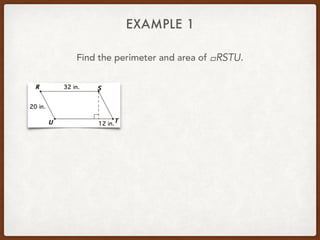
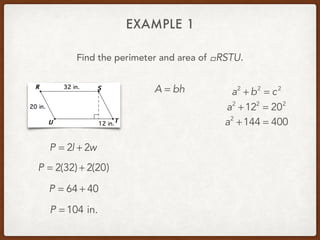
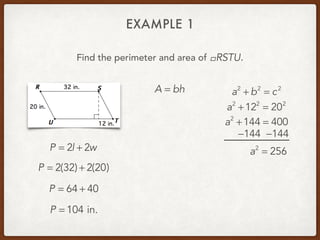
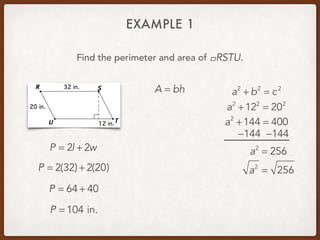
Find the perimeter and area of .!RSTU
EXAMPLE 1
Find the perimeter and area of .!RSTU
P = 2l + 2w
EXAMPLE 1
Find the perimeter and area of .!RSTU
P = 2l + 2w
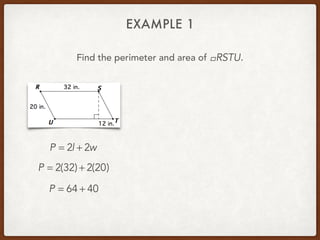
P = 2(32) + 2(20)
EXAMPLE 1
Find the perimeter and area of .!RSTU
P = 2l + 2w
P = 2(32) + 2(20)
P = 64 + 40
EXAMPLE 1
Find the perimeter and area of .!RSTU
P = 2l + 2w
P = 2(32) + 2(20)
P = 64 + 40
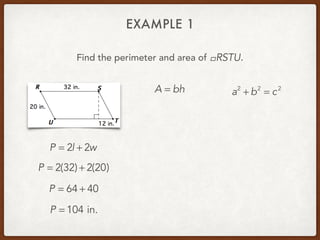
P = 104 in.
EXAMPLE 1
Find the perimeter and area of .!RSTU
P = 2l + 2w
P = 2(32) + 2(20)
P = 64 + 40
P = 104 in.
A = bh
EXAMPLE 1
Find the perimeter and area of .!RSTU
P = 2l + 2w
P = 2(32) + 2(20)
P = 64 + 40
P = 104 in.
A = bh a2
+ b2
= c2
EXAMPLE 1
Find the perimeter and area of .!RSTU
P = 2l + 2w
P = 2(32) + 2(20)
P = 64 + 40
P = 104 in.
A = bh a2
+ b2
= c2
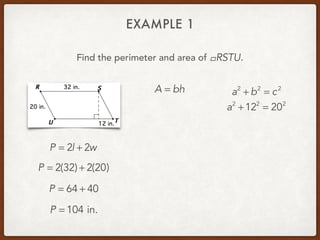
a2
+122
= 202
EXAMPLE 1
Find the perimeter and area of .!RSTU
P = 2l + 2w
P = 2(32) + 2(20)
P = 64 + 40
P = 104 in.
A = bh a2
+ b2
= c2
a2
+122
= 202
a2
+144 = 400
EXAMPLE 1
Find the perimeter and area of .!RSTU
P = 2l + 2w
P = 2(32) + 2(20)
P = 64 + 40
P = 104 in.
A = bh a2
+ b2
= c2
a2
+122
= 202
a2
+144 = 400
−144 −144
EXAMPLE 1
Find the perimeter and area of .!RSTU
P = 2l + 2w
P = 2(32) + 2(20)
P = 64 + 40
P = 104 in.
A = bh a2
+ b2
= c2
a2
+122
= 202
a2
+144 = 400
−144 −144
a2
= 256
EXAMPLE 1
Find the perimeter and area of .!RSTU
P = 2l + 2w
P = 2(32) + 2(20)
P = 64 + 40
P = 104 in.
A = bh a2
+ b2
= c2
a2
+122
= 202
a2
+144 = 400
−144 −144
a2
= 256
a2
= 256
EXAMPLE 1
Find the perimeter and area of .!RSTU
P = 2l + 2w
P = 2(32) + 2(20)
P = 64 + 40
P = 104 in.
A = bh a2
+ b2
= c2
a2
+122
= 202
a2
+144 = 400
−144 −144
a2
= 256
a2
= 256
a = 16
EXAMPLE 1
Find the perimeter and area of .!RSTU
P = 2l + 2w
P = 2(32) + 2(20)
P = 64 + 40
P = 104 in.
A = bh a2
+ b2
= c2
a2
+122
= 202
a2
+144 = 400
−144 −144
a2
= 256
a2
= 256
a = 16
h = 16
EXAMPLE 1
Find the perimeter and area of .!RSTU
P = 2l + 2w
P = 2(32) + 2(20)
P = 64 + 40
P = 104 in.
A = bh a2
+ b2
= c2
a2
+122
= 202
a2
+144 = 400
−144 −144
a2
= 256
a2
= 256
a = 16
h = 16
A = 32(16)
EXAMPLE 1
Find the perimeter and area of .!RSTU
P = 2l + 2w
P = 2(32) + 2(20)
P = 64 + 40
P = 104 in.
A = bh a2
+ b2
= c2
a2
+122
= 202
a2
+144 = 400
−144 −144
a2
= 256
a2
= 256
a = 16
h = 16
A = 32(16)
A = 512 in2
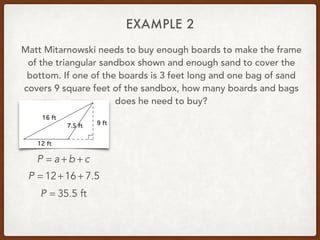
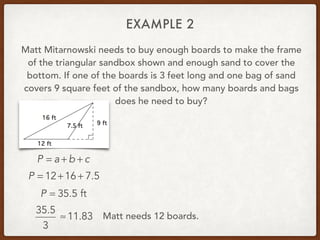
EXAMPLE 2
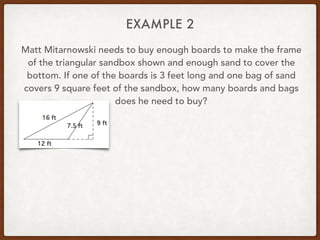
Matt Mitarnowski needs to buy enough boards to make the frame
of the triangular sandbox shown and enough sand to cover the
bottom. If one of the boards is 3 feet long and one bag of sand
covers 9 square feet of the sandbox, how many boards and bags
does he need to buy?
EXAMPLE 2
Matt Mitarnowski needs to buy enough boards to make the frame
of the triangular sandbox shown and enough sand to cover the
bottom. If one of the boards is 3 feet long and one bag of sand
covers 9 square feet of the sandbox, how many boards and bags
does he need to buy?
P = a + b + c
EXAMPLE 2
Matt Mitarnowski needs to buy enough boards to make the frame
of the triangular sandbox shown and enough sand to cover the
bottom. If one of the boards is 3 feet long and one bag of sand
covers 9 square feet of the sandbox, how many boards and bags
does he need to buy?
P = a + b + c
P = 12+16 + 7.5
EXAMPLE 2
Matt Mitarnowski needs to buy enough boards to make the frame
of the triangular sandbox shown and enough sand to cover the
bottom. If one of the boards is 3 feet long and one bag of sand
covers 9 square feet of the sandbox, how many boards and bags
does he need to buy?
P = a + b + c
P = 12+16 + 7.5
P = 35.5 ft
EXAMPLE 2
Matt Mitarnowski needs to buy enough boards to make the frame
of the triangular sandbox shown and enough sand to cover the
bottom. If one of the boards is 3 feet long and one bag of sand
covers 9 square feet of the sandbox, how many boards and bags
does he need to buy?
P = a + b + c
P = 12+16 + 7.5
P = 35.5 ft
35.5
3
EXAMPLE 2
Matt Mitarnowski needs to buy enough boards to make the frame
of the triangular sandbox shown and enough sand to cover the
bottom. If one of the boards is 3 feet long and one bag of sand
covers 9 square feet of the sandbox, how many boards and bags
does he need to buy?
P = a + b + c
P = 12+16 + 7.5
P = 35.5 ft
35.5
3
≈ 11.83
EXAMPLE 2
Matt Mitarnowski needs to buy enough boards to make the frame
of the triangular sandbox shown and enough sand to cover the
bottom. If one of the boards is 3 feet long and one bag of sand
covers 9 square feet of the sandbox, how many boards and bags
does he need to buy?
P = a + b + c
P = 12+16 + 7.5
P = 35.5 ft
35.5
3
≈ 11.83 Matt needs 12 boards.
EXAMPLE 2
Matt Mitarnowski needs to buy enough boards to make the frame
of the triangular sandbox shown and enough sand to cover the
bottom. If one of the boards is 3 feet long and one bag of sand
covers 9 square feet of the sandbox, how many boards and bags
does he need to buy?
P = a + b + c
P = 12+16 + 7.5
P = 35.5 ft
35.5
3
≈ 11.83
A = 1
2
bh
Matt needs 12 boards.
EXAMPLE 2
Matt Mitarnowski needs to buy enough boards to make the frame
of the triangular sandbox shown and enough sand to cover the
bottom. If one of the boards is 3 feet long and one bag of sand
covers 9 square feet of the sandbox, how many boards and bags
does he need to buy?
P = a + b + c
P = 12+16 + 7.5
P = 35.5 ft
35.5
3
≈ 11.83
A = 1
2
bh
Matt needs 12 boards.
A = 1
2
(12)(9)
EXAMPLE 2
Matt Mitarnowski needs to buy enough boards to make the frame
of the triangular sandbox shown and enough sand to cover the
bottom. If one of the boards is 3 feet long and one bag of sand
covers 9 square feet of the sandbox, how many boards and bags
does he need to buy?
P = a + b + c
P = 12+16 + 7.5
P = 35.5 ft
35.5
3
≈ 11.83
A = 1
2
bh
Matt needs 12 boards.
A = 1
2
(12)(9)
A = 54 ft2
EXAMPLE 2
Matt Mitarnowski needs to buy enough boards to make the frame
of the triangular sandbox shown and enough sand to cover the
bottom. If one of the boards is 3 feet long and one bag of sand
covers 9 square feet of the sandbox, how many boards and bags
does he need to buy?
P = a + b + c
P = 12+16 + 7.5
P = 35.5 ft
35.5
3
≈ 11.83
A = 1
2
bh
Matt needs 12 boards.
A = 1
2
(12)(9)
A = 54 ft2
54
9
EXAMPLE 2
Matt Mitarnowski needs to buy enough boards to make the frame
of the triangular sandbox shown and enough sand to cover the
bottom. If one of the boards is 3 feet long and one bag of sand
covers 9 square feet of the sandbox, how many boards and bags
does he need to buy?
P = a + b + c
P = 12+16 + 7.5
P = 35.5 ft
35.5
3
≈ 11.83
A = 1
2
bh
Matt needs 12 boards.
A = 1
2
(12)(9)
A = 54 ft2
54
9
= 6
EXAMPLE 2
Matt Mitarnowski needs to buy enough boards to make the frame
of the triangular sandbox shown and enough sand to cover the
bottom. If one of the boards is 3 feet long and one bag of sand
covers 9 square feet of the sandbox, how many boards and bags
does he need to buy?
P = a + b + c
P = 12+16 + 7.5
P = 35.5 ft
35.5
3
≈ 11.83
A = 1
2
bh
Matt needs 12 boards.
A = 1
2
(12)(9)
A = 54 ft2
54
9
= 6
Matt needs 6 bags of
sand.
POSTULATE 11.2
If two figures are congruent, then they have the same area.
EXAMPLE 3
Find the area of the trapezoid.
EXAMPLE 3
Find the area of the trapezoid.
A = 1
2
h(b1
+ b2
)
EXAMPLE 3
Find the area of the trapezoid.
A = 1
2
h(b1
+ b2
)
A = 1
2
(1)(3 + 2.5)
EXAMPLE 3
Find the area of the trapezoid.
A = 1
2
h(b1
+ b2
)
A = 1
2
(1)(3 + 2.5)
A = 1
2
(5.5)
EXAMPLE 3
Find the area of the trapezoid.
A = 1
2
h(b1
+ b2
)
A = 1
2
(1)(3 + 2.5)
A = 1
2
(5.5)
A = 2.75 cm2
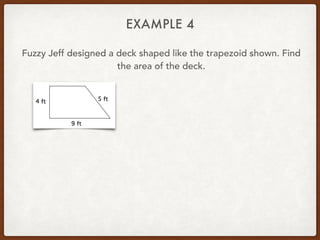
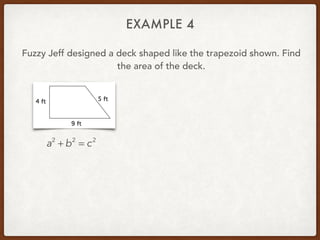
EXAMPLE 4
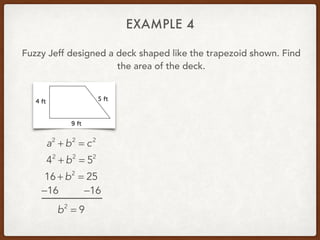
Fuzzy Jeff designed a deck shaped like the trapezoid shown. Find
the area of the deck.
EXAMPLE 4
Fuzzy Jeff designed a deck shaped like the trapezoid shown. Find
the area of the deck.
a2
+ b2
= c2
EXAMPLE 4
Fuzzy Jeff designed a deck shaped like the trapezoid shown. Find
the area of the deck.
a2
+ b2
= c2
42
+ b2
= 52
EXAMPLE 4
Fuzzy Jeff designed a deck shaped like the trapezoid shown. Find
the area of the deck.
a2
+ b2
= c2
42
+ b2
= 52
16 + b2
= 25
EXAMPLE 4
Fuzzy Jeff designed a deck shaped like the trapezoid shown. Find
the area of the deck.
a2
+ b2
= c2
42
+ b2
= 52
16 + b2
= 25
−16 −16
EXAMPLE 4
Fuzzy Jeff designed a deck shaped like the trapezoid shown. Find
the area of the deck.
a2
+ b2
= c2
42
+ b2
= 52
16 + b2
= 25
−16 −16
b2
= 9
EXAMPLE 4
Fuzzy Jeff designed a deck shaped like the trapezoid shown. Find
the area of the deck.
a2
+ b2
= c2
42
+ b2
= 52
16 + b2
= 25
−16 −16
b2
= 9
b2
= 9
EXAMPLE 4
Fuzzy Jeff designed a deck shaped like the trapezoid shown. Find
the area of the deck.
a2
+ b2
= c2
42
+ b2
= 52
16 + b2
= 25
−16 −16
b2
= 9
b2
= 9 b = 3
EXAMPLE 4
Fuzzy Jeff designed a deck shaped like the trapezoid shown. Find
the area of the deck.
a2
+ b2
= c2
42
+ b2
= 52
16 + b2
= 25
−16 −16
b2
= 9
b2
= 9 b = 3
b1
= 9; b2
= 9 − 3 = 6
EXAMPLE 4
Fuzzy Jeff designed a deck shaped like the trapezoid shown. Find
the area of the deck.
a2
+ b2
= c2
42
+ b2
= 52
16 + b2
= 25
−16 −16
b2
= 9
b2
= 9 b = 3
b1
= 9; b2
= 9 − 3 = 6
A = 1
2
h(b1
+ b2
)
EXAMPLE 4
Fuzzy Jeff designed a deck shaped like the trapezoid shown. Find
the area of the deck.
a2
+ b2
= c2
42
+ b2
= 52
16 + b2
= 25
−16 −16
b2
= 9
b2
= 9 b = 3
b1
= 9; b2
= 9 − 3 = 6
A = 1
2
h(b1
+ b2
)
A = 1
2
(4)(6 + 9)
EXAMPLE 4
Fuzzy Jeff designed a deck shaped like the trapezoid shown. Find
the area of the deck.
a2
+ b2
= c2
42
+ b2
= 52
16 + b2
= 25
−16 −16
b2
= 9
b2
= 9 b = 3
b1
= 9; b2
= 9 − 3 = 6
A = 1
2
h(b1
+ b2
)
A = 1
2
(4)(6 + 9)
A = (2)(15)
EXAMPLE 4
Fuzzy Jeff designed a deck shaped like the trapezoid shown. Find
the area of the deck.
a2
+ b2
= c2
42
+ b2
= 52
16 + b2
= 25
−16 −16
b2
= 9
b2
= 9 b = 3
b1
= 9; b2
= 9 − 3 = 6
A = 1
2
h(b1
+ b2
)
A = 1
2
(4)(6 + 9)
A = (2)(15)
A = 30 ft2
EXAMPLE 5
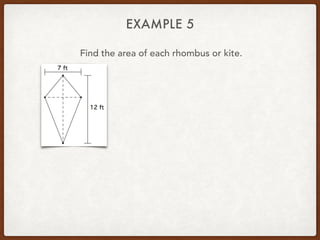
Find the area of each rhombus or kite.
EXAMPLE 5
Find the area of each rhombus or kite.
A = 1
2
d1
d2
EXAMPLE 5
Find the area of each rhombus or kite.
A = 1
2
d1
d2
A = 1
2
(7)(12)
EXAMPLE 5
Find the area of each rhombus or kite.
A = 1
2
d1
d2
A = 1
2
(7)(12)
A = 42 ft2
EXAMPLE 5
Find the area of each rhombus or kite.
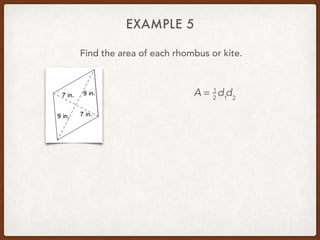
EXAMPLE 5
Find the area of each rhombus or kite.
A = 1
2
d1
d2
EXAMPLE 5
Find the area of each rhombus or kite.
A = 1
2
d1
d2
A = 1
2
(14)(18)
EXAMPLE 5
Find the area of each rhombus or kite.
A = 1
2
d1
d2
A = 1
2
(14)(18)
A = 126 in2
EXAMPLE 6
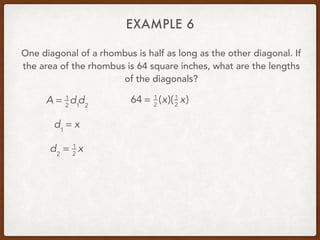
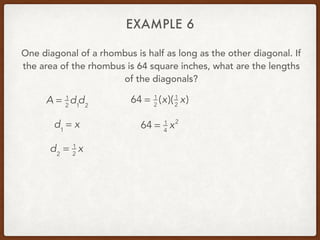
One diagonal of a rhombus is half as long as the other diagonal. If
the area of the rhombus is 64 square inches, what are the lengths
of the diagonals?
EXAMPLE 6
One diagonal of a rhombus is half as long as the other diagonal. If
the area of the rhombus is 64 square inches, what are the lengths
of the diagonals?
A = 1
2
d1
d2
EXAMPLE 6
One diagonal of a rhombus is half as long as the other diagonal. If
the area of the rhombus is 64 square inches, what are the lengths
of the diagonals?
A = 1
2
d1
d2
d1
= x
EXAMPLE 6
One diagonal of a rhombus is half as long as the other diagonal. If
the area of the rhombus is 64 square inches, what are the lengths
of the diagonals?
A = 1
2
d1
d2
d1
= x
d2
= 1
2
x
EXAMPLE 6
One diagonal of a rhombus is half as long as the other diagonal. If
the area of the rhombus is 64 square inches, what are the lengths
of the diagonals?
A = 1
2
d1
d2
d1
= x
d2
= 1
2
x
64 = 1
2
(x)(1
2
x)
EXAMPLE 6
One diagonal of a rhombus is half as long as the other diagonal. If
the area of the rhombus is 64 square inches, what are the lengths
of the diagonals?
A = 1
2
d1
d2
d1
= x
d2
= 1
2
x
64 = 1
2
(x)(1
2
x)
64 = 1
4
x2
EXAMPLE 6
One diagonal of a rhombus is half as long as the other diagonal. If
the area of the rhombus is 64 square inches, what are the lengths
of the diagonals?
A = 1
2
d1
d2
d1
= x
d2
= 1
2
x
64 = 1
2
(x)(1
2
x)
64 = 1
4
x2
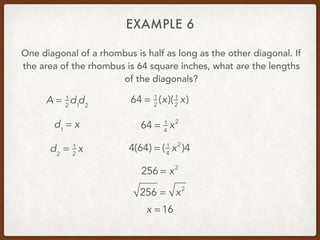
4(64) = ( 1
4
x2
)4
EXAMPLE 6
One diagonal of a rhombus is half as long as the other diagonal. If
the area of the rhombus is 64 square inches, what are the lengths
of the diagonals?
A = 1
2
d1
d2
d1
= x
d2
= 1
2
x
64 = 1
2
(x)(1
2
x)
64 = 1
4
x2
4(64) = ( 1
4
x2
)4
256 = x2
EXAMPLE 6
One diagonal of a rhombus is half as long as the other diagonal. If
the area of the rhombus is 64 square inches, what are the lengths
of the diagonals?
A = 1
2
d1
d2
d1
= x
d2
= 1
2
x
64 = 1
2
(x)(1
2
x)
64 = 1
4
x2
4(64) = ( 1
4
x2
)4
256 = x2
256 = x2
EXAMPLE 6
One diagonal of a rhombus is half as long as the other diagonal. If
the area of the rhombus is 64 square inches, what are the lengths
of the diagonals?
A = 1
2
d1
d2
d1
= x
d2
= 1
2
x
64 = 1
2
(x)(1
2
x)
64 = 1
4
x2
4(64) = ( 1
4
x2
)4
256 = x2
256 = x2
x = 16
EXAMPLE 6
One diagonal of a rhombus is half as long as the other diagonal. If
the area of the rhombus is 64 square inches, what are the lengths
of the diagonals?
A = 1
2
d1
d2
d1
= x
d2
= 1
2
x
64 = 1
2
(x)(1
2
x)
64 = 1
4
x2
4(64) = ( 1
4
x2
)4
256 = x2
256 = x2
x = 16
d1
= 16 in.
EXAMPLE 6
One diagonal of a rhombus is half as long as the other diagonal. If
the area of the rhombus is 64 square inches, what are the lengths
of the diagonals?
A = 1
2
d1
d2
d1
= x
d2
= 1
2
x
64 = 1
2
(x)(1
2
x)
64 = 1
4
x2
4(64) = ( 1
4
x2
)4
256 = x2
256 = x2
x = 16
d1
= 16 in.
d2
= 8 in.
PROBLEM SET
PROBLEM SET
p. 767 #1, 2, 5-9 all; p. 777 #1-13 odd
“The best preparation for tomorrow is doing your best today.”
- H. Jackson Brown, Jr.

Geometry Section 11-1/11-2

  • 1.
    EXTENDING AREA, SURFACEAREA, AND VOLUME CHAPTER 11/12
  • 2.
    AREAS OF PARALLELOGRAMS, TRIANGLES,RHOMBI, AND TRAPEZOIDS SECTION 11-1 AND 11-2
  • 3.
    ESSENTIAL QUESTIONS • Howdo you find perimeters and areas of parallelograms? • How do you find perimeters and areas of triangles? • How do you find areas of trapezoids? • How do you find areas of rhombi and kites?
  • 4.
    VOCABULARY 1. Base ofa Parallelogram: 2. Height of a Parallelogram: 3. Base of a Triangle: 4. Height of a Triangle: 5. Height of a Trapezoid:
  • 5.
    VOCABULARY 1. Base ofa Parallelogram: 2. Height of a Parallelogram: 3. Base of a Triangle: 4. Height of a Triangle: 5. Height of a Trapezoid: Can be any side of a parallelogram
  • 6.
    VOCABULARY 1. Base ofa Parallelogram: 2. Height of a Parallelogram: 3. Base of a Triangle: 4. Height of a Triangle: 5. Height of a Trapezoid: Can be any side of a parallelogram The perpendicular distance between any two parallel bases of a parallelogram
  • 7.
    VOCABULARY 1. Base ofa Parallelogram: 2. Height of a Parallelogram: 3. Base of a Triangle: 4. Height of a Triangle: 5. Height of a Trapezoid: Can be any side of a parallelogram The perpendicular distance between any two parallel bases of a parallelogram Can be any side of a triangle
  • 8.
    VOCABULARY 1. Base ofa Parallelogram: 2. Height of a Parallelogram: 3. Base of a Triangle: 4. Height of a Triangle: 5. Height of a Trapezoid: Can be any side of a parallelogram The perpendicular distance between any two parallel bases of a parallelogram Can be any side of a triangle The length of a segment perpendicular to a base to the opposite vertex
  • 9.
    VOCABULARY 1. Base ofa Parallelogram: 2. Height of a Parallelogram: 3. Base of a Triangle: 4. Height of a Triangle: 5. Height of a Trapezoid: Can be any side of a parallelogram The perpendicular distance between any two parallel bases of a parallelogram Can be any side of a triangle The length of a segment perpendicular to a base to the opposite vertex The perpendicular distance between bases
  • 10.
    EXAMPLE 1 Find theperimeter and area of .!RSTU
  • 11.
    EXAMPLE 1 Find theperimeter and area of .!RSTU P = 2l + 2w
  • 12.
    EXAMPLE 1 Find theperimeter and area of .!RSTU P = 2l + 2w P = 2(32) + 2(20)
  • 13.
    EXAMPLE 1 Find theperimeter and area of .!RSTU P = 2l + 2w P = 2(32) + 2(20) P = 64 + 40
  • 14.
    EXAMPLE 1 Find theperimeter and area of .!RSTU P = 2l + 2w P = 2(32) + 2(20) P = 64 + 40 P = 104 in.
  • 15.
    EXAMPLE 1 Find theperimeter and area of .!RSTU P = 2l + 2w P = 2(32) + 2(20) P = 64 + 40 P = 104 in. A = bh
  • 16.
    EXAMPLE 1 Find theperimeter and area of .!RSTU P = 2l + 2w P = 2(32) + 2(20) P = 64 + 40 P = 104 in. A = bh a2 + b2 = c2
  • 17.
    EXAMPLE 1 Find theperimeter and area of .!RSTU P = 2l + 2w P = 2(32) + 2(20) P = 64 + 40 P = 104 in. A = bh a2 + b2 = c2 a2 +122 = 202
  • 18.
    EXAMPLE 1 Find theperimeter and area of .!RSTU P = 2l + 2w P = 2(32) + 2(20) P = 64 + 40 P = 104 in. A = bh a2 + b2 = c2 a2 +122 = 202 a2 +144 = 400
  • 19.
    EXAMPLE 1 Find theperimeter and area of .!RSTU P = 2l + 2w P = 2(32) + 2(20) P = 64 + 40 P = 104 in. A = bh a2 + b2 = c2 a2 +122 = 202 a2 +144 = 400 −144 −144
  • 20.
    EXAMPLE 1 Find theperimeter and area of .!RSTU P = 2l + 2w P = 2(32) + 2(20) P = 64 + 40 P = 104 in. A = bh a2 + b2 = c2 a2 +122 = 202 a2 +144 = 400 −144 −144 a2 = 256
  • 21.
    EXAMPLE 1 Find theperimeter and area of .!RSTU P = 2l + 2w P = 2(32) + 2(20) P = 64 + 40 P = 104 in. A = bh a2 + b2 = c2 a2 +122 = 202 a2 +144 = 400 −144 −144 a2 = 256 a2 = 256
  • 22.
    EXAMPLE 1 Find theperimeter and area of .!RSTU P = 2l + 2w P = 2(32) + 2(20) P = 64 + 40 P = 104 in. A = bh a2 + b2 = c2 a2 +122 = 202 a2 +144 = 400 −144 −144 a2 = 256 a2 = 256 a = 16
  • 23.
    EXAMPLE 1 Find theperimeter and area of .!RSTU P = 2l + 2w P = 2(32) + 2(20) P = 64 + 40 P = 104 in. A = bh a2 + b2 = c2 a2 +122 = 202 a2 +144 = 400 −144 −144 a2 = 256 a2 = 256 a = 16 h = 16
  • 24.
    EXAMPLE 1 Find theperimeter and area of .!RSTU P = 2l + 2w P = 2(32) + 2(20) P = 64 + 40 P = 104 in. A = bh a2 + b2 = c2 a2 +122 = 202 a2 +144 = 400 −144 −144 a2 = 256 a2 = 256 a = 16 h = 16 A = 32(16)
  • 25.
    EXAMPLE 1 Find theperimeter and area of .!RSTU P = 2l + 2w P = 2(32) + 2(20) P = 64 + 40 P = 104 in. A = bh a2 + b2 = c2 a2 +122 = 202 a2 +144 = 400 −144 −144 a2 = 256 a2 = 256 a = 16 h = 16 A = 32(16) A = 512 in2
  • 26.
    EXAMPLE 2 Matt Mitarnowskineeds to buy enough boards to make the frame of the triangular sandbox shown and enough sand to cover the bottom. If one of the boards is 3 feet long and one bag of sand covers 9 square feet of the sandbox, how many boards and bags does he need to buy?
  • 27.
    EXAMPLE 2 Matt Mitarnowskineeds to buy enough boards to make the frame of the triangular sandbox shown and enough sand to cover the bottom. If one of the boards is 3 feet long and one bag of sand covers 9 square feet of the sandbox, how many boards and bags does he need to buy? P = a + b + c
  • 28.
    EXAMPLE 2 Matt Mitarnowskineeds to buy enough boards to make the frame of the triangular sandbox shown and enough sand to cover the bottom. If one of the boards is 3 feet long and one bag of sand covers 9 square feet of the sandbox, how many boards and bags does he need to buy? P = a + b + c P = 12+16 + 7.5
  • 29.
    EXAMPLE 2 Matt Mitarnowskineeds to buy enough boards to make the frame of the triangular sandbox shown and enough sand to cover the bottom. If one of the boards is 3 feet long and one bag of sand covers 9 square feet of the sandbox, how many boards and bags does he need to buy? P = a + b + c P = 12+16 + 7.5 P = 35.5 ft
  • 30.
    EXAMPLE 2 Matt Mitarnowskineeds to buy enough boards to make the frame of the triangular sandbox shown and enough sand to cover the bottom. If one of the boards is 3 feet long and one bag of sand covers 9 square feet of the sandbox, how many boards and bags does he need to buy? P = a + b + c P = 12+16 + 7.5 P = 35.5 ft 35.5 3
  • 31.
    EXAMPLE 2 Matt Mitarnowskineeds to buy enough boards to make the frame of the triangular sandbox shown and enough sand to cover the bottom. If one of the boards is 3 feet long and one bag of sand covers 9 square feet of the sandbox, how many boards and bags does he need to buy? P = a + b + c P = 12+16 + 7.5 P = 35.5 ft 35.5 3 ≈ 11.83
  • 32.
    EXAMPLE 2 Matt Mitarnowskineeds to buy enough boards to make the frame of the triangular sandbox shown and enough sand to cover the bottom. If one of the boards is 3 feet long and one bag of sand covers 9 square feet of the sandbox, how many boards and bags does he need to buy? P = a + b + c P = 12+16 + 7.5 P = 35.5 ft 35.5 3 ≈ 11.83 Matt needs 12 boards.
  • 33.
    EXAMPLE 2 Matt Mitarnowskineeds to buy enough boards to make the frame of the triangular sandbox shown and enough sand to cover the bottom. If one of the boards is 3 feet long and one bag of sand covers 9 square feet of the sandbox, how many boards and bags does he need to buy? P = a + b + c P = 12+16 + 7.5 P = 35.5 ft 35.5 3 ≈ 11.83 A = 1 2 bh Matt needs 12 boards.
  • 34.
    EXAMPLE 2 Matt Mitarnowskineeds to buy enough boards to make the frame of the triangular sandbox shown and enough sand to cover the bottom. If one of the boards is 3 feet long and one bag of sand covers 9 square feet of the sandbox, how many boards and bags does he need to buy? P = a + b + c P = 12+16 + 7.5 P = 35.5 ft 35.5 3 ≈ 11.83 A = 1 2 bh Matt needs 12 boards. A = 1 2 (12)(9)
  • 35.
    EXAMPLE 2 Matt Mitarnowskineeds to buy enough boards to make the frame of the triangular sandbox shown and enough sand to cover the bottom. If one of the boards is 3 feet long and one bag of sand covers 9 square feet of the sandbox, how many boards and bags does he need to buy? P = a + b + c P = 12+16 + 7.5 P = 35.5 ft 35.5 3 ≈ 11.83 A = 1 2 bh Matt needs 12 boards. A = 1 2 (12)(9) A = 54 ft2
  • 36.
    EXAMPLE 2 Matt Mitarnowskineeds to buy enough boards to make the frame of the triangular sandbox shown and enough sand to cover the bottom. If one of the boards is 3 feet long and one bag of sand covers 9 square feet of the sandbox, how many boards and bags does he need to buy? P = a + b + c P = 12+16 + 7.5 P = 35.5 ft 35.5 3 ≈ 11.83 A = 1 2 bh Matt needs 12 boards. A = 1 2 (12)(9) A = 54 ft2 54 9
  • 37.
    EXAMPLE 2 Matt Mitarnowskineeds to buy enough boards to make the frame of the triangular sandbox shown and enough sand to cover the bottom. If one of the boards is 3 feet long and one bag of sand covers 9 square feet of the sandbox, how many boards and bags does he need to buy? P = a + b + c P = 12+16 + 7.5 P = 35.5 ft 35.5 3 ≈ 11.83 A = 1 2 bh Matt needs 12 boards. A = 1 2 (12)(9) A = 54 ft2 54 9 = 6
  • 38.
    EXAMPLE 2 Matt Mitarnowskineeds to buy enough boards to make the frame of the triangular sandbox shown and enough sand to cover the bottom. If one of the boards is 3 feet long and one bag of sand covers 9 square feet of the sandbox, how many boards and bags does he need to buy? P = a + b + c P = 12+16 + 7.5 P = 35.5 ft 35.5 3 ≈ 11.83 A = 1 2 bh Matt needs 12 boards. A = 1 2 (12)(9) A = 54 ft2 54 9 = 6 Matt needs 6 bags of sand.
  • 39.
    POSTULATE 11.2 If twofigures are congruent, then they have the same area.
  • 40.
    EXAMPLE 3 Find thearea of the trapezoid.
  • 41.
    EXAMPLE 3 Find thearea of the trapezoid. A = 1 2 h(b1 + b2 )
  • 42.
    EXAMPLE 3 Find thearea of the trapezoid. A = 1 2 h(b1 + b2 ) A = 1 2 (1)(3 + 2.5)
  • 43.
    EXAMPLE 3 Find thearea of the trapezoid. A = 1 2 h(b1 + b2 ) A = 1 2 (1)(3 + 2.5) A = 1 2 (5.5)
  • 44.
    EXAMPLE 3 Find thearea of the trapezoid. A = 1 2 h(b1 + b2 ) A = 1 2 (1)(3 + 2.5) A = 1 2 (5.5) A = 2.75 cm2
  • 45.
    EXAMPLE 4 Fuzzy Jeffdesigned a deck shaped like the trapezoid shown. Find the area of the deck.
  • 46.
    EXAMPLE 4 Fuzzy Jeffdesigned a deck shaped like the trapezoid shown. Find the area of the deck. a2 + b2 = c2
  • 47.
    EXAMPLE 4 Fuzzy Jeffdesigned a deck shaped like the trapezoid shown. Find the area of the deck. a2 + b2 = c2 42 + b2 = 52
  • 48.
    EXAMPLE 4 Fuzzy Jeffdesigned a deck shaped like the trapezoid shown. Find the area of the deck. a2 + b2 = c2 42 + b2 = 52 16 + b2 = 25
  • 49.
    EXAMPLE 4 Fuzzy Jeffdesigned a deck shaped like the trapezoid shown. Find the area of the deck. a2 + b2 = c2 42 + b2 = 52 16 + b2 = 25 −16 −16
  • 50.
    EXAMPLE 4 Fuzzy Jeffdesigned a deck shaped like the trapezoid shown. Find the area of the deck. a2 + b2 = c2 42 + b2 = 52 16 + b2 = 25 −16 −16 b2 = 9
  • 51.
    EXAMPLE 4 Fuzzy Jeffdesigned a deck shaped like the trapezoid shown. Find the area of the deck. a2 + b2 = c2 42 + b2 = 52 16 + b2 = 25 −16 −16 b2 = 9 b2 = 9
  • 52.
    EXAMPLE 4 Fuzzy Jeffdesigned a deck shaped like the trapezoid shown. Find the area of the deck. a2 + b2 = c2 42 + b2 = 52 16 + b2 = 25 −16 −16 b2 = 9 b2 = 9 b = 3
  • 53.
    EXAMPLE 4 Fuzzy Jeffdesigned a deck shaped like the trapezoid shown. Find the area of the deck. a2 + b2 = c2 42 + b2 = 52 16 + b2 = 25 −16 −16 b2 = 9 b2 = 9 b = 3 b1 = 9; b2 = 9 − 3 = 6
  • 54.
    EXAMPLE 4 Fuzzy Jeffdesigned a deck shaped like the trapezoid shown. Find the area of the deck. a2 + b2 = c2 42 + b2 = 52 16 + b2 = 25 −16 −16 b2 = 9 b2 = 9 b = 3 b1 = 9; b2 = 9 − 3 = 6 A = 1 2 h(b1 + b2 )
  • 55.
    EXAMPLE 4 Fuzzy Jeffdesigned a deck shaped like the trapezoid shown. Find the area of the deck. a2 + b2 = c2 42 + b2 = 52 16 + b2 = 25 −16 −16 b2 = 9 b2 = 9 b = 3 b1 = 9; b2 = 9 − 3 = 6 A = 1 2 h(b1 + b2 ) A = 1 2 (4)(6 + 9)
  • 56.
    EXAMPLE 4 Fuzzy Jeffdesigned a deck shaped like the trapezoid shown. Find the area of the deck. a2 + b2 = c2 42 + b2 = 52 16 + b2 = 25 −16 −16 b2 = 9 b2 = 9 b = 3 b1 = 9; b2 = 9 − 3 = 6 A = 1 2 h(b1 + b2 ) A = 1 2 (4)(6 + 9) A = (2)(15)
  • 57.
    EXAMPLE 4 Fuzzy Jeffdesigned a deck shaped like the trapezoid shown. Find the area of the deck. a2 + b2 = c2 42 + b2 = 52 16 + b2 = 25 −16 −16 b2 = 9 b2 = 9 b = 3 b1 = 9; b2 = 9 − 3 = 6 A = 1 2 h(b1 + b2 ) A = 1 2 (4)(6 + 9) A = (2)(15) A = 30 ft2
  • 58.
    EXAMPLE 5 Find thearea of each rhombus or kite.
  • 59.
    EXAMPLE 5 Find thearea of each rhombus or kite. A = 1 2 d1 d2
  • 60.
    EXAMPLE 5 Find thearea of each rhombus or kite. A = 1 2 d1 d2 A = 1 2 (7)(12)
  • 61.
    EXAMPLE 5 Find thearea of each rhombus or kite. A = 1 2 d1 d2 A = 1 2 (7)(12) A = 42 ft2
  • 62.
    EXAMPLE 5 Find thearea of each rhombus or kite.
  • 63.
    EXAMPLE 5 Find thearea of each rhombus or kite. A = 1 2 d1 d2
  • 64.
    EXAMPLE 5 Find thearea of each rhombus or kite. A = 1 2 d1 d2 A = 1 2 (14)(18)
  • 65.
    EXAMPLE 5 Find thearea of each rhombus or kite. A = 1 2 d1 d2 A = 1 2 (14)(18) A = 126 in2
  • 66.
    EXAMPLE 6 One diagonalof a rhombus is half as long as the other diagonal. If the area of the rhombus is 64 square inches, what are the lengths of the diagonals?
  • 67.
    EXAMPLE 6 One diagonalof a rhombus is half as long as the other diagonal. If the area of the rhombus is 64 square inches, what are the lengths of the diagonals? A = 1 2 d1 d2
  • 68.
    EXAMPLE 6 One diagonalof a rhombus is half as long as the other diagonal. If the area of the rhombus is 64 square inches, what are the lengths of the diagonals? A = 1 2 d1 d2 d1 = x
  • 69.
    EXAMPLE 6 One diagonalof a rhombus is half as long as the other diagonal. If the area of the rhombus is 64 square inches, what are the lengths of the diagonals? A = 1 2 d1 d2 d1 = x d2 = 1 2 x
  • 70.
    EXAMPLE 6 One diagonalof a rhombus is half as long as the other diagonal. If the area of the rhombus is 64 square inches, what are the lengths of the diagonals? A = 1 2 d1 d2 d1 = x d2 = 1 2 x 64 = 1 2 (x)(1 2 x)
  • 71.
    EXAMPLE 6 One diagonalof a rhombus is half as long as the other diagonal. If the area of the rhombus is 64 square inches, what are the lengths of the diagonals? A = 1 2 d1 d2 d1 = x d2 = 1 2 x 64 = 1 2 (x)(1 2 x) 64 = 1 4 x2
  • 72.
    EXAMPLE 6 One diagonalof a rhombus is half as long as the other diagonal. If the area of the rhombus is 64 square inches, what are the lengths of the diagonals? A = 1 2 d1 d2 d1 = x d2 = 1 2 x 64 = 1 2 (x)(1 2 x) 64 = 1 4 x2 4(64) = ( 1 4 x2 )4
  • 73.
    EXAMPLE 6 One diagonalof a rhombus is half as long as the other diagonal. If the area of the rhombus is 64 square inches, what are the lengths of the diagonals? A = 1 2 d1 d2 d1 = x d2 = 1 2 x 64 = 1 2 (x)(1 2 x) 64 = 1 4 x2 4(64) = ( 1 4 x2 )4 256 = x2
  • 74.
    EXAMPLE 6 One diagonalof a rhombus is half as long as the other diagonal. If the area of the rhombus is 64 square inches, what are the lengths of the diagonals? A = 1 2 d1 d2 d1 = x d2 = 1 2 x 64 = 1 2 (x)(1 2 x) 64 = 1 4 x2 4(64) = ( 1 4 x2 )4 256 = x2 256 = x2
  • 75.
    EXAMPLE 6 One diagonalof a rhombus is half as long as the other diagonal. If the area of the rhombus is 64 square inches, what are the lengths of the diagonals? A = 1 2 d1 d2 d1 = x d2 = 1 2 x 64 = 1 2 (x)(1 2 x) 64 = 1 4 x2 4(64) = ( 1 4 x2 )4 256 = x2 256 = x2 x = 16
  • 76.
    EXAMPLE 6 One diagonalof a rhombus is half as long as the other diagonal. If the area of the rhombus is 64 square inches, what are the lengths of the diagonals? A = 1 2 d1 d2 d1 = x d2 = 1 2 x 64 = 1 2 (x)(1 2 x) 64 = 1 4 x2 4(64) = ( 1 4 x2 )4 256 = x2 256 = x2 x = 16 d1 = 16 in.
  • 77.
    EXAMPLE 6 One diagonalof a rhombus is half as long as the other diagonal. If the area of the rhombus is 64 square inches, what are the lengths of the diagonals? A = 1 2 d1 d2 d1 = x d2 = 1 2 x 64 = 1 2 (x)(1 2 x) 64 = 1 4 x2 4(64) = ( 1 4 x2 )4 256 = x2 256 = x2 x = 16 d1 = 16 in. d2 = 8 in.
  • 78.
  • 79.
    PROBLEM SET p. 767#1, 2, 5-9 all; p. 777 #1-13 odd “The best preparation for tomorrow is doing your best today.” - H. Jackson Brown, Jr.