
UUNNIITT 1111..22 SSUURRFFAACCEE AARREEAASS OOFF 
PPRRIISSMMSS AANNDD CCYYLLIINNDDEERRSS
Warm Up 
Find the perimeter and area of 
each polygon. 
1. a rectangle with base 14 cm and height 
9 cm 
2. a right triangle with 9 cm and 12 cm 
legs 
3. an equilateral triangle with side length 
6 cm 
P = 46 cm; A = 126 cm2 
P = 36 cm; A = 54 cm2
Objectives 
Learn and apply the formula for the 
surface area of a prism. 
Learn and apply the formula for the 
surface area of a cylinder.
lateral face 
lateral edge 
right prism 
oblique prism 
altitude 
surface area 
lateral surface 
axis of a cylinder 
right cylinder 
oblique cylinder 
Vocabulary
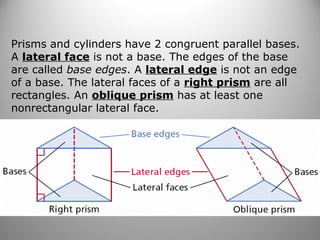
Prisms and cylinders have 2 congruent parallel bases. 
A lateral face is not a base. The edges of the base 
are called base edges. A lateral edge is not an edge 
of a base. The lateral faces of a right prism are all 
rectangles. An oblique prism has at least one 
nonrectangular lateral face.
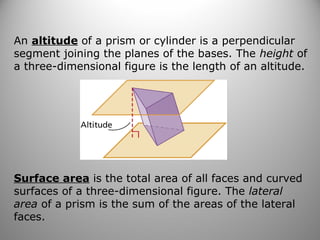
An altitude of a prism or cylinder is a perpendicular 
segment joining the planes of the bases. The height of 
a three-dimensional figure is the length of an altitude. 
Surface area is the total area of all faces and curved 
surfaces of a three-dimensional figure. The lateral 
area of a prism is the sum of the areas of the lateral 
faces.
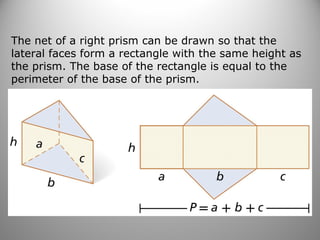
The net of a right prism can be drawn so that the 
lateral faces form a rectangle with the same height as 
the prism. The base of the rectangle is equal to the 
perimeter of the base of the prism.
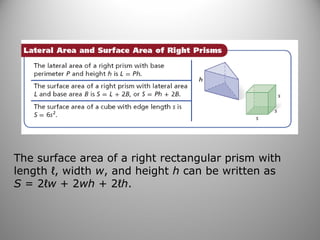
The surface area of a right rectangular prism with 
length ℓ, width w, and height h can be written as 
S = 2ℓw + 2wh + 2ℓh.
Caution! 
The surface area formula is only true for right 
prisms. To find the surface area of an oblique 
prism, add the areas of the faces.
Example 1A: Finding Lateral Areas and Surface Areas 
of Prisms 
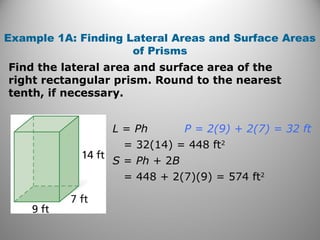
Find the lateral area and surface area of the 
right rectangular prism. Round to the nearest 
tenth, if necessary. 
L = Ph 
= 32(14) = 448 ft2 
S = Ph + 2B 
= 448 + 2(7)(9) = 574 ft2 
P = 2(9) + 2(7) = 32 ft
Example 1B: Finding Lateral Areas and Surface Areas 
of Prisms 
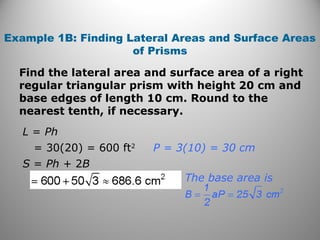
Find the lateral area and surface area of a right 
regular triangular prism with height 20 cm and 
base edges of length 10 cm. Round to the 
nearest tenth, if necessary. 
L = Ph 
= 30(20) = 600 ft2 
S = Ph + 2B 
P = 3(10) = 30 cm 
The base area is
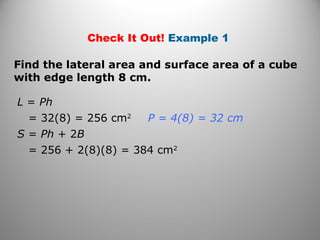
Check It Out! Example 1 
Find the lateral area and surface area of a cube 
with edge length 8 cm. 
L = Ph 
= 32(8) = 256 cm2 
S = Ph + 2B 
= 256 + 2(8)(8) = 384 cm2 
P = 4(8) = 32 cm
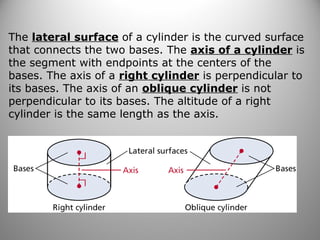
The lateral surface of a cylinder is the curved surface 
that connects the two bases. The axis of a cylinder is 
the segment with endpoints at the centers of the 
bases. The axis of a right cylinder is perpendicular to 
its bases. The axis of an oblique cylinder is not 
perpendicular to its bases. The altitude of a right 
cylinder is the same length as the axis.
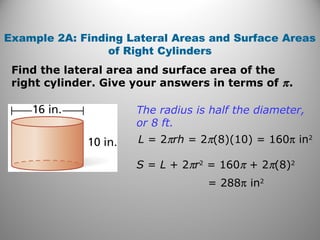
Example 2A: Finding Lateral Areas and Surface Areas 
of Right Cylinders 
Find the lateral area and surface area of the 
right cylinder. Give your answers in terms of p . 
The radius is half the diameter, 
or 8 ft. 
L = 2prh = 2p(8)(10) = 160p in2 
S = L + 2pr2 = 160p + 2p(8)2 
= 288p in2
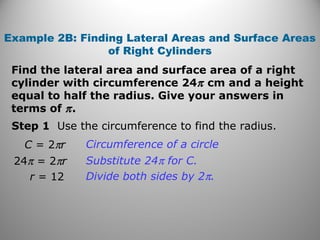
Example 2B: Finding Lateral Areas and Surface Areas 
of Right Cylinders 
Find the lateral area and surface area of a right 
cylinder with circumference 24p cm and a height 
equal to half the radius. Give your answers in 
terms of p . 
Step 1 Use the circumference to find the radius. 
C = 2pr Circumference of a circle 
24p = 2pr Substitute 24p for C. 
r = 12 Divide both sides by 2p.
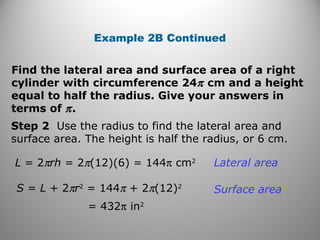
Example 2B Continued 
Find the lateral area and surface area of a right 
cylinder with circumference 24p cm and a height 
equal to half the radius. Give your answers in 
terms of p . 
Step 2 Use the radius to find the lateral area and 
surface area. The height is half the radius, or 6 cm. 
L = 2prh = 2p(12)(6) = 144p cm2 
S = L + 2pr2 = 144p + 2p(12)2 
= 432p in2 
Lateral area 
Surface area
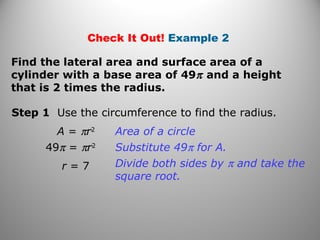
Check It Out! Example 2 
Find the lateral area and surface area of a 
cylinder with a base area of 49p and a height 
that is 2 times the radius. 
Step 1 Use the circumference to find the radius. 
A = pr2 
49p = pr2 
r = 7 
Area of a circle 
Substitute 49p for A. 
Divide both sides by p and take the 
square root.
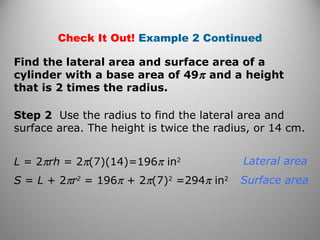
Check It Out! Example 2 Continued 
Find the lateral area and surface area of a 
cylinder with a base area of 49p and a height 
that is 2 times the radius. 
Step 2 Use the radius to find the lateral area and 
surface area. The height is twice the radius, or 14 cm. 
L = 2prh = 2p(7)(14)=196p in2 
S = L + 2pr2 = 196p + 2p(7)2 =294p in2 
Lateral area 
Surface area
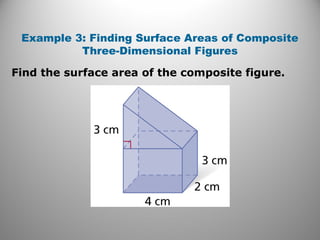
Example 3: Finding Surface Areas of Composite 
Three-Dimensional Figures 
Find the surface area of the composite figure.
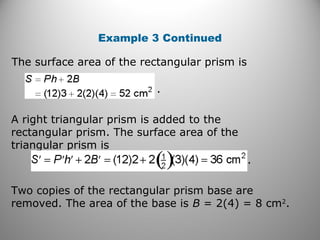
Example 3 Continued 
The surface area of the rectangular prism is 
. 
. 
A right triangular prism is added to the 
rectangular prism. The surface area of the 
triangular prism is 
Two copies of the rectangular prism base are 
removed. The area of the base is B = 2(4) = 8 cm2.
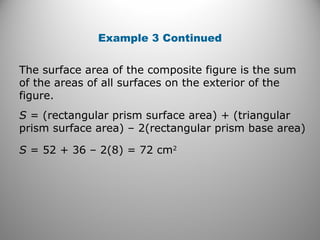
Example 3 Continued 
The surface area of the composite figure is the sum 
of the areas of all surfaces on the exterior of the 
figure. 
S = (rectangular prism surface area) + (triangular 
prism surface area) – 2(rectangular prism base area) 
S = 52 + 36 – 2(8) = 72 cm2
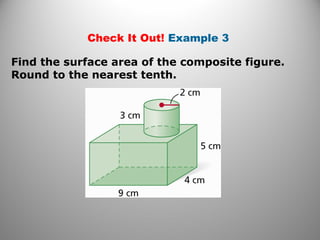
Check It Out! Example 3 
Find the surface area of the composite figure. 
Round to the nearest tenth.
Check It Out! Example 3 Continued 
Find the surface area of the composite figure. 
Round to the nearest tenth. 
The surface area of the rectangular prism is 
S =Ph + 2B = 26(5) + 2(36) = 202 cm2. 
The surface area of the cylinder is 
S =Ph + 2B = 2p(2)(3) + 2p(2)2 = 20p ≈ 62.8 cm2. 
The surface area of the composite figure is the sum 
of the areas of all surfaces on the exterior of the 
figure.
Check It Out! Example 3 Continued 
Find the surface area of the composite figure. 
Round to the nearest tenth. 
S = (rectangular surface area) + 
(cylinder surface area) – 2(cylinder base area) 
S = 202 + 62.8 — 2(p)(22) = 239.7 cm2
Remember! 
Always round at the last step of the problem. Use 
the value of p given by the p key on your 
calculator.
Example 4: Exploring Effects of Changing Dimensions 
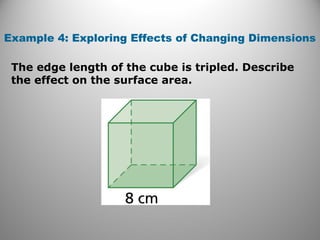
The edge length of the cube is tripled. Describe 
the effect on the surface area.
Example 4 Continued 
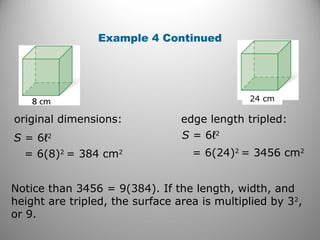
24 cm 
original dimensions: edge length tripled: 
S = 6ℓ2 
= 6(8)2 = 384 cm2 
S = 6ℓ2 
= 6(24)2 = 3456 cm2 
Notice than 3456 = 9(384). If the length, width, and 
height are tripled, the surface area is multiplied by 32, 
or 9.
Check It Out! Example 4 
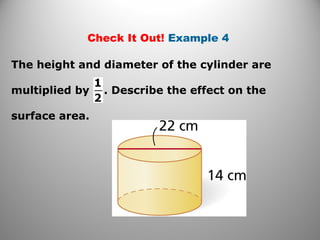
The height and diameter of the cylinder are 
multiplied by . Describe the effect on the 
surface area.
Check It Out! Example 4 Continued 
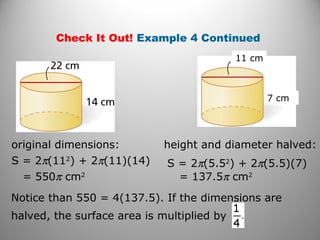
11 cm 
7 cm 
original dimensions: height and diameter halved: 
S = 2p(112) + 2p(11)(14) 
S = 2p(5.52) + 2p(5.5)(7) 
= 550p cm2 
= 137.5p cm2 
Notice than 550 = 4(137.5). If the dimensions are 
halved, the surface area is multiplied by
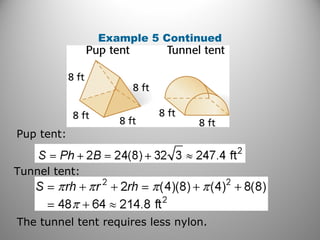
Example 5: Recreation Application 
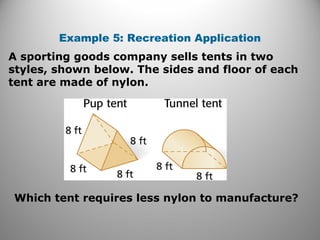
A sporting goods company sells tents in two 
styles, shown below. The sides and floor of each 
tent are made of nylon. 
Which tent requires less nylon to manufacture?
Example 5 Continued 
Pup tent: 
Tunnel tent: 
The tunnel tent requires less nylon.
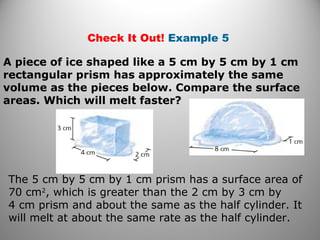
Check It Out! Example 5 
A piece of ice shaped like a 5 cm by 5 cm by 1 cm 
rectangular prism has approximately the same 
volume as the pieces below. Compare the surface 
areas. Which will melt faster? 
The 5 cm by 5 cm by 1 cm prism has a surface area of 
70 cm2, which is greater than the 2 cm by 3 cm by 
4 cm prism and about the same as the half cylinder. It 
will melt at about the same rate as the half cylinder.
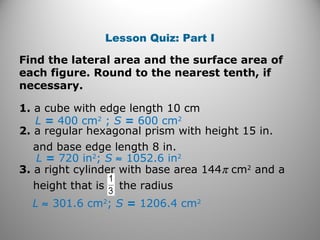
Lesson Quiz: Part I 
Find the lateral area and the surface area of 
each figure. Round to the nearest tenth, if 
necessary. 
1. a cube with edge length 10 cm 
L = 400 cm2 ; S = 600 cm2 
2. a regular hexagonal prism with height 15 in. 
and base edge length 8 in. 
L = 720 in2; S » 1052.6 in2 
3. a right cylinder with base area 144p cm2 and a 
height that is the radius 
L » 301.6 cm2; S = 1206.4 cm2
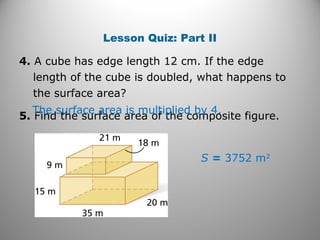
Lesson Quiz: Part II 
4. A cube has edge length 12 cm. If the edge 
length of the cube is doubled, what happens to 
the surface area? 
5. Find the surface area of The surface area is mult ipthliee dc obmy p4o.site figure. 
S = 3752 m2
All rights belong to their 
respective owners. 
Copyright Disclaimer Under 
Section 107 of the Copyright Act 
1976, allowance is made for 
"fair use" for purposes such as 
criticism, comment, news 
reporting, TEACHING, 
scholarship, and research. 
Fair use is a use permitted by 
copyright statute that might 
otherwise be infringing. 
Non-profit, EDUCATIONAL or 
personal use tips the balance in 
favor of fair use.

Geometry unit 11.2

  • 1.
    UUNNIITT 1111..22 SSUURRFFAACCEEAARREEAASS OOFF PPRRIISSMMSS AANNDD CCYYLLIINNDDEERRSS
  • 2.
    Warm Up Findthe perimeter and area of each polygon. 1. a rectangle with base 14 cm and height 9 cm 2. a right triangle with 9 cm and 12 cm legs 3. an equilateral triangle with side length 6 cm P = 46 cm; A = 126 cm2 P = 36 cm; A = 54 cm2
  • 3.
    Objectives Learn andapply the formula for the surface area of a prism. Learn and apply the formula for the surface area of a cylinder.
  • 4.
    lateral face lateraledge right prism oblique prism altitude surface area lateral surface axis of a cylinder right cylinder oblique cylinder Vocabulary
  • 5.
    Prisms and cylindershave 2 congruent parallel bases. A lateral face is not a base. The edges of the base are called base edges. A lateral edge is not an edge of a base. The lateral faces of a right prism are all rectangles. An oblique prism has at least one nonrectangular lateral face.
  • 6.
    An altitude ofa prism or cylinder is a perpendicular segment joining the planes of the bases. The height of a three-dimensional figure is the length of an altitude. Surface area is the total area of all faces and curved surfaces of a three-dimensional figure. The lateral area of a prism is the sum of the areas of the lateral faces.
  • 7.
    The net ofa right prism can be drawn so that the lateral faces form a rectangle with the same height as the prism. The base of the rectangle is equal to the perimeter of the base of the prism.
  • 8.
    The surface areaof a right rectangular prism with length ℓ, width w, and height h can be written as S = 2ℓw + 2wh + 2ℓh.
  • 9.
    Caution! The surfacearea formula is only true for right prisms. To find the surface area of an oblique prism, add the areas of the faces.
  • 10.
    Example 1A: FindingLateral Areas and Surface Areas of Prisms Find the lateral area and surface area of the right rectangular prism. Round to the nearest tenth, if necessary. L = Ph = 32(14) = 448 ft2 S = Ph + 2B = 448 + 2(7)(9) = 574 ft2 P = 2(9) + 2(7) = 32 ft
  • 11.
    Example 1B: FindingLateral Areas and Surface Areas of Prisms Find the lateral area and surface area of a right regular triangular prism with height 20 cm and base edges of length 10 cm. Round to the nearest tenth, if necessary. L = Ph = 30(20) = 600 ft2 S = Ph + 2B P = 3(10) = 30 cm The base area is
  • 12.
    Check It Out!Example 1 Find the lateral area and surface area of a cube with edge length 8 cm. L = Ph = 32(8) = 256 cm2 S = Ph + 2B = 256 + 2(8)(8) = 384 cm2 P = 4(8) = 32 cm
  • 13.
    The lateral surfaceof a cylinder is the curved surface that connects the two bases. The axis of a cylinder is the segment with endpoints at the centers of the bases. The axis of a right cylinder is perpendicular to its bases. The axis of an oblique cylinder is not perpendicular to its bases. The altitude of a right cylinder is the same length as the axis.
  • 15.
    Example 2A: FindingLateral Areas and Surface Areas of Right Cylinders Find the lateral area and surface area of the right cylinder. Give your answers in terms of p . The radius is half the diameter, or 8 ft. L = 2prh = 2p(8)(10) = 160p in2 S = L + 2pr2 = 160p + 2p(8)2 = 288p in2
  • 16.
    Example 2B: FindingLateral Areas and Surface Areas of Right Cylinders Find the lateral area and surface area of a right cylinder with circumference 24p cm and a height equal to half the radius. Give your answers in terms of p . Step 1 Use the circumference to find the radius. C = 2pr Circumference of a circle 24p = 2pr Substitute 24p for C. r = 12 Divide both sides by 2p.
  • 17.
    Example 2B Continued Find the lateral area and surface area of a right cylinder with circumference 24p cm and a height equal to half the radius. Give your answers in terms of p . Step 2 Use the radius to find the lateral area and surface area. The height is half the radius, or 6 cm. L = 2prh = 2p(12)(6) = 144p cm2 S = L + 2pr2 = 144p + 2p(12)2 = 432p in2 Lateral area Surface area
  • 18.
    Check It Out!Example 2 Find the lateral area and surface area of a cylinder with a base area of 49p and a height that is 2 times the radius. Step 1 Use the circumference to find the radius. A = pr2 49p = pr2 r = 7 Area of a circle Substitute 49p for A. Divide both sides by p and take the square root.
  • 19.
    Check It Out!Example 2 Continued Find the lateral area and surface area of a cylinder with a base area of 49p and a height that is 2 times the radius. Step 2 Use the radius to find the lateral area and surface area. The height is twice the radius, or 14 cm. L = 2prh = 2p(7)(14)=196p in2 S = L + 2pr2 = 196p + 2p(7)2 =294p in2 Lateral area Surface area
  • 20.
    Example 3: FindingSurface Areas of Composite Three-Dimensional Figures Find the surface area of the composite figure.
  • 21.
    Example 3 Continued The surface area of the rectangular prism is . . A right triangular prism is added to the rectangular prism. The surface area of the triangular prism is Two copies of the rectangular prism base are removed. The area of the base is B = 2(4) = 8 cm2.
  • 22.
    Example 3 Continued The surface area of the composite figure is the sum of the areas of all surfaces on the exterior of the figure. S = (rectangular prism surface area) + (triangular prism surface area) – 2(rectangular prism base area) S = 52 + 36 – 2(8) = 72 cm2
  • 23.
    Check It Out!Example 3 Find the surface area of the composite figure. Round to the nearest tenth.
  • 24.
    Check It Out!Example 3 Continued Find the surface area of the composite figure. Round to the nearest tenth. The surface area of the rectangular prism is S =Ph + 2B = 26(5) + 2(36) = 202 cm2. The surface area of the cylinder is S =Ph + 2B = 2p(2)(3) + 2p(2)2 = 20p ≈ 62.8 cm2. The surface area of the composite figure is the sum of the areas of all surfaces on the exterior of the figure.
  • 25.
    Check It Out!Example 3 Continued Find the surface area of the composite figure. Round to the nearest tenth. S = (rectangular surface area) + (cylinder surface area) – 2(cylinder base area) S = 202 + 62.8 — 2(p)(22) = 239.7 cm2
  • 26.
    Remember! Always roundat the last step of the problem. Use the value of p given by the p key on your calculator.
  • 27.
    Example 4: ExploringEffects of Changing Dimensions The edge length of the cube is tripled. Describe the effect on the surface area.
  • 28.
    Example 4 Continued 24 cm original dimensions: edge length tripled: S = 6ℓ2 = 6(8)2 = 384 cm2 S = 6ℓ2 = 6(24)2 = 3456 cm2 Notice than 3456 = 9(384). If the length, width, and height are tripled, the surface area is multiplied by 32, or 9.
  • 29.
    Check It Out!Example 4 The height and diameter of the cylinder are multiplied by . Describe the effect on the surface area.
  • 30.
    Check It Out!Example 4 Continued 11 cm 7 cm original dimensions: height and diameter halved: S = 2p(112) + 2p(11)(14) S = 2p(5.52) + 2p(5.5)(7) = 550p cm2 = 137.5p cm2 Notice than 550 = 4(137.5). If the dimensions are halved, the surface area is multiplied by
  • 31.
    Example 5: RecreationApplication A sporting goods company sells tents in two styles, shown below. The sides and floor of each tent are made of nylon. Which tent requires less nylon to manufacture?
  • 32.
    Example 5 Continued Pup tent: Tunnel tent: The tunnel tent requires less nylon.
  • 33.
    Check It Out!Example 5 A piece of ice shaped like a 5 cm by 5 cm by 1 cm rectangular prism has approximately the same volume as the pieces below. Compare the surface areas. Which will melt faster? The 5 cm by 5 cm by 1 cm prism has a surface area of 70 cm2, which is greater than the 2 cm by 3 cm by 4 cm prism and about the same as the half cylinder. It will melt at about the same rate as the half cylinder.
  • 34.
    Lesson Quiz: PartI Find the lateral area and the surface area of each figure. Round to the nearest tenth, if necessary. 1. a cube with edge length 10 cm L = 400 cm2 ; S = 600 cm2 2. a regular hexagonal prism with height 15 in. and base edge length 8 in. L = 720 in2; S » 1052.6 in2 3. a right cylinder with base area 144p cm2 and a height that is the radius L » 301.6 cm2; S = 1206.4 cm2
  • 35.
    Lesson Quiz: PartII 4. A cube has edge length 12 cm. If the edge length of the cube is doubled, what happens to the surface area? 5. Find the surface area of The surface area is mult ipthliee dc obmy p4o.site figure. S = 3752 m2
  • 36.
    All rights belongto their respective owners. Copyright Disclaimer Under Section 107 of the Copyright Act 1976, allowance is made for "fair use" for purposes such as criticism, comment, news reporting, TEACHING, scholarship, and research. Fair use is a use permitted by copyright statute that might otherwise be infringing. Non-profit, EDUCATIONAL or personal use tips the balance in favor of fair use.