5.13.5 Surface Area
The student is able to (I can):
• Calculate the surface area prisms, cylinders, pyramids,
and cones
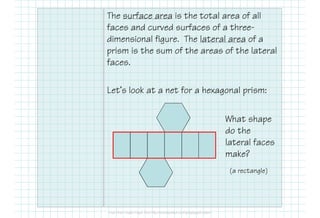
The surface area is the total area of all
faces and curved surfaces of a three-
dimensional figure. The lateral area of a
prism is the sum of the areas of the lateral
faces.
Let’s look at a net for a hexagonal prism:
What shape
do the
lateral faces
make?
(a rectangle)
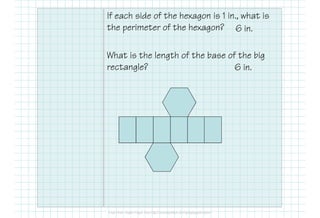
If each side of the hexagon is 1 in., what is
the perimeter of the hexagon?
What is the length of the base of the big
rectangle?
6 in.
6 in.
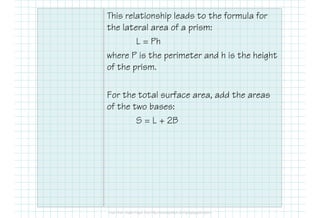
This relationship leads to the formula for
the lateral area of a prism:
L = Ph
where P is the perimeter and h is the height
of the prism.
For the total surface area, add the areas
of the two bases:
S = L + 2B
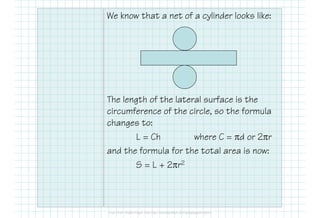
We know that a net of a cylinder looks like:
The length of the lateral surface is the
circumference of the circle, so the formula
changes to:
L = Ch where C = πd or 2πr
and the formula for the total area is now:
S = L + 2πr2
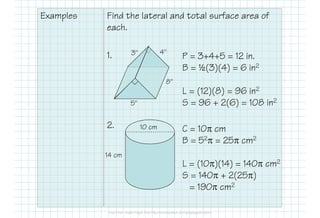
Examples Find the lateral and total surface area of
each.
1.
2. 10 cm
14 cm
4"3"
8"
5"
P = 3+4+5 = 12 in.
B = ½(3)(4) = 6 in2
L = (12)(8) = 96 in2
S = 96 + 2(6) = 108 in2
C = 10π cm
B = 52π = 25π cm2
L = (10π)(14) = 140π cm2
S = 140π + 2(25π)
= 190π cm2
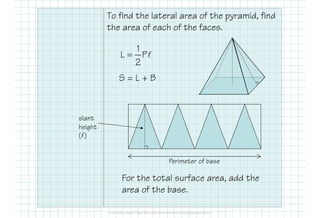
To find the lateral area of the pyramid, find
the area of each of the faces.
Perimeter of base
slant
height
(ℓ)
1
L P
2
= ℓ
For the total surface area, add the
area of the base.
S = L + B
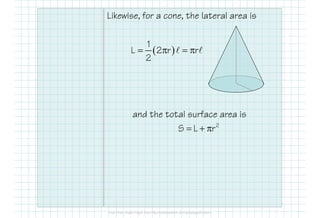
Likewise, for a cone, the lateral area is
( )
1
L 2 r r
2
= π = πℓ ℓ
and the total surface area is
2
S L r= + π
Examples Find the lateral and surface area of the
following:
1.
2.
8 in.
20 in.
5 m
5 m
2
8 3
B 6
4
 
=  
 
2
96 3 in=
1
L [(6)(8)](20)
2
=
2
480 in=
2
S 480 96 3 in= +
2
646.3 in≈
5 2 m L (5)(5 2)= π
2
25 2 m= π
2
S 25 2 25 m= π + π
2
189.6 m≈

5.13.5 Surface Area

  • 1.
    5.13.5 Surface Area Thestudent is able to (I can): • Calculate the surface area prisms, cylinders, pyramids, and cones
  • 2.
    The surface areais the total area of all faces and curved surfaces of a three- dimensional figure. The lateral area of a prism is the sum of the areas of the lateral faces. Let’s look at a net for a hexagonal prism: What shape do the lateral faces make? (a rectangle)
  • 3.
    If each sideof the hexagon is 1 in., what is the perimeter of the hexagon? What is the length of the base of the big rectangle? 6 in. 6 in.
  • 4.
    This relationship leadsto the formula for the lateral area of a prism: L = Ph where P is the perimeter and h is the height of the prism. For the total surface area, add the areas of the two bases: S = L + 2B
  • 5.
    We know thata net of a cylinder looks like: The length of the lateral surface is the circumference of the circle, so the formula changes to: L = Ch where C = πd or 2πr and the formula for the total area is now: S = L + 2πr2
  • 6.
    Examples Find thelateral and total surface area of each. 1. 2. 10 cm 14 cm 4"3" 8" 5" P = 3+4+5 = 12 in. B = ½(3)(4) = 6 in2 L = (12)(8) = 96 in2 S = 96 + 2(6) = 108 in2 C = 10π cm B = 52π = 25π cm2 L = (10π)(14) = 140π cm2 S = 140π + 2(25π) = 190π cm2
  • 7.
    To find thelateral area of the pyramid, find the area of each of the faces. Perimeter of base slant height (ℓ) 1 L P 2 = ℓ For the total surface area, add the area of the base. S = L + B
  • 8.
    Likewise, for acone, the lateral area is ( ) 1 L 2 r r 2 = π = πℓ ℓ and the total surface area is 2 S L r= + π
  • 9.
    Examples Find thelateral and surface area of the following: 1. 2. 8 in. 20 in. 5 m 5 m 2 8 3 B 6 4   =     2 96 3 in= 1 L [(6)(8)](20) 2 = 2 480 in= 2 S 480 96 3 in= + 2 646.3 in≈ 5 2 m L (5)(5 2)= π 2 25 2 m= π 2 S 25 2 25 m= π + π 2 189.6 m≈