SECTION 1-2
Line Segments and Distance
ESSENTIAL QUESTIONS
How do you calculate with measures?
How do yo find the distance between two points?
VOCABULARY
1. Line Segment:
2. Betweenness of Points:
3. Between:
VOCABULARY
1. Line Segment: A portion of a line that is
distinguished due to having endpoints
2. Betweenness of Points:
3. Between:
VOCABULARY
1. Line Segment: A portion of a line that is
distinguished due to having endpoints
AB is “segment AB”;
2. Betweenness of Points:
3. Between:
VOCABULARY
1. Line Segment: A portion of a line that is
distinguished due to having endpoints
AB is “segment AB”; AB is “the measure of AB”
2. Betweenness of Points:
3. Between:
VOCABULARY
1. Line Segment: A portion of a line that is
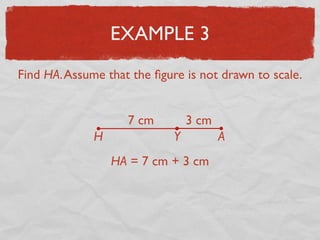
distinguished due to having endpoints
AB is “segment AB”; AB is “the measure of AB”
2. Betweenness of Points: For any two points A and B,
the point C will be between A and B when C is
between A and B on the line
3. Between:
VOCABULARY
1. Line Segment: A portion of a line that is
distinguished due to having endpoints
AB is “segment AB”; AB is “the measure of AB”
2. Betweenness of Points: For any two points A and B,
the point C will be between A and B when C is
between A and B on the line
3. Between: Point K is between points J and L if and
only if (IFF) J, K, and L are collinear and JK + KL = JL
VOCABULARY
4. Congruent:
5. Rigid Transformation:
6. Congruent Segments:
VOCABULARY
4. Congruent: Two figures that have the same shape
and size
5. Rigid Transformation:
6. Congruent Segments:
VOCABULARY
4. Congruent: Two figures that have the same shape
and size
5. Rigid Transformation: When a figure changes
position but keeps the same size and shape
6. Congruent Segments:
VOCABULARY
4. Congruent: Two figures that have the same shape
and size
5. Rigid Transformation: When a figure changes
position but keeps the same size and shape
6. Congruent Segments: Any segments that have the
same measure
VOCABULARY
4. Congruent: Two figures that have the same shape
and size
5. Rigid Transformation: When a figure changes
position but keeps the same size and shape
6. Congruent Segments: Any segments that have the
same measure
AB ≅ CD is “segment AB is congruent to
segment CD”
VOCABULARY
7. Construction:
8. Distance:
9. Irrational Number:
VOCABULARY
7. Construction: The process of drawing geometric
figures using only a compass and straight edge
(ruler)
8. Distance:
9. Irrational Number:
VOCABULARY
7. Construction: The process of drawing geometric
figures using only a compass and straight edge
(ruler)
8. Distance: The length of the segment formed
between two points
9. Irrational Number:
VOCABULARY
7. Construction: The process of drawing geometric
figures using only a compass and straight edge
(ruler)
8. Distance: The length of the segment formed
between two points
9. Irrational Number: A number that cannot by
written as a ratio of two numbers(cannot be
written as a fraction); will be a non-repeating, non-
ending decimal
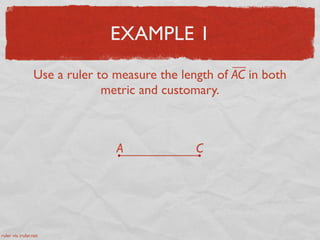
EXAMPLE 1
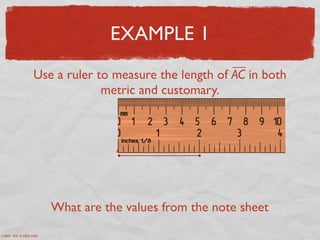
Use a ruler to measure the length of AC in both
metric and customary.
A C
ruler via iruler.net
EXAMPLE 1
Use a ruler to measure the length of AC in both
metric and customary.
A C
ruler via iruler.net
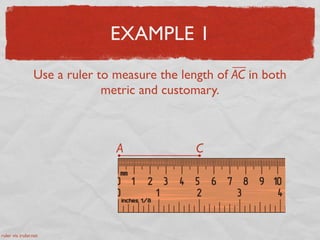
EXAMPLE 1
Use a ruler to measure the length of AC in both
metric and customary.
A C
ruler via iruler.net
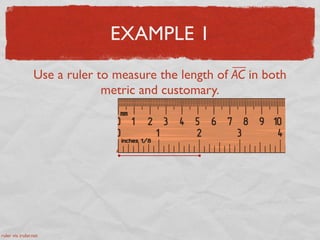
EXAMPLE 1
Use a ruler to measure the length of AC in both
metric and customary.
A C
What are the values from the note sheet
ruler via iruler.net
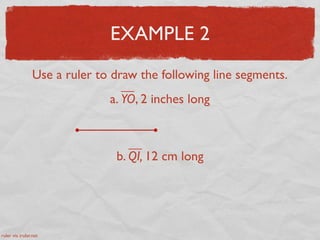
EXAMPLE 2
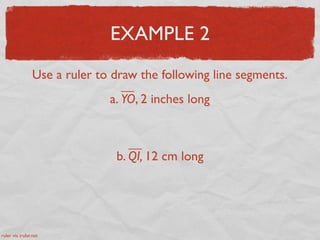
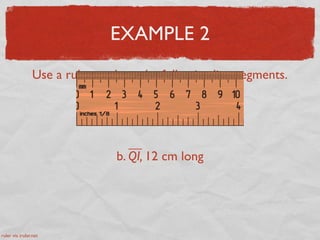
Use a ruler to draw the following line segments.
a. YO, 2 inches long
b. QI, 12 cm long
ruler via iruler.net
EXAMPLE 2
Use a ruler to draw the following line segments.
a. YO, 2 inches long
b. QI, 12 cm long
ruler via iruler.net
EXAMPLE 2
Use a ruler to draw the following line segments.
a. YO, 2 inches long
b. QI, 12 cm long
ruler via iruler.net
EXAMPLE 2
Use a ruler to draw the following line segments.
a. YO, 2 inches long
b. QI, 12 cm long
ruler via iruler.net
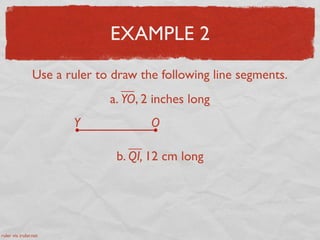
EXAMPLE 2
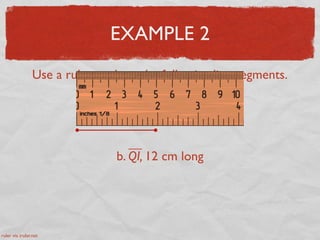
Use a ruler to draw the following line segments.
a. YO, 2 inches long
Y O
b. QI, 12 cm long
ruler via iruler.net
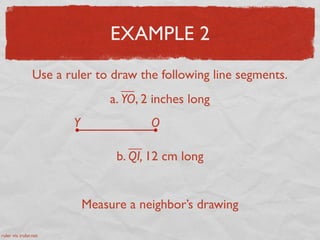
EXAMPLE 2
Use a ruler to draw the following line segments.
a. YO, 2 inches long
Y O
b. QI, 12 cm long
Measure a neighbor’s drawing
ruler via iruler.net
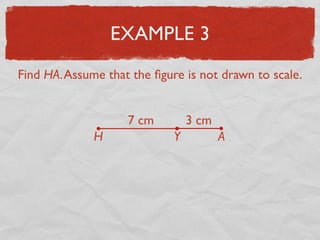
EXAMPLE 3
Find HA.Assume that the figure is not drawn to scale.
7 cm 3 cm
H Y A
EXAMPLE 3
Find HA.Assume that the figure is not drawn to scale.
7 cm 3 cm
H Y A
HA = 7 cm + 3 cm
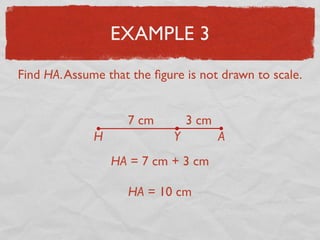
EXAMPLE 3
Find HA.Assume that the figure is not drawn to scale.
7 cm 3 cm
H Y A
HA = 7 cm + 3 cm
HA = 10 cm
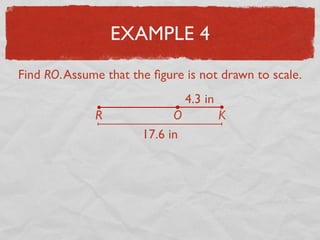
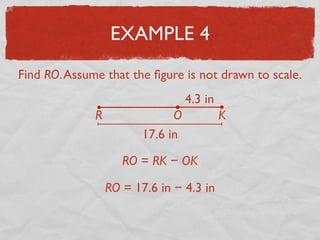
EXAMPLE 4
Find RO.Assume that the figure is not drawn to scale.
17.6 in
4.3 in
R O K
EXAMPLE 4
Find RO.Assume that the figure is not drawn to scale.
17.6 in
4.3 in
R O K
RO = RK − OK
EXAMPLE 4
Find RO.Assume that the figure is not drawn to scale.
17.6 in
4.3 in
R O K
RO = 17.6 in − 4.3 in
RO = RK − OK
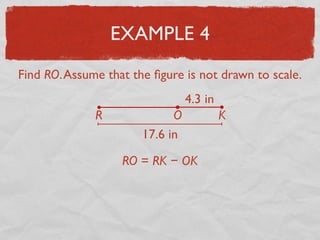
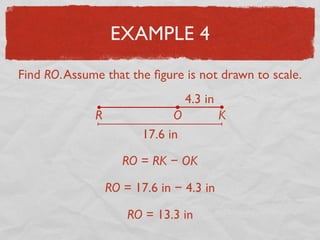
EXAMPLE 4
Find RO.Assume that the figure is not drawn to scale.
17.6 in
4.3 in
R O K
RO = 17.6 in − 4.3 in
RO = RK − OK
RO = 13.3 in
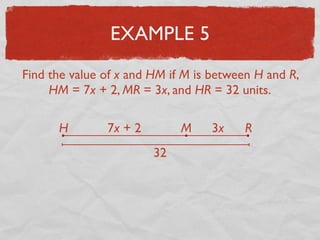
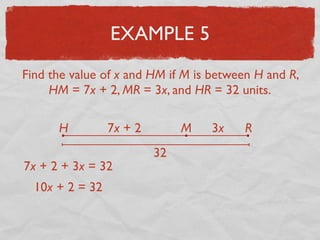
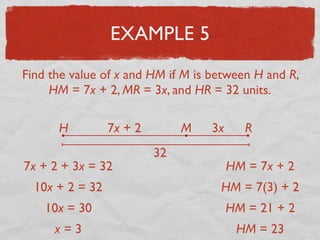
EXAMPLE 5
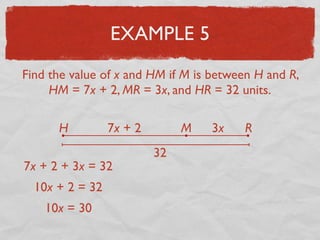
Find the value of x and HM if M is between H and R,
HM = 7x + 2, MR = 3x, and HR = 32 units.
H RM7x + 2 3x
32
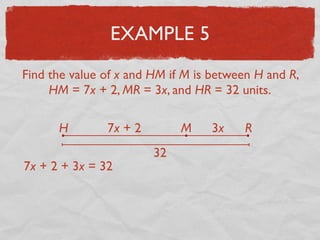
EXAMPLE 5
Find the value of x and HM if M is between H and R,
HM = 7x + 2, MR = 3x, and HR = 32 units.
H RM7x + 2 3x
32
7x + 2 + 3x = 32
EXAMPLE 5
Find the value of x and HM if M is between H and R,
HM = 7x + 2, MR = 3x, and HR = 32 units.
H RM7x + 2 3x
32
7x + 2 + 3x = 32
10x + 2 = 32
EXAMPLE 5
Find the value of x and HM if M is between H and R,
HM = 7x + 2, MR = 3x, and HR = 32 units.
H RM7x + 2 3x
32
7x + 2 + 3x = 32
10x + 2 = 32
10x = 30
EXAMPLE 5
Find the value of x and HM if M is between H and R,
HM = 7x + 2, MR = 3x, and HR = 32 units.
H RM7x + 2 3x
32
7x + 2 + 3x = 32
10x + 2 = 32
10x = 30
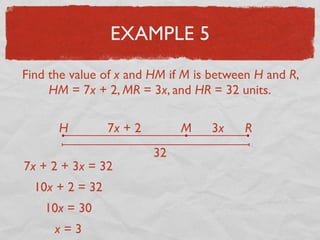
x = 3
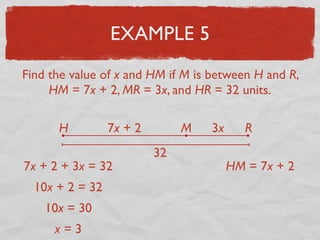
EXAMPLE 5
Find the value of x and HM if M is between H and R,
HM = 7x + 2, MR = 3x, and HR = 32 units.
H RM7x + 2 3x
32
7x + 2 + 3x = 32
10x + 2 = 32
10x = 30
x = 3
HM = 7x + 2
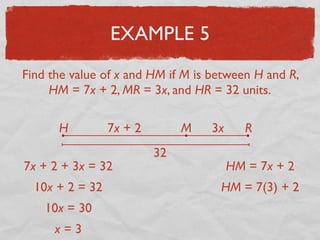
EXAMPLE 5
Find the value of x and HM if M is between H and R,
HM = 7x + 2, MR = 3x, and HR = 32 units.
H RM7x + 2 3x
32
7x + 2 + 3x = 32
10x + 2 = 32
10x = 30
x = 3
HM = 7x + 2
HM = 7(3) + 2
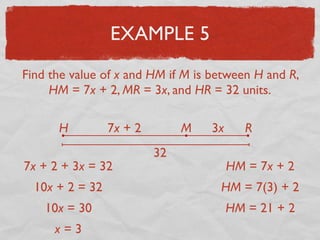
EXAMPLE 5
Find the value of x and HM if M is between H and R,
HM = 7x + 2, MR = 3x, and HR = 32 units.
H RM7x + 2 3x
32
7x + 2 + 3x = 32
10x + 2 = 32
10x = 30
x = 3
HM = 7x + 2
HM = 7(3) + 2
HM = 21 + 2
EXAMPLE 5
Find the value of x and HM if M is between H and R,
HM = 7x + 2, MR = 3x, and HR = 32 units.
H RM7x + 2 3x
32
7x + 2 + 3x = 32
10x + 2 = 32
10x = 30
x = 3
HM = 7x + 2
HM = 7(3) + 2
HM = 21 + 2
HM = 23
DISTANCE FORMULA
DISTANCE FORMULA
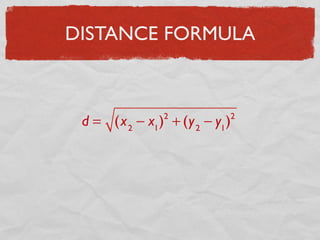
d = (x2
− x1
)2
+ (y2
− y1
)2
DISTANCE FORMULA
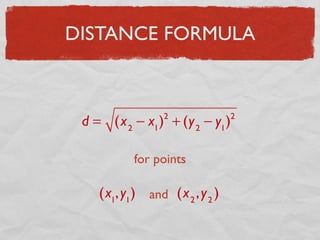
d = (x2
− x1
)2
+ (y2
− y1
)2
for points
(x1
,y1
) and (x2
,y2
)
EXAMPLE 6
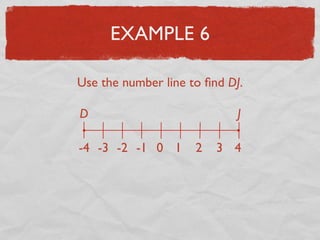
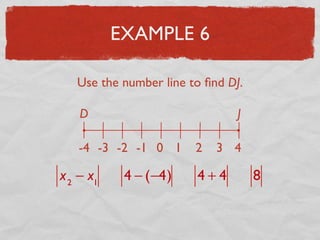
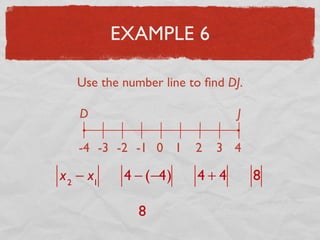
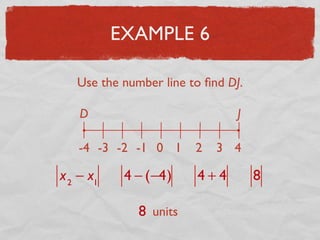
Use the number line to find DJ.
D J
-4 -3 -2 -1 0 1 2 3 4
EXAMPLE 6
Use the number line to find DJ.
D J
-4 -3 -2 -1 0 1 2 3 4
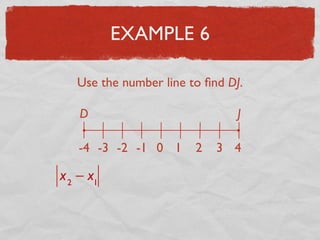
x2
− x1
EXAMPLE 6
Use the number line to find DJ.
D J
-4 -3 -2 -1 0 1 2 3 4
x2
− x1
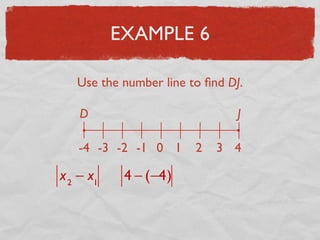
4 − (−4)
EXAMPLE 6
Use the number line to find DJ.
D J
-4 -3 -2 -1 0 1 2 3 4
x2
− x1
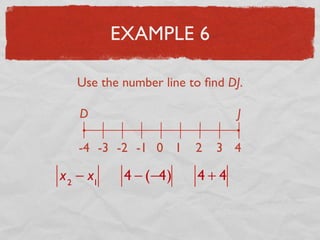
4 − (−4) 4 + 4
EXAMPLE 6
Use the number line to find DJ.
D J
-4 -3 -2 -1 0 1 2 3 4
x2
− x1
4 − (−4) 4 + 4 8
EXAMPLE 6
Use the number line to find DJ.
D J
-4 -3 -2 -1 0 1 2 3 4
x2
− x1
4 − (−4) 4 + 4 8
8
EXAMPLE 6
Use the number line to find DJ.
D J
-4 -3 -2 -1 0 1 2 3 4
x2
− x1
4 − (−4) 4 + 4 8
8 units
EXAMPLE 7
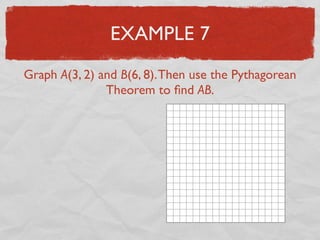
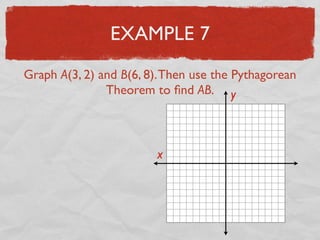
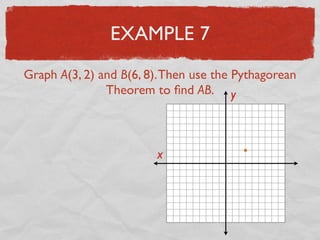
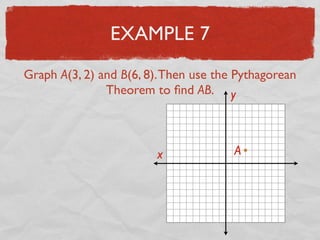
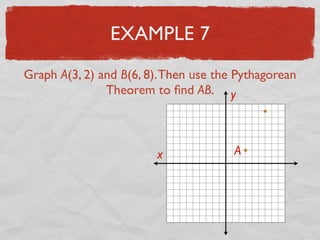
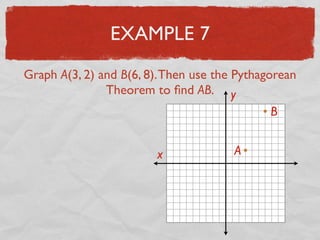
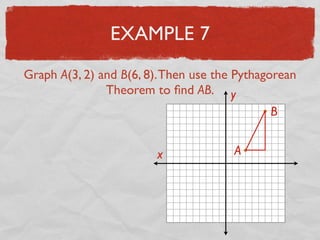
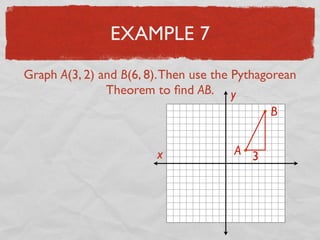
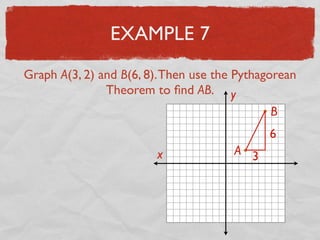
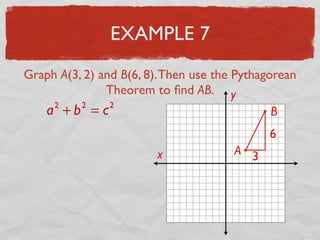
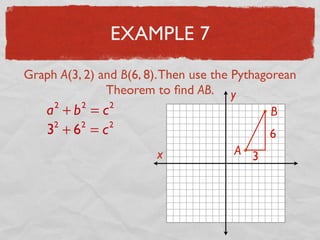
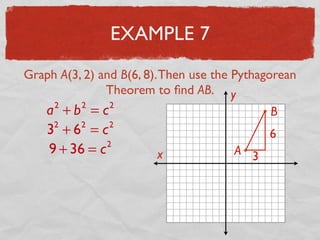
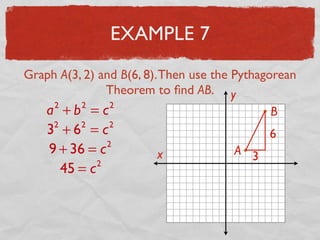
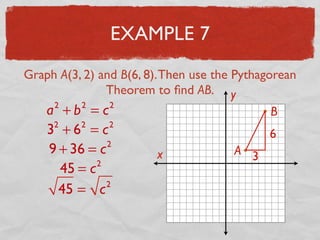
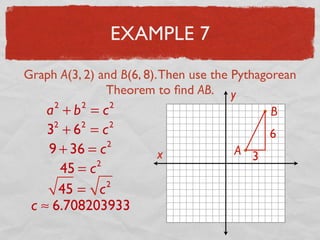
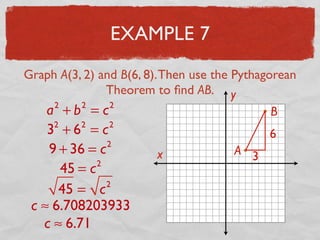
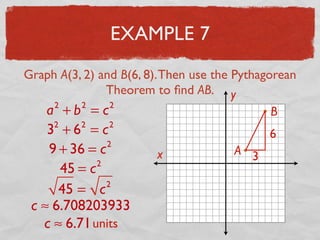
Graph A(3, 2) and B(6, 8).Then use the Pythagorean
Theorem to find AB.
EXAMPLE 7
Graph A(3, 2) and B(6, 8).Then use the Pythagorean
Theorem to find AB.
x
y
EXAMPLE 7
Graph A(3, 2) and B(6, 8).Then use the Pythagorean
Theorem to find AB.
x
y
EXAMPLE 7
Graph A(3, 2) and B(6, 8).Then use the Pythagorean
Theorem to find AB.
x
y
A
EXAMPLE 7
Graph A(3, 2) and B(6, 8).Then use the Pythagorean
Theorem to find AB.
x
y
A
EXAMPLE 7
Graph A(3, 2) and B(6, 8).Then use the Pythagorean
Theorem to find AB.
x
y
A
B
EXAMPLE 7
Graph A(3, 2) and B(6, 8).Then use the Pythagorean
Theorem to find AB.
x
y
A
B
EXAMPLE 7
Graph A(3, 2) and B(6, 8).Then use the Pythagorean
Theorem to find AB.
x
y
A
B
3
EXAMPLE 7
Graph A(3, 2) and B(6, 8).Then use the Pythagorean
Theorem to find AB.
x
y
A
B
3
6
EXAMPLE 7
Graph A(3, 2) and B(6, 8).Then use the Pythagorean
Theorem to find AB.
x
y
A
B
3
6
a2
+ b2
= c2
EXAMPLE 7
Graph A(3, 2) and B(6, 8).Then use the Pythagorean
Theorem to find AB.
x
y
A
B
3
6
a2
+ b2
= c2
32
+ 62
= c2
EXAMPLE 7
Graph A(3, 2) and B(6, 8).Then use the Pythagorean
Theorem to find AB.
x
y
A
B
3
6
a2
+ b2
= c2
32
+ 62
= c2
9 + 36 = c2
EXAMPLE 7
Graph A(3, 2) and B(6, 8).Then use the Pythagorean
Theorem to find AB.
x
y
A
B
3
6
a2
+ b2
= c2
32
+ 62
= c2
9 + 36 = c2
45 = c2
EXAMPLE 7
Graph A(3, 2) and B(6, 8).Then use the Pythagorean
Theorem to find AB.
x
y
A
B
3
6
a2
+ b2
= c2
32
+ 62
= c2
9 + 36 = c2
45 = c2
45 = c2
EXAMPLE 7
Graph A(3, 2) and B(6, 8).Then use the Pythagorean
Theorem to find AB.
x
y
A
B
3
6
a2
+ b2
= c2
32
+ 62
= c2
9 + 36 = c2
45 = c2
45 = c2
c ≈ 6.708203933
EXAMPLE 7
Graph A(3, 2) and B(6, 8).Then use the Pythagorean
Theorem to find AB.
x
y
A
B
3
6
a2
+ b2
= c2
32
+ 62
= c2
9 + 36 = c2
45 = c2
45 = c2
c ≈ 6.708203933
c ≈ 6.71
EXAMPLE 7
Graph A(3, 2) and B(6, 8).Then use the Pythagorean
Theorem to find AB.
x
y
A
B
3
6
a2
+ b2
= c2
32
+ 62
= c2
9 + 36 = c2
45 = c2
45 = c2
c ≈ 6.708203933
c ≈ 6.71units
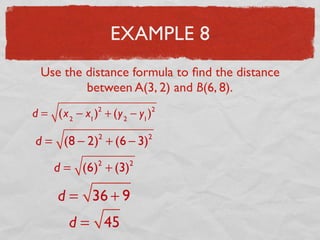
EXAMPLE 8
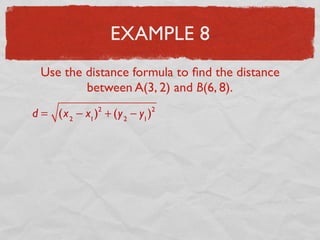
Use the distance formula to find the distance
between A(3, 2) and B(6, 8).
d = (x2
− x1
)2
+ (y2
− y1
)2
EXAMPLE 8
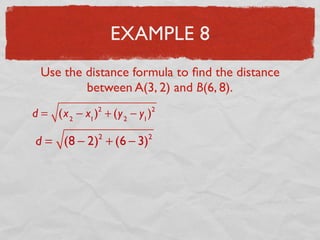
Use the distance formula to find the distance
between A(3, 2) and B(6, 8).
d = (x2
− x1
)2
+ (y2
− y1
)2
d = (8 − 2)2
+ (6 − 3)2
EXAMPLE 8
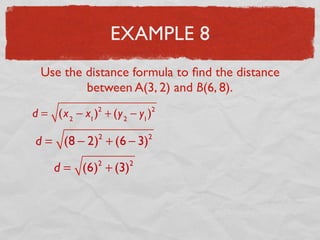
Use the distance formula to find the distance
between A(3, 2) and B(6, 8).
d = (x2
− x1
)2
+ (y2
− y1
)2
d = (8 − 2)2
+ (6 − 3)2
d = (6)2
+ (3)2
EXAMPLE 8
Use the distance formula to find the distance
between A(3, 2) and B(6, 8).
d = (x2
− x1
)2
+ (y2
− y1
)2
d = (8 − 2)2
+ (6 − 3)2
d = (6)2
+ (3)2
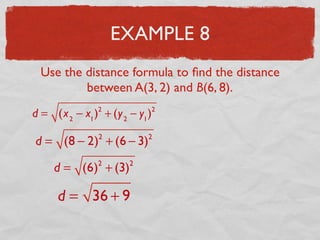
d = 36 + 9
EXAMPLE 8
Use the distance formula to find the distance
between A(3, 2) and B(6, 8).
d = (x2
− x1
)2
+ (y2
− y1
)2
d = (8 − 2)2
+ (6 − 3)2
d = (6)2
+ (3)2
d = 36 + 9
d = 45
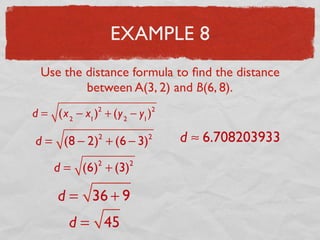
EXAMPLE 8
Use the distance formula to find the distance
between A(3, 2) and B(6, 8).
d = (x2
− x1
)2
+ (y2
− y1
)2
d = (8 − 2)2
+ (6 − 3)2
d = (6)2
+ (3)2
d = 36 + 9
d = 45
d ≈ 6.708203933
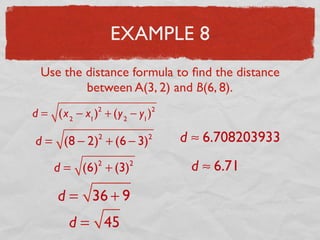
EXAMPLE 8
Use the distance formula to find the distance
between A(3, 2) and B(6, 8).
d = (x2
− x1
)2
+ (y2
− y1
)2
d = (8 − 2)2
+ (6 − 3)2
d = (6)2
+ (3)2
d = 36 + 9
d = 45
d ≈ 6.708203933
d ≈ 6.71
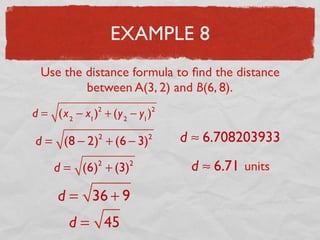
EXAMPLE 8
Use the distance formula to find the distance
between A(3, 2) and B(6, 8).
d = (x2
− x1
)2
+ (y2
− y1
)2
d = (8 − 2)2
+ (6 − 3)2
d = (6)2
+ (3)2
d = 36 + 9
d = 45
d ≈ 6.708203933
d ≈ 6.71 units

Geometry Section 1-2

  • 1.
  • 2.
    ESSENTIAL QUESTIONS How doyou calculate with measures? How do yo find the distance between two points?
  • 3.
    VOCABULARY 1. Line Segment: 2.Betweenness of Points: 3. Between:
  • 4.
    VOCABULARY 1. Line Segment:A portion of a line that is distinguished due to having endpoints 2. Betweenness of Points: 3. Between:
  • 5.
    VOCABULARY 1. Line Segment:A portion of a line that is distinguished due to having endpoints AB is “segment AB”; 2. Betweenness of Points: 3. Between:
  • 6.
    VOCABULARY 1. Line Segment:A portion of a line that is distinguished due to having endpoints AB is “segment AB”; AB is “the measure of AB” 2. Betweenness of Points: 3. Between:
  • 7.
    VOCABULARY 1. Line Segment:A portion of a line that is distinguished due to having endpoints AB is “segment AB”; AB is “the measure of AB” 2. Betweenness of Points: For any two points A and B, the point C will be between A and B when C is between A and B on the line 3. Between:
  • 8.
    VOCABULARY 1. Line Segment:A portion of a line that is distinguished due to having endpoints AB is “segment AB”; AB is “the measure of AB” 2. Betweenness of Points: For any two points A and B, the point C will be between A and B when C is between A and B on the line 3. Between: Point K is between points J and L if and only if (IFF) J, K, and L are collinear and JK + KL = JL
  • 9.
    VOCABULARY 4. Congruent: 5. RigidTransformation: 6. Congruent Segments:
  • 10.
    VOCABULARY 4. Congruent: Twofigures that have the same shape and size 5. Rigid Transformation: 6. Congruent Segments:
  • 11.
    VOCABULARY 4. Congruent: Twofigures that have the same shape and size 5. Rigid Transformation: When a figure changes position but keeps the same size and shape 6. Congruent Segments:
  • 12.
    VOCABULARY 4. Congruent: Twofigures that have the same shape and size 5. Rigid Transformation: When a figure changes position but keeps the same size and shape 6. Congruent Segments: Any segments that have the same measure
  • 13.
    VOCABULARY 4. Congruent: Twofigures that have the same shape and size 5. Rigid Transformation: When a figure changes position but keeps the same size and shape 6. Congruent Segments: Any segments that have the same measure AB ≅ CD is “segment AB is congruent to segment CD”
  • 14.
  • 15.
    VOCABULARY 7. Construction: Theprocess of drawing geometric figures using only a compass and straight edge (ruler) 8. Distance: 9. Irrational Number:
  • 16.
    VOCABULARY 7. Construction: Theprocess of drawing geometric figures using only a compass and straight edge (ruler) 8. Distance: The length of the segment formed between two points 9. Irrational Number:
  • 17.
    VOCABULARY 7. Construction: Theprocess of drawing geometric figures using only a compass and straight edge (ruler) 8. Distance: The length of the segment formed between two points 9. Irrational Number: A number that cannot by written as a ratio of two numbers(cannot be written as a fraction); will be a non-repeating, non- ending decimal
  • 18.
    EXAMPLE 1 Use aruler to measure the length of AC in both metric and customary. A C ruler via iruler.net
  • 19.
    EXAMPLE 1 Use aruler to measure the length of AC in both metric and customary. A C ruler via iruler.net
  • 20.
    EXAMPLE 1 Use aruler to measure the length of AC in both metric and customary. A C ruler via iruler.net
  • 21.
    EXAMPLE 1 Use aruler to measure the length of AC in both metric and customary. A C What are the values from the note sheet ruler via iruler.net
  • 22.
    EXAMPLE 2 Use aruler to draw the following line segments. a. YO, 2 inches long b. QI, 12 cm long ruler via iruler.net
  • 23.
    EXAMPLE 2 Use aruler to draw the following line segments. a. YO, 2 inches long b. QI, 12 cm long ruler via iruler.net
  • 24.
    EXAMPLE 2 Use aruler to draw the following line segments. a. YO, 2 inches long b. QI, 12 cm long ruler via iruler.net
  • 25.
    EXAMPLE 2 Use aruler to draw the following line segments. a. YO, 2 inches long b. QI, 12 cm long ruler via iruler.net
  • 26.
    EXAMPLE 2 Use aruler to draw the following line segments. a. YO, 2 inches long Y O b. QI, 12 cm long ruler via iruler.net
  • 27.
    EXAMPLE 2 Use aruler to draw the following line segments. a. YO, 2 inches long Y O b. QI, 12 cm long Measure a neighbor’s drawing ruler via iruler.net
  • 28.
    EXAMPLE 3 Find HA.Assumethat the figure is not drawn to scale. 7 cm 3 cm H Y A
  • 29.
    EXAMPLE 3 Find HA.Assumethat the figure is not drawn to scale. 7 cm 3 cm H Y A HA = 7 cm + 3 cm
  • 30.
    EXAMPLE 3 Find HA.Assumethat the figure is not drawn to scale. 7 cm 3 cm H Y A HA = 7 cm + 3 cm HA = 10 cm
  • 31.
    EXAMPLE 4 Find RO.Assumethat the figure is not drawn to scale. 17.6 in 4.3 in R O K
  • 32.
    EXAMPLE 4 Find RO.Assumethat the figure is not drawn to scale. 17.6 in 4.3 in R O K RO = RK − OK
  • 33.
    EXAMPLE 4 Find RO.Assumethat the figure is not drawn to scale. 17.6 in 4.3 in R O K RO = 17.6 in − 4.3 in RO = RK − OK
  • 34.
    EXAMPLE 4 Find RO.Assumethat the figure is not drawn to scale. 17.6 in 4.3 in R O K RO = 17.6 in − 4.3 in RO = RK − OK RO = 13.3 in
  • 35.
    EXAMPLE 5 Find thevalue of x and HM if M is between H and R, HM = 7x + 2, MR = 3x, and HR = 32 units. H RM7x + 2 3x 32
  • 36.
    EXAMPLE 5 Find thevalue of x and HM if M is between H and R, HM = 7x + 2, MR = 3x, and HR = 32 units. H RM7x + 2 3x 32 7x + 2 + 3x = 32
  • 37.
    EXAMPLE 5 Find thevalue of x and HM if M is between H and R, HM = 7x + 2, MR = 3x, and HR = 32 units. H RM7x + 2 3x 32 7x + 2 + 3x = 32 10x + 2 = 32
  • 38.
    EXAMPLE 5 Find thevalue of x and HM if M is between H and R, HM = 7x + 2, MR = 3x, and HR = 32 units. H RM7x + 2 3x 32 7x + 2 + 3x = 32 10x + 2 = 32 10x = 30
  • 39.
    EXAMPLE 5 Find thevalue of x and HM if M is between H and R, HM = 7x + 2, MR = 3x, and HR = 32 units. H RM7x + 2 3x 32 7x + 2 + 3x = 32 10x + 2 = 32 10x = 30 x = 3
  • 40.
    EXAMPLE 5 Find thevalue of x and HM if M is between H and R, HM = 7x + 2, MR = 3x, and HR = 32 units. H RM7x + 2 3x 32 7x + 2 + 3x = 32 10x + 2 = 32 10x = 30 x = 3 HM = 7x + 2
  • 41.
    EXAMPLE 5 Find thevalue of x and HM if M is between H and R, HM = 7x + 2, MR = 3x, and HR = 32 units. H RM7x + 2 3x 32 7x + 2 + 3x = 32 10x + 2 = 32 10x = 30 x = 3 HM = 7x + 2 HM = 7(3) + 2
  • 42.
    EXAMPLE 5 Find thevalue of x and HM if M is between H and R, HM = 7x + 2, MR = 3x, and HR = 32 units. H RM7x + 2 3x 32 7x + 2 + 3x = 32 10x + 2 = 32 10x = 30 x = 3 HM = 7x + 2 HM = 7(3) + 2 HM = 21 + 2
  • 43.
    EXAMPLE 5 Find thevalue of x and HM if M is between H and R, HM = 7x + 2, MR = 3x, and HR = 32 units. H RM7x + 2 3x 32 7x + 2 + 3x = 32 10x + 2 = 32 10x = 30 x = 3 HM = 7x + 2 HM = 7(3) + 2 HM = 21 + 2 HM = 23
  • 44.
  • 45.
    DISTANCE FORMULA d =(x2 − x1 )2 + (y2 − y1 )2
  • 46.
    DISTANCE FORMULA d =(x2 − x1 )2 + (y2 − y1 )2 for points (x1 ,y1 ) and (x2 ,y2 )
  • 47.
    EXAMPLE 6 Use thenumber line to find DJ. D J -4 -3 -2 -1 0 1 2 3 4
  • 48.
    EXAMPLE 6 Use thenumber line to find DJ. D J -4 -3 -2 -1 0 1 2 3 4 x2 − x1
  • 49.
    EXAMPLE 6 Use thenumber line to find DJ. D J -4 -3 -2 -1 0 1 2 3 4 x2 − x1 4 − (−4)
  • 50.
    EXAMPLE 6 Use thenumber line to find DJ. D J -4 -3 -2 -1 0 1 2 3 4 x2 − x1 4 − (−4) 4 + 4
  • 51.
    EXAMPLE 6 Use thenumber line to find DJ. D J -4 -3 -2 -1 0 1 2 3 4 x2 − x1 4 − (−4) 4 + 4 8
  • 52.
    EXAMPLE 6 Use thenumber line to find DJ. D J -4 -3 -2 -1 0 1 2 3 4 x2 − x1 4 − (−4) 4 + 4 8 8
  • 53.
    EXAMPLE 6 Use thenumber line to find DJ. D J -4 -3 -2 -1 0 1 2 3 4 x2 − x1 4 − (−4) 4 + 4 8 8 units
  • 54.
    EXAMPLE 7 Graph A(3,2) and B(6, 8).Then use the Pythagorean Theorem to find AB.
  • 55.
    EXAMPLE 7 Graph A(3,2) and B(6, 8).Then use the Pythagorean Theorem to find AB. x y
  • 56.
    EXAMPLE 7 Graph A(3,2) and B(6, 8).Then use the Pythagorean Theorem to find AB. x y
  • 57.
    EXAMPLE 7 Graph A(3,2) and B(6, 8).Then use the Pythagorean Theorem to find AB. x y A
  • 58.
    EXAMPLE 7 Graph A(3,2) and B(6, 8).Then use the Pythagorean Theorem to find AB. x y A
  • 59.
    EXAMPLE 7 Graph A(3,2) and B(6, 8).Then use the Pythagorean Theorem to find AB. x y A B
  • 60.
    EXAMPLE 7 Graph A(3,2) and B(6, 8).Then use the Pythagorean Theorem to find AB. x y A B
  • 61.
    EXAMPLE 7 Graph A(3,2) and B(6, 8).Then use the Pythagorean Theorem to find AB. x y A B 3
  • 62.
    EXAMPLE 7 Graph A(3,2) and B(6, 8).Then use the Pythagorean Theorem to find AB. x y A B 3 6
  • 63.
    EXAMPLE 7 Graph A(3,2) and B(6, 8).Then use the Pythagorean Theorem to find AB. x y A B 3 6 a2 + b2 = c2
  • 64.
    EXAMPLE 7 Graph A(3,2) and B(6, 8).Then use the Pythagorean Theorem to find AB. x y A B 3 6 a2 + b2 = c2 32 + 62 = c2
  • 65.
    EXAMPLE 7 Graph A(3,2) and B(6, 8).Then use the Pythagorean Theorem to find AB. x y A B 3 6 a2 + b2 = c2 32 + 62 = c2 9 + 36 = c2
  • 66.
    EXAMPLE 7 Graph A(3,2) and B(6, 8).Then use the Pythagorean Theorem to find AB. x y A B 3 6 a2 + b2 = c2 32 + 62 = c2 9 + 36 = c2 45 = c2
  • 67.
    EXAMPLE 7 Graph A(3,2) and B(6, 8).Then use the Pythagorean Theorem to find AB. x y A B 3 6 a2 + b2 = c2 32 + 62 = c2 9 + 36 = c2 45 = c2 45 = c2
  • 68.
    EXAMPLE 7 Graph A(3,2) and B(6, 8).Then use the Pythagorean Theorem to find AB. x y A B 3 6 a2 + b2 = c2 32 + 62 = c2 9 + 36 = c2 45 = c2 45 = c2 c ≈ 6.708203933
  • 69.
    EXAMPLE 7 Graph A(3,2) and B(6, 8).Then use the Pythagorean Theorem to find AB. x y A B 3 6 a2 + b2 = c2 32 + 62 = c2 9 + 36 = c2 45 = c2 45 = c2 c ≈ 6.708203933 c ≈ 6.71
  • 70.
    EXAMPLE 7 Graph A(3,2) and B(6, 8).Then use the Pythagorean Theorem to find AB. x y A B 3 6 a2 + b2 = c2 32 + 62 = c2 9 + 36 = c2 45 = c2 45 = c2 c ≈ 6.708203933 c ≈ 6.71units
  • 71.
    EXAMPLE 8 Use thedistance formula to find the distance between A(3, 2) and B(6, 8). d = (x2 − x1 )2 + (y2 − y1 )2
  • 72.
    EXAMPLE 8 Use thedistance formula to find the distance between A(3, 2) and B(6, 8). d = (x2 − x1 )2 + (y2 − y1 )2 d = (8 − 2)2 + (6 − 3)2
  • 73.
    EXAMPLE 8 Use thedistance formula to find the distance between A(3, 2) and B(6, 8). d = (x2 − x1 )2 + (y2 − y1 )2 d = (8 − 2)2 + (6 − 3)2 d = (6)2 + (3)2
  • 74.
    EXAMPLE 8 Use thedistance formula to find the distance between A(3, 2) and B(6, 8). d = (x2 − x1 )2 + (y2 − y1 )2 d = (8 − 2)2 + (6 − 3)2 d = (6)2 + (3)2 d = 36 + 9
  • 75.
    EXAMPLE 8 Use thedistance formula to find the distance between A(3, 2) and B(6, 8). d = (x2 − x1 )2 + (y2 − y1 )2 d = (8 − 2)2 + (6 − 3)2 d = (6)2 + (3)2 d = 36 + 9 d = 45
  • 76.
    EXAMPLE 8 Use thedistance formula to find the distance between A(3, 2) and B(6, 8). d = (x2 − x1 )2 + (y2 − y1 )2 d = (8 − 2)2 + (6 − 3)2 d = (6)2 + (3)2 d = 36 + 9 d = 45 d ≈ 6.708203933
  • 77.
    EXAMPLE 8 Use thedistance formula to find the distance between A(3, 2) and B(6, 8). d = (x2 − x1 )2 + (y2 − y1 )2 d = (8 − 2)2 + (6 − 3)2 d = (6)2 + (3)2 d = 36 + 9 d = 45 d ≈ 6.708203933 d ≈ 6.71
  • 78.
    EXAMPLE 8 Use thedistance formula to find the distance between A(3, 2) and B(6, 8). d = (x2 − x1 )2 + (y2 − y1 )2 d = (8 − 2)2 + (6 − 3)2 d = (6)2 + (3)2 d = 36 + 9 d = 45 d ≈ 6.708203933 d ≈ 6.71 units