GRADE 8
WEEK 2
DAY 1
IDENTIFY COMMON CONSUMABLE
MATERIALS IN WOODWORKING, MASONRY,
AND CONSTRUCTION PAINTING
DESCRIBE THE CHARACTERISTICS AND
PROPER USAGE OF EACH
CONSTRUCTION MATERIAL
REFLECT ON ENVIRONMENTALLY
FRIENDLY PRACTICES IN
CONSTRUCTION
LEARNING
OBJECTIVES
REVIEW
UNLOCKING CONTENT
VOCABULARY
• Consumable- an item used during operations
requiring frequent replacement.
• Materials- raw products utilized to construct
various objects, such as buildings or
structures.
• Consumable Materials- any materials utilized
only once, often experiencing wear and tear, and
need replacement.
UNLOCKING CONTENT
VOCABULARY
COMMON CONSTRUCTION MATERIALS
(WOODWORKING, MASONRY,
CONSTRUCTION PAINTING)
1. Wood Materials (Lumber)
• Softwood: Wood from coniferous (evergreen)
trees (e.g., Pine, Cedar).
• Hardwood: Wood from deciduous (leaf-
shedding) trees (e.g., Narra, Mahogany,
Molave).
• Engineered Wood: Man-made wood products
formed by binding strands or fibers (e.g.,
CONSUMABLE MATERIALS
IN WOODWORKING
2. Fastening & Hardware
• Nails: Metal spikes used to fasten wood
pieces together.
• Screws: Threaded fasteners for a stronger
hold.
• Hinges: Movable joints used for doors
and cabinet covers.
CONSUMABLE MATERIALS
IN WOODWORKING
3. Roofing Materials
• Indigenous/Traditional: Cogon, Bamboo,
Nipa.
• Industrial/Modern: Metal Roofing
(Galvanized Iron / Corrugated Sheets).
CONSUMABLE MATERIALS
IN WOODWORKING
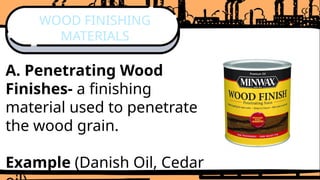
A. Penetrating Wood
Finishes- a finishing
material used to penetrate
the wood grain.
Example (Danish Oil, Cedar
WOOD FINISHING
MATERIALS
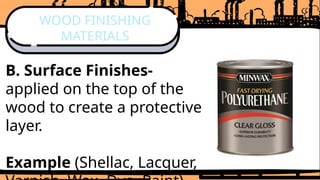
B. Surface Finishes-
applied on the top of the
wood to create a protective
layer.
Example (Shellac, Lacquer,
WOOD FINISHING
MATERIALS
The following are the common consumable
materials in masonry.
1. Cement
2. Bricks and Concrete Hollow Blocks
3. Aggregate
● Coarse Aggregate and Fine Aggregate
4. Rebar (reinforcing bar)
CONSUMABLE MATERIALS
IN MASONRY
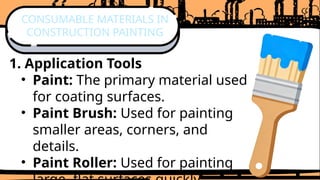
1. Application Tools
• Paint: The primary material used
for coating surfaces.
• Paint Brush: Used for painting
smaller areas, corners, and
details.
• Paint Roller: Used for painting
CONSUMABLE MATERIALS IN
CONSTRUCTION PAINTING
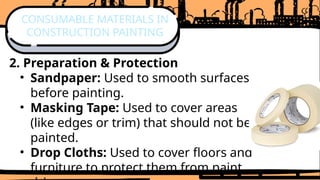
2. Preparation & Protection
• Sandpaper: Used to smooth surfaces
before painting.
• Masking Tape: Used to cover areas
(like edges or trim) that should not be
painted.
• Drop Cloths: Used to cover floors and
furniture to protect them from paint
CONSUMABLE MATERIALS IN
CONSTRUCTION PAINTING
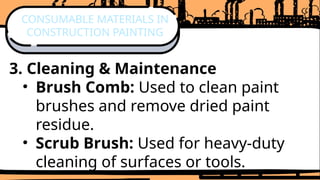
3. Cleaning & Maintenance
• Brush Comb: Used to clean paint
brushes and remove dried paint
residue.
• Scrub Brush: Used for heavy-duty
cleaning of surfaces or tools.
CONSUMABLE MATERIALS IN
CONSTRUCTION PAINTING
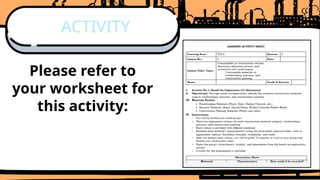
ACTIVITY
Please refer to
your worksheet for
this activity:
Learners’ Takeaways
In today’s lessons, I have learned that……
____________________________________________________
____________________________________________________
____________________________________________________
____________________________________________________
_______
GENERALIZATION
THANK YOU
GRADE 8
WEEK 2
DAY 2
IDENTIFY CONSUMABLES IN
PLUMBING, METAL WORKS, AND
TILE SETTING
ANALYZE HOW DIFFERENT
MATERIALS ARE USED BASED ON
FUNCTION AND PLACEMENT
REFLECT ON ENVIRONMENTAL
IMPACTS OF CONSUMABLE USE
AND DISPOSAL
LEARNING
OBJECTIVES
REVIEW
COMMON CONSTRUCTION MATERIALS
(PLUMBING, METAL WORKS, TILE
SETTING)
1. Pipes (Conduits)
• PVC Pipe: Polyvinyl Chloride; widely used plastic
piping.
• ABS Pipe: Acrylonitrile Butadiene Styrene;
distinct black plastic pipe.
• PPR Pipe: Polypropylene Random Copolymer;
heat-resistant plastic pipe.
• Steel Pipe: Durable metal piping (galvanized or
CONSUMABLE MATERIALS
IN PLUMBING
2. Connections & Control
• Fittings: Connectors used to join pipes,
change direction, or change diameter
(e.g., elbows, tees).
• Valves: Devices used to control, stop, or
regulate the flow of water.
CONSUMABLE MATERIALS
IN PLUMBING
3. Installation & Sealing
• Fixtures: End-point devices that deliver or drain water
(e.g., faucets, sinks).
• Sealants & Adhesives: Materials used to ensure
watertight joints.
⚬ PVC Sealant/Solvent Cement: Chemical welder for
plastic pipes.
⚬ Teflon Tape: Thread seal tape used on threaded
pipe connections.
CONSUMABLE MATERIALS
IN PLUMBING
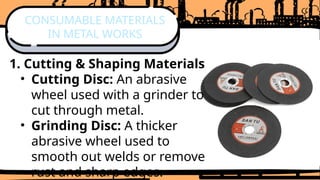
1. Cutting & Shaping Materials
• Cutting Disc: An abrasive
wheel used with a grinder to
cut through metal.
• Grinding Disc: A thicker
abrasive wheel used to
smooth out welds or remove
rust and sharp edges.
CONSUMABLE MATERIALS
IN METAL WORKS
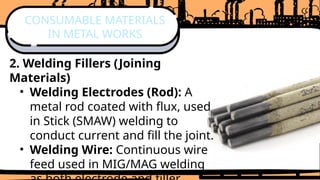
2. Welding Fillers (Joining
Materials)
• Welding Electrodes (Rod): A
metal rod coated with flux, used
in Stick (SMAW) welding to
conduct current and fill the joint.
• Welding Wire: Continuous wire
feed used in MIG/MAG welding
CONSUMABLE MATERIALS
IN METAL WORKS
3. Protective Media
• Shielding Gas: Gas (like Argon or CO2) used
to protect the weld pool from contaminants
in the air (oxygen/nitrogen) during the
welding process.
CONSUMABLE MATERIALS
IN METAL WORKS
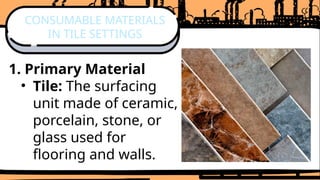
1. Primary Material
• Tile: The surfacing
unit made of ceramic,
porcelain, stone, or
glass used for
flooring and walls.
CONSUMABLE MATERIALS
IN TILE SETTINGS
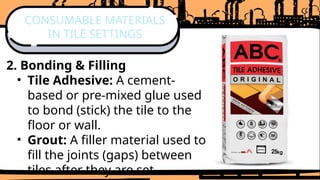
2. Bonding & Filling
• Tile Adhesive: A cement-
based or pre-mixed glue used
to bond (stick) the tile to the
floor or wall.
• Grout: A filler material used to
fill the joints (gaps) between
tiles after they are set.
CONSUMABLE MATERIALS
IN TILE SETTINGS
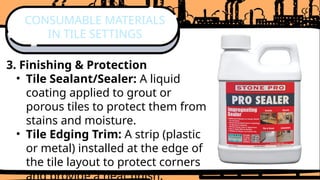
3. Finishing & Protection
• Tile Sealant/Sealer: A liquid
coating applied to grout or
porous tiles to protect them from
stains and moisture.
• Tile Edging Trim: A strip (plastic
or metal) installed at the edge of
the tile layout to protect corners
and provide a neat finish.
CONSUMABLE MATERIALS
IN TILE SETTINGS
ACTIVITY
Please refer to
your worksheet for
this activity:
Learners’ Takeaways
In today’s lessons, I have learned that……
____________________________________________________
____________________________________________________
____________________________________________________
____________________________________________________
_______
GENERALIZATION
THANK YOU
GRADE 8
WEEK 2
DAY 3
IDENTIFY CONSUMABLES USED
IN ELECTRICAL AND ELECTRONIC
WORKS
BUILD AND TEST A BASIC LED
CIRCUIT USING STANDARD
COMPONENTS
APPLY PROPER SAFETY AND
TROUBLESHOOTING PROCEDURES
LEARNING
OBJECTIVES
REVIEW
CONSUMABLE MATERIALS IN
ELECTRICAL AND
ELECTRONIC
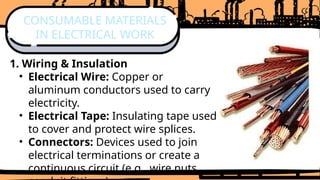
1. Wiring & Insulation
• Electrical Wire: Copper or
aluminum conductors used to carry
electricity.
• Electrical Tape: Insulating tape used
to cover and protect wire splices.
• Connectors: Devices used to join
electrical terminations or create a
continuous circuit (e.g., wire nuts,
CONSUMABLE MATERIALS
IN ELECTRICAL WORK
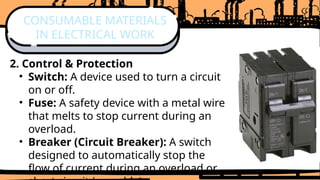
2. Control & Protection
• Switch: A device used to turn a circuit
on or off.
• Fuse: A safety device with a metal wire
that melts to stop current during an
overload.
• Breaker (Circuit Breaker): A switch
designed to automatically stop the
flow of current during an overload or
CONSUMABLE MATERIALS
IN ELECTRICAL WORK
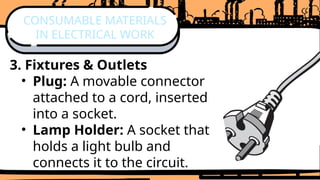
3. Fixtures & Outlets
• Plug: A movable connector
attached to a cord, inserted
into a socket.
• Lamp Holder: A socket that
holds a light bulb and
connects it to the circuit.
CONSUMABLE MATERIALS
IN ELECTRICAL WORK
4. Containment & Rough-ins
• Conduit / Pipes: Tubes used to protect and route
electrical wiring.
• Clamps: Straps used to secure conduits or pipes to walls
or ceilings.
• Junction Box: An enclosure housing electrical wire
connections or splices.
• Utility Box: A box installed behind walls to house
switches or outlets.
CONSUMABLE MATERIALS
IN ELECTRICAL WORK
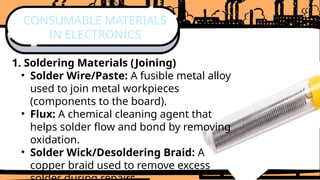
1. Soldering Materials (Joining)
• Solder Wire/Paste: A fusible metal alloy
used to join metal workpieces
(components to the board).
• Flux: A chemical cleaning agent that
helps solder flow and bond by removing
oxidation.
• Solder Wick/Desoldering Braid: A
copper braid used to remove excess
CONSUMABLE MATERIALS
IN ELECTRONICS
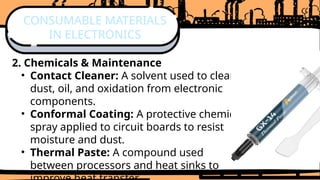
2. Chemicals & Maintenance
• Contact Cleaner: A solvent used to clean
dust, oil, and oxidation from electronic
components.
• Conformal Coating: A protective chemical
spray applied to circuit boards to resist
moisture and dust.
• Thermal Paste: A compound used
between processors and heat sinks to
CONSUMABLE MATERIALS
IN ELECTRONICS
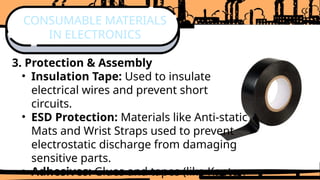
3. Protection & Assembly
• Insulation Tape: Used to insulate
electrical wires and prevent short
circuits.
• ESD Protection: Materials like Anti-static
Mats and Wrist Straps used to prevent
electrostatic discharge from damaging
sensitive parts.
• Adhesives: Glues and tapes (like Kapton
CONSUMABLE MATERIALS
IN ELECTRONICS
ACTIVITY
Please refer to
your worksheet for
this activity:
Learners’ Takeaways
In today’s lessons, I have learned that……
____________________________________________________
____________________________________________________
____________________________________________________
____________________________________________________
_______
GENERALIZATION
THANK YOU
GRADE 8
WEEK 2
DAY 4
IDENTIFY CONSUMABLE MATERIALS IN
AUTOMOTIVE AND SMALL ENGINE
MAINTENANCE
DESCRIBE EACH MATERIAL’S
PURPOSE IN ENSURING VEHICLE
FUNCTION AND SAFETY
COMPARE AND CONTRAST
AUTOMOTIVE AND ENGINE
CONSUMABLES
LEARNING
OBJECTIVES
REVIEW
COMMON MATERIALS IN
AUTOMOTIVE AND SMALL ENGINE
WORKS
1. Fluids & Lubricants
• Fuels: The energy source for the engine (Diesel or
Gasoline).
• Lubricants: Substances that reduce friction between
moving parts (Engine Oil, Grease, Transmission Fluid).
• Brake Fluid: Hydraulic fluid used to transfer force in
the braking system.
• Coolant / Antifreeze: Liquid used to regulate the
engine's temperature and prevent overheating.
CONSUMABLE MATERIALS
IN AUTOMOTIVE
2. Filters & Sealing
• Filters: Components that remove
impurities.
⚬ Air Filter: Cleans the air entering the
engine.
⚬ Oil Filter: Removes contaminants
from engine oil.
CONSUMABLE MATERIALS
IN AUTOMOTIVE
3. Ignition & Electrical
• Spark Plug: A device that delivers the
electric spark to ignite the fuel in the
engine.
• Battery: The rechargeable power
source for starting the engine and
CONSUMABLE MATERIALS
IN AUTOMOTIVE
4. Friction & Wear Components
• Braking System:
⚬ Brake Pads & Lining: Friction material used in
disc brake systems.
⚬ Brake Shoe: Friction material used in drum
brake systems.
• Tire: Rubber covering filled with air that supports
the vehicle's load and provides traction.
CONSUMABLE MATERIALS
IN AUTOMOTIVE
ACTIVITY
Please refer to
your worksheet for
this activity:
Learners’ Takeaways
In today’s lessons, I have learned that……
____________________________________________________
____________________________________________________
____________________________________________________
____________________________________________________
_______
GENERALIZATION

THANK YOU

WEEK 2 (2).pptx TLE COOKERY 10 QUARTER 4

  • 1.
  • 2.
    IDENTIFY COMMON CONSUMABLE MATERIALSIN WOODWORKING, MASONRY, AND CONSTRUCTION PAINTING DESCRIBE THE CHARACTERISTICS AND PROPER USAGE OF EACH CONSTRUCTION MATERIAL REFLECT ON ENVIRONMENTALLY FRIENDLY PRACTICES IN CONSTRUCTION LEARNING OBJECTIVES
  • 3.
  • 5.
  • 6.
    • Consumable- anitem used during operations requiring frequent replacement. • Materials- raw products utilized to construct various objects, such as buildings or structures. • Consumable Materials- any materials utilized only once, often experiencing wear and tear, and need replacement. UNLOCKING CONTENT VOCABULARY
  • 7.
    COMMON CONSTRUCTION MATERIALS (WOODWORKING,MASONRY, CONSTRUCTION PAINTING)
  • 8.
    1. Wood Materials(Lumber) • Softwood: Wood from coniferous (evergreen) trees (e.g., Pine, Cedar). • Hardwood: Wood from deciduous (leaf- shedding) trees (e.g., Narra, Mahogany, Molave). • Engineered Wood: Man-made wood products formed by binding strands or fibers (e.g., CONSUMABLE MATERIALS IN WOODWORKING
  • 9.
    2. Fastening &Hardware • Nails: Metal spikes used to fasten wood pieces together. • Screws: Threaded fasteners for a stronger hold. • Hinges: Movable joints used for doors and cabinet covers. CONSUMABLE MATERIALS IN WOODWORKING
  • 10.
    3. Roofing Materials •Indigenous/Traditional: Cogon, Bamboo, Nipa. • Industrial/Modern: Metal Roofing (Galvanized Iron / Corrugated Sheets). CONSUMABLE MATERIALS IN WOODWORKING
  • 11.
    A. Penetrating Wood Finishes-a finishing material used to penetrate the wood grain. Example (Danish Oil, Cedar WOOD FINISHING MATERIALS
  • 12.
    B. Surface Finishes- appliedon the top of the wood to create a protective layer. Example (Shellac, Lacquer, WOOD FINISHING MATERIALS
  • 13.
    The following arethe common consumable materials in masonry. 1. Cement 2. Bricks and Concrete Hollow Blocks 3. Aggregate ● Coarse Aggregate and Fine Aggregate 4. Rebar (reinforcing bar) CONSUMABLE MATERIALS IN MASONRY
  • 14.
    1. Application Tools •Paint: The primary material used for coating surfaces. • Paint Brush: Used for painting smaller areas, corners, and details. • Paint Roller: Used for painting CONSUMABLE MATERIALS IN CONSTRUCTION PAINTING
  • 15.
    2. Preparation &Protection • Sandpaper: Used to smooth surfaces before painting. • Masking Tape: Used to cover areas (like edges or trim) that should not be painted. • Drop Cloths: Used to cover floors and furniture to protect them from paint CONSUMABLE MATERIALS IN CONSTRUCTION PAINTING
  • 16.
    3. Cleaning &Maintenance • Brush Comb: Used to clean paint brushes and remove dried paint residue. • Scrub Brush: Used for heavy-duty cleaning of surfaces or tools. CONSUMABLE MATERIALS IN CONSTRUCTION PAINTING
  • 17.
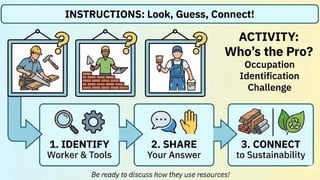
    ACTIVITY Please refer to yourworksheet for this activity:
  • 18.
    Learners’ Takeaways In today’slessons, I have learned that…… ____________________________________________________ ____________________________________________________ ____________________________________________________ ____________________________________________________ _______ GENERALIZATION
  • 19.
  • 20.
  • 21.
    IDENTIFY CONSUMABLES IN PLUMBING,METAL WORKS, AND TILE SETTING ANALYZE HOW DIFFERENT MATERIALS ARE USED BASED ON FUNCTION AND PLACEMENT REFLECT ON ENVIRONMENTAL IMPACTS OF CONSUMABLE USE AND DISPOSAL LEARNING OBJECTIVES
  • 22.
  • 23.
    COMMON CONSTRUCTION MATERIALS (PLUMBING,METAL WORKS, TILE SETTING)
  • 24.
    1. Pipes (Conduits) •PVC Pipe: Polyvinyl Chloride; widely used plastic piping. • ABS Pipe: Acrylonitrile Butadiene Styrene; distinct black plastic pipe. • PPR Pipe: Polypropylene Random Copolymer; heat-resistant plastic pipe. • Steel Pipe: Durable metal piping (galvanized or CONSUMABLE MATERIALS IN PLUMBING
  • 25.
    2. Connections &Control • Fittings: Connectors used to join pipes, change direction, or change diameter (e.g., elbows, tees). • Valves: Devices used to control, stop, or regulate the flow of water. CONSUMABLE MATERIALS IN PLUMBING
  • 26.
    3. Installation &Sealing • Fixtures: End-point devices that deliver or drain water (e.g., faucets, sinks). • Sealants & Adhesives: Materials used to ensure watertight joints. ⚬ PVC Sealant/Solvent Cement: Chemical welder for plastic pipes. ⚬ Teflon Tape: Thread seal tape used on threaded pipe connections. CONSUMABLE MATERIALS IN PLUMBING
  • 27.
    1. Cutting &Shaping Materials • Cutting Disc: An abrasive wheel used with a grinder to cut through metal. • Grinding Disc: A thicker abrasive wheel used to smooth out welds or remove rust and sharp edges. CONSUMABLE MATERIALS IN METAL WORKS
  • 28.
    2. Welding Fillers(Joining Materials) • Welding Electrodes (Rod): A metal rod coated with flux, used in Stick (SMAW) welding to conduct current and fill the joint. • Welding Wire: Continuous wire feed used in MIG/MAG welding CONSUMABLE MATERIALS IN METAL WORKS
  • 29.
    3. Protective Media •Shielding Gas: Gas (like Argon or CO2) used to protect the weld pool from contaminants in the air (oxygen/nitrogen) during the welding process. CONSUMABLE MATERIALS IN METAL WORKS
  • 30.
    1. Primary Material •Tile: The surfacing unit made of ceramic, porcelain, stone, or glass used for flooring and walls. CONSUMABLE MATERIALS IN TILE SETTINGS
  • 31.
    2. Bonding &Filling • Tile Adhesive: A cement- based or pre-mixed glue used to bond (stick) the tile to the floor or wall. • Grout: A filler material used to fill the joints (gaps) between tiles after they are set. CONSUMABLE MATERIALS IN TILE SETTINGS
  • 32.
    3. Finishing &Protection • Tile Sealant/Sealer: A liquid coating applied to grout or porous tiles to protect them from stains and moisture. • Tile Edging Trim: A strip (plastic or metal) installed at the edge of the tile layout to protect corners and provide a neat finish. CONSUMABLE MATERIALS IN TILE SETTINGS
  • 33.
    ACTIVITY Please refer to yourworksheet for this activity:
  • 34.
    Learners’ Takeaways In today’slessons, I have learned that…… ____________________________________________________ ____________________________________________________ ____________________________________________________ ____________________________________________________ _______ GENERALIZATION
  • 35.
  • 36.
  • 37.
    IDENTIFY CONSUMABLES USED INELECTRICAL AND ELECTRONIC WORKS BUILD AND TEST A BASIC LED CIRCUIT USING STANDARD COMPONENTS APPLY PROPER SAFETY AND TROUBLESHOOTING PROCEDURES LEARNING OBJECTIVES
  • 38.
  • 39.
  • 40.
    1. Wiring &Insulation • Electrical Wire: Copper or aluminum conductors used to carry electricity. • Electrical Tape: Insulating tape used to cover and protect wire splices. • Connectors: Devices used to join electrical terminations or create a continuous circuit (e.g., wire nuts, CONSUMABLE MATERIALS IN ELECTRICAL WORK
  • 41.
    2. Control &Protection • Switch: A device used to turn a circuit on or off. • Fuse: A safety device with a metal wire that melts to stop current during an overload. • Breaker (Circuit Breaker): A switch designed to automatically stop the flow of current during an overload or CONSUMABLE MATERIALS IN ELECTRICAL WORK
  • 42.
    3. Fixtures &Outlets • Plug: A movable connector attached to a cord, inserted into a socket. • Lamp Holder: A socket that holds a light bulb and connects it to the circuit. CONSUMABLE MATERIALS IN ELECTRICAL WORK
  • 43.
    4. Containment &Rough-ins • Conduit / Pipes: Tubes used to protect and route electrical wiring. • Clamps: Straps used to secure conduits or pipes to walls or ceilings. • Junction Box: An enclosure housing electrical wire connections or splices. • Utility Box: A box installed behind walls to house switches or outlets. CONSUMABLE MATERIALS IN ELECTRICAL WORK
  • 44.
    1. Soldering Materials(Joining) • Solder Wire/Paste: A fusible metal alloy used to join metal workpieces (components to the board). • Flux: A chemical cleaning agent that helps solder flow and bond by removing oxidation. • Solder Wick/Desoldering Braid: A copper braid used to remove excess CONSUMABLE MATERIALS IN ELECTRONICS
  • 45.
    2. Chemicals &Maintenance • Contact Cleaner: A solvent used to clean dust, oil, and oxidation from electronic components. • Conformal Coating: A protective chemical spray applied to circuit boards to resist moisture and dust. • Thermal Paste: A compound used between processors and heat sinks to CONSUMABLE MATERIALS IN ELECTRONICS
  • 46.
    3. Protection &Assembly • Insulation Tape: Used to insulate electrical wires and prevent short circuits. • ESD Protection: Materials like Anti-static Mats and Wrist Straps used to prevent electrostatic discharge from damaging sensitive parts. • Adhesives: Glues and tapes (like Kapton CONSUMABLE MATERIALS IN ELECTRONICS
  • 47.
    ACTIVITY Please refer to yourworksheet for this activity:
  • 48.
    Learners’ Takeaways In today’slessons, I have learned that…… ____________________________________________________ ____________________________________________________ ____________________________________________________ ____________________________________________________ _______ GENERALIZATION
  • 49.
  • 50.
  • 51.
    IDENTIFY CONSUMABLE MATERIALSIN AUTOMOTIVE AND SMALL ENGINE MAINTENANCE DESCRIBE EACH MATERIAL’S PURPOSE IN ENSURING VEHICLE FUNCTION AND SAFETY COMPARE AND CONTRAST AUTOMOTIVE AND ENGINE CONSUMABLES LEARNING OBJECTIVES
  • 52.
  • 53.
    COMMON MATERIALS IN AUTOMOTIVEAND SMALL ENGINE WORKS
  • 54.
    1. Fluids &Lubricants • Fuels: The energy source for the engine (Diesel or Gasoline). • Lubricants: Substances that reduce friction between moving parts (Engine Oil, Grease, Transmission Fluid). • Brake Fluid: Hydraulic fluid used to transfer force in the braking system. • Coolant / Antifreeze: Liquid used to regulate the engine's temperature and prevent overheating. CONSUMABLE MATERIALS IN AUTOMOTIVE
  • 55.
    2. Filters &Sealing • Filters: Components that remove impurities. ⚬ Air Filter: Cleans the air entering the engine. ⚬ Oil Filter: Removes contaminants from engine oil. CONSUMABLE MATERIALS IN AUTOMOTIVE
  • 56.
    3. Ignition &Electrical • Spark Plug: A device that delivers the electric spark to ignite the fuel in the engine. • Battery: The rechargeable power source for starting the engine and CONSUMABLE MATERIALS IN AUTOMOTIVE
  • 57.
    4. Friction &Wear Components • Braking System: ⚬ Brake Pads & Lining: Friction material used in disc brake systems. ⚬ Brake Shoe: Friction material used in drum brake systems. • Tire: Rubber covering filled with air that supports the vehicle's load and provides traction. CONSUMABLE MATERIALS IN AUTOMOTIVE
  • 58.
    ACTIVITY Please refer to yourworksheet for this activity:
  • 59.
    Learners’ Takeaways In today’slessons, I have learned that…… ____________________________________________________ ____________________________________________________ ____________________________________________________ ____________________________________________________ _______ GENERALIZATION
  • 60.