Surface Area
• Surface area is found by finding the area of
all the sides and then adding those answers
up.
• How will the answer be labeled?
– Units2 because it is area!
SA
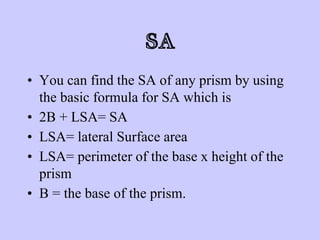
• You can find the SA of any prism by using
the basic formula for SA which is
• 2B + LSA= SA
• LSA= lateral Surface area
• LSA= perimeter of the base x height of the
prism
• B = the base of the prism.
Rectangular Prism
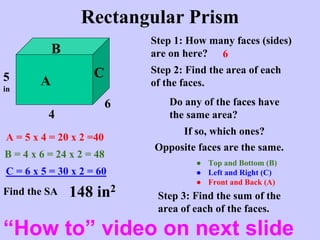
Step 1: How many faces (sides)
are on here? 6
Step 2: Find the area of each
of the faces.
A
B
C
4
5
in
6 Do any of the faces have
the same area?
A = 5 x 4 = 20 x 2 =40
C = 6 x 5 = 30 x 2 = 60
B = 4 x 6 = 24 x 2 = 48
If so, which ones?
148 in2
Opposite faces are the same.
Find the SA Step 3: Find the sum of the
area of each of the faces.
“How to” video on next slide
● Top and Bottom (B)
● Left and Right (C)
● Front and Back (A)
Rectangular Prism
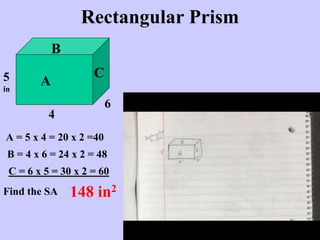
A
B
C
4
5
in
6
A = 5 x 4 = 20 x 2 =40
C = 6 x 5 = 30 x 2 = 60
B = 4 x 6 = 24 x 2 = 48
148 in2
Find the SA
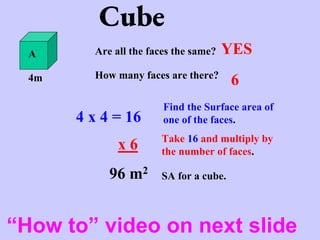
Cube
Are all the faces the same? YES
4m How many faces are there?
6
Find the Surface area of
one of the faces.
A
4 x 4 = 16
Take 16 and multiply by
the number of faces.
x 6
SA for a cube.
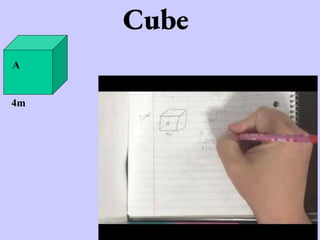
“How to” video on next slide
96 m2
Cube
4m
A
Triangular Prisms
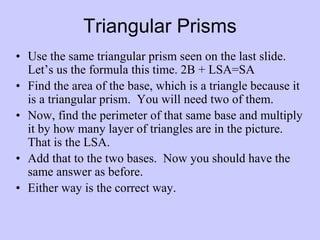
• Use the same triangular prism seen on the last slide.
Let’s us the formula this time. 2B + LSA=SA
• Find the area of the base, which is a triangle because it
is a triangular prism. You will need two of them.
• Now, find the perimeter of that same base and multiply
it by how many layer of triangles are in the picture.
That is the LSA.
• Add that to the two bases. Now you should have the
same answer as before.
• Either way is the correct way.
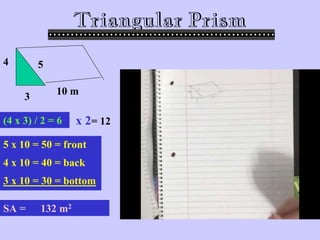
Triangular Prism
How many faces are
there? 5
How many of each shape does it
take to make this prism?
2 triangles and 3 rectangles = SA of a
triangular prism
4
3
5
10 m
Find the surface area. Start by
finding the area of the triangle.
(4 x 3) / 2 = 6
How many triangles were
there? 2
x 2= 12
Find the area of the 3
rectangles.
5 x 10 = 50 = front
4 x 10 = 40 = back
3 x 10 = 30 = bottom
SA = 132 m2
What is the final SA?
“How to” video on next slide
Triangular Prism
4
3
5
10 m
x 2= 12
5 x 10 = 50 = front
4 x 10 = 40 = back
3 x 10 = 30 = bottom
SA = 132 m2
(4 x 3) / 2 = 6
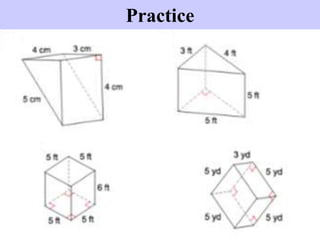
Practice
Practice...answers
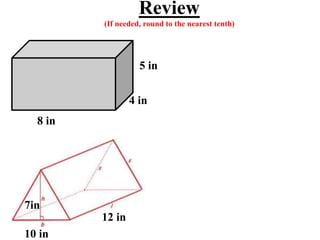
Review
(If needed, round to the nearest tenth)
8 in
4 in
5 in
10 in
12 in
7in
6 faces
All rectangles
5 faces
2 triangle bases
3 rectangles
3 faces
2 circle bases
1 rectangle side
2B + LSA
2 (LxW) + (L+W+L + W) x H
2B + LSA
2 [½ (AxB)] + (A+B+C) x H
A
B
C
L
W
2B + LSA
2 (𝛑 r² ) + (𝛑 D) x H
Diameter radius
Surface Area
𝛑 = 3.14
Cylinders
6
10m
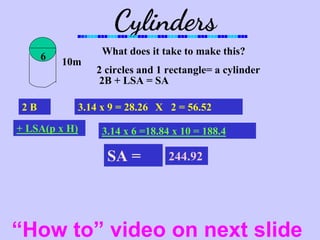
What does it take to make this?
2 circles and 1 rectangle= a cylinder
2 B 3.14 x 9 = 28.26 X 2 = 56.52
+ LSA(p x H) 3.14 x 6 =18.84 x 10 = 188.4
SA = 244.92
2B + LSA = SA
“How to” video on next slide
Cylinders
6
10m
What does it take to make this?
2 circles and 1 rectangle= a cylinder
3.14 x 9 = 28.26 X 2 = 56.52
3.14 x 6 =18.84 x 10 = 188.4
SA = 244.92
2B + LSA = SA
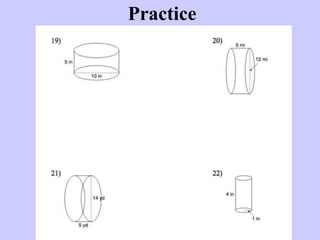
Practice
Practice Answers
Intro to Compound Figures
Finding the total surface area
for when you want to wrap 2
rectangular prisms together…
How much paper would be
required?
Video is easiest to be seen when in
“Full Screen”
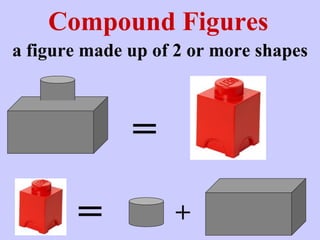
Compound Figures
a figure made up of 2 or more shapes
=
+
=
1. Determine what regular shapes make up the compound
shape
1. Find the surface area of each shape, but make sure you
only account for the space being covered since the two
shapes are attached as one…
a. The shape DOES NOT come apart
1. p
2. You do not need to account for the
bottom of the cylinder, nor do you
need the circle the cylinder makes
on the top face of the rectangular
prism.
a. these surface are not seen nor
are they covered since the
shapes are attached
The circular base of the cylinder is not accounted for
nor is the space on the rectangular prism that the circle
sits on. These areas do not count since the two shapes
are attached and therefore you would not cover these
areas individually

surface area.ppt.pptx

  • 1.
    Surface Area • Surfacearea is found by finding the area of all the sides and then adding those answers up. • How will the answer be labeled? – Units2 because it is area!
  • 2.
    SA • You canfind the SA of any prism by using the basic formula for SA which is • 2B + LSA= SA • LSA= lateral Surface area • LSA= perimeter of the base x height of the prism • B = the base of the prism.
  • 3.
    Rectangular Prism Step 1:How many faces (sides) are on here? 6 Step 2: Find the area of each of the faces. A B C 4 5 in 6 Do any of the faces have the same area? A = 5 x 4 = 20 x 2 =40 C = 6 x 5 = 30 x 2 = 60 B = 4 x 6 = 24 x 2 = 48 If so, which ones? 148 in2 Opposite faces are the same. Find the SA Step 3: Find the sum of the area of each of the faces. “How to” video on next slide ● Top and Bottom (B) ● Left and Right (C) ● Front and Back (A)
  • 4.
    Rectangular Prism A B C 4 5 in 6 A =5 x 4 = 20 x 2 =40 C = 6 x 5 = 30 x 2 = 60 B = 4 x 6 = 24 x 2 = 48 148 in2 Find the SA
  • 5.
    Cube Are all thefaces the same? YES 4m How many faces are there? 6 Find the Surface area of one of the faces. A 4 x 4 = 16 Take 16 and multiply by the number of faces. x 6 SA for a cube. “How to” video on next slide 96 m2
  • 6.
  • 7.
    Triangular Prisms • Usethe same triangular prism seen on the last slide. Let’s us the formula this time. 2B + LSA=SA • Find the area of the base, which is a triangle because it is a triangular prism. You will need two of them. • Now, find the perimeter of that same base and multiply it by how many layer of triangles are in the picture. That is the LSA. • Add that to the two bases. Now you should have the same answer as before. • Either way is the correct way.
  • 8.
    Triangular Prism How manyfaces are there? 5 How many of each shape does it take to make this prism? 2 triangles and 3 rectangles = SA of a triangular prism 4 3 5 10 m Find the surface area. Start by finding the area of the triangle. (4 x 3) / 2 = 6 How many triangles were there? 2 x 2= 12 Find the area of the 3 rectangles. 5 x 10 = 50 = front 4 x 10 = 40 = back 3 x 10 = 30 = bottom SA = 132 m2 What is the final SA? “How to” video on next slide
  • 9.
    Triangular Prism 4 3 5 10 m x2= 12 5 x 10 = 50 = front 4 x 10 = 40 = back 3 x 10 = 30 = bottom SA = 132 m2 (4 x 3) / 2 = 6
  • 10.
  • 11.
  • 12.
    Review (If needed, roundto the nearest tenth) 8 in 4 in 5 in 10 in 12 in 7in
  • 13.
    6 faces All rectangles 5faces 2 triangle bases 3 rectangles 3 faces 2 circle bases 1 rectangle side 2B + LSA 2 (LxW) + (L+W+L + W) x H 2B + LSA 2 [½ (AxB)] + (A+B+C) x H A B C L W 2B + LSA 2 (𝛑 r² ) + (𝛑 D) x H Diameter radius Surface Area 𝛑 = 3.14
  • 14.
    Cylinders 6 10m What does ittake to make this? 2 circles and 1 rectangle= a cylinder 2 B 3.14 x 9 = 28.26 X 2 = 56.52 + LSA(p x H) 3.14 x 6 =18.84 x 10 = 188.4 SA = 244.92 2B + LSA = SA “How to” video on next slide
  • 15.
    Cylinders 6 10m What does ittake to make this? 2 circles and 1 rectangle= a cylinder 3.14 x 9 = 28.26 X 2 = 56.52 3.14 x 6 =18.84 x 10 = 188.4 SA = 244.92 2B + LSA = SA
  • 16.
  • 17.
  • 18.
    Intro to CompoundFigures Finding the total surface area for when you want to wrap 2 rectangular prisms together… How much paper would be required? Video is easiest to be seen when in “Full Screen”
  • 19.
    Compound Figures a figuremade up of 2 or more shapes = + =
  • 20.
    1. Determine whatregular shapes make up the compound shape 1. Find the surface area of each shape, but make sure you only account for the space being covered since the two shapes are attached as one… a. The shape DOES NOT come apart 1. p 2. You do not need to account for the bottom of the cylinder, nor do you need the circle the cylinder makes on the top face of the rectangular prism. a. these surface are not seen nor are they covered since the shapes are attached The circular base of the cylinder is not accounted for nor is the space on the rectangular prism that the circle sits on. These areas do not count since the two shapes are attached and therefore you would not cover these areas individually