SECTION 6-2
Parallelograms
Essential Questions
How do you recognize and apply properties of the sides and
angles of parallelograms?
How do you recognize and apply properties of the diagonals of
parallelograms?
Vocabulary
1. Parallelogram:
Vocabulary
1. Parallelogram: A quadrilateral that has two pairs of parallel sides
Properties and Theorems
6.3 - Opposite Sides:
6.4 - Opposite Angles:
6.5 - Consecutive Angles:
6.6 - Right Angles:
Properties and Theorems
6.3 - Opposite Sides: If a quadrilateral is a parallelogram, then its
opposite sides are congruent
6.4 - Opposite Angles:
6.5 - Consecutive Angles:
6.6 - Right Angles:
Properties and Theorems
6.3 - Opposite Sides: If a quadrilateral is a parallelogram, then its
opposite sides are congruent
6.4 - Opposite Angles: If a quadrilateral is a parallelogram, then its
opposite angles are congruent
6.5 - Consecutive Angles:
6.6 - Right Angles:
Properties and Theorems
6.3 - Opposite Sides: If a quadrilateral is a parallelogram, then its
opposite sides are congruent
6.4 - Opposite Angles: If a quadrilateral is a parallelogram, then its
opposite angles are congruent
6.5 - Consecutive Angles: If a quadrilateral is a parallelogram, then its
consecutive angles are supplementary
6.6 - Right Angles:
Properties and Theorems
6.3 - Opposite Sides: If a quadrilateral is a parallelogram, then its
opposite sides are congruent
6.4 - Opposite Angles: If a quadrilateral is a parallelogram, then its
opposite angles are congruent
6.5 - Consecutive Angles: If a quadrilateral is a parallelogram, then its
consecutive angles are supplementary
6.6 - Right Angles: If a parallelogram has one right angle, then it has four
right angles
Properties and Theorems
6.7 - Bisecting Diagonals:
6.8 - Triangles from Diagonals:
Properties and Theorems
6.7 - Bisecting Diagonals: If a quadrilateral is a parallelogram, then its
diagonals bisect each other
6.8 - Triangles from Diagonals:
Properties and Theorems
6.7 - Bisecting Diagonals: If a quadrilateral is a parallelogram, then its
diagonals bisect each other
6.8 - Triangles from Diagonals: If a quadrilateral is a parallelogram, then
each diagonal separates the parallelogram into two congruent
triangles
Example 1
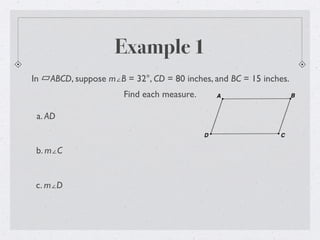
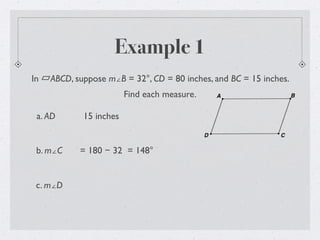
In ABCD, suppose m∠B = 32°, CD = 80 inches, and BC = 15 inches.
Find each measure.
a. AD
b. m∠C
c. m∠D
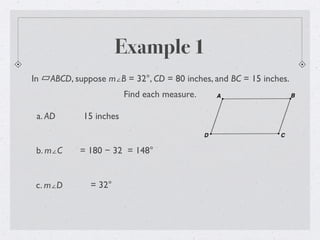
Example 1
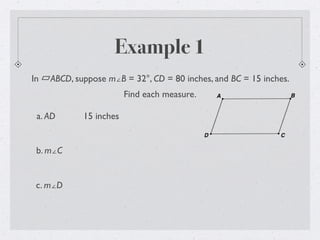
In ABCD, suppose m∠B = 32°, CD = 80 inches, and BC = 15 inches.
Find each measure.
a. AD 15 inches
b. m∠C
c. m∠D
Example 1
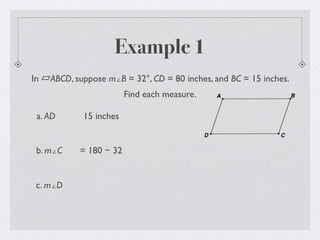
In ABCD, suppose m∠B = 32°, CD = 80 inches, and BC = 15 inches.
Find each measure.
a. AD 15 inches
b. m∠C = 180 − 32
c. m∠D
Example 1
In ABCD, suppose m∠B = 32°, CD = 80 inches, and BC = 15 inches.
Find each measure.
a. AD 15 inches
b. m∠C = 180 − 32 = 148°
c. m∠D
Example 1
In ABCD, suppose m∠B = 32°, CD = 80 inches, and BC = 15 inches.
Find each measure.
a. AD 15 inches
b. m∠C = 180 − 32 = 148°
c. m∠D = 32°
Example 2
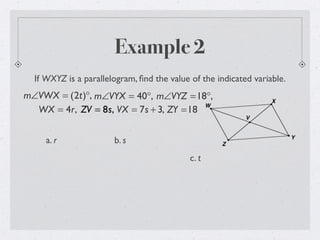
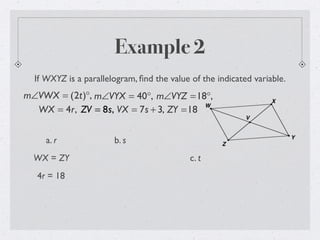
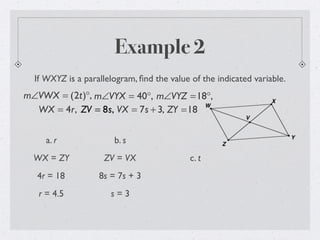
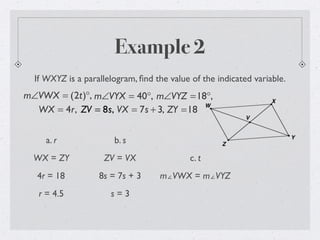
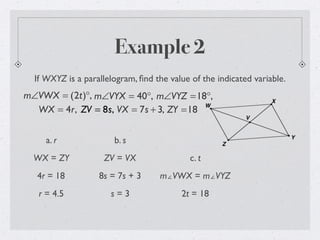
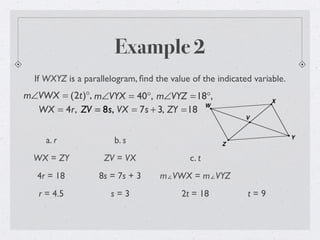
If WXYZ is a parallelogram, find the value of the indicated variable.
m∠VWX = (2t)°, m∠VYX = 40°, m∠VYZ =18°,
WX = 4r, ZV = 8s, VX = 7s + 3, ZY =18
a. r b. s
c. t
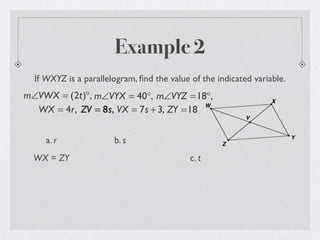
Example 2
If WXYZ is a parallelogram, find the value of the indicated variable.
m∠VWX = (2t)°, m∠VYX = 40°, m∠VYZ =18°,
WX = 4r, ZV = 8s, VX = 7s + 3, ZY =18
a. r
WX = ZY
b. s
c. t
Example 2
If WXYZ is a parallelogram, find the value of the indicated variable.
m∠VWX = (2t)°, m∠VYX = 40°, m∠VYZ =18°,
WX = 4r, ZV = 8s, VX = 7s + 3, ZY =18
a. r
WX = ZY
4r = 18
b. s
c. t
Example 2
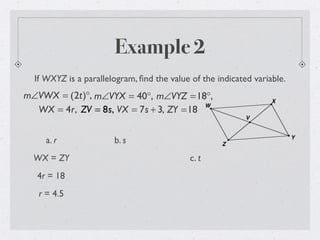
If WXYZ is a parallelogram, find the value of the indicated variable.
m∠VWX = (2t)°, m∠VYX = 40°, m∠VYZ =18°,
WX = 4r, ZV = 8s, VX = 7s + 3, ZY =18
a. r
WX = ZY
4r = 18
r = 4.5
b. s
c. t
Example 2
If WXYZ is a parallelogram, find the value of the indicated variable.
m∠VWX = (2t)°, m∠VYX = 40°, m∠VYZ =18°,
WX = 4r, ZV = 8s, VX = 7s + 3, ZY =18
a. r
WX = ZY
4r = 18
r = 4.5
b. s
ZV = VX c. t
Example 2
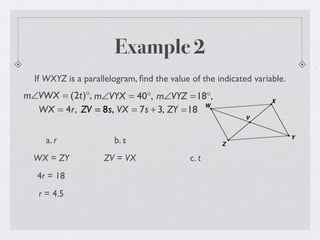
If WXYZ is a parallelogram, find the value of the indicated variable.
m∠VWX = (2t)°, m∠VYX = 40°, m∠VYZ =18°,
WX = 4r, ZV = 8s, VX = 7s + 3, ZY =18
a. r
WX = ZY
4r = 18
r = 4.5
b. s
ZV = VX
8s = 7s + 3
c. t
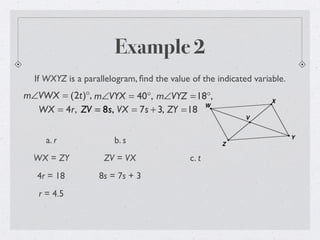
Example 2
If WXYZ is a parallelogram, find the value of the indicated variable.
m∠VWX = (2t)°, m∠VYX = 40°, m∠VYZ =18°,
WX = 4r, ZV = 8s, VX = 7s + 3, ZY =18
a. r
WX = ZY
4r = 18
r = 4.5
b. s
ZV = VX
8s = 7s + 3
s = 3
c. t
Example 2
If WXYZ is a parallelogram, find the value of the indicated variable.
m∠VWX = (2t)°, m∠VYX = 40°, m∠VYZ =18°,
WX = 4r, ZV = 8s, VX = 7s + 3, ZY =18
a. r
WX = ZY
4r = 18
r = 4.5
b. s
ZV = VX
8s = 7s + 3
s = 3
c. t
m∠VWX = m∠VYZ
Example 2
If WXYZ is a parallelogram, find the value of the indicated variable.
m∠VWX = (2t)°, m∠VYX = 40°, m∠VYZ =18°,
WX = 4r, ZV = 8s, VX = 7s + 3, ZY =18
a. r
WX = ZY
4r = 18
r = 4.5
b. s
ZV = VX
8s = 7s + 3
s = 3
c. t
m∠VWX = m∠VYZ
2t = 18
Example 2
If WXYZ is a parallelogram, find the value of the indicated variable.
m∠VWX = (2t)°, m∠VYX = 40°, m∠VYZ =18°,
WX = 4r, ZV = 8s, VX = 7s + 3, ZY =18
a. r
WX = ZY
4r = 18
r = 4.5
b. s
ZV = VX
8s = 7s + 3
s = 3
c. t
m∠VWX = m∠VYZ
2t = 18 t = 9
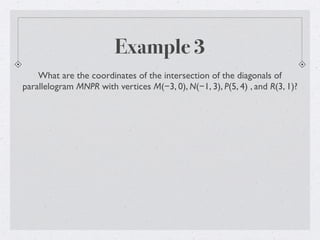
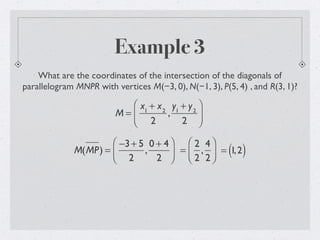
Example 3
What are the coordinates of the intersection of the diagonals of
parallelogram MNPR with vertices M(−3, 0), N(−1, 3), P(5, 4) , and R(3, 1)?
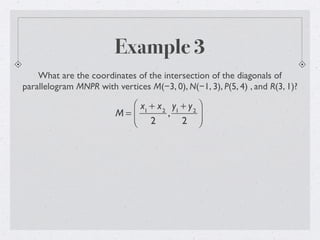
Example 3
What are the coordinates of the intersection of the diagonals of
parallelogram MNPR with vertices M(−3, 0), N(−1, 3), P(5, 4) , and R(3, 1)?
M =
x1
+ x2
2
,
y1
+ y2
2
⎛
⎝
⎜
⎞
⎠
⎟
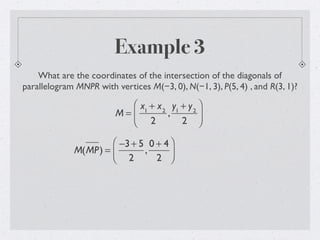
Example 3
What are the coordinates of the intersection of the diagonals of
parallelogram MNPR with vertices M(−3, 0), N(−1, 3), P(5, 4) , and R(3, 1)?
M =
x1
+ x2
2
,
y1
+ y2
2
⎛
⎝
⎜
⎞
⎠
⎟
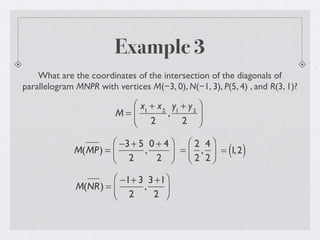
M(MP) =
−3+ 5
2
,
0 + 4
2
⎛
⎝⎜
⎞
⎠⎟
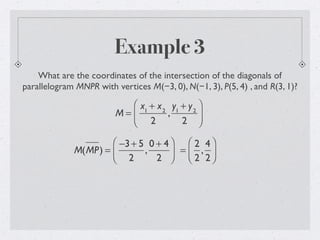
Example 3
What are the coordinates of the intersection of the diagonals of
parallelogram MNPR with vertices M(−3, 0), N(−1, 3), P(5, 4) , and R(3, 1)?
M =
x1
+ x2
2
,
y1
+ y2
2
⎛
⎝
⎜
⎞
⎠
⎟
M(MP) =
−3+ 5
2
,
0 + 4
2
⎛
⎝⎜
⎞
⎠⎟ =
2
2
,
4
2
⎛
⎝⎜
⎞
⎠⎟
Example 3
What are the coordinates of the intersection of the diagonals of
parallelogram MNPR with vertices M(−3, 0), N(−1, 3), P(5, 4) , and R(3, 1)?
M =
x1
+ x2
2
,
y1
+ y2
2
⎛
⎝
⎜
⎞
⎠
⎟
M(MP) =
−3+ 5
2
,
0 + 4
2
⎛
⎝⎜
⎞
⎠⎟ =
2
2
,
4
2
⎛
⎝⎜
⎞
⎠⎟ = 1,2( )
Example 3
What are the coordinates of the intersection of the diagonals of
parallelogram MNPR with vertices M(−3, 0), N(−1, 3), P(5, 4) , and R(3, 1)?
M =
x1
+ x2
2
,
y1
+ y2
2
⎛
⎝
⎜
⎞
⎠
⎟
M(MP) =
−3+ 5
2
,
0 + 4
2
⎛
⎝⎜
⎞
⎠⎟ =
2
2
,
4
2
⎛
⎝⎜
⎞
⎠⎟ = 1,2( )
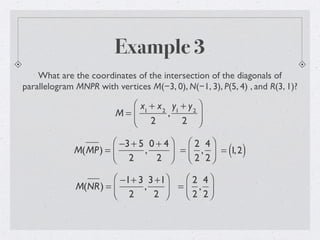
M(NR) =
−1+ 3
2
,
3+1
2
⎛
⎝⎜
⎞
⎠⎟
Example 3
What are the coordinates of the intersection of the diagonals of
parallelogram MNPR with vertices M(−3, 0), N(−1, 3), P(5, 4) , and R(3, 1)?
M =
x1
+ x2
2
,
y1
+ y2
2
⎛
⎝
⎜
⎞
⎠
⎟
M(MP) =
−3+ 5
2
,
0 + 4
2
⎛
⎝⎜
⎞
⎠⎟ =
2
2
,
4
2
⎛
⎝⎜
⎞
⎠⎟ = 1,2( )
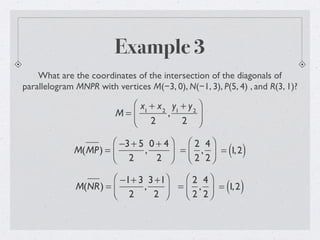
M(NR) =
−1+ 3
2
,
3+1
2
⎛
⎝⎜
⎞
⎠⎟ =
2
2
,
4
2
⎛
⎝⎜
⎞
⎠⎟
Example 3
What are the coordinates of the intersection of the diagonals of
parallelogram MNPR with vertices M(−3, 0), N(−1, 3), P(5, 4) , and R(3, 1)?
M =
x1
+ x2
2
,
y1
+ y2
2
⎛
⎝
⎜
⎞
⎠
⎟
M(MP) =
−3+ 5
2
,
0 + 4
2
⎛
⎝⎜
⎞
⎠⎟ =
2
2
,
4
2
⎛
⎝⎜
⎞
⎠⎟ = 1,2( )
M(NR) =
−1+ 3
2
,
3+1
2
⎛
⎝⎜
⎞
⎠⎟ =
2
2
,
4
2
⎛
⎝⎜
⎞
⎠⎟ = 1,2( )
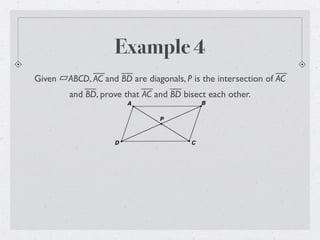
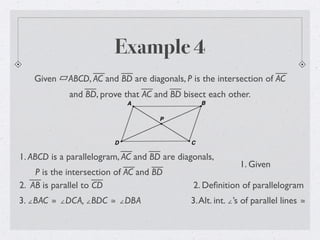
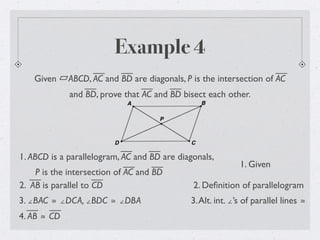
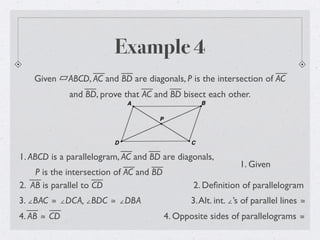
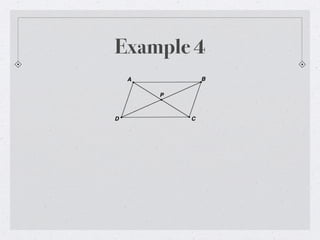
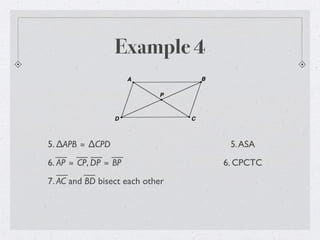
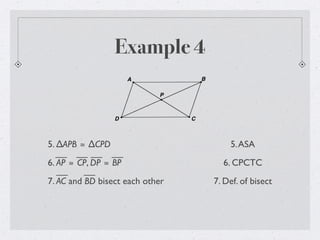
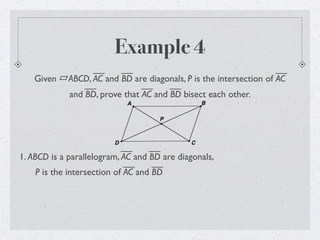
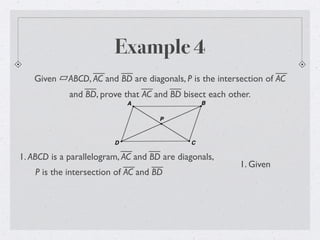
Example 4
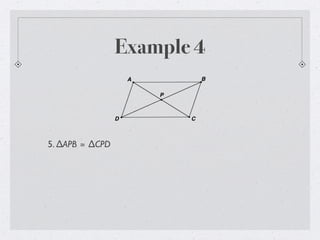
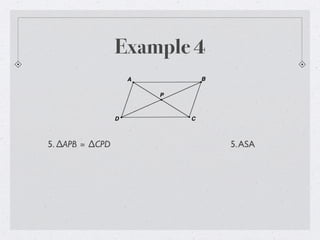
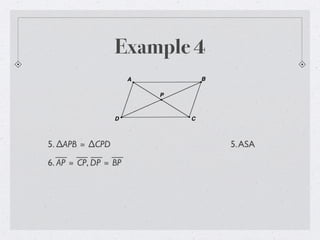
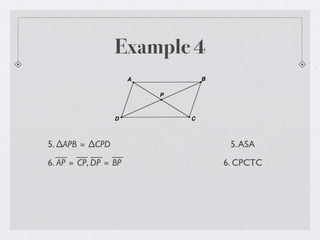
Given ABCD, AC and BD are diagonals, P is the intersection of AC
and BD, prove that AC and BD bisect each other.
Example 4
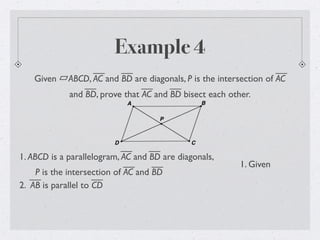
Given ABCD, AC and BD are diagonals, P is the intersection of AC
and BD, prove that AC and BD bisect each other.
1. ABCD is a parallelogram, AC and BD are diagonals,
P is the intersection of AC and BD
Example 4
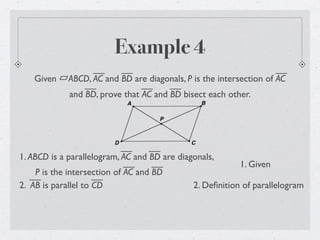
Given ABCD, AC and BD are diagonals, P is the intersection of AC
and BD, prove that AC and BD bisect each other.
1. ABCD is a parallelogram, AC and BD are diagonals,
P is the intersection of AC and BD
1. Given
Example 4
Given ABCD, AC and BD are diagonals, P is the intersection of AC
and BD, prove that AC and BD bisect each other.
1. ABCD is a parallelogram, AC and BD are diagonals,
P is the intersection of AC and BD
1. Given
2. AB is parallel to CD
Example 4
Given ABCD, AC and BD are diagonals, P is the intersection of AC
and BD, prove that AC and BD bisect each other.
1. ABCD is a parallelogram, AC and BD are diagonals,
P is the intersection of AC and BD
1. Given
2. Definition of parallelogram2. AB is parallel to CD
Example 4
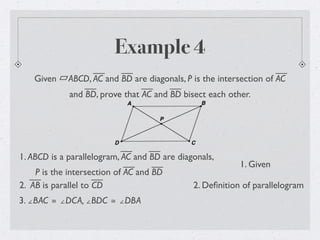
Given ABCD, AC and BD are diagonals, P is the intersection of AC
and BD, prove that AC and BD bisect each other.
1. ABCD is a parallelogram, AC and BD are diagonals,
P is the intersection of AC and BD
1. Given
2. Definition of parallelogram
3. ∠BAC ≅ ∠DCA, ∠BDC ≅ ∠DBA
2. AB is parallel to CD
Example 4
Given ABCD, AC and BD are diagonals, P is the intersection of AC
and BD, prove that AC and BD bisect each other.
1. ABCD is a parallelogram, AC and BD are diagonals,
P is the intersection of AC and BD
1. Given
2. Definition of parallelogram
3. ∠BAC ≅ ∠DCA, ∠BDC ≅ ∠DBA
2. AB is parallel to CD
3.Alt. int. ∠’s of parallel lines ≅
Example 4
Given ABCD, AC and BD are diagonals, P is the intersection of AC
and BD, prove that AC and BD bisect each other.
1. ABCD is a parallelogram, AC and BD are diagonals,
P is the intersection of AC and BD
1. Given
2. Definition of parallelogram
3. ∠BAC ≅ ∠DCA, ∠BDC ≅ ∠DBA
2. AB is parallel to CD
3.Alt. int. ∠’s of parallel lines ≅
4. AB ≅ CD
Example 4
Given ABCD, AC and BD are diagonals, P is the intersection of AC
and BD, prove that AC and BD bisect each other.
1. ABCD is a parallelogram, AC and BD are diagonals,
P is the intersection of AC and BD
1. Given
2. Definition of parallelogram
3. ∠BAC ≅ ∠DCA, ∠BDC ≅ ∠DBA
2. AB is parallel to CD
3.Alt. int. ∠’s of parallel lines ≅
4. AB ≅ CD 4. Opposite sides of parallelograms ≅
Example 4
Example 4
5. ∆APB ≅ ∆CPD
Example 4
5. ∆APB ≅ ∆CPD 5.ASA
Example 4
5. ∆APB ≅ ∆CPD 5.ASA
6. AP ≅ CP, DP ≅ BP
Example 4
5. ∆APB ≅ ∆CPD 5.ASA
6. AP ≅ CP, DP ≅ BP 6. CPCTC
Example 4
5. ∆APB ≅ ∆CPD 5.ASA
6. AP ≅ CP, DP ≅ BP 6. CPCTC
7. AC and BD bisect each other
Example 4
5. ∆APB ≅ ∆CPD 5.ASA
6. AP ≅ CP, DP ≅ BP 6. CPCTC
7. AC and BD bisect each other 7. Def. of bisect

Geometry Section 6-2

  • 1.
  • 2.
    Essential Questions How doyou recognize and apply properties of the sides and angles of parallelograms? How do you recognize and apply properties of the diagonals of parallelograms?
  • 3.
  • 4.
    Vocabulary 1. Parallelogram: Aquadrilateral that has two pairs of parallel sides
  • 5.
    Properties and Theorems 6.3- Opposite Sides: 6.4 - Opposite Angles: 6.5 - Consecutive Angles: 6.6 - Right Angles:
  • 6.
    Properties and Theorems 6.3- Opposite Sides: If a quadrilateral is a parallelogram, then its opposite sides are congruent 6.4 - Opposite Angles: 6.5 - Consecutive Angles: 6.6 - Right Angles:
  • 7.
    Properties and Theorems 6.3- Opposite Sides: If a quadrilateral is a parallelogram, then its opposite sides are congruent 6.4 - Opposite Angles: If a quadrilateral is a parallelogram, then its opposite angles are congruent 6.5 - Consecutive Angles: 6.6 - Right Angles:
  • 8.
    Properties and Theorems 6.3- Opposite Sides: If a quadrilateral is a parallelogram, then its opposite sides are congruent 6.4 - Opposite Angles: If a quadrilateral is a parallelogram, then its opposite angles are congruent 6.5 - Consecutive Angles: If a quadrilateral is a parallelogram, then its consecutive angles are supplementary 6.6 - Right Angles:
  • 9.
    Properties and Theorems 6.3- Opposite Sides: If a quadrilateral is a parallelogram, then its opposite sides are congruent 6.4 - Opposite Angles: If a quadrilateral is a parallelogram, then its opposite angles are congruent 6.5 - Consecutive Angles: If a quadrilateral is a parallelogram, then its consecutive angles are supplementary 6.6 - Right Angles: If a parallelogram has one right angle, then it has four right angles
  • 10.
    Properties and Theorems 6.7- Bisecting Diagonals: 6.8 - Triangles from Diagonals:
  • 11.
    Properties and Theorems 6.7- Bisecting Diagonals: If a quadrilateral is a parallelogram, then its diagonals bisect each other 6.8 - Triangles from Diagonals:
  • 12.
    Properties and Theorems 6.7- Bisecting Diagonals: If a quadrilateral is a parallelogram, then its diagonals bisect each other 6.8 - Triangles from Diagonals: If a quadrilateral is a parallelogram, then each diagonal separates the parallelogram into two congruent triangles
  • 13.
    Example 1 In ABCD,suppose m∠B = 32°, CD = 80 inches, and BC = 15 inches. Find each measure. a. AD b. m∠C c. m∠D
  • 14.
    Example 1 In ABCD,suppose m∠B = 32°, CD = 80 inches, and BC = 15 inches. Find each measure. a. AD 15 inches b. m∠C c. m∠D
  • 15.
    Example 1 In ABCD,suppose m∠B = 32°, CD = 80 inches, and BC = 15 inches. Find each measure. a. AD 15 inches b. m∠C = 180 − 32 c. m∠D
  • 16.
    Example 1 In ABCD,suppose m∠B = 32°, CD = 80 inches, and BC = 15 inches. Find each measure. a. AD 15 inches b. m∠C = 180 − 32 = 148° c. m∠D
  • 17.
    Example 1 In ABCD,suppose m∠B = 32°, CD = 80 inches, and BC = 15 inches. Find each measure. a. AD 15 inches b. m∠C = 180 − 32 = 148° c. m∠D = 32°
  • 18.
    Example 2 If WXYZis a parallelogram, find the value of the indicated variable. m∠VWX = (2t)°, m∠VYX = 40°, m∠VYZ =18°, WX = 4r, ZV = 8s, VX = 7s + 3, ZY =18 a. r b. s c. t
  • 19.
    Example 2 If WXYZis a parallelogram, find the value of the indicated variable. m∠VWX = (2t)°, m∠VYX = 40°, m∠VYZ =18°, WX = 4r, ZV = 8s, VX = 7s + 3, ZY =18 a. r WX = ZY b. s c. t
  • 20.
    Example 2 If WXYZis a parallelogram, find the value of the indicated variable. m∠VWX = (2t)°, m∠VYX = 40°, m∠VYZ =18°, WX = 4r, ZV = 8s, VX = 7s + 3, ZY =18 a. r WX = ZY 4r = 18 b. s c. t
  • 21.
    Example 2 If WXYZis a parallelogram, find the value of the indicated variable. m∠VWX = (2t)°, m∠VYX = 40°, m∠VYZ =18°, WX = 4r, ZV = 8s, VX = 7s + 3, ZY =18 a. r WX = ZY 4r = 18 r = 4.5 b. s c. t
  • 22.
    Example 2 If WXYZis a parallelogram, find the value of the indicated variable. m∠VWX = (2t)°, m∠VYX = 40°, m∠VYZ =18°, WX = 4r, ZV = 8s, VX = 7s + 3, ZY =18 a. r WX = ZY 4r = 18 r = 4.5 b. s ZV = VX c. t
  • 23.
    Example 2 If WXYZis a parallelogram, find the value of the indicated variable. m∠VWX = (2t)°, m∠VYX = 40°, m∠VYZ =18°, WX = 4r, ZV = 8s, VX = 7s + 3, ZY =18 a. r WX = ZY 4r = 18 r = 4.5 b. s ZV = VX 8s = 7s + 3 c. t
  • 24.
    Example 2 If WXYZis a parallelogram, find the value of the indicated variable. m∠VWX = (2t)°, m∠VYX = 40°, m∠VYZ =18°, WX = 4r, ZV = 8s, VX = 7s + 3, ZY =18 a. r WX = ZY 4r = 18 r = 4.5 b. s ZV = VX 8s = 7s + 3 s = 3 c. t
  • 25.
    Example 2 If WXYZis a parallelogram, find the value of the indicated variable. m∠VWX = (2t)°, m∠VYX = 40°, m∠VYZ =18°, WX = 4r, ZV = 8s, VX = 7s + 3, ZY =18 a. r WX = ZY 4r = 18 r = 4.5 b. s ZV = VX 8s = 7s + 3 s = 3 c. t m∠VWX = m∠VYZ
  • 26.
    Example 2 If WXYZis a parallelogram, find the value of the indicated variable. m∠VWX = (2t)°, m∠VYX = 40°, m∠VYZ =18°, WX = 4r, ZV = 8s, VX = 7s + 3, ZY =18 a. r WX = ZY 4r = 18 r = 4.5 b. s ZV = VX 8s = 7s + 3 s = 3 c. t m∠VWX = m∠VYZ 2t = 18
  • 27.
    Example 2 If WXYZis a parallelogram, find the value of the indicated variable. m∠VWX = (2t)°, m∠VYX = 40°, m∠VYZ =18°, WX = 4r, ZV = 8s, VX = 7s + 3, ZY =18 a. r WX = ZY 4r = 18 r = 4.5 b. s ZV = VX 8s = 7s + 3 s = 3 c. t m∠VWX = m∠VYZ 2t = 18 t = 9
  • 28.
    Example 3 What arethe coordinates of the intersection of the diagonals of parallelogram MNPR with vertices M(−3, 0), N(−1, 3), P(5, 4) , and R(3, 1)?
  • 29.
    Example 3 What arethe coordinates of the intersection of the diagonals of parallelogram MNPR with vertices M(−3, 0), N(−1, 3), P(5, 4) , and R(3, 1)? M = x1 + x2 2 , y1 + y2 2 ⎛ ⎝ ⎜ ⎞ ⎠ ⎟
  • 30.
    Example 3 What arethe coordinates of the intersection of the diagonals of parallelogram MNPR with vertices M(−3, 0), N(−1, 3), P(5, 4) , and R(3, 1)? M = x1 + x2 2 , y1 + y2 2 ⎛ ⎝ ⎜ ⎞ ⎠ ⎟ M(MP) = −3+ 5 2 , 0 + 4 2 ⎛ ⎝⎜ ⎞ ⎠⎟
  • 31.
    Example 3 What arethe coordinates of the intersection of the diagonals of parallelogram MNPR with vertices M(−3, 0), N(−1, 3), P(5, 4) , and R(3, 1)? M = x1 + x2 2 , y1 + y2 2 ⎛ ⎝ ⎜ ⎞ ⎠ ⎟ M(MP) = −3+ 5 2 , 0 + 4 2 ⎛ ⎝⎜ ⎞ ⎠⎟ = 2 2 , 4 2 ⎛ ⎝⎜ ⎞ ⎠⎟
  • 32.
    Example 3 What arethe coordinates of the intersection of the diagonals of parallelogram MNPR with vertices M(−3, 0), N(−1, 3), P(5, 4) , and R(3, 1)? M = x1 + x2 2 , y1 + y2 2 ⎛ ⎝ ⎜ ⎞ ⎠ ⎟ M(MP) = −3+ 5 2 , 0 + 4 2 ⎛ ⎝⎜ ⎞ ⎠⎟ = 2 2 , 4 2 ⎛ ⎝⎜ ⎞ ⎠⎟ = 1,2( )
  • 33.
    Example 3 What arethe coordinates of the intersection of the diagonals of parallelogram MNPR with vertices M(−3, 0), N(−1, 3), P(5, 4) , and R(3, 1)? M = x1 + x2 2 , y1 + y2 2 ⎛ ⎝ ⎜ ⎞ ⎠ ⎟ M(MP) = −3+ 5 2 , 0 + 4 2 ⎛ ⎝⎜ ⎞ ⎠⎟ = 2 2 , 4 2 ⎛ ⎝⎜ ⎞ ⎠⎟ = 1,2( ) M(NR) = −1+ 3 2 , 3+1 2 ⎛ ⎝⎜ ⎞ ⎠⎟
  • 34.
    Example 3 What arethe coordinates of the intersection of the diagonals of parallelogram MNPR with vertices M(−3, 0), N(−1, 3), P(5, 4) , and R(3, 1)? M = x1 + x2 2 , y1 + y2 2 ⎛ ⎝ ⎜ ⎞ ⎠ ⎟ M(MP) = −3+ 5 2 , 0 + 4 2 ⎛ ⎝⎜ ⎞ ⎠⎟ = 2 2 , 4 2 ⎛ ⎝⎜ ⎞ ⎠⎟ = 1,2( ) M(NR) = −1+ 3 2 , 3+1 2 ⎛ ⎝⎜ ⎞ ⎠⎟ = 2 2 , 4 2 ⎛ ⎝⎜ ⎞ ⎠⎟
  • 35.
    Example 3 What arethe coordinates of the intersection of the diagonals of parallelogram MNPR with vertices M(−3, 0), N(−1, 3), P(5, 4) , and R(3, 1)? M = x1 + x2 2 , y1 + y2 2 ⎛ ⎝ ⎜ ⎞ ⎠ ⎟ M(MP) = −3+ 5 2 , 0 + 4 2 ⎛ ⎝⎜ ⎞ ⎠⎟ = 2 2 , 4 2 ⎛ ⎝⎜ ⎞ ⎠⎟ = 1,2( ) M(NR) = −1+ 3 2 , 3+1 2 ⎛ ⎝⎜ ⎞ ⎠⎟ = 2 2 , 4 2 ⎛ ⎝⎜ ⎞ ⎠⎟ = 1,2( )
  • 36.
    Example 4 Given ABCD,AC and BD are diagonals, P is the intersection of AC and BD, prove that AC and BD bisect each other.
  • 37.
    Example 4 Given ABCD,AC and BD are diagonals, P is the intersection of AC and BD, prove that AC and BD bisect each other. 1. ABCD is a parallelogram, AC and BD are diagonals, P is the intersection of AC and BD
  • 38.
    Example 4 Given ABCD,AC and BD are diagonals, P is the intersection of AC and BD, prove that AC and BD bisect each other. 1. ABCD is a parallelogram, AC and BD are diagonals, P is the intersection of AC and BD 1. Given
  • 39.
    Example 4 Given ABCD,AC and BD are diagonals, P is the intersection of AC and BD, prove that AC and BD bisect each other. 1. ABCD is a parallelogram, AC and BD are diagonals, P is the intersection of AC and BD 1. Given 2. AB is parallel to CD
  • 40.
    Example 4 Given ABCD,AC and BD are diagonals, P is the intersection of AC and BD, prove that AC and BD bisect each other. 1. ABCD is a parallelogram, AC and BD are diagonals, P is the intersection of AC and BD 1. Given 2. Definition of parallelogram2. AB is parallel to CD
  • 41.
    Example 4 Given ABCD,AC and BD are diagonals, P is the intersection of AC and BD, prove that AC and BD bisect each other. 1. ABCD is a parallelogram, AC and BD are diagonals, P is the intersection of AC and BD 1. Given 2. Definition of parallelogram 3. ∠BAC ≅ ∠DCA, ∠BDC ≅ ∠DBA 2. AB is parallel to CD
  • 42.
    Example 4 Given ABCD,AC and BD are diagonals, P is the intersection of AC and BD, prove that AC and BD bisect each other. 1. ABCD is a parallelogram, AC and BD are diagonals, P is the intersection of AC and BD 1. Given 2. Definition of parallelogram 3. ∠BAC ≅ ∠DCA, ∠BDC ≅ ∠DBA 2. AB is parallel to CD 3.Alt. int. ∠’s of parallel lines ≅
  • 43.
    Example 4 Given ABCD,AC and BD are diagonals, P is the intersection of AC and BD, prove that AC and BD bisect each other. 1. ABCD is a parallelogram, AC and BD are diagonals, P is the intersection of AC and BD 1. Given 2. Definition of parallelogram 3. ∠BAC ≅ ∠DCA, ∠BDC ≅ ∠DBA 2. AB is parallel to CD 3.Alt. int. ∠’s of parallel lines ≅ 4. AB ≅ CD
  • 44.
    Example 4 Given ABCD,AC and BD are diagonals, P is the intersection of AC and BD, prove that AC and BD bisect each other. 1. ABCD is a parallelogram, AC and BD are diagonals, P is the intersection of AC and BD 1. Given 2. Definition of parallelogram 3. ∠BAC ≅ ∠DCA, ∠BDC ≅ ∠DBA 2. AB is parallel to CD 3.Alt. int. ∠’s of parallel lines ≅ 4. AB ≅ CD 4. Opposite sides of parallelograms ≅
  • 45.
  • 46.
  • 47.
    Example 4 5. ∆APB≅ ∆CPD 5.ASA
  • 48.
    Example 4 5. ∆APB≅ ∆CPD 5.ASA 6. AP ≅ CP, DP ≅ BP
  • 49.
    Example 4 5. ∆APB≅ ∆CPD 5.ASA 6. AP ≅ CP, DP ≅ BP 6. CPCTC
  • 50.
    Example 4 5. ∆APB≅ ∆CPD 5.ASA 6. AP ≅ CP, DP ≅ BP 6. CPCTC 7. AC and BD bisect each other
  • 51.
    Example 4 5. ∆APB≅ ∆CPD 5.ASA 6. AP ≅ CP, DP ≅ BP 6. CPCTC 7. AC and BD bisect each other 7. Def. of bisect