CHAPTER 1
Tools of Geometry
SECTION 1-1
Points, Lines, and Planes
ESSENTIAL QUESTIONS
How do you identify and model points, lines, and
planes?
How do you identify intersecting lines and planes?
VOCABULARY
1. Undefined Term:
2. Point:
3. Line:
VOCABULARY
1. Undefined Term: The things in Geometry that can
really only be explained in examples and
descriptions
2. Point:
3. Line:
VOCABULARY
1. Undefined Term: The things in Geometry that can
really only be explained in examples and
descriptions
2. Point: A location in space with no shape or size;
noted as a capital letter
3. Line:
VOCABULARY
1. Undefined Term: The things in Geometry that can
really only be explained in examples and
descriptions
2. Point: A location in space with no shape or size;
noted as a capital letter
3. Line: An infinite number of points that together have
no thickness or width; need two points to determine
the line; use either a lowercase letter or AB
VOCABULARY
4. Plane:
5. Collinear:
6. Coplanar:
7. Intersection:
VOCABULARY
4. Plane: A flat surface with at least three points that
goes on forever in all directions; three points
determine a plane; Often a capital script letter
5. Collinear:
6. Coplanar:
7. Intersection:
VOCABULARY
4. Plane: A flat surface with at least three points that
goes on forever in all directions; three points
determine a plane; Often a capital script letter
5. Collinear: Points that lie on the same line
6. Coplanar:
7. Intersection:
VOCABULARY
4. Plane: A flat surface with at least three points that
goes on forever in all directions; three points
determine a plane; Often a capital script letter
5. Collinear: Points that lie on the same line
6. Coplanar: Points that lie in the same plane
7. Intersection:
VOCABULARY
4. Plane: A flat surface with at least three points that
goes on forever in all directions; three points
determine a plane; Often a capital script letter
5. Collinear: Points that lie on the same line
6. Coplanar: Points that lie in the same plane
7. Intersection: Where two figures meet; this is the set
of points they have in common
VOCABULARY
8. Definition:
9. Defined Terms:
10. Space:
VOCABULARY
8. Definition: Explanations that are used based off of
other undefined and defined terms
9. Defined Terms:
10. Space:
VOCABULARY
8. Definition: Explanations that are used based off of
other undefined and defined terms
9. Defined Terms: Another way of working with a
definition
10. Space: An infinite three-dimensional set of points
EXAMPLE 1
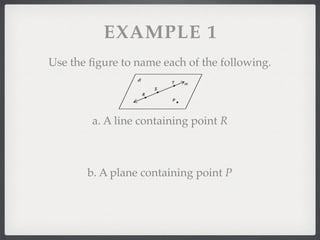
Use the figure to name each of the following.
a. A line containing point R
b. A plane containing point P
EXAMPLE 1
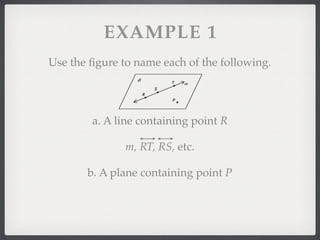
Use the figure to name each of the following.
a. A line containing point R
m, RT, RS, etc.
b. A plane containing point P
EXAMPLE 1
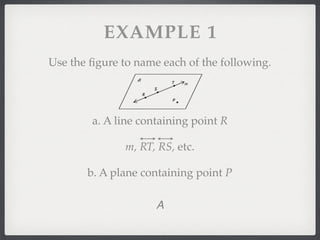
Use the figure to name each of the following.
a. A line containing point R
m, RT, RS, etc.
b. A plane containing point P
A
EXAMPLE 2
Name the geometric shape modeled by each object.
a. A crack in a sidewalk
b. A drop of water on the sidewalk
EXAMPLE 2
Name the geometric shape modeled by each object.
a. A crack in a sidewalk
line
b. A drop of water on the sidewalk
EXAMPLE 2
Name the geometric shape modeled by each object.
a. A crack in a sidewalk
line
b. A drop of water on the sidewalk
point
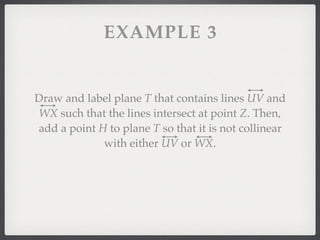
EXAMPLE 3
Draw and label plane T that contains lines UV and
WX such that the lines intersect at point Z. Then,
add a point H to plane T so that it is not collinear
with either UV or WX.
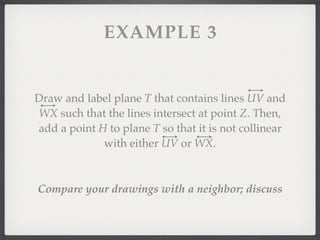
EXAMPLE 3
Draw and label plane T that contains lines UV and
WX such that the lines intersect at point Z. Then,
add a point H to plane T so that it is not collinear
with either UV or WX.
Compare your drawings with a neighbor; discuss
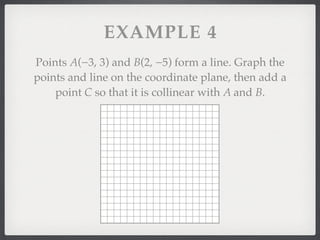
EXAMPLE 4
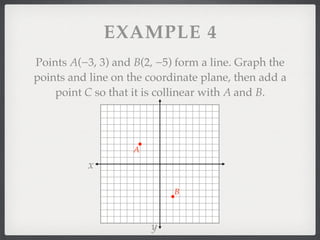
Points A(−3, 3) and B(2, −5) form a line. Graph the
points and line on the coordinate plane, then add a
point C so that it is collinear with A and B.
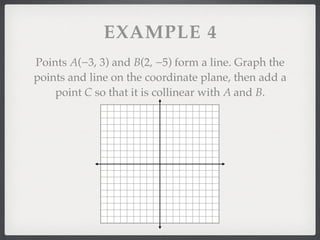
EXAMPLE 4
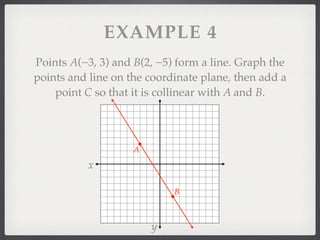
Points A(−3, 3) and B(2, −5) form a line. Graph the
points and line on the coordinate plane, then add a
point C so that it is collinear with A and B.
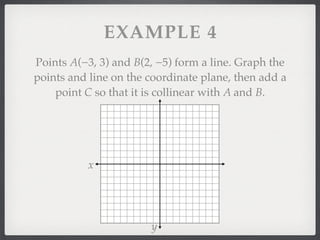
EXAMPLE 4
Points A(−3, 3) and B(2, −5) form a line. Graph the
points and line on the coordinate plane, then add a
point C so that it is collinear with A and B.
x
y
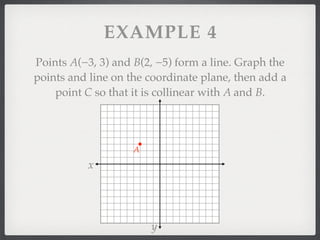
EXAMPLE 4
Points A(−3, 3) and B(2, −5) form a line. Graph the
points and line on the coordinate plane, then add a
point C so that it is collinear with A and B.
x
y
A
EXAMPLE 4
Points A(−3, 3) and B(2, −5) form a line. Graph the
points and line on the coordinate plane, then add a
point C so that it is collinear with A and B.
x
y
A
B
EXAMPLE 4
Points A(−3, 3) and B(2, −5) form a line. Graph the
points and line on the coordinate plane, then add a
point C so that it is collinear with A and B.
x
y
A
B
EXAMPLE 4
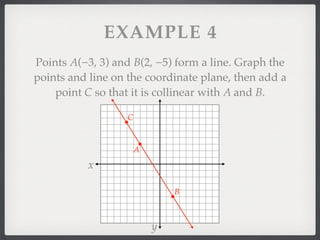
Points A(−3, 3) and B(2, −5) form a line. Graph the
points and line on the coordinate plane, then add a
point C so that it is collinear with A and B.
x
y
A
B
C
EXAMPLE 5
Answer the following.
a. How many points are need to form a line?
b. How many points are needed to form a plane?
c. What is the intersection of two planes?
d. What is the intersection of two lines?
e. What is the difference between collinear and coplanar?

Geometry Section 1-1

  • 1.
  • 2.
  • 3.
    ESSENTIAL QUESTIONS How doyou identify and model points, lines, and planes? How do you identify intersecting lines and planes?
  • 4.
  • 5.
    VOCABULARY 1. Undefined Term:The things in Geometry that can really only be explained in examples and descriptions 2. Point: 3. Line:
  • 6.
    VOCABULARY 1. Undefined Term:The things in Geometry that can really only be explained in examples and descriptions 2. Point: A location in space with no shape or size; noted as a capital letter 3. Line:
  • 7.
    VOCABULARY 1. Undefined Term:The things in Geometry that can really only be explained in examples and descriptions 2. Point: A location in space with no shape or size; noted as a capital letter 3. Line: An infinite number of points that together have no thickness or width; need two points to determine the line; use either a lowercase letter or AB
  • 8.
    VOCABULARY 4. Plane: 5. Collinear: 6.Coplanar: 7. Intersection:
  • 9.
    VOCABULARY 4. Plane: Aflat surface with at least three points that goes on forever in all directions; three points determine a plane; Often a capital script letter 5. Collinear: 6. Coplanar: 7. Intersection:
  • 10.
    VOCABULARY 4. Plane: Aflat surface with at least three points that goes on forever in all directions; three points determine a plane; Often a capital script letter 5. Collinear: Points that lie on the same line 6. Coplanar: 7. Intersection:
  • 11.
    VOCABULARY 4. Plane: Aflat surface with at least three points that goes on forever in all directions; three points determine a plane; Often a capital script letter 5. Collinear: Points that lie on the same line 6. Coplanar: Points that lie in the same plane 7. Intersection:
  • 12.
    VOCABULARY 4. Plane: Aflat surface with at least three points that goes on forever in all directions; three points determine a plane; Often a capital script letter 5. Collinear: Points that lie on the same line 6. Coplanar: Points that lie in the same plane 7. Intersection: Where two figures meet; this is the set of points they have in common
  • 13.
  • 14.
    VOCABULARY 8. Definition: Explanationsthat are used based off of other undefined and defined terms 9. Defined Terms: 10. Space:
  • 15.
    VOCABULARY 8. Definition: Explanationsthat are used based off of other undefined and defined terms 9. Defined Terms: Another way of working with a definition 10. Space: An infinite three-dimensional set of points
  • 16.
    EXAMPLE 1 Use thefigure to name each of the following. a. A line containing point R b. A plane containing point P
  • 17.
    EXAMPLE 1 Use thefigure to name each of the following. a. A line containing point R m, RT, RS, etc. b. A plane containing point P
  • 18.
    EXAMPLE 1 Use thefigure to name each of the following. a. A line containing point R m, RT, RS, etc. b. A plane containing point P A
  • 19.
    EXAMPLE 2 Name thegeometric shape modeled by each object. a. A crack in a sidewalk b. A drop of water on the sidewalk
  • 20.
    EXAMPLE 2 Name thegeometric shape modeled by each object. a. A crack in a sidewalk line b. A drop of water on the sidewalk
  • 21.
    EXAMPLE 2 Name thegeometric shape modeled by each object. a. A crack in a sidewalk line b. A drop of water on the sidewalk point
  • 22.
    EXAMPLE 3 Draw andlabel plane T that contains lines UV and WX such that the lines intersect at point Z. Then, add a point H to plane T so that it is not collinear with either UV or WX.
  • 23.
    EXAMPLE 3 Draw andlabel plane T that contains lines UV and WX such that the lines intersect at point Z. Then, add a point H to plane T so that it is not collinear with either UV or WX. Compare your drawings with a neighbor; discuss
  • 24.
    EXAMPLE 4 Points A(−3,3) and B(2, −5) form a line. Graph the points and line on the coordinate plane, then add a point C so that it is collinear with A and B.
  • 25.
    EXAMPLE 4 Points A(−3,3) and B(2, −5) form a line. Graph the points and line on the coordinate plane, then add a point C so that it is collinear with A and B.
  • 26.
    EXAMPLE 4 Points A(−3,3) and B(2, −5) form a line. Graph the points and line on the coordinate plane, then add a point C so that it is collinear with A and B. x y
  • 27.
    EXAMPLE 4 Points A(−3,3) and B(2, −5) form a line. Graph the points and line on the coordinate plane, then add a point C so that it is collinear with A and B. x y A
  • 28.
    EXAMPLE 4 Points A(−3,3) and B(2, −5) form a line. Graph the points and line on the coordinate plane, then add a point C so that it is collinear with A and B. x y A B
  • 29.
    EXAMPLE 4 Points A(−3,3) and B(2, −5) form a line. Graph the points and line on the coordinate plane, then add a point C so that it is collinear with A and B. x y A B
  • 30.
    EXAMPLE 4 Points A(−3,3) and B(2, −5) form a line. Graph the points and line on the coordinate plane, then add a point C so that it is collinear with A and B. x y A B C
  • 31.
    EXAMPLE 5 Answer thefollowing. a. How many points are need to form a line? b. How many points are needed to form a plane? c. What is the intersection of two planes? d. What is the intersection of two lines? e. What is the difference between collinear and coplanar?