Chapter 12 - Surface Area & Volume of Solids Objectives: Identify types of solids Calculate surface area & volume of: Prisms Pyramids Cylinders Cones Spheres
12.2 & 3 Surface Area of Prisms & Cylinders & Pyramids & Cones Objectives: Find Surface Area of prisms cylinders pyramids cones
Prisms A  prism  is a polyhedron with 2 congruent faces, called  bases , that lie in parallel planes.  The other faces, ( lateral faces) , are parallelograms formed by connecting the corresponding vertices of the bases.  The segments connecting these vertices are  lateral edges .
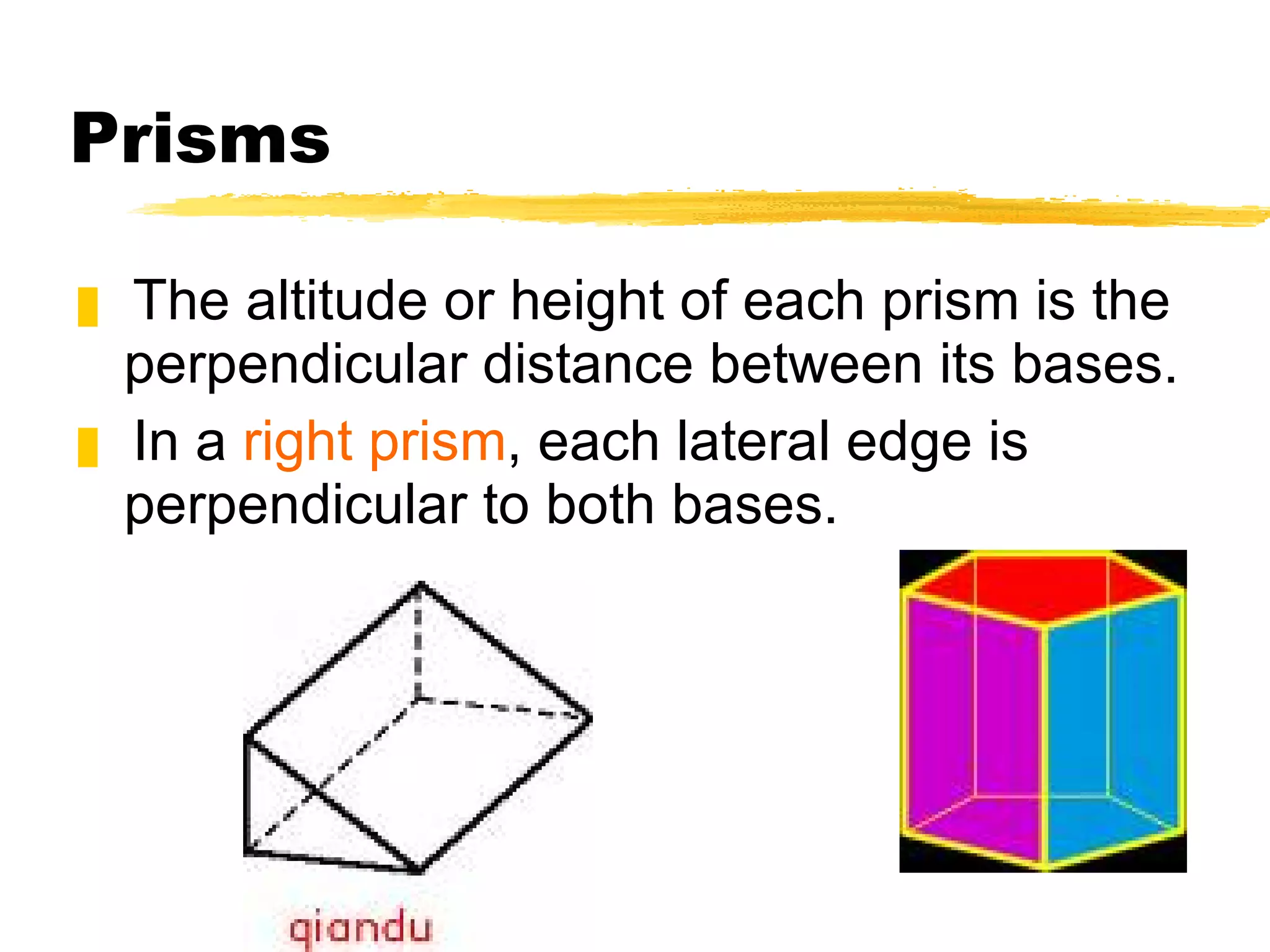
Prisms The altitude or height of each prism is the perpendicular distance between its bases. In a  right prism , each lateral edge is perpendicular to both bases.
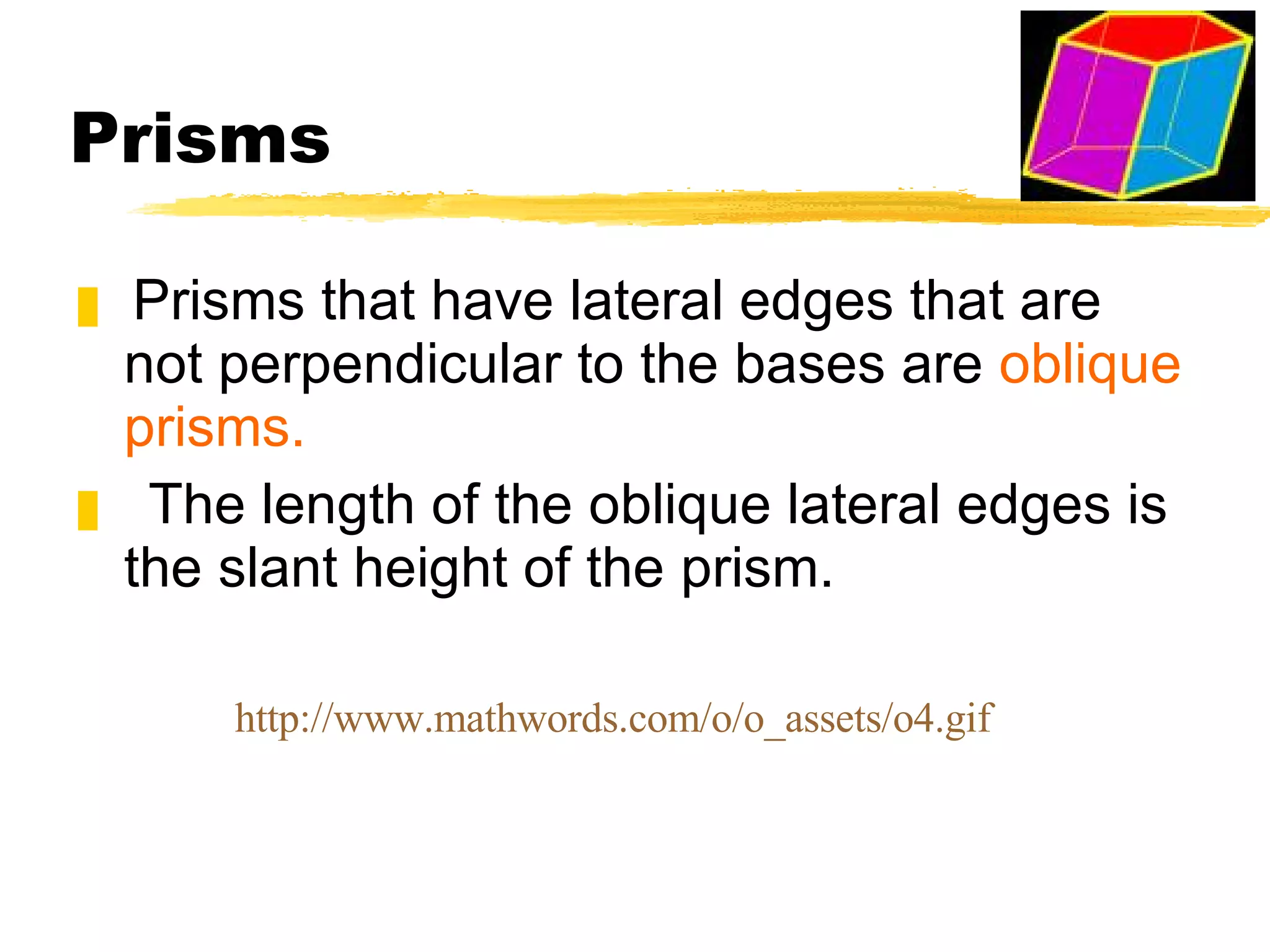
Prisms Prisms that have lateral edges that are not perpendicular to the bases are  oblique prisms. The length of the oblique lateral edges is the slant height of the prism. http://www.mathwords.com/o/o_assets/o4.gif
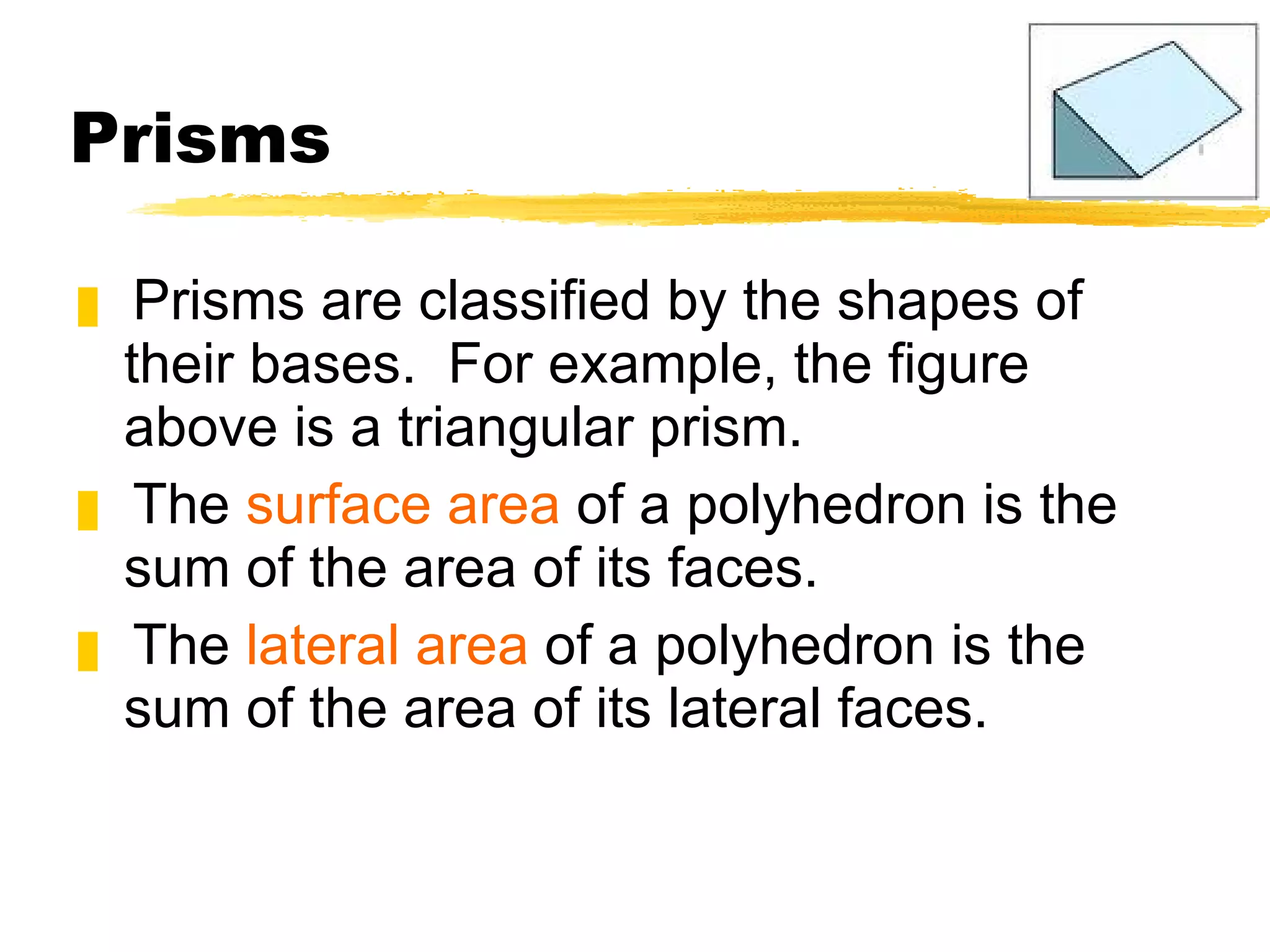
Prisms Prisms are classified by the shapes of their bases.  For example, the figure above is a triangular prism. The  surface area  of a polyhedron is the sum of the area of its faces. The  lateral area  of a polyhedron is the sum of the area of its lateral faces.
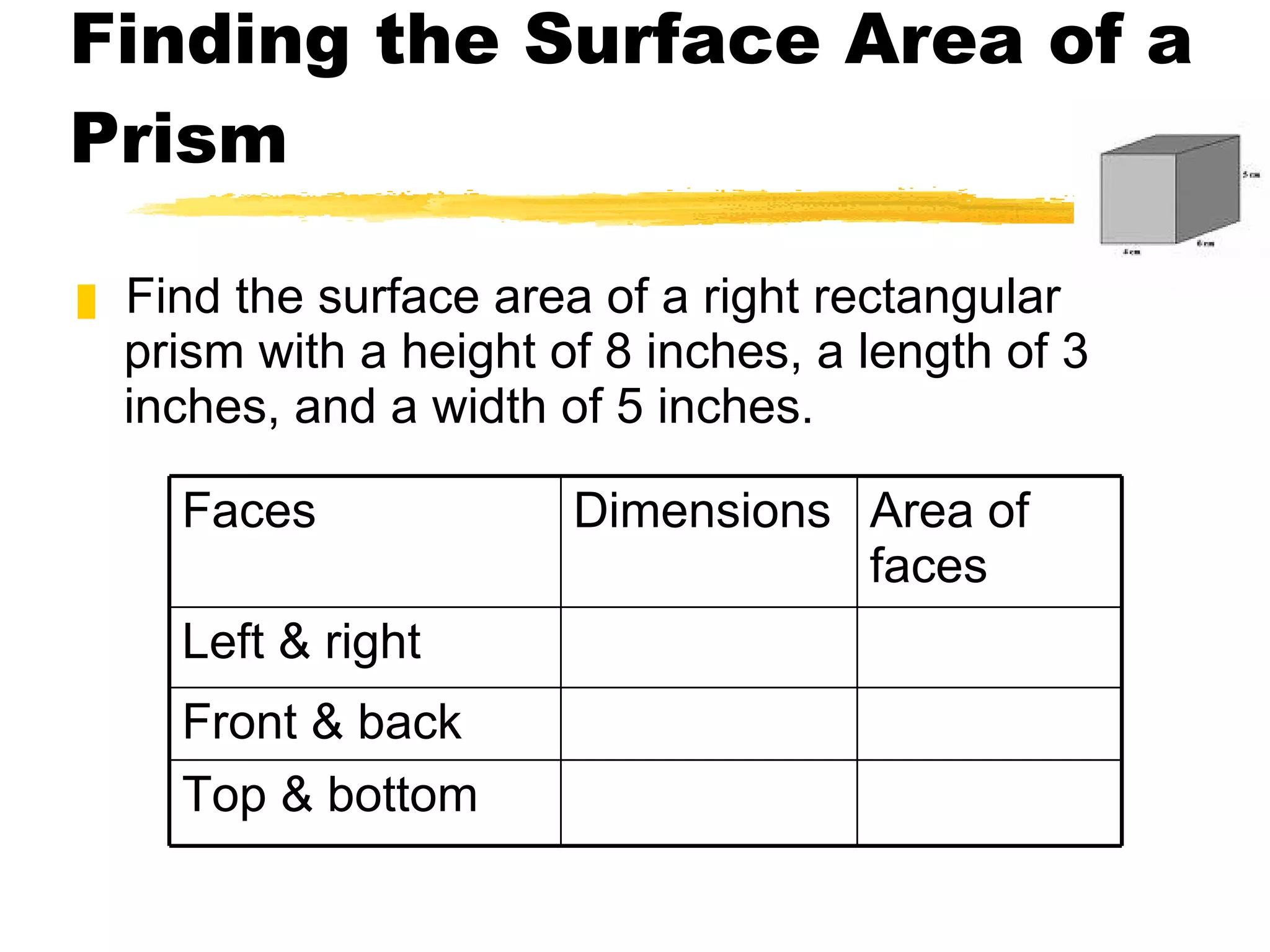
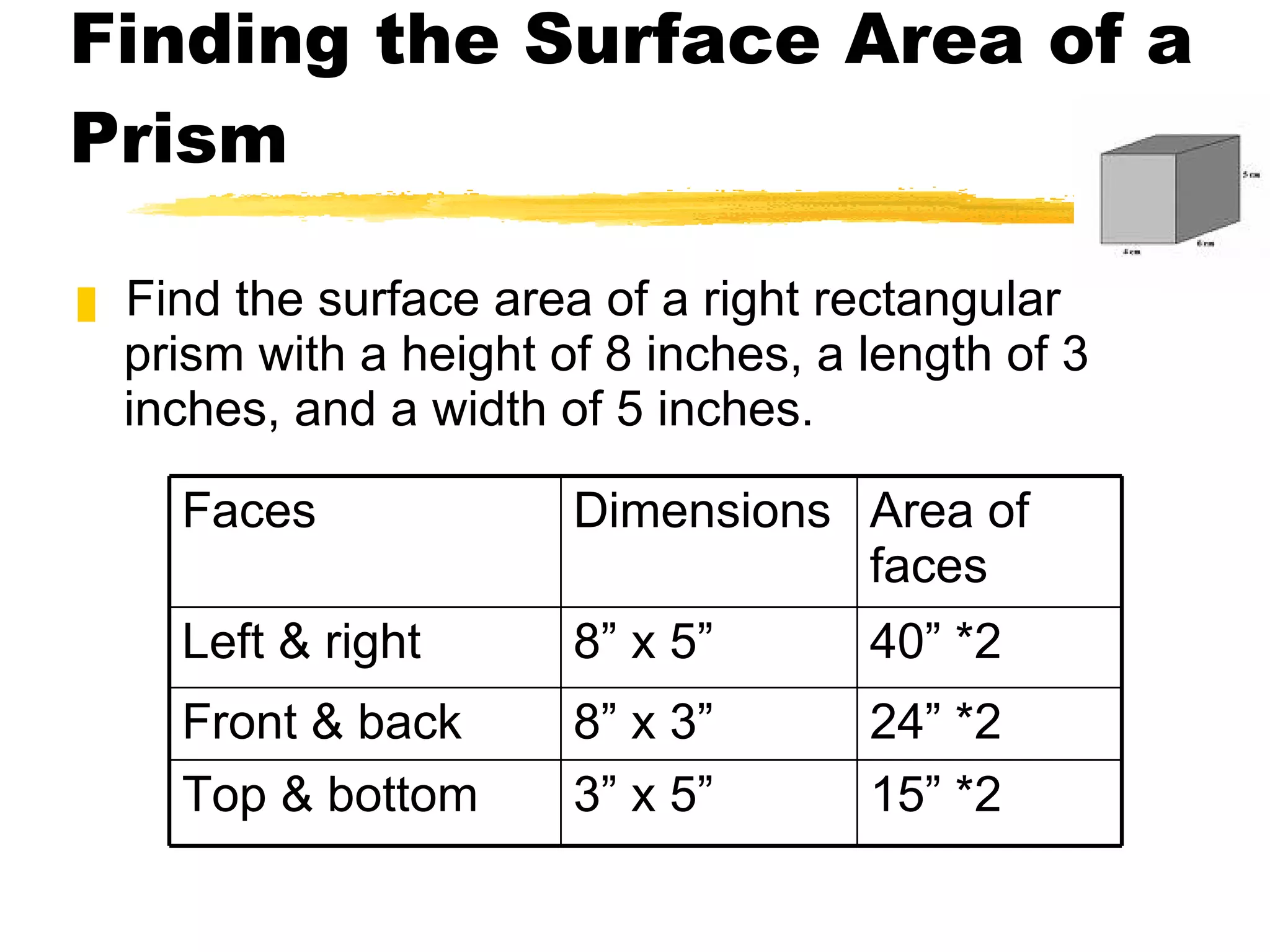
Finding the Surface Area of a Prism Find the surface area of a right rectangular prism with a height of 8 inches, a length of 3 inches, and a width of 5 inches. Faces Dimensions Area of faces Left & right Front & back Top & bottom
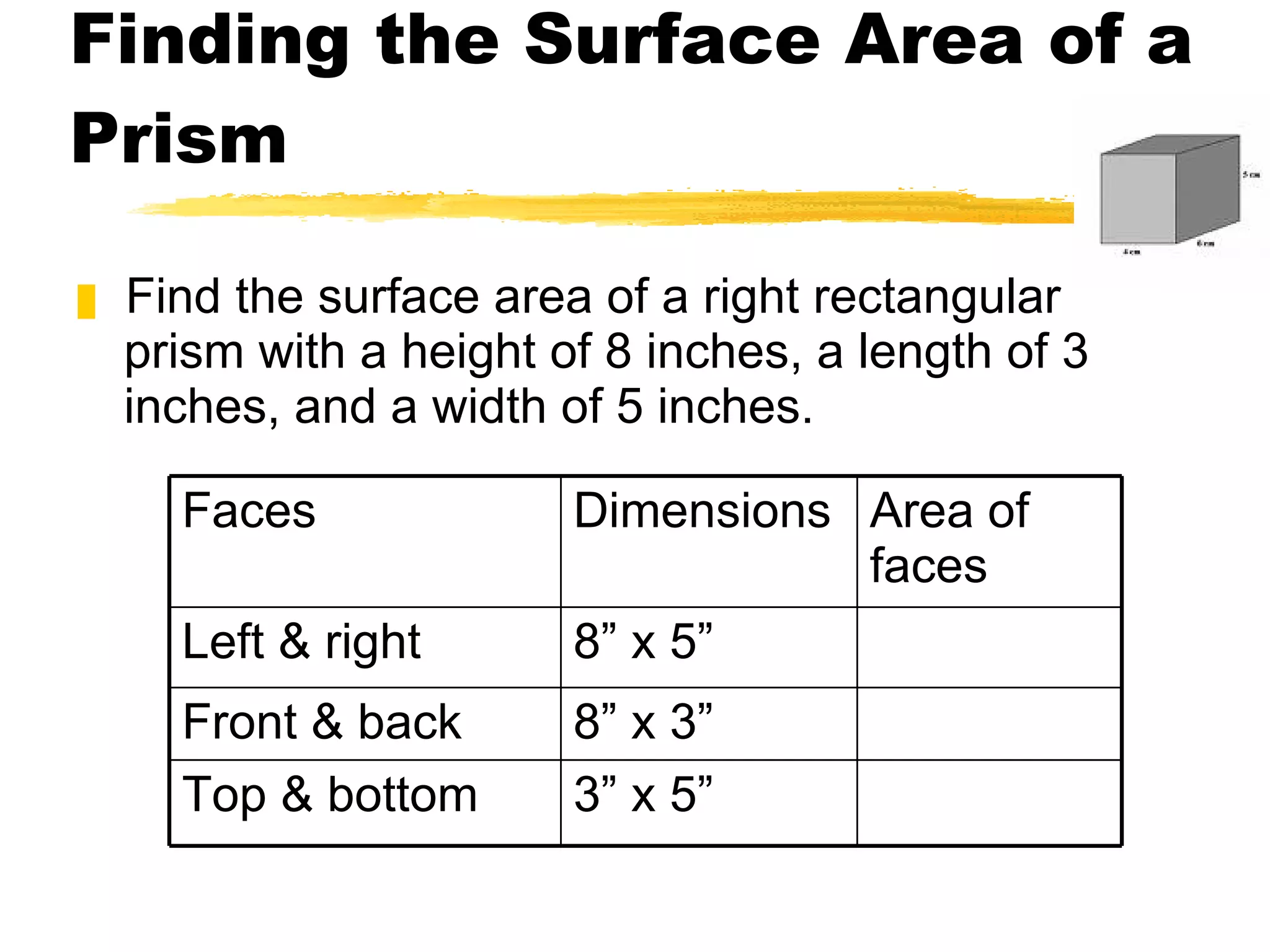
Finding the Surface Area of a Prism Find the surface area of a right rectangular prism with a height of 8 inches, a length of 3 inches, and a width of 5 inches. Faces Dimensions Area of faces Left & right 8” x 5” Front & back 8” x 3” Top & bottom 3” x 5”
Finding the Surface Area of a Prism Find the surface area of a right rectangular prism with a height of 8 inches, a length of 3 inches, and a width of 5 inches. Faces Dimensions Area of faces Left & right 8” x 5” 40” *2 Front & back 8” x 3” 24” *2 Top & bottom 3” x 5” 15” *2
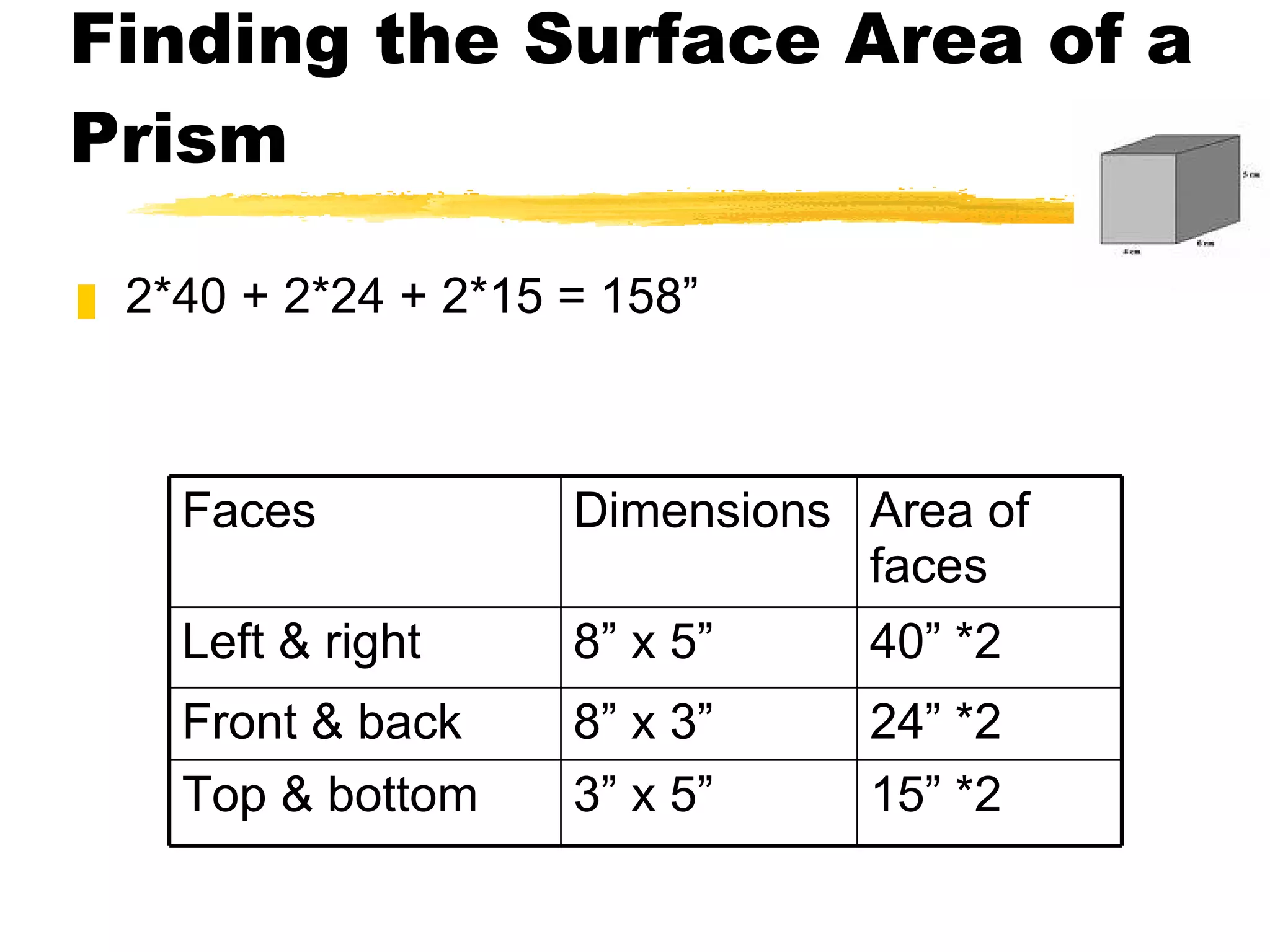
Finding the Surface Area of a Prism 2*40 + 2*24 + 2*15 = 158” Faces Dimensions Area of faces Left & right 8” x 5” 40” *2 Front & back 8” x 3” 24” *2 Top & bottom 3” x 5” 15” *2
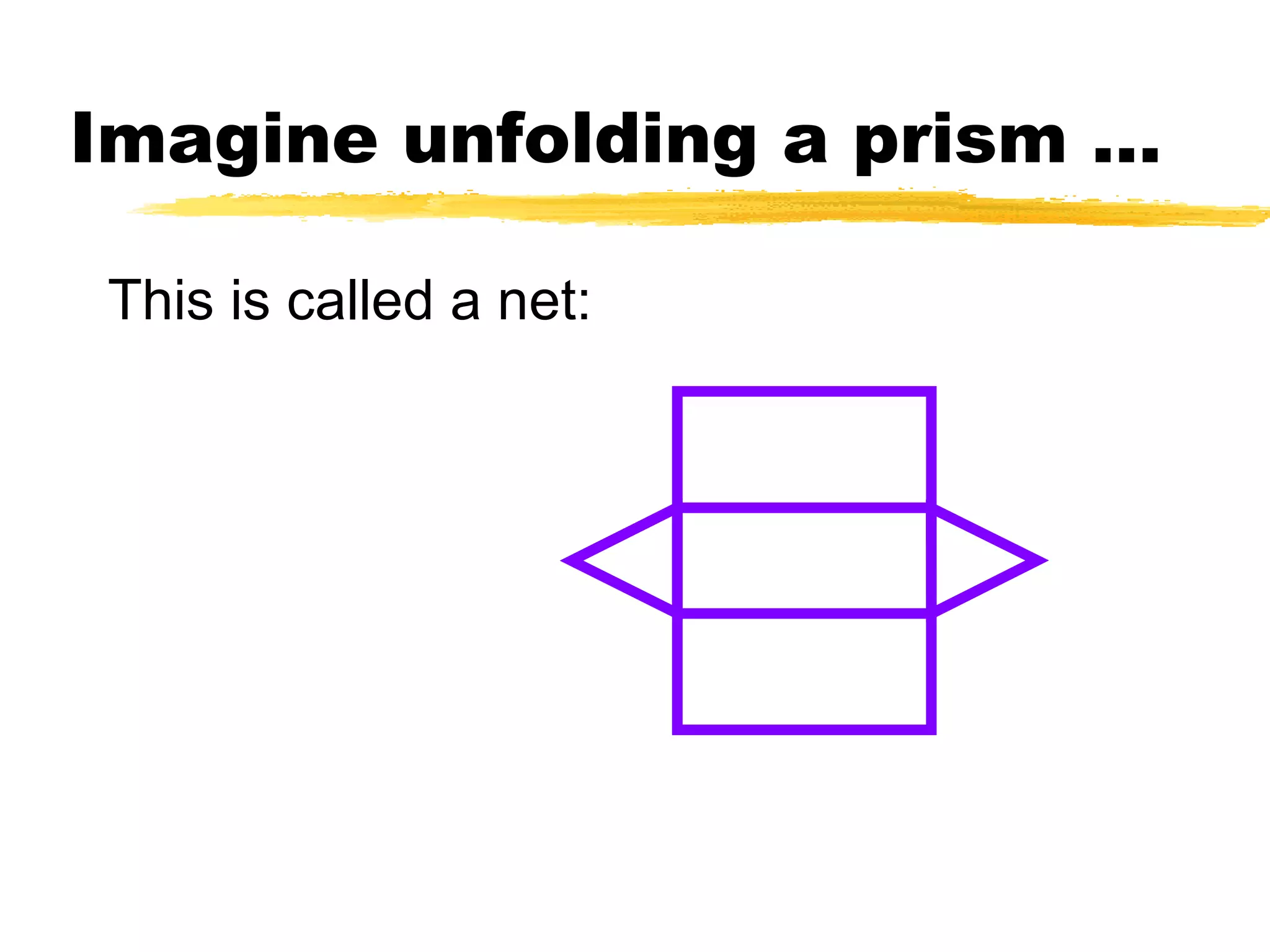
Imagine unfolding a prism … This is called a net:
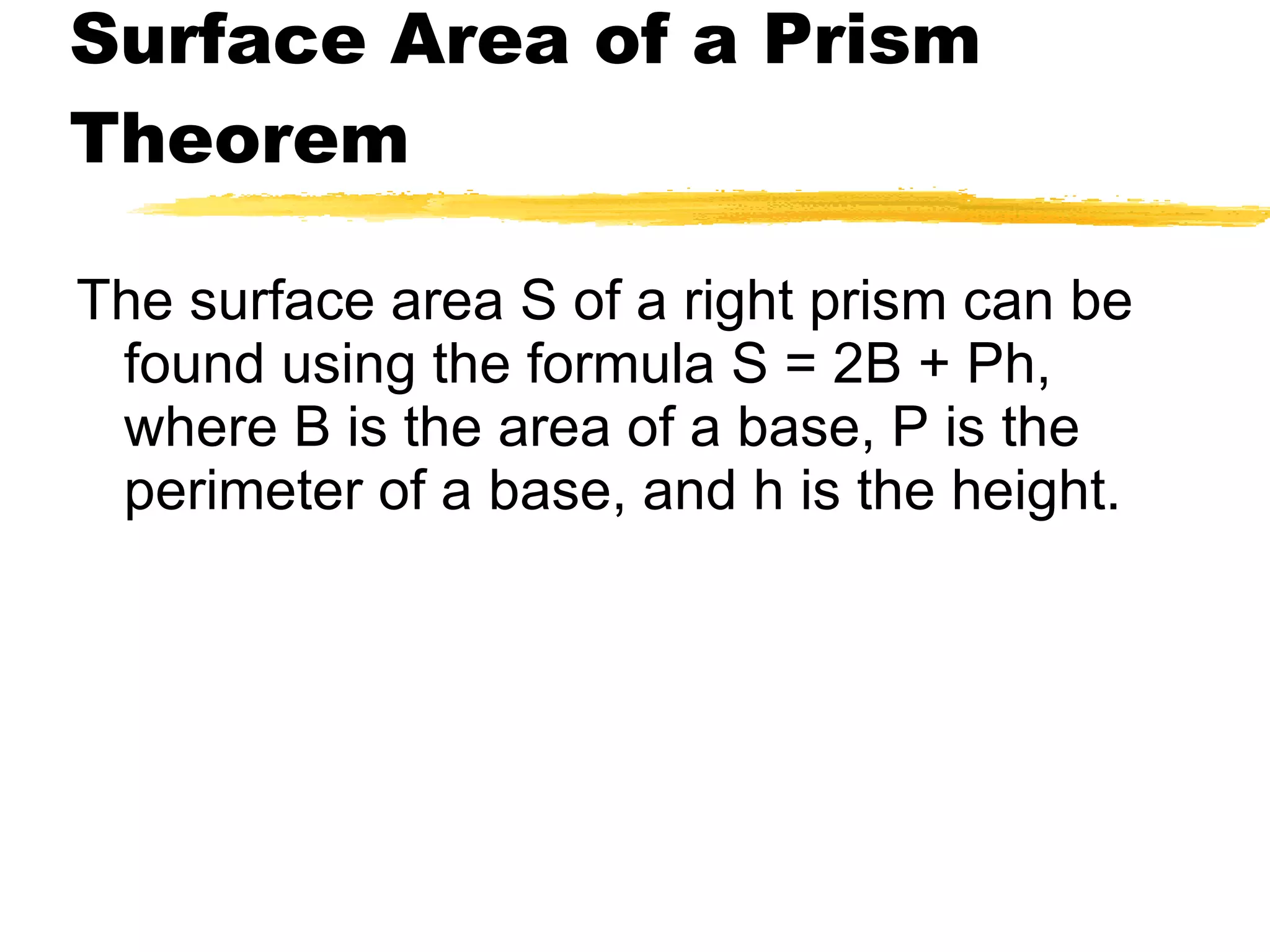
Surface Area of a Prism Theorem The surface area S of a right prism can be found using the formula S = 2B + Ph, where B is the area of a base, P is the perimeter of a base, and h is the height.
Do example 2, p. 729
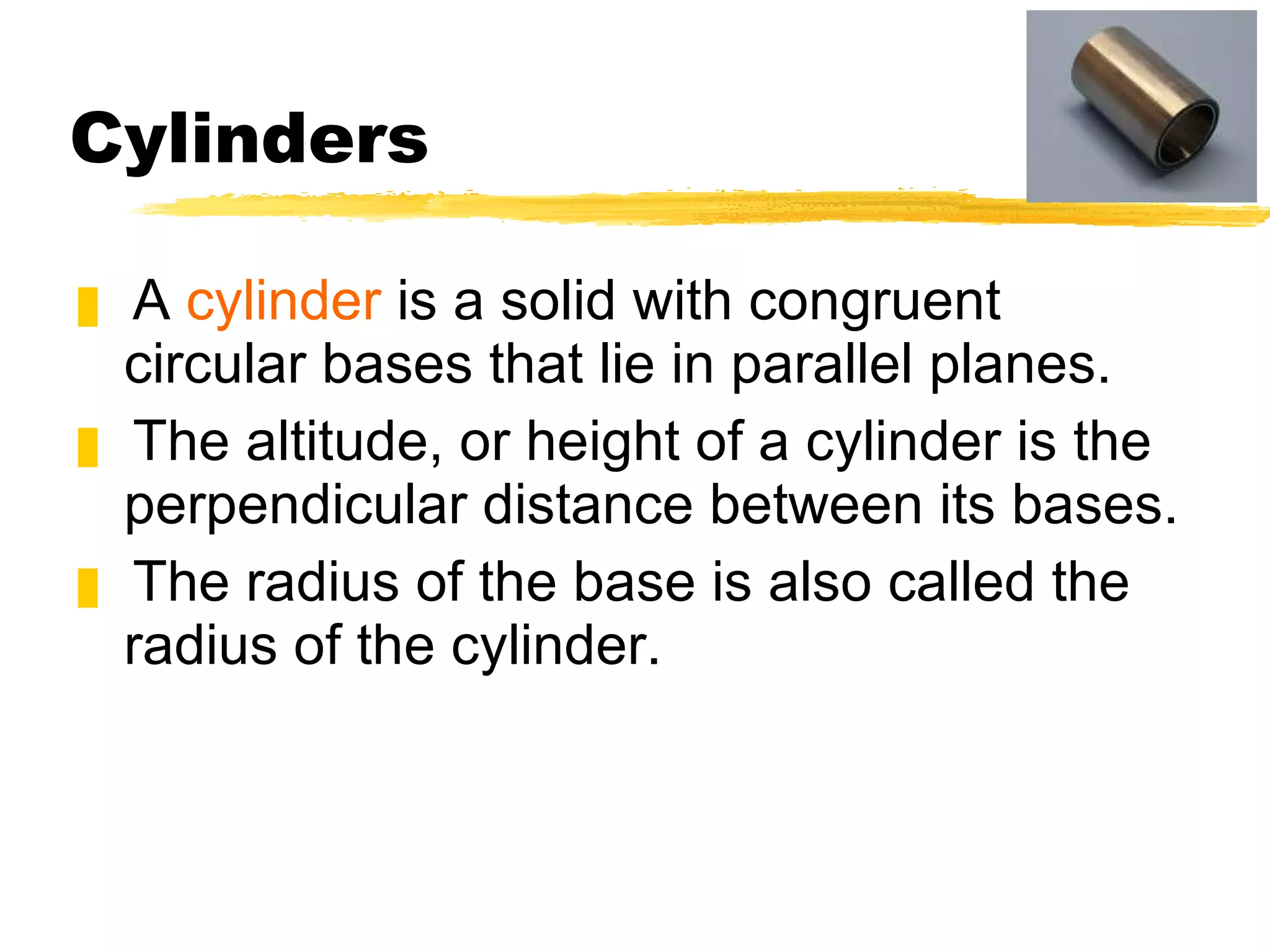
Cylinders A  cylinder  is a solid with congruent circular bases that lie in parallel planes.  The altitude, or height of a cylinder is the perpendicular distance between its bases. The radius of the base is also called the radius of the cylinder.
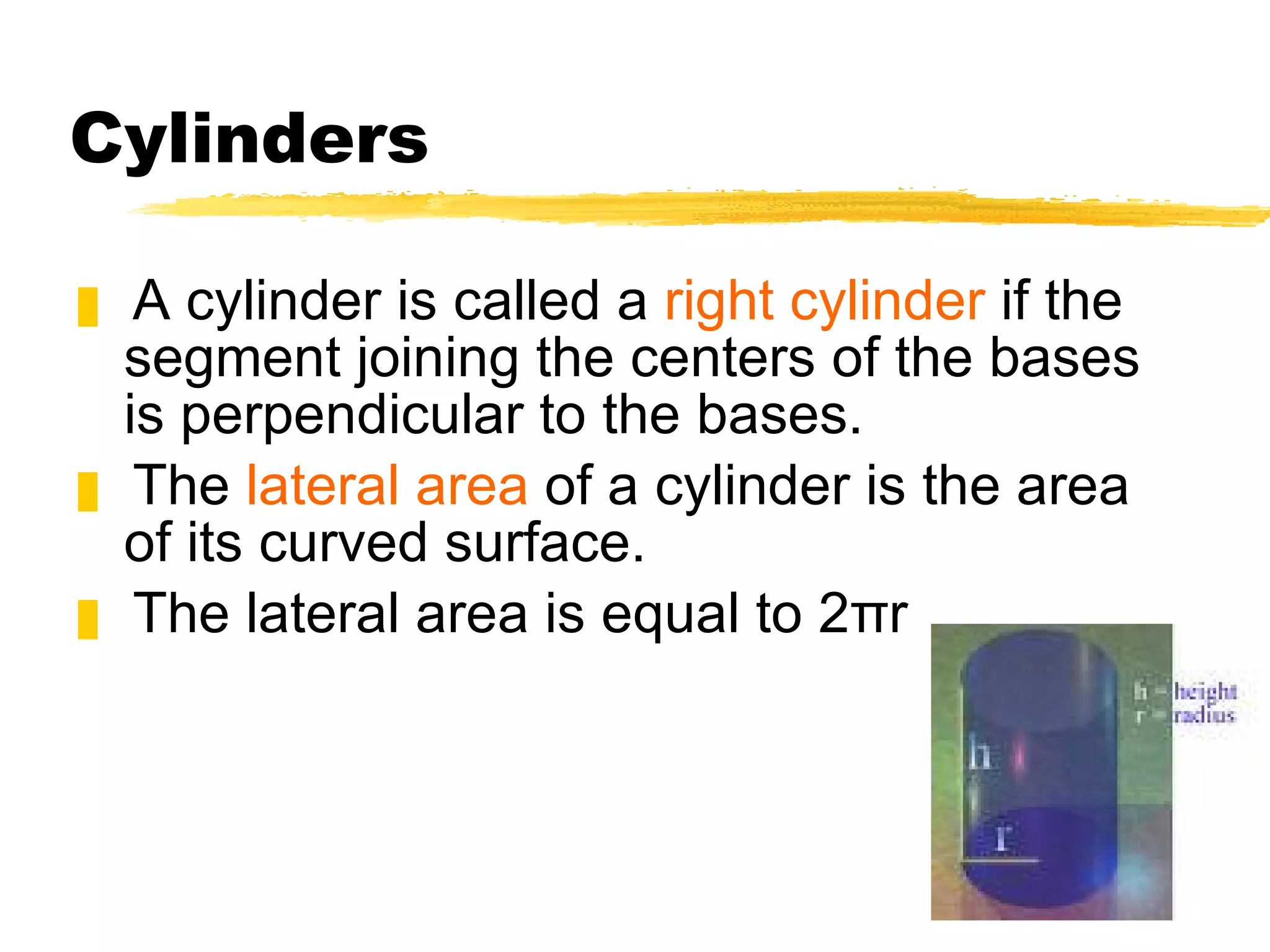
Cylinders A cylinder is called a  right cylinder  if the segment joining the centers of the bases is perpendicular to the bases. The  lateral area  of a cylinder is the area of its curved surface.  The lateral area is equal to 2πr
Cylinders The surface area of a cylinder is equal to the sum of the lateral area and the areas of the 2 bases: S = 2B + Ch = 2πr 2 + 2πrh
Do Example 3, p. 730
Pyramids A  pyramid  is a polyhedron in which the base is a polygon and the lateral faces are triangles with a common vertex. The intersection of 2 lateral faces is a lateral edge.  The intersection of the base and a lateral face is a base edge.  The altitude, or height, of the pyramid is the perpendicular distance between the base and the vertex.
Pyramids A  regular pyramid  has a regular polygon for a base and its height meets the base at its center. The slant height of a regular pyramid is the altitude of any lateral face. A nonregular pyramid does not have a slant height.
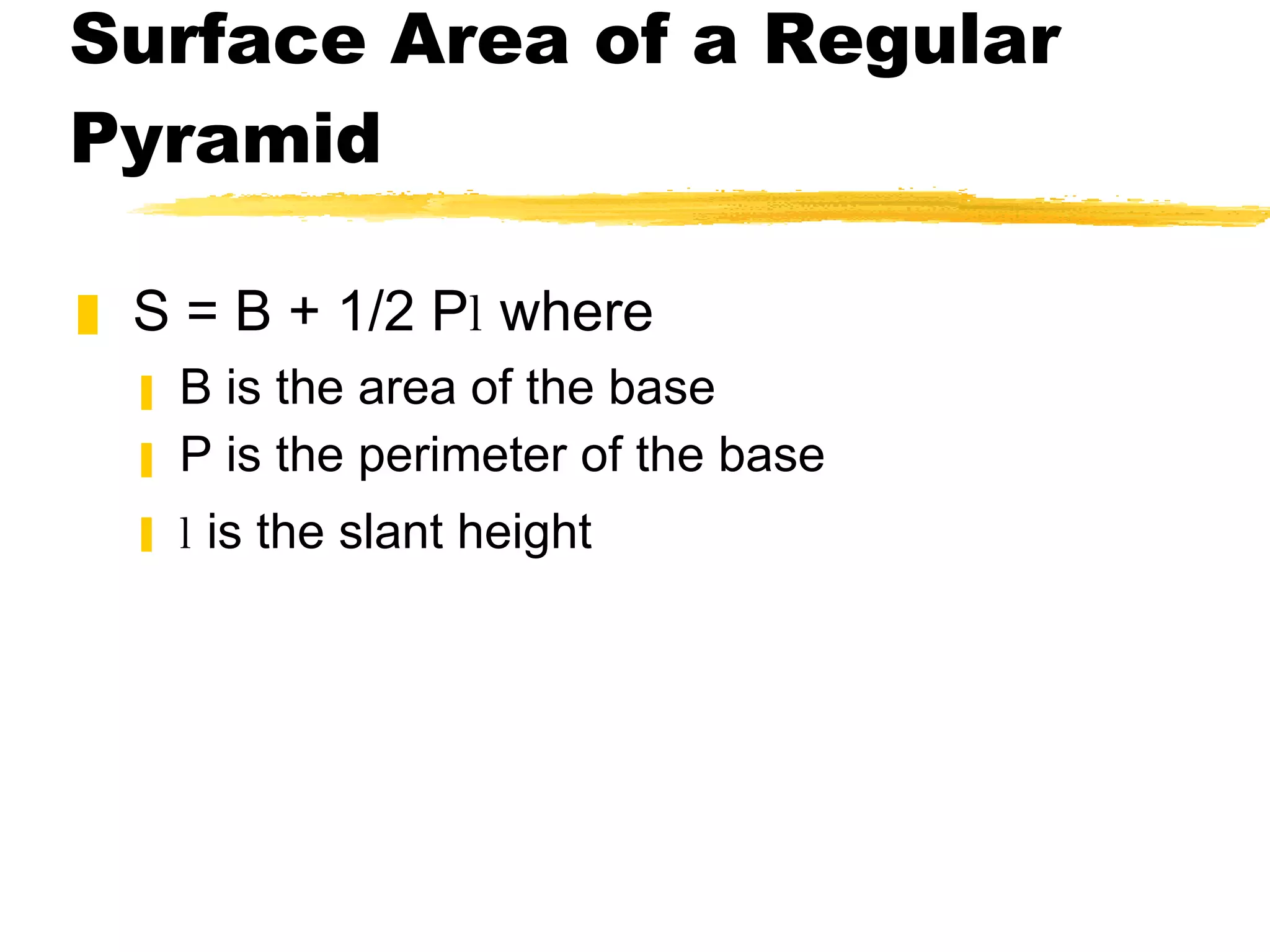
Surface Area of a Regular Pyramid S = B + 1/2 P l  where B is the area of the base P is the perimeter of the base l  is the slant height
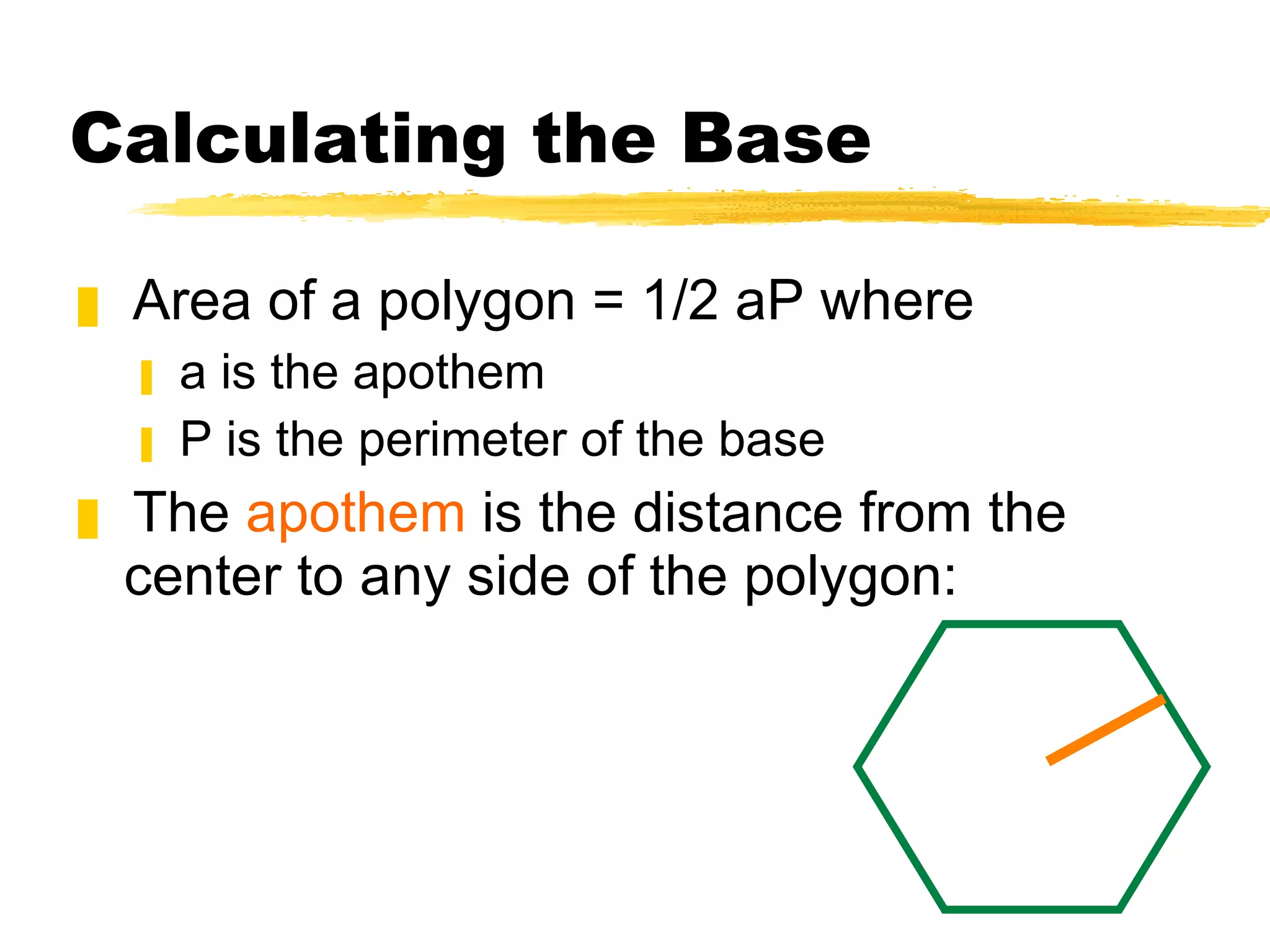
Calculating the Base Area of a polygon = 1/2 aP where a is the apothem P is the perimeter of the base The  apothem  is the distance from the center to any side of the polygon:
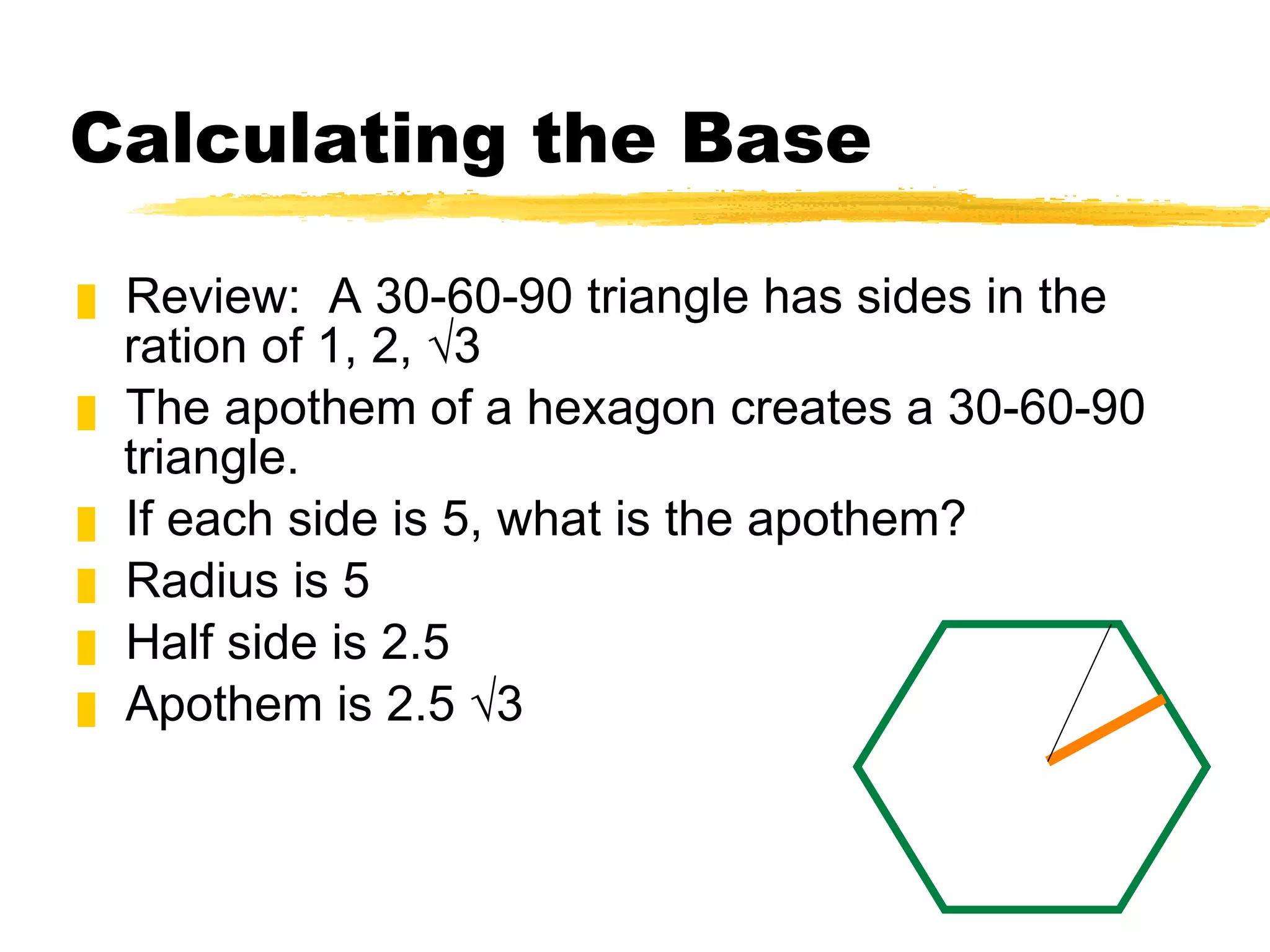
Calculating the Base Review:  A 30-60-90 triangle has sides in the ration of 1, 2, √3 The apothem of a hexagon creates a 30-60-90 triangle. If each side is 5, what is the apothem? Radius is 5 Half side is 2.5 Apothem is 2.5 √3
Do Example 2, p. 736
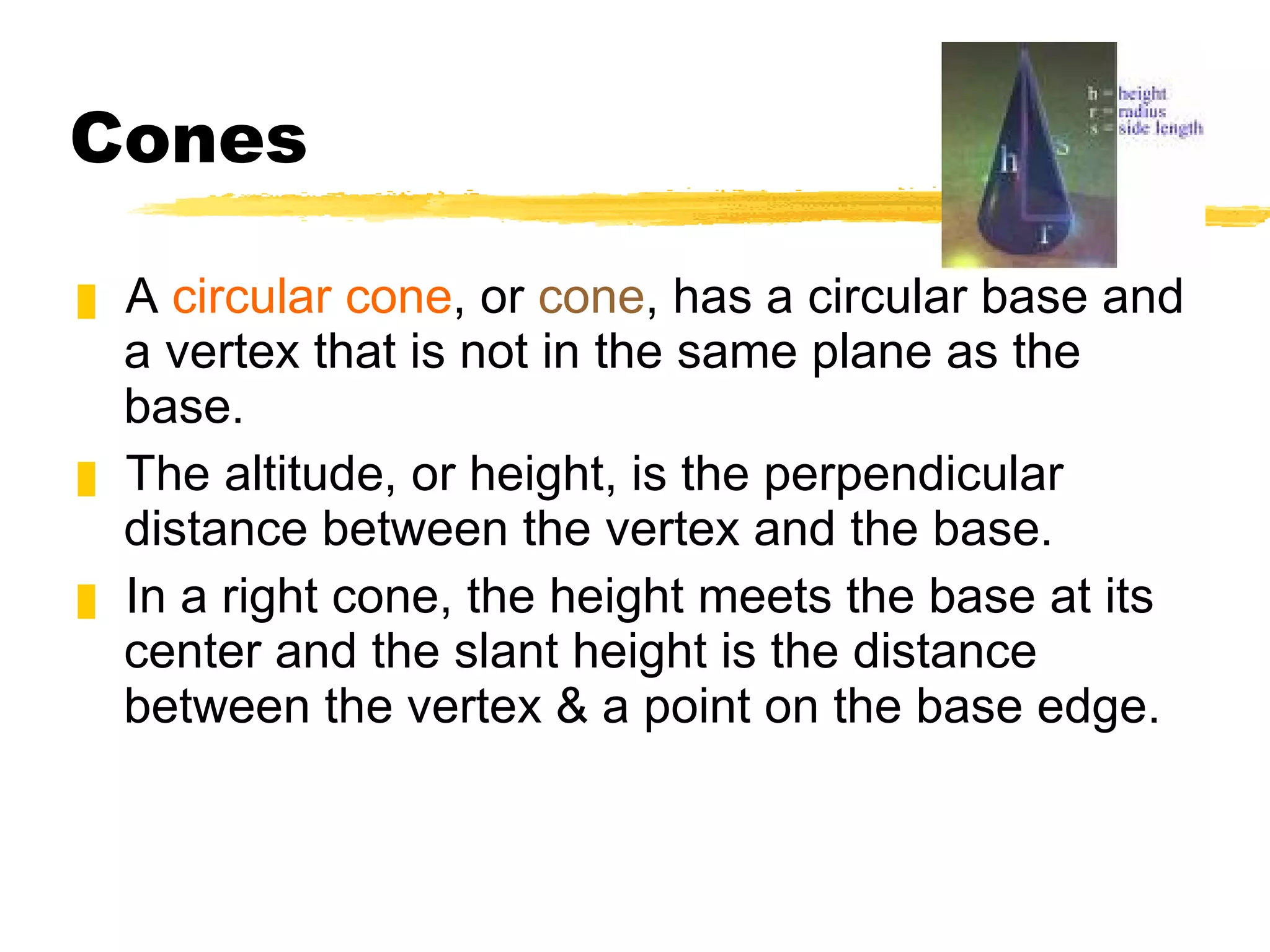
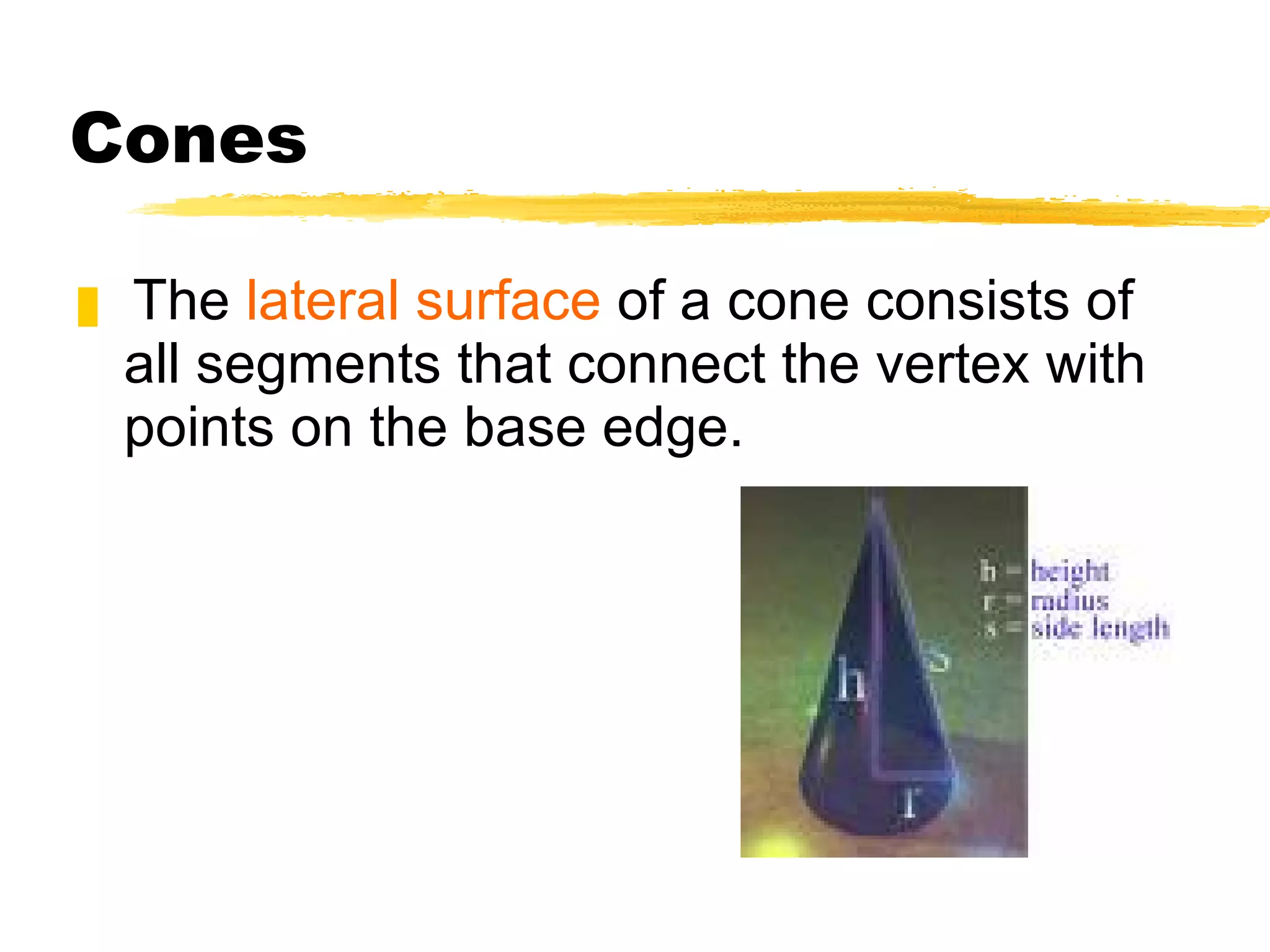
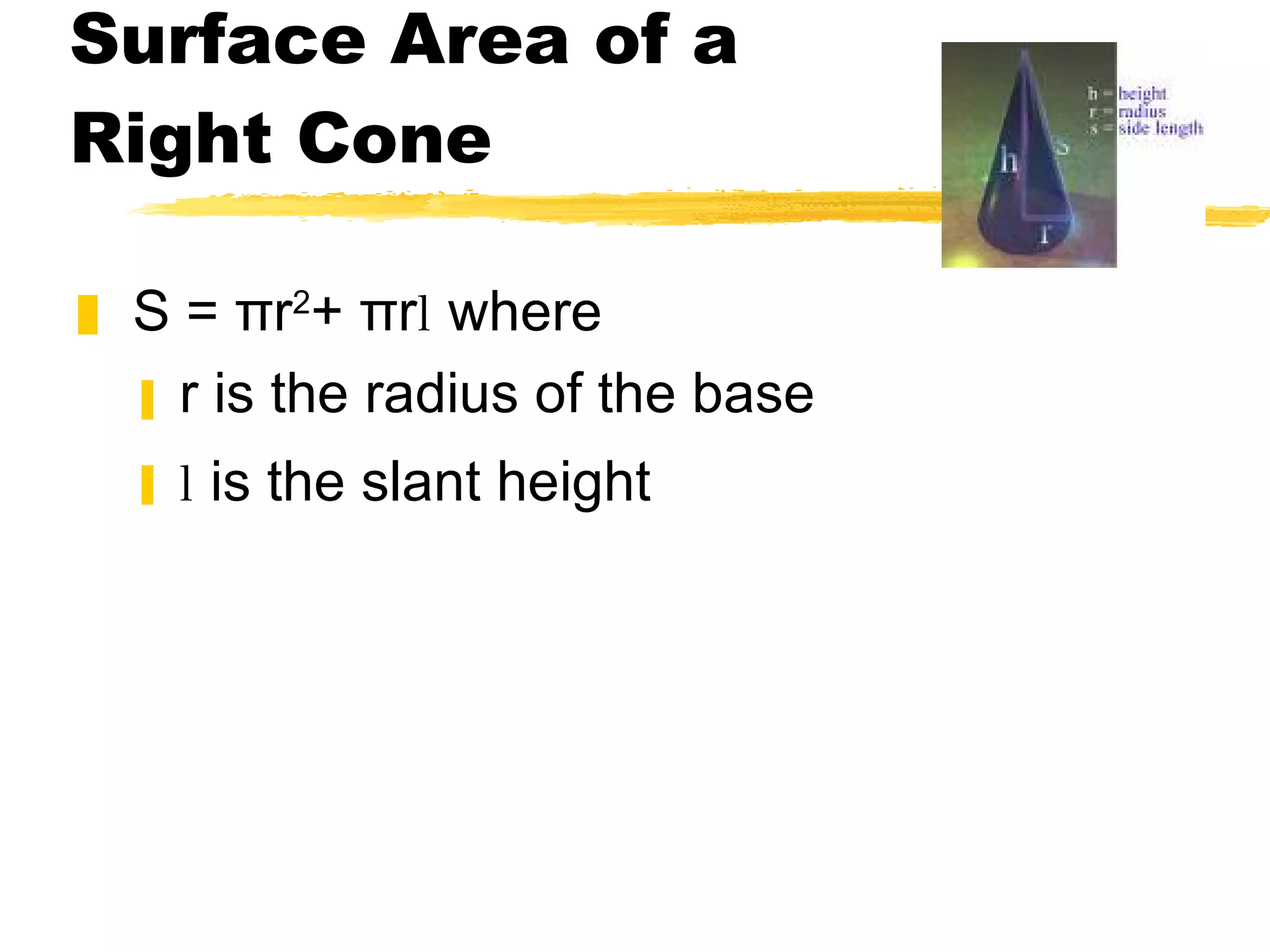
Cones A  circular cone , or  cone , has a circular base and a vertex that is not in the same plane as the base. The altitude, or height, is the perpendicular distance between the vertex and the base. In a right cone, the height meets the base at its center and the slant height is the distance between the vertex & a point on the base edge.
Cones The  lateral surface  of a cone consists of all segments that connect the vertex with points on the base edge.
Surface Area of a  Right Cone S = πr 2 + πr l  where r is the radius of the base l  is the slant height
Homework Do worksheets Quiz Tomorrow

Geom12point2and3 97

  • 1.
    Chapter 12 -Surface Area & Volume of Solids Objectives: Identify types of solids Calculate surface area & volume of: Prisms Pyramids Cylinders Cones Spheres
  • 2.
    12.2 & 3Surface Area of Prisms & Cylinders & Pyramids & Cones Objectives: Find Surface Area of prisms cylinders pyramids cones
  • 3.
    Prisms A prism is a polyhedron with 2 congruent faces, called bases , that lie in parallel planes. The other faces, ( lateral faces) , are parallelograms formed by connecting the corresponding vertices of the bases. The segments connecting these vertices are lateral edges .
  • 4.
    Prisms The altitudeor height of each prism is the perpendicular distance between its bases. In a right prism , each lateral edge is perpendicular to both bases.
  • 5.
    Prisms Prisms thathave lateral edges that are not perpendicular to the bases are oblique prisms. The length of the oblique lateral edges is the slant height of the prism. http://www.mathwords.com/o/o_assets/o4.gif
  • 6.
    Prisms Prisms areclassified by the shapes of their bases. For example, the figure above is a triangular prism. The surface area of a polyhedron is the sum of the area of its faces. The lateral area of a polyhedron is the sum of the area of its lateral faces.
  • 7.
    Finding the SurfaceArea of a Prism Find the surface area of a right rectangular prism with a height of 8 inches, a length of 3 inches, and a width of 5 inches. Faces Dimensions Area of faces Left & right Front & back Top & bottom
  • 8.
    Finding the SurfaceArea of a Prism Find the surface area of a right rectangular prism with a height of 8 inches, a length of 3 inches, and a width of 5 inches. Faces Dimensions Area of faces Left & right 8” x 5” Front & back 8” x 3” Top & bottom 3” x 5”
  • 9.
    Finding the SurfaceArea of a Prism Find the surface area of a right rectangular prism with a height of 8 inches, a length of 3 inches, and a width of 5 inches. Faces Dimensions Area of faces Left & right 8” x 5” 40” *2 Front & back 8” x 3” 24” *2 Top & bottom 3” x 5” 15” *2
  • 10.
    Finding the SurfaceArea of a Prism 2*40 + 2*24 + 2*15 = 158” Faces Dimensions Area of faces Left & right 8” x 5” 40” *2 Front & back 8” x 3” 24” *2 Top & bottom 3” x 5” 15” *2
  • 11.
    Imagine unfolding aprism … This is called a net:
  • 12.
    Surface Area ofa Prism Theorem The surface area S of a right prism can be found using the formula S = 2B + Ph, where B is the area of a base, P is the perimeter of a base, and h is the height.
  • 13.
  • 14.
    Cylinders A cylinder is a solid with congruent circular bases that lie in parallel planes. The altitude, or height of a cylinder is the perpendicular distance between its bases. The radius of the base is also called the radius of the cylinder.
  • 15.
    Cylinders A cylinderis called a right cylinder if the segment joining the centers of the bases is perpendicular to the bases. The lateral area of a cylinder is the area of its curved surface. The lateral area is equal to 2πr
  • 16.
    Cylinders The surfacearea of a cylinder is equal to the sum of the lateral area and the areas of the 2 bases: S = 2B + Ch = 2πr 2 + 2πrh
  • 17.
  • 18.
    Pyramids A pyramid is a polyhedron in which the base is a polygon and the lateral faces are triangles with a common vertex. The intersection of 2 lateral faces is a lateral edge. The intersection of the base and a lateral face is a base edge. The altitude, or height, of the pyramid is the perpendicular distance between the base and the vertex.
  • 19.
    Pyramids A regular pyramid has a regular polygon for a base and its height meets the base at its center. The slant height of a regular pyramid is the altitude of any lateral face. A nonregular pyramid does not have a slant height.
  • 20.
    Surface Area ofa Regular Pyramid S = B + 1/2 P l where B is the area of the base P is the perimeter of the base l is the slant height
  • 21.
    Calculating the BaseArea of a polygon = 1/2 aP where a is the apothem P is the perimeter of the base The apothem is the distance from the center to any side of the polygon:
  • 22.
    Calculating the BaseReview: A 30-60-90 triangle has sides in the ration of 1, 2, √3 The apothem of a hexagon creates a 30-60-90 triangle. If each side is 5, what is the apothem? Radius is 5 Half side is 2.5 Apothem is 2.5 √3
  • 23.
  • 24.
    Cones A circular cone , or cone , has a circular base and a vertex that is not in the same plane as the base. The altitude, or height, is the perpendicular distance between the vertex and the base. In a right cone, the height meets the base at its center and the slant height is the distance between the vertex & a point on the base edge.
  • 25.
    Cones The lateral surface of a cone consists of all segments that connect the vertex with points on the base edge.
  • 26.
    Surface Area ofa Right Cone S = πr 2 + πr l where r is the radius of the base l is the slant height
  • 27.